Ethiopia's Green Coffee Bean Exports to Existing Partners Could Reach USD 829.96 Million, While Unwrought Gold Opens USD 2.01 Billion Across New Markets by 2031
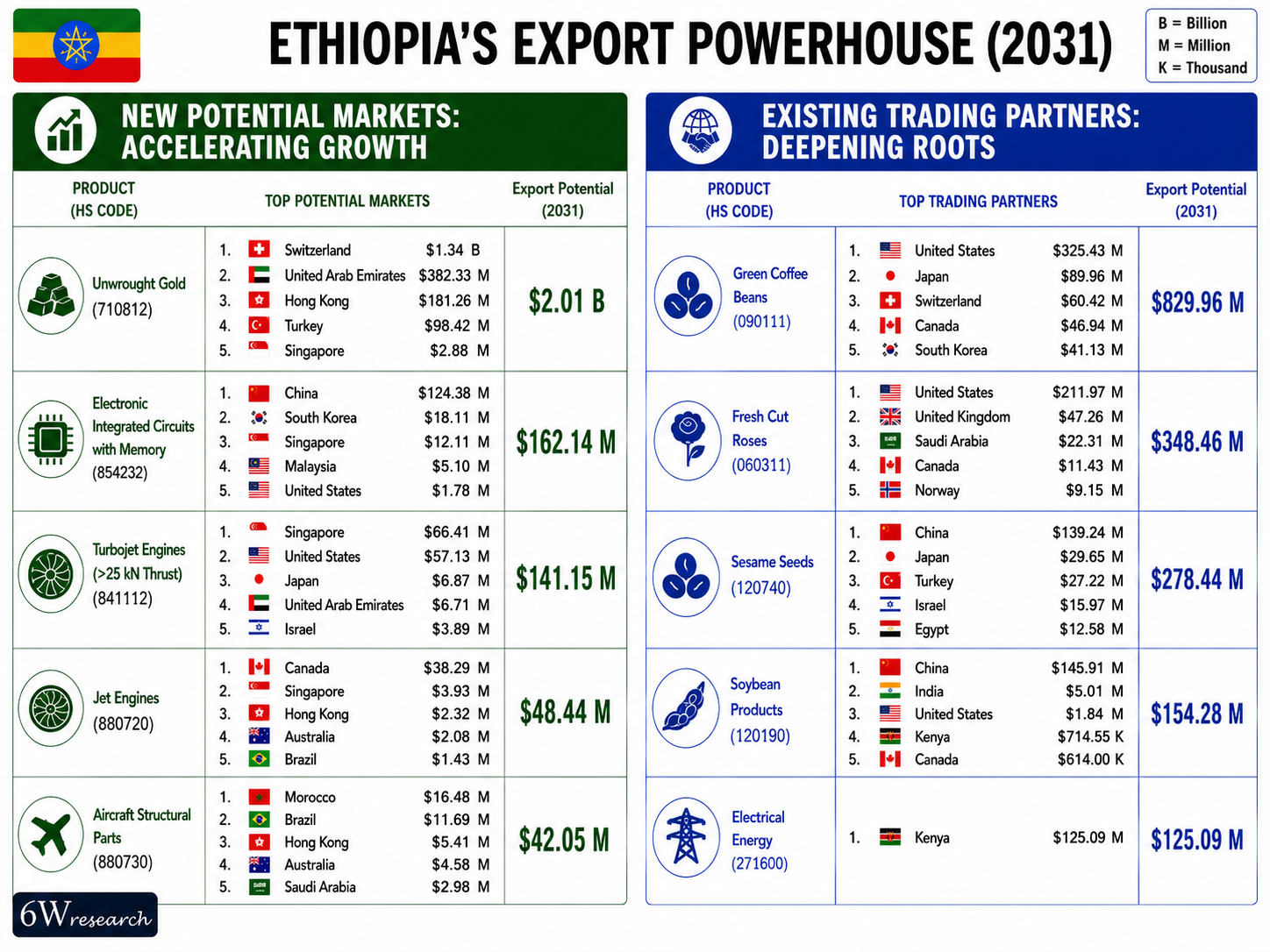
Ethiopia’s export potential is a big swing, with new-corridor potential of USD 2.98 billion above its established export base of USD 2.67 billion. The United States leads established trade at 32.03%, while Switzerland leads in new opportunities with 45.30%, driven by gold exports. Coffee, cut flowers, and sesame seeds are still core traditional export strengths, but precious metals have become a major growth avenue, along with nascent opportunities in aircraft engines and parts connected to Ethiopia’s aviation ecosystem.
 Source: 6WExportGTM
Switzerland Emerges as the Leading Destination for Ethiopia’s New Potential Markets, Reshaping Future Trade Potential
Switzerland emerges as Ethiopia’s largest new potential export market with USD 1.35 billion in opportunity, significantly ahead of the United Arab Emirates (USD 0.40 billion) and Hong Kong (USD 0.21 billion). China and the United States offer more diversification opportunities with each contributing USD 0.16 billion in potential exports. The concentration of demand in Switzerland mirrors the increasing role of precious metals, particularly gold, as a driver of Ethiopia’s future export growth, while new trade corridors through the Middle East and Asia provide further opportunities to diversify markets.
| Top 5 Existing Leading Importers | Export Potential (USD Billion) | Top 5 New Potential Importers | Export Potential (USD Billion) |
| United States | 0.86 | Switzerland | 1.35 |
| China | 0.47 | United Arab Emirates | 0.4 |
| Japan | 0.15 | Hong Kong | 0.21 |
| Kenya | 0.14 | China | 0.16 |
| Canada | 0.14 | United States | 0.16 |
Source: 6WExportGTM
The United States accounts for USD 0.86 billion of Ethiopia's established export potential, nearly double China's USD 0.47 billion in second place. Japan, Kenya and Canada each contribute a modest USD 0.14 to 0.15 billion. This spread reflects a traditional trade base built around Western demand for Ethiopian coffee and flowers, with China absorbing sesame seeds and soybean products, and Kenya standing out as the only regional buyer of scale, importing Ethiopian electrical energy directly across the border.
A Single Gold Corridor to Switzerland Now Rivals Ethiopia's Entire Established Export Base
Unwrought gold represents Ethiopia's largest new-corridor opportunity by an extraordinary margin at USD 2.01 billion a figure larger than any single established product and nearly as large as Ethiopia's entire established export base combined. It is led by Switzerland at USD 1.34 billion and the United Arab Emirates at USD 382.33 million, with Hong Kong and Turkey contributing smaller amounts. This scale is consistent with a genuine formalization drive underway in Ethiopia's gold sector: the central bank has been raising the prices it pays artisanal miners to pull supply away from smuggling networks, and legal gold exports have climbed toward record levels even as a large share of production is still believed to leak into informal and cross-border channels.
Electronic integrated circuits with memory and turbojet engines add a further USD 162.14 million and USD 141.14 million. Integrated circuits are led by China at USD 124.38 million, with South Korea, Singapore, Malaysia and the United States providing smaller volumes a pattern that likely reflects Ethiopia's growing electronics-import and re-export activity rather than domestic chip production. Turbojet engines are led by Singapore at USD 66.41 million and the United States at USD 57.13 million, a category far more consistent with Ethiopian Airlines' aircraft-maintenance operations sourcing and moving high-value engine components than with any domestic aerospace manufacturing base.
Jet engines and aircraft structural parts round out the new-corridor top five, both at a modest scale. Jet engines contribute USD 48.44 million, led by Canada at USD 38.29 million, while aircraft structural parts add USD 42.05 million, led by Morocco and Brazil. Both categories most plausibly trace back to the same aviation-services activity as turbojet engines rather than representing new manufacturing capability. Overall, Ethiopia's 2031 new-corridor story is really a story about one commodity and one buyer: gold flowing to Switzerland significantly exceeds every other new-corridor category combined.
Ethiopia’s Agricultural Export Heritage Continues to Thrive Through Coffee, Flowers and Sesame Seeds
Green coffee beans represent Ethiopia's largest established export opportunity at USD 829.96 million, led by the United States at USD 325.43 million and Japan at USD 89.96 million, followed by Switzerland, Canada and South Korea. This globally diversified, specialty-grade buyer base reflects Ethiopia's standing as coffee's birthplace and one of Africa's leading coffee producers, with roasters in mature Western and East Asian markets alike paying a premium for its heirloom varietals.
Fresh cut roses and sesame seeds add a further USD 348.46 million and USD 278.44 million. Fresh cut roses are led by the United States at USD 211.96 million and the United Kingdom at USD 47.26 million, followed by Saudi Arabia, Canada and Norway, consistent with Ethiopia's high-altitude floriculture industry around Addis Ababa supplying cut flowers to demanding, quality-sensitive Western markets. Sesame seeds are led by China at USD 145.91 million, followed by Japan, Turkey, Israel and Egypt, reflecting Ethiopia's position as one of the world's leading sesame exporters to Asian and Middle Eastern processors.
Soybean products and electrical energy complete the established top five, both concentrated on a single dominant buyer. Soybean products contribute USD 154.28 million, led almost entirely by China at USD 145.91 million, with India, the United States, Kenya and Canada splitting a negligible remainder. Electrical energy adds USD 125.08 million, sold entirely to Kenya, reflecting Ethiopia's growing hydropower generation capacity finding a direct regional outlet across the border. Collectively, these five categories confirm that Ethiopia's established export base rests on genuine agricultural comparative advantage coffee, flowers and sesame with a small but real cross-border electricity trade layered on top.
|
Ethiopia's export story is unusual in this series: a formalizing gold sector has, in the space of a few years, grown large enough to rival the country's entire traditional agricultural export base. That shift is a genuine opportunity if the country can keep pulling supply out of informal channels, but it also means Ethiopia's near-term export trajectory now depends as much on central bank pricing policy as on coffee harvests or flower yields. 6WExportGTM Analysis |
A Central Bank Exit from Gold and an MRO Expansion: Two Developments Shaping Ethiopia's Export Base
Two developments now underway help explain the figures above: a major overhaul of how Ethiopia's central bank manages the gold trade, which anchors the country's outsized new-corridor opportunity, and continued expansion of Ethiopian Airlines' aircraft-maintenance operations, which helps explain the aviation-linked trade flows appearing in new-corridor data.
A Central Bank Exit from the Gold Trade Could Reshape Ethiopia's Largest New-Corridor Opportunity
Ethiopia's gold-export potential is being reshaped by a fundamental change in how the metal reaches international markets. The National Bank of Ethiopia has for years been the sole legal buyer of domestically mined gold, paying artisanal miners a premium of 5% to 15% above international prices to pull supply away from smuggling networks a policy that helped legal gold exports approach USD 2.2 billion in a recent fiscal year even as officials estimate that more than 60% of total production still leaks into informal or cross-border trade. Under an IMF-backed reform program, the central bank is now committed to phasing out that premium by September 2026 and exiting its monopoly position entirely by the end of that year, opening the gold trade to private banks for the first time. For a new-corridor opportunity already worth USD 2.01 billion and concentrated overwhelmingly in Switzerland, that transition is a genuine inflection point: it could either accelerate formalization by giving miners more competitive buyers, or risk a short-term dip in officially recorded exports as the market adjusts.
|
Ethiopia's 2031 export growth will increasingly hinge on whether the shift away from central-bank gold buying pulls more supply into formal channels or simply changes who captures the existing flow the difference between a genuinely larger gold sector and one that just changes hands. Manish Pant, Senior Data Scientist, Data Science & Market Intelligence, 6Wresearch |
Ethiopian Airlines' MRO Expansion Explains Ethiopia's Aviation Linked New Corridor Flows
The turbojet engine, jet engine and aircraft structural parts flows appearing in Ethiopia's new corridor data are best explained by the continued expansion of Ethiopian Airlines' aircraft maintenance business rather than any domestic aerospace manufacturing. The airline has completed a roughly USD 150 million expansion of its Maintenance, Repair and Overhaul complex at Bole International Airport, adding a widebody hangar, a component maintenance workshop and an automated parts warehouse that together increase airframe maintenance capacity by around 50% and let the carrier service aircraft for other African and Middle Eastern airlines. Alongside this, construction has begun on the USD 12.5 billion Bishoftu mega-airport outside Addis Ababa, designed to eventually handle 110 million passengers a year and to integrate Ethiopian Airlines' MRO and cargo operations as the carrier's fleet keeps growing. For a set of new corridor, engine and parts categories worth a combined USD 231.64 million, this expanding maintenance services base supports treating these flows as a genuine, if indirect, export opportunity tied to aviation services rather than manufacturing.
|
Ethiopia's export growth through 2031 will stay overwhelmingly commodity-led, but Ethiopian Airlines' MRO expansion is a reminder that some of the country's smaller new-corridor categories reflect aviation services trade rather than untapped manufacturing potential. Manisha Gupta, Data Analyst, Data Science & Market Intelligence, 6Wresearch |
The Takeaway
Ethiopia should focus on converting its formalizing gold sector into a durable, transparent second export pillar alongside its traditional coffee, flower and sesame trade, while treating the smaller aviation linked flows in its data as a byproduct of Ethiopian Airlines' regional maintenance role rather than a genuine new industrial opportunity. The country's next phase of export growth will depend heavily on how successfully the central bank's exit from gold buying is managed over the next twelve months.
Key strategic priorities for Ethiopia include:
- Manage the central bank's gold-market exit carefully to protect formal export gains: Unwrought gold is Ethiopia's single largest new-corridor opportunity at USD 2.01 billion, nearly matching the country's entire established export base. This means the National Bank of Ethiopia will phase out its buying premium by September 2026 and leave the gold trade by December 2026. The transition to private bank buying will have to be carefully sequenced to avoid pushing supply back toward informal channels.
- Continue investing in coffee quality and market access to defend Ethiopia's core export base: Green coffee beans, fresh cut roses and sesame seeds together generate USD 1.46 billion in established export potential, reaching the United States, Japan, China and Europe. Ethiopia should keep investing in specialty-grade coffee certification and cold-chain logistics for flowers to protect this genuinely diversified, quality-driven buyer base.
- Treat Ethiopian Airlines' MRO growth as a services export to develop deliberately, not a manufacturing signal: Turbojet engines, jet engines, and aircraft structural parts together represent USD 231.64 million in new market opportunities tied to Ethiopian Airlines' expanding maintenance operations. Ethiopia should support this as a genuine aviation services export opportunity leveraging the new Bole MRO complex and the future Bishoftu airport rather than reading it as evidence of a new manufacturing sector.
- Deepen the Kenya electricity relationship as a template for regional trade: Electrical energy exports to Kenya, worth USD 0.13 billion, show Ethiopia's hydropower capacity can generate direct, low-friction regional trade. Ethiopia should explore whether similar cross border power arrangements can be extended to other neighboring markets as generation capacity grows.
Overall, Ethiopia's export growth through 2031 should be driven by successfully formalizing its gold sector through the central bank's transition period, while protecting the genuine agricultural and services strengths coffee, flowers, sesame and aviation maintenance that already generate real, diversified export earnings.

Leadership Perspectives from Industry Events
Search
6Wresearch in the News
 Forbes
Citing 6Wresearch analytics to map global infrastructure and pharmaceutical industry trajectories.
 Bloomberg Law
Direct syndication of 6Wresearch's macro data points, capturing complex supply chain shifts.
 Reuters
Tracking industrial manufacturing adjustments and electronic security ecosystem scaling.
 Mint
Mint
Utilizing deep-tech sector market sizing to analyze global automation and robotics.
 The Economic Times
Anchoring features on industrial IoT growth metrics and connected smart-grid devices.
 Business Standard
Featuring strategic evaluations of Advanced Driver Assistance Systems (ADAS) and AI road safety.
 The Hindu
Spotlighting core commercial metrics ranging from unmanned aerial vehicles (UAVs) to consumer durables.
 Financial Express
Anchoring quarterly reviews on cross-border real estate tech and structural hardware manufacturing.
 Yahoo Finance
Syndicating the tracker's $30.1 billion untapped-market findings, spotlighting Japan, the US and China as India's top new-potential importers.
 India Today
Carrying the release on smartphones leading India's export potential to $94 billion by 2031, per 6WExportGTM data.
 Dailyhunt
Distributing the tracker findings to its regional readership, framing India's export diversification into Japan and Mexico.
 PR Newswire Original release
Publishing the full India Export Attractiveness Tracker 2026, detailing new trade corridors across iron ore, LCVs and pharmaceuticals.
 The Industrial
Highlighting the tracker's read on India's semiconductor ambitions and long-term chip-assembly export potential.
 PTI News
Reporting on the $66.81 billion pharmaceuticals export opportunity flagged in the tracker, amid looming US generic-drug tariffs.
 Tribune India
Covering the tracker's tariff-versus-regulation analysis across India's mature export markets in the US, China and UAE.
 ANI News
Amplifying the report's findings on polished diamonds, refined petroleum and medicines as India's core export engines.
 International Business Magazine
Covering the report's insight into how AEB, blind spot detection, and driver monitoring are reshaping India's ADAS market.
 Focus Gaming News
Highlighting the research forecast for Egypt's gambling market, projecting steady growth through 2032.
Thought Leadership and Analyst Meet





Our Clients








Latest Reports
- Poland Engine Ignition Components Market (2026-2032)
- Peru Engine Ignition Components Market (2026-2032)
- Pakistan Engine Ignition Components Market (2026-2032)
- Oman Engine Ignition Components Market (2026-2032)
- Nigeria Engine Ignition Components Market (2026-2032)
- Nepal Engine Ignition Components Market (2026-2032)
- Myanmar Engine Ignition Components Market (2026-2032)
- Morocco Engine Ignition Components Market (2026-2032)
- Mexico Engine Ignition Components Market (2026-2032)
- Malaysia Engine Ignition Components Market (2026-2032)
Industry Events and Analyst Meet

EV India Expo 2026

HIMTEX 2026

India Refining Summit 2026

India EV Show 2026

EV tech India Expo 2026
Whitepaper
- Middle East & Africa Commercial Security Market Click here to view more.
- Middle East & Africa Fire Safety Systems & Equipment Market Click here to view more.
- GCC Drone Market Click here to view more.
- Middle East Lighting Fixture Market Click here to view more.
- GCC Physical & Perimeter Security Market Click here to view more.


