France's Large Aircraft Exports to Existing Partners Could Reach USD 23.71 Billion, While Wheat Opens USD 1.75 Billion Across New Markets by 2031
France’s established export base is led by the United States (26.45%), followed by China (12.81%), and remains anchored in aircraft, jewellery, cosmetics and wine. New-corridor opportunities show a different pattern, with China leading at 20.06% and the United States at 8.92%. France export potential is increasingly linked to future diversification through wheat, sorghum, maize and manganese ores, opening new demand across Asian, African and Latin American markets.
 Source: 6WExportGTM
China Overtakes the US-Led Order to Lead France's New-Corridor Potential
France’s new export potential is led by China at USD 8.05 billion, supported by strong demand across industrial, agricultural, luxury and consumer-oriented categories. The United States follows at USD 3.58 billion, reflecting France’s established commercial ties and scope to expand into additional product segments. The opportunity landscape is widened with Mexico, India and Canada with potential of USD 2.49 billion, USD 2.46 billion and USD 1.98 billion respectively. Together, these markets provide France with a diversified platform for export expansion across Asia and North America.
| Top 5 Existing Importers | Export Potential (USD Billion) | Top 5 New Potential Importers | Export Potential (USD Billion) |
| United States | 156.74 | China | 8.05 |
| China | 75.89 | United States | 3.58 |
| Japan | 28.77 | Mexico | 2.49 |
| Switzerland | 25.39 | India | 2.46 |
| Hong Kong | 25.07 | Canada | 1.98 |
Source: 6WExportGTM
The United States accounts for USD 156.74 billion of France's established export potential, more than double China's USD 75.89 billion in second place. Japan ranks third at USD 28.77 billion, with Switzerland and Hong Kong contributing USD 25.39 billion and USD 25.07 billion. This reflects France's classic aerospace-and-luxury export model, with large aircraft, jewelry, cosmetics and wine flowing to large consumer markets and duty-free luxury-retail hubs across North America and Asia.
A Bulk Agricultural Corridor to Asia and Africa Headlines France's New-Corridor Opportunities
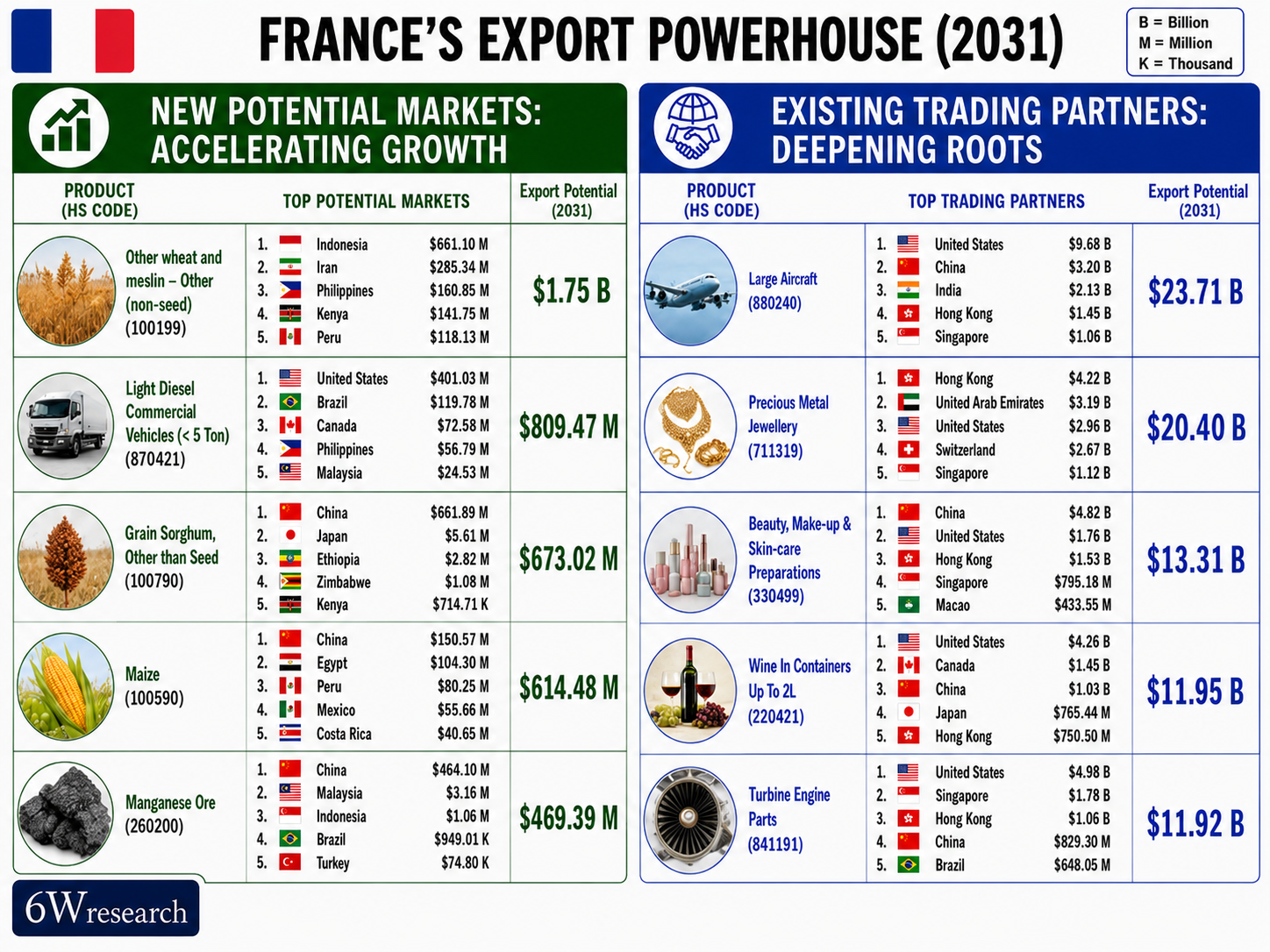
Other wheat and meslin (non-seed) represent France's largest new-corridor opportunity at USD 1.75 billion, led by Indonesia at USD 0.66 billion (37.89%), followed by Iran at USD 0.29 billion (16.35%) and the Philippines at USD 0.16 billion (9.22%). This spread reflects France's position as Europe's largest wheat producer seeking new food-security buyers in Southeast Asia and the Middle East, where large, import-dependent populations are looking to diversify supply away from Black Sea grain amid ongoing competition from Russian and Ukrainian exports in France's traditional North African markets.
Light diesel commercial vehicles (≤5 Ton) and grain sorghum add a further USD 0.81 billion and USD 0.67 billion. Commercial vehicles are led by the United States (49.54%), Brazil (14.79%) and Canada (8.97%), a genuinely new market for French light-vehicle manufacturers outside their traditional European base, consistent with fleet and van-export opportunities in the Americas. Grain sorghum, by contrast, is sold almost entirely to China (98.34%), reflecting Beijing's use of imported sorghum as a substitute feed grain amid constraints on its own domestic feed-grain supply.
Maize and manganese ore round out the new-corridor top five, contributing USD 0.61 billion and USD 0.47 billion. Maize is more diversified, led by China (24.51%), Egypt (16.98%) and Peru (13.06%), consistent with broad-based global demand for feed and food-grade grain. Manganese ore is sold almost entirely to China (98.87%), reflecting China's dominant global steel and battery-grade manganese-processing capacity, positioning France as an unlikely new raw-material supplier despite not being a traditional mining exporter. Across all five categories, France's new-corridor opportunity through 2031 looks less like an extension of its aerospace-and-luxury export identity and more like a bulk commodity trade with China, Southeast Asia and the Americas.
Aircraft, Jewelry and Wine Remain the Foundation of France's US-Anchored, Luxury-Led Established Trade
Large aircraft represent France's largest established export opportunity at USD 23.71 billion, led by the United States at USD 9.68 billion (40.82%), China at USD 3.20 billion (13.49%) and India at USD 2.13 billion (9.00%). The United States' dominant share reflects Airbus's deep ties to American carriers replacing wide- and narrow-body fleets, while China and India's fast-growing aviation markets add substantial new-aircraft orders as their domestic airlines expand capacity.
Precious metal jewellery and beauty, make-up and skin-care preparations add a further USD 20.40 billion and USD 13.31 billion. Jewellery is led by Hong Kong (20.70%), the UAE (15.64%) and the United States (14.53%), reflecting Hong Kong and Dubai's roles as major luxury re-export and duty-free retail hubs, alongside direct US consumer demand. Beauty and skin-care preparations are led by China (36.18%), the United States (13.25%) and Hong Kong (11.47%), tracking China's still-expanding cosmetics market and French beauty brands' strong positioning there, with Hong Kong and Macao serving as duty-free gateways into mainland Chinese demand.
Wine in containers up to 2L and turbine engine parts complete the established top five, contributing USD 11.95 billion and USD 11.92 billion. Wine is led by the United States (35.67%), Canada (12.10%) and China (8.63%), with the US remaining the single largest export market for French wine producers. Turbine engine parts are led by the United States (41.81%), Singapore (14.91%) and Hong Kong (8.89%), reflecting Safran and CFM International's close partnership supplying engine components into the US aerospace supply chain, with Singapore and Hong Kong serving as regional maintenance and overhaul hubs for Asian carriers. Collectively, these five categories confirm that France's established export advantage rests on high-value aerospace and luxury goods, split between American aerospace-and-wine demand and Asian luxury-and-beauty consumption, making both US tariff policy and Chinese consumer and trade dynamics equally consequential to the country's near-term export outlook.
|
France's export base is a story of two very different kinds of dependence: American demand for its aircraft and wine, and Asian demand for its jewelry and cosmetics. Both relationships are currently under real trade-policy strain at the same time, which makes France's established export base unusually exposed on two fronts simultaneously, even as its new-corridor opportunity looks almost nothing like the luxury economy the country is known for. 6WExportGTM Analysis |
Top Global Export Opportunities (2031), By Product
| Product | Export Opportunity (USD Billion) |
| Electronic Integrated Circuits | 685.7 |
| Refined Petroleum Oils | 668.4 |
| Light Petroleum Oils | 588.9 |
| Logic Electronic Integrated Circuits | 507.9 |
| Medicines | 381.2 |
| Gasoline Passenger Cars (1.5–3.0L) | 360.9 |
| Smartphones | 343.6 |
| Electronic Integrated Circuits with Memory | 333.2 |
| Data Transmission Equipment | 216.9 |
| Immunological Products | 209.6 |
Excludes naturally occurring products (e.g., crude oil, raw gold). Source: 6WExportGTM
France is well positioned to participate in several of the world’s largest export opportunity pools through its established strengths in pharmaceuticals, automotive manufacturing, aerospace-linked electronics and advanced industrial technologies. Categories such as medicines, immunological products, passenger vehicles and data-transmission equipment align particularly well with France’s existing production capabilities, while growth in electronics and semiconductor-linked products offers additional scope to deepen participation in high-value global supply chains.
A US Tariff Threat and a China Cognac Standoff: Two Developments Shaping France's Export Base
Two developments now underway help explain the pressures and opportunities for France: renewed US tariff threats targeting French wine and luxury goods specifically, which sit on top of the existing 15% EU-US baseline, and an ongoing Chinese anti-dumping dispute over French brandy and cognac, which has already cut deeply into France's second-largest established export relationship.
US Tariffs Have Settled at 15%, but Trump's 200% Threat Keeps French Wine and Luxury Goods on Edge
Under the EU-US trade framework in force since mid-2026, French exports to the United States face a 15% all-inclusive tariff ceiling, with wine and spirits notably excluded from the sector-specific exemptions Brussels had sought. French wine and spirits exports fell for a third consecutive year in 2025, dropping 8% in value to €14.3 billion as US tariffs and Chinese duties both weighed on demand, with sales specifically to the United States down 21% to €3.0 billion. In January 2026, President Trump threatened a 200% tariff on French wine and champagne over an unrelated geopolitical dispute, a threat industry group FEVS said must be handled "with composure" but which nonetheless illustrates how exposed the sector remains to sudden escalation. For an established wine export opportunity worth USD 11.95 billion and led by the United States at 35.67%, continued tariff volatility remains a persistent risk to France's export outlook through 2031, even as aircraft and aircraft parts France's two largest established sectors are set to revert to near-duty-free MFN treatment under the same framework.
|
France's aerospace sector is actually emerging from this trade cycle in reasonable shape, with aircraft reverting toward duty-free treatment. Wine is the opposite story: it never got the exemption the industry lobbied for, and now sits exposed to a 200% threat that has nothing to do with wine at all. That asymmetry is the real story of France's US trade exposure right now. Manish Pant, Senior Data Scientist, Data Science & Market Intelligence, 6Wresearch |
China's Anti-Dumping Tariffs on Cognac Have Cut Deep, With a Minimum-Price Deal Still Under Negotiation
China opened an anti-dumping investigation into EU brandy in January 2024, widely seen as retaliation for the EU's tariffs on Chinese electric vehicles, and has since required importers of French cognac and other grape brandies to pay deposits of 30-40% pending a final ruling that could impose permanent duties of up to 39%. French wine and spirits sales to China fell 20% in value to €767 million in 2025, with cognac exports specifically plunging 24% in value, and negotiators for French producers have offered China minimum import prices between USD 20 and roughly USD 300 per litre as a proposed resolution, with both sides describing an agreement "in principle" as of mid-2026, though full terms remain unsettled. The dispute matters beyond spirits: China is France's second-largest established export market at USD 75.89 billion, and its largest new-corridor market at USD 8.05 billion, meaning the trajectory of this negotiation carries signal value for the broader France-China trade relationship, including the beauty and skin-care trade that depends heavily on Chinese consumer demand.
|
Cognac is a small line item next to aircraft and jewelry in France's overall trade picture, but it has become the test case for how France and China resolve trade disputes more broadly. A durable minimum-price agreement here would be a good signal for the rest of France's China-facing export base; a collapse in talks would be a warning sign well beyond the spirits industry. Manisha Gupta, Data Analyst, Data Science & Market Intelligence, 6Wresearch |
The Takeaway
France should treat its export outlook through 2031 as one of managing simultaneous exposure on two fronts rather than straightforward growth, since its established base depends on American demand for aircraft and wine at the same time as Chinese demand for jewelry and cosmetics, and both relationships currently carry live trade-policy risk. The path forward depends on protecting the aerospace-and-luxury trade that anchors current exports while building out the genuinely different bulk-commodity opportunity emerging in new-corridor markets.
Key strategic priorities for France include:
- Protect wine and spirits from renewed US tariff escalation: Wine in containers up to 2L represents USD 11.95 billion of established export potential, with the United States absorbing 35.67% of exports even after three consecutive years of decline. With President Trump having threatened a 200% tariff on French wine, producers and the French government should pursue every available diplomatic and legal channel to secure a sector-specific exemption before any escalation materializes.
- Push the China cognac negotiation to a durable conclusion: China's anti-dumping duties have already cut cognac exports by 24% in value, and China remains both France's second-largest established market (USD 75.89 billion) and its largest new-corridor market (USD 8.05 billion). France should treat the proposed minimum-price agreement as a template for de-escalating broader France-China trade friction, not just a spirits-specific fix.
- Capitalize on the aerospace sector's favorable tariff trajectory: Large aircraft (USD 23.71 billion) and aircraft parts (USD 31.49 billion combined across turbojet engines and turbine parts) are set to revert toward near-duty-free MFN treatment with the United States. France should use this relatively favorable window to lock in long-term aircraft orders from US carriers before any future trade-policy shift.
- Build out the bulk-commodity new-corridor opportunity deliberately: Wheat, sorghum, maize and manganese ore together represent the bulk of France's USD 40.15 billion new-corridor potential, led by China, Indonesia and other buyers largely absent from France's luxury-and-aerospace established base. France should treat this as a genuinely separate growth track, requiring different trade relationships and logistics than its traditional export model.
Overall, France's export growth through 2031 will depend less on any single tariff resolution and more on how well the country manages parallel trade tension with its two largest partners a reminder that for a luxury-and-aerospace exporter of France's scale, the health of both the transatlantic and Sino-European trade relationships now shapes the export outlook in equal measure.

Leadership Perspectives from Industry Events
Search
6Wresearch in the News
 Forbes
Citing 6Wresearch analytics to map global infrastructure and pharmaceutical industry trajectories.
 Bloomberg Law
Direct syndication of 6Wresearch's macro data points, capturing complex supply chain shifts.
 Reuters
Tracking industrial manufacturing adjustments and electronic security ecosystem scaling.
 Mint
Mint
Utilizing deep-tech sector market sizing to analyze global automation and robotics.
 The Economic Times
Anchoring features on industrial IoT growth metrics and connected smart-grid devices.
 Business Standard
Featuring strategic evaluations of Advanced Driver Assistance Systems (ADAS) and AI road safety.
 The Hindu
Spotlighting core commercial metrics ranging from unmanned aerial vehicles (UAVs) to consumer durables.
 Financial Express
Anchoring quarterly reviews on cross-border real estate tech and structural hardware manufacturing.
 Yahoo Finance
Syndicating the tracker's $30.1 billion untapped-market findings, spotlighting Japan, the US and China as India's top new-potential importers.
 India Today
Carrying the release on smartphones leading India's export potential to $94 billion by 2031, per 6WExportGTM data.
 Dailyhunt
Distributing the tracker findings to its regional readership, framing India's export diversification into Japan and Mexico.
 PR Newswire Original release
Publishing the full India Export Attractiveness Tracker 2026, detailing new trade corridors across iron ore, LCVs and pharmaceuticals.
 The Industrial
Highlighting the tracker's read on India's semiconductor ambitions and long-term chip-assembly export potential.
 PTI News
Reporting on the $66.81 billion pharmaceuticals export opportunity flagged in the tracker, amid looming US generic-drug tariffs.
 Tribune India
Covering the tracker's tariff-versus-regulation analysis across India's mature export markets in the US, China and UAE.
 ANI News
Amplifying the report's findings on polished diamonds, refined petroleum and medicines as India's core export engines.
 International Business Magazine
Covering the report's insight into how AEB, blind spot detection, and driver monitoring are reshaping India's ADAS market.
 Focus Gaming News
Highlighting the research forecast for Egypt's gambling market, projecting steady growth through 2032.
Thought Leadership and Analyst Meet





Our Clients








Latest Reports
- Namibia Financial Asset Management Market (2026-2032)
- Mozambique Financial Asset Management Market (2026-2032)
- Montenegro Financial Asset Management Market (2026-2032)
- Mongolia Financial Asset Management Market (2026-2032)
- Monaco Financial Asset Management Market (2026-2032)
- Micronesia Financial Asset Management Market (2026-2032)
- Mauritius Financial Asset Management Market (2026-2032)
- Mauritania Financial Asset Management Market (2026-2032)
- Marshall Islands Financial Asset Management Market (2026-2032)
- Malta Financial Asset Management Market (2026-2032)
Industry Events and Analyst Meet

EV India Expo 2026

HIMTEX 2026

India Refining Summit 2026

India EV Show 2026

EV tech India Expo 2026
Whitepaper
- Middle East & Africa Commercial Security Market Click here to view more.
- Middle East & Africa Fire Safety Systems & Equipment Market Click here to view more.
- GCC Drone Market Click here to view more.
- Middle East Lighting Fixture Market Click here to view more.
- GCC Physical & Perimeter Security Market Click here to view more.


