Guinea’s Aluminium Ore Exports to Existing Partners Could Reach USD 9.12 Billion, While Unwrought Gold Opens USD 2.07 Billion Across New Markets by 2031.
Aluminium ore remains the dominant pillar of Guinea’s established export base, with China accounting for nearly 83% of established demand, far ahead of India as the second-largest market. In contrast, the new-corridor opportunity is centered around a different commodity and buyer structure, with Hong Kong capturing almost 68% of potential value, followed by the United States. This reflects the emergence of a significant gold-related trade opportunity that differs from traditional Guinea’s bauxite export model.
Source: 6WExportGTM
China’s Overwhelming Established Dominance Is Matched by Hong Kong’s Command of New-Corridor Gold Trade
Guinea's emerging export opportunities point to real potential to move beyond its traditional mineral trade base. Hong Kong leads the way here at USD 1.71 billion, with the United States following at USD 0.43 billion. What's driving Hong Kong's dominant position is largely gold-related trade and the broader precious-metal value chain — it makes sense given the city's role as a major global refining and trading centre. The US figure, though smaller, still signals genuine room for broader market diversification, and China at USD 0.10 billion, India at USD 0.07 billion, and Canada at USD 0.06 billion add further opportunity across minerals, metals, and other resource-based exports. Taken together, these emerging markets suggest Guinea has a real chance to diversify where it sends its exports, and in doing so, capture more value from the natural-resource base it already has.
| Top 5 Existing Importers | Export Potential (USD Billion) | Top 5 New Potential Importers | Export Potential (USD Billion) |
| China | 8.17 | Hong Kong | 1.71 |
| India | 0.67 | United States | 0.43 |
| United Arab Emirates | 0.49 | China | 0.10 |
| Canada | 0.15 | India | 0.07 |
| Malaysia | 0.10 | Canada | 0.06 |
Source: 6WExportGTM
Guinea’s established export opportunities remain highly concentrated in China, which leads with USD 8.17 billion, reflecting its dominant role as the primary destination for Guinea’s bauxite and mineral exports. India follows with USD 0.67 billion, supported by demand for mineral resources and raw materials, while the United Arab Emirates contributes USD 0.49 billion through commodity trading and resource-linked supply chains. Canada at USD 0.15 billion and Malaysia at USD 0.10 billion represent additional established markets for Guinea’s mineral exports. Overall, Guinea’s existing export structure highlights strong dependence on China as an anchor market while also showing opportunities to strengthen relationships with other global buyers and diversify its resource export destinations.
An Enormous Gold-Trading Relationship, Plus Genuine Diversification in Cocoa, Diamonds and Rubber
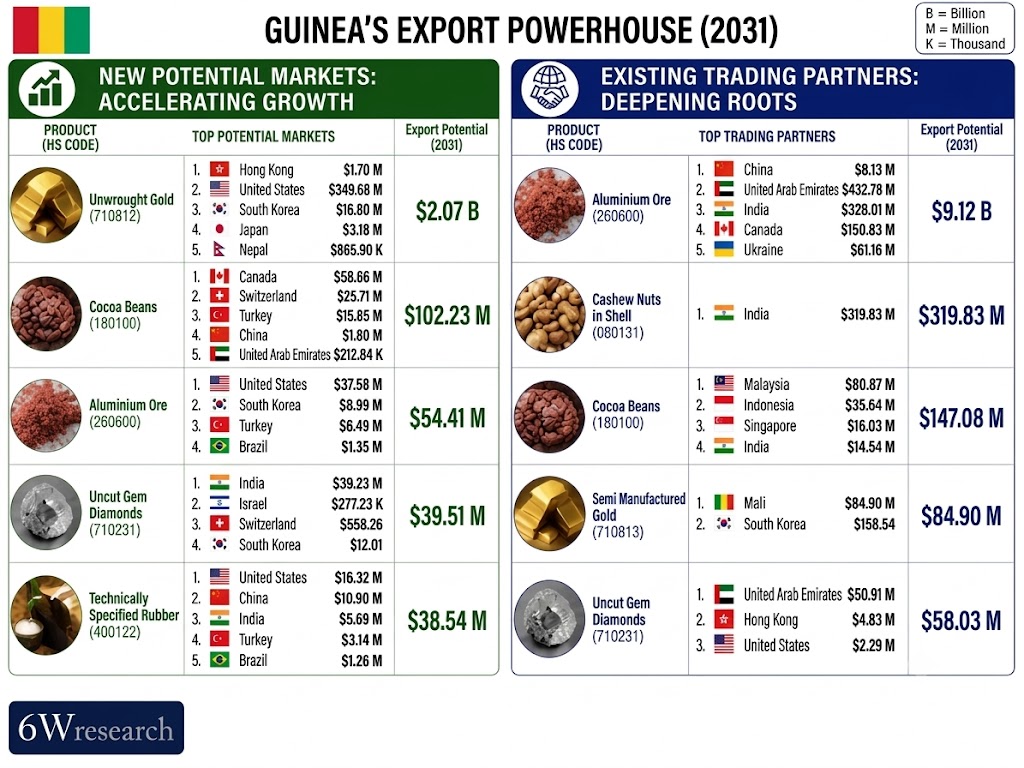
Unwrought gold is the leading new-corridor product by a vast margin at USD 2.07 billion, led by Hong Kong (USD 1.70 billion), the United States (USD 349.68 million) and South Korea (USD 16.80 million). Hong Kong hosts major regional gold-trading and bullion infrastructure, absorbing Guinean gold output as global buyers diversify sourcing amid rising prices; the United States represents a smaller but genuine secondary bullion-market relationship, while South Korea and Japan reflect smaller East Asian jewelry and industrial demand.
Cocoa beans and aluminium ore together account for another USD 156.64 million of new-market potential. Cocoa beans’ USD 102.23 million is led by Canada (USD 58.66 million) and Switzerland (USD 25.71 million), both home to major chocolate and confectionery manufacturing industries seeking diversified cocoa sourcing beyond traditional West African supply concentrated in Côte d’Ivoire and Ghana. Aluminium ore’s USD 54.41 million in new-corridor value is led by the United States (USD 37.58 million), reflecting American smelters diversifying bauxite sourcing amid a broader push to secure critical mineral supply chains outside China.
Uncut gem diamonds and technically specified rubber close out the top five opportunity. Diamonds’ USD 39.51 million in new-corridor value is led almost entirely by India at USD 39.23 million, reflecting India’s Surat diamond-cutting industry absorbing rough stones directly a new buyer relationship distinct from the UAE-anchored established diamond trade. Technically specified rubber’s USD 38.54 million is led by the United States at USD 16.32 million and China USD 10.90 million. Taken together, the five products show Guinea’s new-corridor opportunity dominated by an enormous gold-trading relationship with Hong Kong, the remaining four products show buyer diversification into cocoa-manufacturing and diamond-cutting economies distinct from the established base.
Guinea’s Established Exports Driven by Bauxite, Agriculture and Precious Metals with Strong Buyer Concentration
Aluminium ore, Guinea’s largest established product at USD 9.12 billion, is led by China at USD 8.13 billion, the United Arab Emirates at USD 432.78 million and India at USD 328.01 million. Guinea holds some of the world’s largest bauxite reserves, and China’s aluminum-smelting industry the largest in the world has invested heavily in Guinean mining infrastructure to secure long-term bauxite supply, the UAE and India represent much smaller alternative refining and industrial relationships.
Cashew nuts in shell (USD 319.83 million) and cocoa beans (USD 147.08 million) together contribute another USD 466.91 million. Cashew nuts are sold entirely to India, consistent with its massive cashew-processing industry importing raw nuts from West African suppliers to feed shelling and roasting operations. Cocoa beans are led by Malaysia at USD 80.87 million, Indonesia at USD 35.64 million and Singapore at USD 16.03 million, reflecting Malaysia’s significant cocoa-grinding and processing capacity as a regional hub, Indonesia’s own large cocoa-processing industry, and Singapore’s role as a regional trading and re-export center.
Semi manufactured gold (USD 84.90 million) and uncut gem diamonds (USD 58.03 million) close out the top five opportunities. Semi manufactured gold is sold almost entirely to Mali, an unusual established relationship most likely reflecting regional West African gold-processing or transshipment links between two major regional gold producers rather than direct end-consumption. Uncut gem diamonds are led by the United Arab Emirates at USD 50.91 million, with the Dubai Diamond Exchange serving as the dominant trading and re-export gateway for Guinean rough stones. Read together, established trade reveals a pattern of extreme, product-by-product single-buyer concentration China for aluminium ore, India for cashews, Mali for semi-manufactured gold, the UAE for diamonds meaning Guinea’s established export base, while spanning five different products, offers almost no buyer diversification within any individual product.
|
Guinea’s export landscape shows potential to evolve beyond its traditional mineral-focused base by expanding into gold, cocoa, gemstones, and processed commodities. While existing trade remains concentrated among established partners, emerging markets highlight opportunities to diversify buyers and strengthen participation in global value chains through improved processing capabilities, broader market access, and greater value addition. 6WExportGTM Analysis |
Top Global Export Opportunities (2031), By Product
| Product | Export Opportunity (USD Billion) |
| Electronic Integrated Circuits | 685.7 |
| Refined Petroleum Oils | 668.4 |
| Light Petroleum Oils | 588.9 |
| Logic Electronic Integrated Circuits | 507.9 |
| Medicines | 381.2 |
| Gasoline Passenger Cars (1.5–3.0L) | 360.9 |
| Smartphones | 343.6 |
| Electronic Integrated Circuits with Memory | 333.2 |
| Data Transmission Equipment | 216.9 |
| Immunological Products | 209.6 |
Excludes naturally occurring products (e.g., crude oil, raw gold). Source: 6WExportGTM
Looking ahead to 2031, global export growth is expected to be led by advanced electronics, energy products, pharmaceuticals, and automotive technology. For Guinea, the relevant takeaway isn't that it will compete directly in these categories, but that these trends underline just how important it's becoming to move beyond raw commodity exports and capture more value along the way. Guinea isn't going to break into semiconductors or advanced manufacturing anytime soon, but it's genuinely well placed to benefit from rising global demand for critical minerals, industrial inputs, and processed resources. Its strong position in bauxite, gold, and other minerals gives it a solid foundation to build on — the real opportunity lies in expanding downstream processing and cementing a stronger role within global supply chains rather than just supplying raw ore. Developing mineral refining capabilities, improving infrastructure, and supporting agricultural value chains will be key to capturing greater export value and diversifying Guinea’s future trade opportunities.
Two Developments Shaping Guinea’s Export Base: A Record Bauxite Boom and a Sweeping Gold-Export Ban
Two developments in particular stand out when it comes to Guinea's export outlook. The first is the continued expansion of its bauxite sector, which is reinforcing Guinea's position as one of the world's major suppliers while deepening its trade relationship with China even further. The second is a tightening of controls on raw gold exports — a shift that could genuinely reshape the emerging gold trade by pushing more processing to happen domestically rather than sending raw material abroad.
A Record Bauxite Boom Deepens Guinea’s Dependence on China Even as Margins Tighten
Guinea's bauxite industry keeps strengthening its position as a major global supplier. Exports hit a record 114.8 million tonnes in the first half of 2026, up from 99.8 million tonnes over the same period in 2025. That builds on an already strong 2025, when Guinea shipped roughly 183 million tonnes of bauxite — 25% annual growth — with about 74% of that heading to China. China's growing reliance on Guinea fits into a broader strategy of securing raw materials for its aluminium industry; Chinese bauxite imports rose 26.4% in 2025, reaching 200.5 million tonnes.
Chinese-linked operators remain central to Guinea's mining sector. The SMB-Winning consortium, for instance, is pushing ahead with a USD 3 billion investment plan that includes a 135-kilometre railway and a planned alumina refinery aimed at increasing domestic value addition. Even with export volumes climbing, the sector isn't without pressure — bauxite prices have softened to around USD 38-39 per dry tonne, and both fuel and freight costs have been rising. With established aluminium ore export potential sitting at USD 9.12 billion, and dependence on China running high, Guinea is increasingly focused on building out local processing capacity, a move that would let it capture a larger share of the economic value its mineral resources actually generate.
|
Guinea’s bauxite sector highlights the country’s strength as a global mineral supplier, but also the need to move beyond raw ore exports. Expanding domestic refining and processing capacity could help Guinea capture more value from rising export volumes while reducing dependence on a single market. Manish Pant, Senior Data Scientist, Data Science & Market Intelligence, 6Wresearch |
A Sweeping Ban on Raw Gold Exports Could Upend Guinea’s USD 2.07 Billion Hong Kong Gold Trade
Guinea's gold sector is entering a genuinely new phase, one focused on building out more of the value chain domestically rather than just exporting raw material. The June 2026 policy requiring gold to be processed and certified within the country before export is likely to reshape how Guinea's gold trade is structured, rather than shrink its overall market potential. Unwrought gold opportunity is projected at USD 2.07 billion by 2031, backed by solid global demand and existing relationships with major gold-trading hubs like Hong Kong and the United States. The USD 30 million Nimba Gold Refinery adds real weight to this shift — it's starting out with capacity of 530 tonnes a year, with plans to expand to 733 tonnes, and gives Guinea a genuine ability to supply refined gold products directly into international markets rather than relying on buyers to do that processing elsewhere. If this plays out as intended, it should improve how much value Guinea actually retains from its gold, add more transparency to exports, and position the country as a more integrated player within the global gold supply chain rather than just a raw-material source.
|
Guinea’s move toward domestic gold processing could reshape its export mix by shifting demand from raw unwrought gold toward refined and semi-processed gold products. This transition may create new opportunities across the gold value chain, enabling greater value retention, attracting international buyers seeking certified products, and strengthening Guinea’s role in global precious-metal markets. Manisha Gupta, Data Analyst, Data Science & Market Intelligence, 6Wresearch |
The Takeaway
Guinea’s export base is highly dependent on a few dominant buyers, with large established export volumes concentrated around mineral commodities and China’s central role in the bauxite trade. New export opportunities show a similar pattern of concentration in gold-related markets, although cocoa, diamonds and rubber provide early signs of wider diversification. The strategic priority for Guinea is to leverage current developments including the expansion of bauxite production and the transition toward domestic gold refining to capture greater value locally rather than relying primarily on higher volumes of raw commodity exports.
Key strategic priorities for Guinea include:
- Accelerate domestic alumina refining to capture more bauxite value, since aluminium ore already represents USD 9.12 billion in established value with China alone taking USD 8.13 billion, while 2026’s weakening prices (USD 38–39 per tonne) and rising freight costs make raw-ore export margins increasingly thin without local processing.
- Ensure the Nimba Gold Refinery can absorb artisanal output at scale, given the refinery’s planned 530-733 tonne annual capacity dwarfs Guinea’s actual 2025 exports of 2.33 million ounces, but the raw-gold export ban announced in June 2026 will only succeed in redirecting the USD 1.70 billion Hong Kong relationship if artisanal miners can physically and affordably reach the facility.
- Build on the cocoa-diversification relationships in Canada and Switzerland, since these two chocolate-manufacturing economies already represent USD 58.66 million and USD 25.71 million in new-corridor cocoa demand, offering a genuine alternative to the established Malaysia and Indonesia anchored cocoa trade.
- Diversify diamond and cashew buyers beyond single-country dependence, given cashew nuts in shell are sold 100% to India and uncut gem diamonds are overwhelmingly UAE-bound in established trade, while India’s emerging new-corridor rough-diamond demand (USD 39.23 million) shows at least one alternative relationship already forming.
Ultimately, Guinea’s 2031 export outlook depends on whether the country can convert record mineral-export volumes and a sweeping gold-refining mandate into genuine domestic value capture, rather than continuing to ship ever-larger quantities of raw bauxite and gold to the same concentrated set of buyers that already dominate its trade.

Leadership Perspectives from Industry Events
Search
6Wresearch in the News
 Forbes
Citing 6Wresearch analytics to map global infrastructure and pharmaceutical industry trajectories.
 Bloomberg Law
Direct syndication of 6Wresearch's macro data points, capturing complex supply chain shifts.
 Reuters
Tracking industrial manufacturing adjustments and electronic security ecosystem scaling.
 Mint
Mint
Utilizing deep-tech sector market sizing to analyze global automation and robotics.
 The Economic Times
Anchoring features on industrial IoT growth metrics and connected smart-grid devices.
 Business Standard
Featuring strategic evaluations of Advanced Driver Assistance Systems (ADAS) and AI road safety.
 The Hindu
Spotlighting core commercial metrics ranging from unmanned aerial vehicles (UAVs) to consumer durables.
 Financial Express
Anchoring quarterly reviews on cross-border real estate tech and structural hardware manufacturing.
 Yahoo Finance
Syndicating the tracker's $30.1 billion untapped-market findings, spotlighting Japan, the US and China as India's top new-potential importers.
 India Today
Carrying the release on smartphones leading India's export potential to $94 billion by 2031, per 6WExportGTM data.
 Dailyhunt
Distributing the tracker findings to its regional readership, framing India's export diversification into Japan and Mexico.
 PR Newswire Original release
Publishing the full India Export Attractiveness Tracker 2026, detailing new trade corridors across iron ore, LCVs and pharmaceuticals.
 The Industrial
Highlighting the tracker's read on India's semiconductor ambitions and long-term chip-assembly export potential.
 PTI News
Reporting on the $66.81 billion pharmaceuticals export opportunity flagged in the tracker, amid looming US generic-drug tariffs.
 Tribune India
Covering the tracker's tariff-versus-regulation analysis across India's mature export markets in the US, China and UAE.
 ANI News
Amplifying the report's findings on polished diamonds, refined petroleum and medicines as India's core export engines.
 International Business Magazine
Covering the report's insight into how AEB, blind spot detection, and driver monitoring are reshaping India's ADAS market.
 Focus Gaming News
Highlighting the research forecast for Egypt's gambling market, projecting steady growth through 2032.
Thought Leadership and Analyst Meet





Our Clients








Latest Reports
- Austria X-ray Imaging Devices Market (2026-2032)
- Armenia X-ray Imaging Devices Market (2026-2032)
- Antigua and Barbuda X-ray Imaging Devices Market (2026-2032)
- Angola X-ray Imaging Devices Market (2026-2032)
- Andorra X-ray Imaging Devices Market (2026-2032)
- Albania X-ray Imaging Devices Market (2026-2032)
- Afghanistan X-ray Imaging Devices Market (2026-2032)
- United States (US) X-ray Imaging Devices Market (2026-2032)
- United Kingdom (UK) X-ray Imaging Devices Market (2026-2032)
- United Arab Emirates (UAE) X-ray Imaging Devices Market (2026-2032)
Industry Events and Analyst Meet

EV India Expo 2026

HIMTEX 2026

India Refining Summit 2026

India EV Show 2026

EV tech India Expo 2026
Whitepaper
- Middle East & Africa Commercial Security Market Click here to view more.
- Middle East & Africa Fire Safety Systems & Equipment Market Click here to view more.
- GCC Drone Market Click here to view more.
- Middle East Lighting Fixture Market Click here to view more.
- GCC Physical & Perimeter Security Market Click here to view more.


