Hungary's Pharmaceutical Preparation Exports to Existing Partners Could Reach USD 12.19 Billion, While Vaccines Open USD 2.84 Billion Across New Markets by 2031
The United States leads Hungary’s export potential, accounting for 36.32% and 23.27%, respectively. Hungary’s export strength is anchored in pharmaceuticals, electronics, batteries and automotive products, with new opportunities largely extending these existing capabilities into additional markets. Rather than shifting into new industries, Hungary’s future growth is expected to come from deeper integration into global manufacturing supply chains.
 Source: 6WExportGTM
The United States Extends Its Established Lead into Hungary's New-Market Potential
Hungary’s new export potential is led by the United States at USD 7.53 billion, reflecting strong opportunities across its established strengths in automotive, pharmaceuticals, electronics and advanced manufacturing. Hong Kong and China follow with potential of USD 2.67 billion and USD 2.31 billion, supported by demand for technology-intensive products and industrial components. India and Mexico, with opportunities of USD 1.89 billion and USD 1.75 billion, further expand Hungary’s diversification potential across Asian and North American markets.
| Top 5 Existing Importers | Export Potential (USD Billion) | Top 5 New Potential Importers | Export Potential (USD Billion) |
| United States | 45.02 | United States | 7.53 |
| China | 16.70 | Hong Kong | 2.67 |
| Mexico | 6.11 | China | 2.31 |
| Canada | 5.88 | India | 1.89 |
| Japan | 5.81 | Mexico | 1.75 |
Source: 6WExportGTM
The United States accounts for USD 45.02 billion of Hungary's established export potential, more than two and a half times China's USD 16.70 billion in second place. Mexico ranks third at USD 6.11 billion, with Canada and Japan contributing USD 5.88 billion and USD 5.81 billion. This reflects Hungary's role as a manufacturing and assembly hub for pharmaceuticals, computing hardware and automotive components destined overwhelmingly for American end markets, with Mexico, Canada and Japan absorbing smaller volumes tied to their own automotive and electronics supply chains.
A Vaccine and Vehicle Corridor Built Overwhelmingly on US and Hong Kong Demand Headlines Hungary's New Potential Market Opportunities
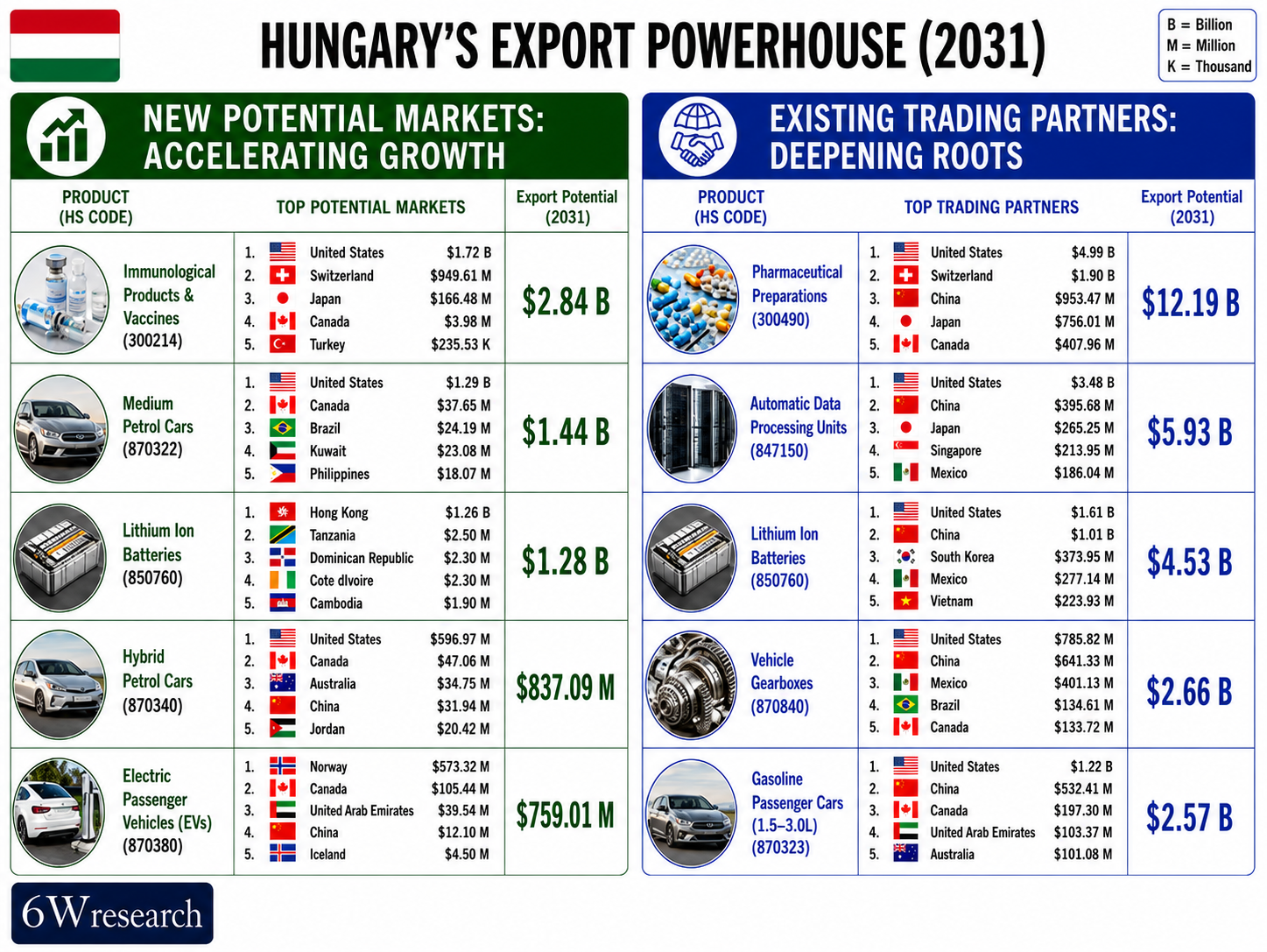
Immunological products and vaccines represent Hungary’s largest new-corridor opportunity at USD 2.84 billion, led by the United States at USD 1.72 billion, followed by Switzerland at USD 949.61 million and Japan at USD 166.48 million. This opportunity reflects Hungary’s established pharmaceutical capabilities, including advanced manufacturing, formulation and export networks serving highly regulated healthcare markets. The concentration of demand in the US and Switzerland highlights the importance of premium healthcare systems with strong pharmaceutical procurement structures and established distribution channels for biological and vaccine products.
Medium petrol cars and lithium-ion batteries contribute a further USD 1.44 billion and USD 1.28 billion, respectively. Medium petrol car opportunities are heavily concentrated in the United States at USD 1.29 billion, with smaller opportunities in Canada (USD 37.65 million), Brazil (USD 24.19 million), Kuwait (USD 23.08 million) and the Philippines (USD 18.07 million). This reflects Hungary’s integration into European automotive manufacturing networks and its ability to serve overseas vehicle markets through established OEM and supplier ecosystems. Lithium-ion battery opportunities are dominated by Hong Kong at USD 1.26 billion, while other destinations remain relatively small, indicating potential links with regional battery trading and distribution networks as Hungary expands its role in the global EV battery supply chain.
This is a sign of Hungary’s integration into European automotive manufacturing networks and its capability of accessing overseas vehicle markets through existing OEM and supplier ecosystems. Hong Kong’s lithium-ion battery opportunities amount to USD 1.26 billion, far outstripping other destinations, which are relatively small in size, indicating potential links to regional battery trading and distribution networks as Hungary continues to expand its role in the global EV battery supply chain.
Hybrid petrol cars and electric passenger vehicles complete Hungary’s top five new-corridor opportunities, contributing USD 837.09 million and USD 759.01 million, respectively. The United States leads the demand for hybrid vehicles with USD 596.97 million followed by Canada at USD 47.06 million, reflecting continued demand for efficient vehicles in developed automotive markets. Norway is the largest electric vehicle opportunity worth USD 573.32 million followed by Canada (USD 105.44 million) and UAE (USD39.54 million) driven by increasing electric vehicle adoption and charging infrastructure development. In general, Hungary’s new-corridor opportunities are largely based on existing strengths in pharmaceuticals, automotive manufacturing and battery technologies, taking these capabilities to new international markets.
Pharmaceuticals and Computing Hardware Remain the Foundation of Hungary's US-Anchored Established Trade
Pharmaceutical preparations represent Hungary’s largest established export opportunity at USD 12.19 billion, led by the United States at USD 4.99 billion, followed by Switzerland at USD 1.90 billion and China at USD 953.47 million. This is testament to Hungary’s long-standing pharmaceutical manufacturing capabilities, supported by a strong generics industry, state-of-the-art production facilities and integration in regulated healthcare markets. Demand from the US and Swiss markets is driven by their large pharmaceutical consumption base, innovation ecosystems, and established import channels of European-produced medicines.
Automatic data processing units and lithium-ion batteries contribute a further USD 5.93 billion and USD 4.53 billion, respectively. Data processing units are led by the United States at USD 3.48 billion, with additional demand from China (USD 395.68 million), Japan (USD 265.25 million) and Singapore (USD 213.95 million). This reflects Hungary’s role as a key location for electronics manufacturing and assembly in European technology supply chains, reflecting foreign investment and proximity to key industrial markets. The United States is the world’s largest lithium-ion battery exporter at USD 1.61 billion, followed by China at USD 1.01 billion, South Korea at USD 373.95 million and Mexico at USD 277.14 million. This position is driven by Hungary’s fast rise as a European EV battery production hub, with huge investments from global battery and automotive players and increased demand from electric mobility supply chains.
Vehicle gearboxes and gasoline passenger cars contribute USD 2.66 billion and USD 2.57 billion, respectively, completing Hungary’s established top five export opportunities. The main export destinations for Gearbox are the US, China and Mexico with USD 785.82 million, USD 641.33 million and USD 401.13 million respectively, indicating the strong integration of Hungary into the global automotive component supply chains. The United States is the biggest gasoline passenger car export market at USD 1.22 billion, followed by China at USD 532.41 million and Canada at USD 197.30 million, reflecting Hungary’s position as a European vehicle manufacturing base catering to global OEM networks. Collectively, these categories demonstrate that Hungary’s export competitiveness is built on high-value manufacturing, pharmaceuticals, electronics and automotive supply chains, rather than commodity-driven trade.
|
Hungary’s export outlook reflects a strong transition toward high-value manufacturing and technology-driven industries. Established strengths in pharmaceuticals, automotive and electronics are being complemented by emerging opportunities in electric mobility, battery technologies and advanced healthcare products. This indicates a growth path focused on deepening global supply-chain integration while expanding into future-oriented industries and new international markets. 6WExportGTM Analysis |
Top Global Export Opportunities (2031), By Product
| Product | Export Opportunity (USD Billion) |
| Electronic Integrated Circuits | 685.7 |
| Refined Petroleum Oils | 668.4 |
| Light Petroleum Oils | 588.9 |
| Logic Electronic Integrated Circuits | 507.9 |
| Medicines | 381.2 |
| Gasoline Passenger Cars (1.5–3.0L) | 360.9 |
| Smartphones | 343.6 |
| Electronic Integrated Circuits with Memory | 333.2 |
| Data Transmission Equipment | 216.9 |
| Immunological Products | 209.6 |
Excludes naturally occurring products (e.g., crude oil, raw gold). Source: 6WExportGTM
The global export outlook is increasingly driven by advanced electronics, pharmaceuticals, automotive technologies and energy-transition products. Hungary is well positioned with these growth areas, with its established capabilities in medicines, immunological products, lithium-ion batteries, vehicle components and passenger vehicles. With global demand for electric vehicles, hybrid mobility solutions, battery technologies and healthcare products on the rise, Hungary’s strong manufacturing ecosystem and integration into European supply chains put it in a good position to capture further opportunities in automotive, life sciences and high-value industrial segments.
What Hungary Already Sells and Where
Automotive Parts form Hungary's largest established trade sector at USD 15.82 billion, led by large petrol engines at 17.57% share, with vehicle safety parts adding 12.53% share. Passenger Vehicles rank second at USD 13.26 billion, led by gasoline passenger cars at 21.64% share, with medium petrol cars adding 21.51% share. Pharmaceuticals follow at USD 10.58 billion, led by pharmaceutical preparations at 36.56% share, with immunological products adding 27.17% share together confirming that Hungary's export base is anchored in an integrated automotive-manufacturing complex alongside a genuinely significant pharmaceutical industry.
| Sector | Exports (USD Billion) | Leading Products / Share |
| Automotive Parts | 15.82 | Large Petrol Engines (17.57%), Vehicle Safety Parts (12.53%) |
| Passenger Vehicles | 13.26 | Gasoline Passenger Cars (21.64%), Medium Petrol Cars (21.51%) |
| Pharmaceuticals | 10.58 | Pharmaceutical Preparations (36.56%), Immunological Products (27.17%) |
Source: UN Comtrade
Germany is Hungary's largest destination market at USD 38.02 billion, led by lithium-ion batteries at a 9.16% share and miscellaneous trade goods at 5.34%. Romania ranks second at USD 8.56 billion, led by electrical energy at an 8.29% share and pharmaceutical preparations at 7.20%, while Poland follows at USD 8.47 billion, led by immunological products at a 14.03% share and miscellaneous trade goods at 6.22% a pattern that shows Hungary's current export capacity anchored in deeply integrated German automotive-and-battery supply chains alongside significant regional trade with its immediate Central European neighbors.
| Country | Exports (USD Billion) | Leading Products / Share |
| Germany | 38.02 | Lithium-Ion Batteries (9.16%), Miscellaneous Trade Goods (5.34%) |
| Romania | 8.56 | Electrical Energy (8.29%), Pharmaceutical Preparations (7.20%) |
| Poland | 8.47 | Immunological Products (14.03%), Miscellaneous Trade Goods (6.22%) |
Source: UN Comtrade
A Battery-Plant Controversy and a US Auto Tariff Threat: Two Developments Shaping Hungary's Export Base
Two key developments are shaping Hungary’s export outlook and influencing the opportunities for Hungary: the expansion of CATL’s Debrecen battery plant, which is expected to strengthen Hungary’s position in lithium-ion battery supply chains, and evolving US tariff policies on European-built vehicles, which could impact the automotive sector that remains a cornerstone of Hungary’s export strength.
CATL’s Debrecen Battery Plant Remains Central to Hungary’s EV Supply Chain Expansion
CATL’s USD 8.00 billion, 100-gigawatt-hour battery plant in Debrecen, one of Europe’s largest battery-cell investments, represents a major step in strengthening Hungary’s position within the global electric-vehicle supply chain. The facility is expected to support future battery demand from leading automotive manufacturers, including Mercedes-Benz, BMW, Stellantis and Volkswagen, while reinforcing Hungary’s role as a regional hub for EV production. As Hungary’s lithium-ion battery exports can reach USD 4.53 billion in established trade, with an additional USD 1.28 billion in new-corridor potential, continued investment in battery manufacturing capacity and supply-chain development will be key to capturing rising global demand for electrification technologies.
|
Hungary’s export growth combines established industrial strengths with emerging technologies, enabling deeper global partnerships and creating new opportunities across mobility, healthcare and high-value manufacturing sectors. Manish Pant, Senior Data Scientist, Data Science & Market Intelligence, 6Wresearch |
US Auto Tariff Stability Supports Hungary’s Automotive Export Outlook, While Future Policy Shifts Remain a Key Watchpoint
Under the EU-US trade framework, EU-built vehicles and automotive components face a 15% all-inclusive US tariff, significantly lower than the earlier 27.5% rate and the previously threatened 25% Section 232 tariff, helping maintain the competitiveness of Hungary’s automotive exports. The sector remains a cornerstone of Hungary’s export ecosystem, accounting for nearly 40% of historical exports to the US and benefiting from deep integration with German automotive supply chains. Around 25% of Hungary’s exports are directed to Germany, with an additional 10-15% indirectly connected to German vehicle manufacturers. With the US market accounting for 47.55% of established gasoline passenger car exports and 89.49% of new-corridor medium petrol car opportunities, maintaining stable trade conditions will be critical for sustaining Hungary’s automotive growth, supporting vehicle production, component exports and future electrification opportunities.
|
Hungary is strengthening its position in global value chains by building on automotive, pharmaceutical and electronics capabilities while accelerating growth in EVs, batteries and advanced manufacturing. Manisha Gupta, Data Analyst, Data Science & Market Intelligence, 6Wresearch |
The Takeaway
Hungary should treat its export outlook through 2031 as one of protecting a deeply integrated manufacturing platform rather than pursuing new markets, since its established and new-corridor trade both funnels overwhelmingly toward the United States and its two largest growth categories batteries and automotive parts each carry distinct, live risks. The path forward depends on pushing the Debrecen battery plant through to stable production, managing exposure to renewed US auto tariff threats, and using the genuinely new Hong Kong and Norway relationships as a foundation for further diversification.
Key strategic priorities for Hungary include:
- Push the Debrecen battery plant through to stable, full-scale production: Lithium-ion batteries already represent USD 4.53 billion in established export potential and USD 1.28 billion in new-corridor potential, but delays and environmental disputes at CATL's Debrecen plant are actively disrupting customer relationships, including Mercedes-Benz's temporary shift to Chinese-sourced cells. Hungary should prioritize regulatory clarity and a credible remediation timeline to restore customer confidence.
- Prepare the automotive supply chain for renewed US tariff volatility: Gasoline passenger cars draw 47.55% of established value from the United States, and new-corridor medium petrol cars are 89.49% dependent on the same market. With President Trump having threatened to raise EU auto tariffs from 15% back toward 25%, Hungary's government and automotive suppliers should engage directly with German OEMs on contingency planning.
- Build on the Hong Kong battery-trading relationship deliberately: Hong Kong's emergence as the leading new-corridor buyer for lithium-ion batteries (98.31% share, USD 1.28 billion) likely reflects a trading and re-export function rather than end-use demand. Hungary should work to identify and cultivate the underlying end markets behind this flow to convert it into a more durable, transparent trade relationship.
- Diversify pharmaceutical and vaccine exports beyond the US-Switzerland axis: Pharmaceutical preparations (USD 12.19 billion) and immunological products and vaccines (USD 2.84 billion new-corridor) both lean heavily on the United States and Switzerland. Hungary should leverage its existing EU regulatory approvals to pursue additional markets in Asia and the Middle East, where pharmaceutical demand is growing quickly.
Overall, Hungary's export growth through 2031 will depend less on discovering new markets and more on how well the country manages two very specific risks the Debrecen battery plant's path to stable production and the trajectory of US auto tariffs a reminder that for a manufacturing-platform economy like Hungary's, the decisions of a handful of foreign automakers and trade negotiators now matter as much as anything happening in its own export strategy.

Leadership Perspectives from Industry Events
Search
6Wresearch in the News
 Forbes
Citing 6Wresearch analytics to map global infrastructure and pharmaceutical industry trajectories.
 Bloomberg Law
Direct syndication of 6Wresearch's macro data points, capturing complex supply chain shifts.
 Reuters
Tracking industrial manufacturing adjustments and electronic security ecosystem scaling.
 Mint
Mint
Utilizing deep-tech sector market sizing to analyze global automation and robotics.
 The Economic Times
Anchoring features on industrial IoT growth metrics and connected smart-grid devices.
 Business Standard
Featuring strategic evaluations of Advanced Driver Assistance Systems (ADAS) and AI road safety.
 The Hindu
Spotlighting core commercial metrics ranging from unmanned aerial vehicles (UAVs) to consumer durables.
 Financial Express
Anchoring quarterly reviews on cross-border real estate tech and structural hardware manufacturing.
 Yahoo Finance
Syndicating the tracker's $30.1 billion untapped-market findings, spotlighting Japan, the US and China as India's top new-potential importers.
 India Today
Carrying the release on smartphones leading India's export potential to $94 billion by 2031, per 6WExportGTM data.
 Dailyhunt
Distributing the tracker findings to its regional readership, framing India's export diversification into Japan and Mexico.
 PR Newswire Original release
Publishing the full India Export Attractiveness Tracker 2026, detailing new trade corridors across iron ore, LCVs and pharmaceuticals.
 The Industrial
Highlighting the tracker's read on India's semiconductor ambitions and long-term chip-assembly export potential.
 PTI News
Reporting on the $66.81 billion pharmaceuticals export opportunity flagged in the tracker, amid looming US generic-drug tariffs.
 Tribune India
Covering the tracker's tariff-versus-regulation analysis across India's mature export markets in the US, China and UAE.
 ANI News
Amplifying the report's findings on polished diamonds, refined petroleum and medicines as India's core export engines.
 International Business Magazine
Covering the report's insight into how AEB, blind spot detection, and driver monitoring are reshaping India's ADAS market.
 Focus Gaming News
Highlighting the research forecast for Egypt's gambling market, projecting steady growth through 2032.
Thought Leadership and Analyst Meet





Our Clients








Latest Reports
- Namibia Financial Asset Management Market (2026-2032)
- Mozambique Financial Asset Management Market (2026-2032)
- Montenegro Financial Asset Management Market (2026-2032)
- Mongolia Financial Asset Management Market (2026-2032)
- Monaco Financial Asset Management Market (2026-2032)
- Micronesia Financial Asset Management Market (2026-2032)
- Mauritius Financial Asset Management Market (2026-2032)
- Mauritania Financial Asset Management Market (2026-2032)
- Marshall Islands Financial Asset Management Market (2026-2032)
- Malta Financial Asset Management Market (2026-2032)
Industry Events and Analyst Meet

EV India Expo 2026

HIMTEX 2026

India Refining Summit 2026

India EV Show 2026

EV tech India Expo 2026
Whitepaper
- Middle East & Africa Commercial Security Market Click here to view more.
- Middle East & Africa Fire Safety Systems & Equipment Market Click here to view more.
- GCC Drone Market Click here to view more.
- Middle East Lighting Fixture Market Click here to view more.
- GCC Physical & Perimeter Security Market Click here to view more.


