Coal, Copper and Ferro Nickel Anchor Over USD 69 Billion of Indonesia’s 2031 Potential and USD 22.1 Billion in Untapped Growth Is Opening Through Gold, Fuel and Automotive Products
Indonesia's next export growth wave will extend beyond its traditional resource base. While China and the United States anchor existing export potential, accounting for 33.01% and 12.82%, respectively, the United States (22.73%) and India (7.68%) emerge as the leading destinations for entirely new product lines. This creates fresh opportunities to expand exports of gold, fuels and automotive products, while coal, nickel and copper continue to underpin Indonesia Export Potential through deeper penetration of established markets.
 Source: 6WExportGTM
Where Indonesia Exports Today and Where New Products Could Go Next
Looking at current product lines through 2031, Indonesia's export potential remains firmly anchored by its existing resource partners, led by China at USD 97.29 billion 33.01% of the total main-category opportunity. The United States follows at USD 37.80 billion (12.82%), with India (USD 29.15 billion, 9.89%), Japan (USD 27.43 billion, 9.30%) and South Korea (USD 15.55 billion, 5.27%) rounding out a top five that underscores how much of Indonesia's coal, nickel and copper-led export economy still rests on a handful of large, established markets.
| Top 5 Current Leading Importers | Export Potential (USD Billion) | Top 5 New Potential Importers | Export Potential (USD Billion) |
| China | 97.29 | United States | 5.02 |
| United States | 37.8 | India | 1.7 |
| India | 29.15 | Canada | 1.55 |
| Japan | 27.43 | Turkey | 1.31 |
| South Korea | 15.55 | United Arab Emirates | 1.31 |
Source: 6WExportGTM
However, Indonesia's growth story is set to diversify through new product lines where Indonesia currently has minimal trade, rather than through its trade relationships as a whole. The United States emerges as the top new-potential market for such products at USD 5.02 billion (22.73%), followed by India (USD 1.70 billion, 7.68%) and Canada (USD 1.55 billion, 7.00%) showing that even existing partners hold room to grow through categories Indonesia has yet to tap. Turkey (USD 1.31 billion, 5.94%) and the United Arab Emirates (USD 1.31 billion, 5.91%) round out the top five, pointing to Indonesia's potential to expand into Middle Eastern and Eurasian markets.
Untapped Export Opportunities Opening New Global Markets for Indonesia
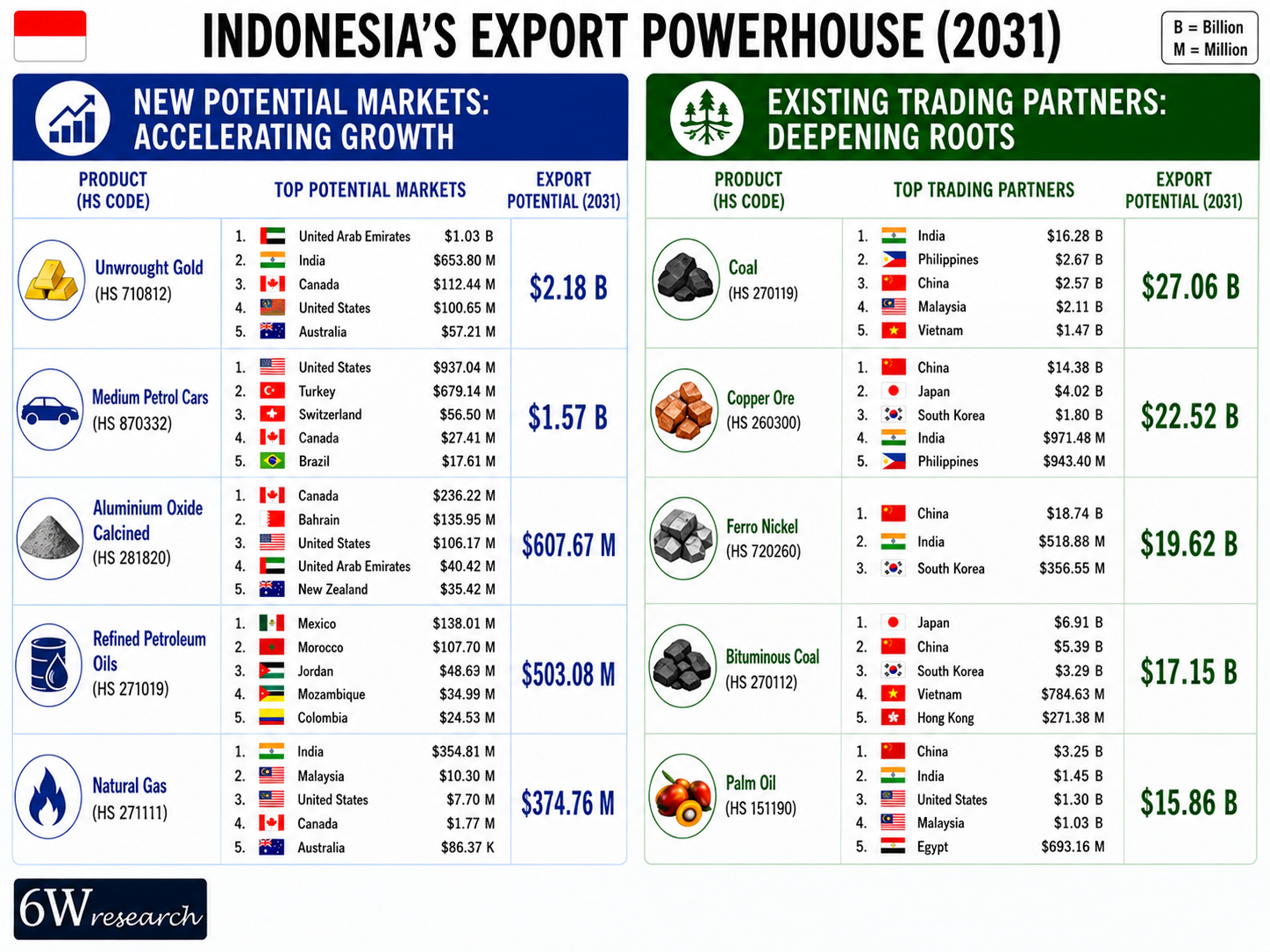
Gold, cars and fuel are where Indonesia's next buyers are showing up. While Indonesia currently has minimal trade with these countries for example, Unwrought Gold with the UAE, or Medium Petrol Cars with the United States analysis by 6WExportGTM, a part of 6Wresearch, shows substantial untapped export opportunities projected to emerge by 2031, creating significant scope for market diversification.
Unwrought Gold tops the list of emerging opportunities, offering a combined potential of USD 2.18 billion by 2031. The United Arab Emirates is the standout at USD 1.03 billion, followed closely by India at USD 853.80 million together the two markets account for the vast majority of this opportunity with Canada (USD 112.44 million), the United States (USD 100.65 million) and Australia (USD 57.21 million) contributing smaller volumes. Notably, this new gold-export opportunity isn't emerging in isolation: in March 2025, President Prabowo Subianto inaugurated Freeport Indonesia's precious metal refining plant in Gresik, East Java a facility with capacity to process up to 52 tons of gold per year from copper-smelting byproducts, giving Indonesia the domestic refining capacity to actually supply the new buyers this data points to.
Medium Petrol Cars add a further USD 1.57 billion, led by the United States (USD 937.04 million) and Turkey (USD 479.14 million); Aluminum Oxide Calcined contributes USD 607.67 million, led by Canada (USD 236.22 million) and Bahrain (USD 135.55 million); Refined Petroleum Oils add USD 503.08 million in new-market potential, led by Mexico (USD 136.01 million) and Morocco (USD 107.70 million); and Natural Gas closes out the list at USD 374.76 million, almost entirely concentrated in a single new buyer India, at USD 354.81 million.
From Coal to Ferro Nickel: Indonesia’s Highest-Value Export Opportunities
Coal, copper ore, ferro nickel, palm oil and lignite represent Indonesia's highest-value future export potential by 2031, reflecting an economy still fundamentally built on resource extraction and first-stage processing. Projections indicate massive long-term potential, led by India across coal (USD 16.28 billion) and China across copper ore (USD 14.38 billion), ferro nickel (USD 18.74 billion) and lignite (USD 12.91 billion), alongside substantial growth opportunities across the Philippines, South Korea and Malaysia.
Coal remains Indonesia's single largest opportunity. Total potential is estimated at USD 27.06 billion by 2031, led overwhelmingly by India at USD 16.28 billion more than half of the entire product opportunity followed by the Philippines (USD 2.67 billion), China (USD 2.57 billion), Malaysia (USD 2.11 billion) and Vietnam (USD 1.47 billion). Copper Ore adds a further USD 22.52 billion, led by China (USD 14.38 billion) and Japan (USD 4.02 billion) demand that Indonesia is actively building capacity to capture: Freeport Indonesia's USD 3.7 billion Manyar smelter in Gresik, which processes up to 1.7 million tonnes of copper concentrate annually, is targeted to resume production in September 2026 after a period of reduced output, directly expanding the domestic processing base behind this export potential.
Ferro Nickel contributes USD 19.62 billion, almost entirely concentrated in China (USD 18.74 billion) a reminder of how tightly Indonesia's nickel-processing trade is bound to a single buyer with India (USD 518.88 million) and South Korea (USD 356.55 million) a distant second and third. Palm Oil adds USD 15.86 billion, led by China (USD 3.25 billion) and India (USD 1.45 billion), though this figure sits against a backdrop of rising domestic consumption: Indonesia's B40 biodiesel mandate, in effect since January 2025, already diverts a growing share of crude palm oil into domestic fuel blending, with a further move to B50 under active consideration for 2026 a policy that could tighten export availability even as new demand emerges abroad. Lignite closes out the core list at USD 12.91 billion, sold almost entirely to a single buyer, China.
|
Indonesia's strongest export priorities remain coal, copper ore and ferro nickel into China, supported by growing coal demand from India, and a widening palm oil footprint across China, India and the United States. |
Betting the Mine on the Battery: Indonesia's Downstream Gamble
Indonesia's export future hinges on a single strategic wager: converting its dominant position in raw nickel and coal into a durable role in the global EV battery supply chain, before the world's demand for both shifts under its feet. Ferro nickel alone is worth USD 19.62 billion of Indonesia's 2031 export potential, almost entirely concentrated in China and the country's long-standing ban on unprocessed ore exports has already forced the build-out of a genuine domestic processing base, with 49 Rotary Kiln Electric Furnace smelters operating by 2025, turning raw nickel ore into nickel pig iron, ferronickel, nickel matte and increasingly, battery-grade nickel sulphate.
This bet is now being scaled aggressively, and it isn't limited to nickel. In June 2026, Indonesia's Ministry of Down Streaming and Investment pitched an estimated USD 121 billion in investment opportunities to build a fully integrated national EV battery ecosystem, building on deals like South Korean battery maker EcoPro's USD 967 million nickel smelter expansion. Copper and gold are following the same down streaming playbook Freeport's USD 3.7 billion Manyar smelter and its new Gresik gold-refining plant are proof the model extends beyond nickel. However, the strategy carries significant and widely acknowledged risks. Throughout 2026, sudden mining quota reductions, changes to export levies, and regulatory reversals have unsettled investors—most notably around CATL's USD 6 billion integrated nickel-to-battery complex. At the same time, the global EV market's growing preference for lower-cost, nickel-free lithium iron phosphate (LFP) batteries could weaken long-term demand for the nickel-based battery chemistries that underpin Indonesia's downstream industrial strategy.
|
Indonesia has already won the hard part building 49 smelters and forcing the world to process nickel on its terms. The open question now is whether that processing base can move fast enough into battery-grade materials before the market's own chemistry preferences shift away from nickel entirely. Manish Pant, Senior Data Scientist, Data Science & Market Intelligence, 6Wresearch |
|
With ferro nickel exports still 96% dependent on a single buyer, Indonesia's USD 121 billion battery ambitions are as much a diversification story as a down streaming one the country needs new customers for its processed nickel almost as urgently as it needs new processing capacity. Manisha Gupta, Data Analyst, Data Science & Market Intelligence, 6Wresearch |
Indonesia's next wave of export growth will come from executing its nickel-to-battery down streaming strategy while actively diversifying its buyer base beyond China using coal's continued strength in India, copper's demand in Japan, and its newly online gold-refining capacity as bridges to fund the transition, rather than betting the entire strategy on nickel-based EV chemistries alone.
Top Global Export Opportunities (2031), By Product
| Product | Export Opportunity (USD Billion) |
| Electronic Integrated Circuits | 685.7 |
| Refined Petroleum Oils | 668.4 |
| Light Petroleum Oils | 588.9 |
| Logic Electronic Integrated Circuits | 507.9 |
| Medicines | 381.2 |
| Gasoline Passenger Cars (1.5–3.0L) | 360.9 |
| Smartphones | 343.6 |
| Electronic integrated circuits with memory | 333.2 |
| Data Transmission Equipment | 216.9 |
| Immunological Products | 209.6 |
Excludes naturally occurring products (e.g., crude oil, raw gold). Source: 6WExportGTM
Globally, the largest export opportunities beyond naturally occurring products are concentrated in electronics, energy and pharmaceuticals highlighting the growing dominance of semiconductors, advanced manufacturing and high-value technology products in global trade. Japan already sits inside several of these categories, but its real priority through 2031 is defending semiconductor-equipment leadership, stabilizing its auto industry through a difficult transition, and using energy and metals diversification to reduce the geopolitical exposure that comes with a resource-poor, trade-dependent economy.
The Foundation: What's Already Paying the Bills
A handful of established sectors, supported by scaled mining and agricultural production capacity, underpin Indonesia's current trade base. Coal leads at USD 39.45 billion, split out by coal(Non-Agglomerated) (57.07%) and bituminous coal (19.87%). Iron & Steel follows at USD 27.04 billion, almost entirely driven by ferro nickel (51.99%), while Oilseeds contributes USD 22.63 billion, led by palm oil (76.58%) and crude palm oil (12%).
| Sector | Exports (USD Billion) | Leading Products / Share |
| Coal | 39.45 | Coal (Non-Agglomerated) (57.07%), Bituminous Coal (19.87%) |
| Iron & Steel | 27.04 | Ferro Nickel (51.99%), Stainless Steel sheets ( 7.79%) |
| Oilseeds | 22.63 | Palm Oil (76.58%), Crude Palm Oil (12%) |
Source: UN Comtrade
By trading value, three markets stand out. China leads at USD 62.73 billion, led by ferro nickel (21.14% share) and lignite (11.43%). The United States follows at USD 26.59 billion, led by palm oil (4.89%) and electrical processing machines (3.63%). Japan rounds out the top three at USD 20.71 billion, led by bituminous coal (14.17%) and Liquified Natural Gas (LNG) (9.75%) confirming that Indonesia's three largest trading relationships are all fundamentally resource-led.
| Country | Exports (USD Billion) | Leading Products / Share |
| China | 62.73 | Ferro Nickel (21.14%), Lignite (11.43%) |
| United States | 26.59 | Palm Oil (4.89%), Electrical Processing Machines (3.63%) |
| Japan | 20.71 | Bituminous Coal (14.17%), Liquified Natural Gas (LNG) (9.75%) |
Source: UN Comtrade
So, Where Does This Leave Indonesia?
Indonesia's next export wave will be won or lost on execution of a single strategic bet: whether its nickel-processing base already built out across 49 smelters and drawing an estimated USD 121 billion in prospective EV battery investment can move up the value chain into battery-grade materials before global demand chemistry shifts toward nickel-free alternatives. That same down streaming playbook is already spreading to copper (Freeport's USD 3.7 billion Manyar smelter, restarting September 2026) and gold (a new 52-tonne-per-year refining plant in Gresik), while palm oil faces its own domestic-versus-export tension as the B40, and potentially B50, biodiesel mandate absorbs cruder palm oil at home. The fundamentals remain resource-heavy and China-concentrated: coal, copper ore and ferro nickel together account for over USD 69 billion of 2031 potential, with ferro nickel alone 96% dependent on a single buyer. The playbook is twofold: accelerate downstream diversification into battery materials while actively courting new nickel and copper buyers beyond China, because that dual-track approach more than any single new corridor is where the next USD 22.1 billion in untapped potential will actually be won. A detailed tariff and regulatory-measures analysis for Indonesia's key corridors will follow in a subsequent update.

Leadership Perspectives from Industry Events
Search
6Wresearch in the News
 Forbes
Citing 6Wresearch analytics to map global infrastructure and pharmaceutical industry trajectories.
 Bloomberg Law
Direct syndication of 6Wresearch's macro data points, capturing complex supply chain shifts.
 Reuters
Tracking industrial manufacturing adjustments and electronic security ecosystem scaling.
 Mint
Mint
Utilizing deep-tech sector market sizing to analyze global automation and robotics.
 The Economic Times
Anchoring features on industrial IoT growth metrics and connected smart-grid devices.
 Business Standard
Featuring strategic evaluations of Advanced Driver Assistance Systems (ADAS) and AI road safety.
 The Hindu
Spotlighting core commercial metrics ranging from unmanned aerial vehicles (UAVs) to consumer durables.
 Financial Express
Anchoring quarterly reviews on cross-border real estate tech and structural hardware manufacturing.
 Yahoo Finance
Syndicating the tracker's $30.1 billion untapped-market findings, spotlighting Japan, the US and China as India's top new-potential importers.
 India Today
Carrying the release on smartphones leading India's export potential to $94 billion by 2031, per 6WExportGTM data.
 Dailyhunt
Distributing the tracker findings to its regional readership, framing India's export diversification into Japan and Mexico.
 PR Newswire Original release
Publishing the full India Export Attractiveness Tracker 2026, detailing new trade corridors across iron ore, LCVs and pharmaceuticals.
 The Industrial
Highlighting the tracker's read on India's semiconductor ambitions and long-term chip-assembly export potential.
 PTI News
Reporting on the $66.81 billion pharmaceuticals export opportunity flagged in the tracker, amid looming US generic-drug tariffs.
 Tribune India
Covering the tracker's tariff-versus-regulation analysis across India's mature export markets in the US, China and UAE.
 ANI News
Amplifying the report's findings on polished diamonds, refined petroleum and medicines as India's core export engines.
 International Business Magazine
Covering the report's insight into how AEB, blind spot detection, and driver monitoring are reshaping India's ADAS market.
 Focus Gaming News
Highlighting the research forecast for Egypt's gambling market, projecting steady growth through 2032.
Thought Leadership and Analyst Meet





Our Clients








Latest Reports
- Peru Holistic Health Market (2026-2032)
- Pakistan Holistic Health Market (2026-2032)
- Oman Holistic Health Market (2026-2032)
- Nigeria Holistic Health Market (2026-2032)
- Nepal Holistic Health Market (2026-2032)
- Myanmar Holistic Health Market (2026-2032)
- Morocco Holistic Health Market (2026-2032)
- Mexico Holistic Health Market (2026-2032)
- Malaysia Holistic Health Market (2026-2032)
- Lebanon Holistic Health Market (2026-2032)
Industry Events and Analyst Meet

EV India Expo 2026

HIMTEX 2026

India Refining Summit 2026

India EV Show 2026

EV tech India Expo 2026
Whitepaper
- Middle East & Africa Commercial Security Market Click here to view more.
- Middle East & Africa Fire Safety Systems & Equipment Market Click here to view more.
- GCC Drone Market Click here to view more.
- Middle East Lighting Fixture Market Click here to view more.
- GCC Physical & Perimeter Security Market Click here to view more.


