Israel's Electronic Integrated Circuit Exports to Existing Partners Could Reach USD 36.70 Billion, While Optical Devices Open USD 151.61 Million Across New Markets by 2031
Israel's export potential leans heavily on China, which accounts for 34.65% of total export potential, followed by the United States at 15.51% and Hong Kong at 12.16% — a mix largely shaped by semiconductor and diamond trade. The picture looks noticeably more spread out on the emerging side, though. Mexico leads there at 13.63%, with China following at 10.67%, and real momentum also building across India, Japan, and other regional markets. This shift points to a genuine opportunity for Israel to move beyond its traditional trading partners through technology-driven and higher-value exports, even as it continues to navigate the ongoing challenges facing its diamond sector.
Source: 6WExportGTM
Mexico Leads a Far More Fragmented New-Corridor Field Than Israel's China-Dominated Established Trade
When it comes to new export corridors, Israel's biggest opportunities are spread across Mexico, China, India, Japan, and Hong Kong — together representing a meaningful pool of untapped potential in emerging trade channels. Mexico comes out on top with export potential of USD 0.55 billion, driven mainly by opportunities in advanced manufacturing, electronics, and industrial goods. China follows at USD 0.43 billion, underpinned by demand for high-value Israeli technology, chemicals, and specialised products. India represents a further USD 0.28 billion of opportunity, reflecting deepening bilateral trade across technology, agriculture, and industrial solutions. Japan and Hong Kong round things out at USD 0.23 billion and USD 0.21 billion respectively, pointing to additional openings across Asia-Pacific markets where demand for innovation-driven products and specialty exports remains strong.
| Top 5 Existing Importers | Export Potential (USD Billion) | Top 5 New Potential Importers | Export Potential (USD Billion) |
| China | 23.03 | Mexico | 0.55 |
| United States | 10.31 | China | 0.43 |
| Hong Kong | 8.08 | India | 0.28 |
| Singapore | 3.79 | Japan | 0.23 |
| South Korea | 3.62 | Hong Kong | 0.21 |
Source: 6WExportGTM
Israel's established export base is still fairly concentrated, clustered mainly around a handful of major global trade hubs. China sits well out in front at USD 23.03 billion, with the United States following at USD 10.31 billion. Hong Kong comes in third among existing destinations at USD 8.08 billion, which tracks given its long-running role as a hub for electronics and diamond trading. Behind that, Singapore and South Korea account for USD 3.79 billion and USD 3.62 billion respectively, both driven largely by steady demand for Israeli semiconductors, advanced technology, chemicals, and industrial goods. What this really shows is how deeply Israel is already woven into Asian manufacturing ecosystems and global tech supply chains, especially at the higher-value end of the export mix.
Optical Instruments to Mexico and a New Regional Electronics Corridor Headline Israel's New-Corridor Opportunities
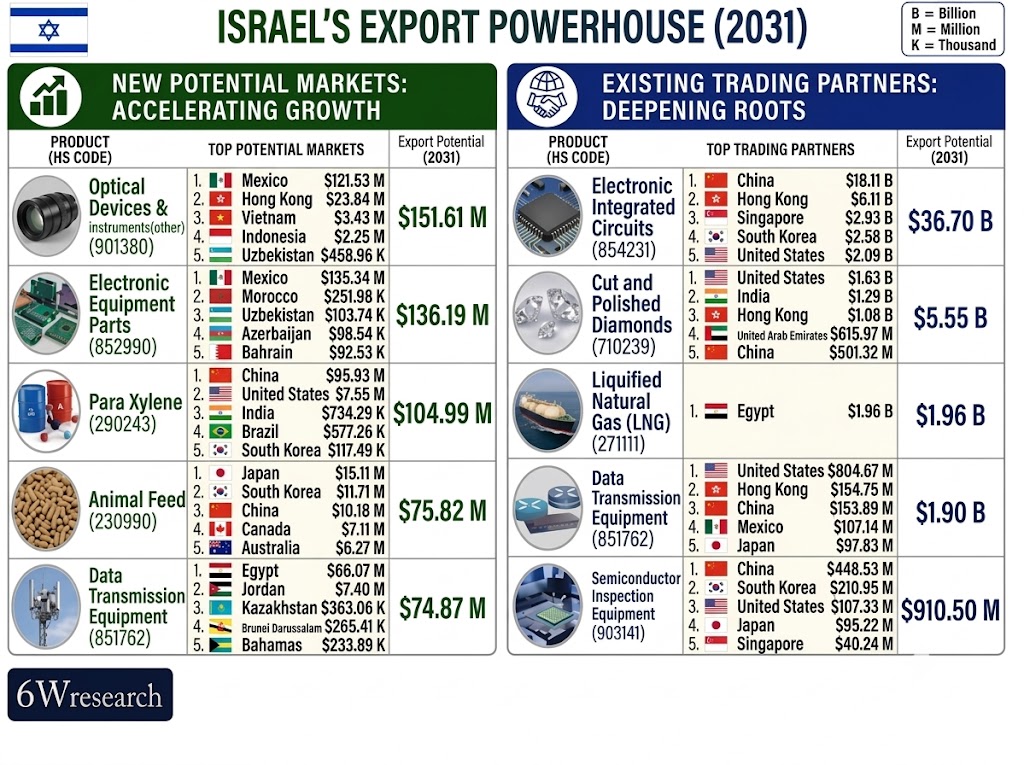
Optical devices and other instruments are the leading new-corridor product at USD 151.61 million, overwhelmingly led by Mexico at USD 121.53 million, with Hong Kong (USD 23.84 million) and Vietnam (USD 3.43 million) a distant second and third. Mexico's dominance likely reflects its role as a major North American-facing manufacturing and assembly hub, where Israeli precision-optics and instrumentation components feed into finished devices destined for the US market under nearshoring-driven supply chains; Hong Kong's smaller share reflects its function as a regional trading and re-export gateway, while Vietnam's presence points to Israeli optics components entering Southeast Asian electronics assembly lines.
Electronic equipment parts and para xylene together represent US$241.18 million in new export potential for Israel. Electronic equipment parts contribute US$136.19 million, with nearly the entire opportunity concentrated in Mexico (US$135.34 million), highlighting Mexico’s role as a major manufacturing and electronics assembly hub linked to North American supply chains. Para xylene accounts for US$104.99 million, led by China (US$95.93 million) due to its large polyester and PTA manufacturing sector, where para xylene is a key raw material, while the United States represents a smaller secondary opportunity at US$7.55 million.
Animal feed and data transmission equipment round out Israel's top five new export opportunities. Animal feed represents US$75.82 million in potential, spread across Japan at US$15.11 million, South Korea at US$11.71 million, and China at US$10.18 million — demand here is largely coming from East Asia's sizeable livestock and aquaculture industries, which need more advanced feed solutions and additives than they're currently getting locally. Data transmission equipment accounts for US$74.87 million, and this one's much more concentrated, with Egypt driving the bulk of it at US$66.07 million, followed by Jordan at US$7.40 million — a reflection of ongoing telecom infrastructure buildout and Israel's strong trade ties in the region. Put together, these findings point to two broader trends worth noting: Mexico establishing itself as a manufacturing hub for Israeli technology exports, and steadily growing demand across both Asian markets and neighbouring Middle Eastern countries for more specialised, higher-value products.
Semiconductors and Diamonds Remain the Foundation of Israel's East-Asia-Anchored Established Trade
Electronic integrated circuits represent Israel's largest established export opportunity at USD 36.70 billion, led by China at USD 18.11 billion, Hong Kong at USD 6.11 billion and Singapore at USD 2.93 billion. China's overwhelming share reflects its position as the world's largest electronics-assembly and semiconductor-packaging hub, absorbing chips produced by Israel's Intel, Tower Semiconductor and Nvidia-Mellanox operations, with South Korea and the United States rounding out a genuinely global buyer base.
Cut and polished diamonds and liquefied natural gas add a further USD 5.55 billion and USD 1.96 billion. Diamonds are led by the United States at USD 1.63 billion and India at USD 1.29 billion, reflecting deep US consumer demand alongside India's role as the global center of diamond cutting and polishing at Surat. LNG is sold entirely to Egypt, reflecting Israel's regional pipeline gas-export relationship built around the Leviathan and Tamar fields.
Data transmission equipment and semiconductor inspection equipment complete the established top five, contributing USD 1.90 billion and USD 910.50 million. Data transmission equipment is led by the United States at USD 804.67 million and Hong Kong at USD 154.75 million. Semiconductor inspection equipment, produced by Israeli firms with deep expertise in chip-testing technology, is led by China at USD 448.53 million and South Korea at USD 210.95 million, both major chip-fabrication economies. Collectively, these five products confirm that Israel's established export advantage rests overwhelmingly on a globally significant semiconductor cluster, with diamonds and regional gas exports providing genuine, if much smaller, secondary pillars.
|
Israel's export base is a story of extreme concentration in a narrow, high-value technology cluster, with China absorbing more than a third of established trade almost entirely through semiconductor exports. The new-corridor analysis looks like a different country altogether: far more fragmented, led by a new Mexican manufacturing relationship rather than deepening the China-and-diamonds identity that defines established trade. 6WExportGTM Analysis |
Top Global Export Opportunities (2031), By Product
| Product | Export Opportunity (USD Billion) |
| Electronic Integrated Circuits | 685.7 |
| Refined Petroleum Oils | 668.4 |
| Light Petroleum Oils | 588.9 |
| Logic Electronic Integrated Circuits | 507.9 |
| Medicines | 381.2 |
| Gasoline Passenger Cars (1.5–3.0L) | 360.9 |
| Smartphones | 343.6 |
| Electronic Integrated Circuits with Memory | 333.2 |
| Data Transmission Equipment | 216.9 |
| Immunological Products | 209.6 |
Excludes naturally occurring products (e.g., crude oil, raw gold). Source: 6WExportGTM
The global export landscape in 2031 is projected to be heavily influenced by high-value, technology-driven sectors, with the combined categories of electronic integrated circuits and logic chips representing an immense aggregate opportunity. This major global trend coincides with Israel’s current competitive advantages as Electronic Integrated Circuits is not only the world’s leading opportunity, but also Israel’s number one export product. Similarly, Data Transmission Equipments are identified as a critical growth area, highlighting that Israel is not just embedded in mature markets but is also successfully diversifying, having already established a massive multibillion dollar export base while cultivating crucial new potential markets in regions such as Egypt to secure its future global influence.
A Resilient Chip Sector and a Diamond Industry in Crisis: Two Developments Shaping Israel's Export Base
Two key developments are shaping Israel’s export landscape: the semiconductor sector has demonstrated strong resilience despite ongoing regional conflicts, although growth remains concentrated among a limited number of major companies, while the diamond-trading industry has experienced a significant decline, leading to a structural shift in one of Israel’s largest traditional export categories.
Israel's Semiconductor Sector Has Proven Resilient Through the War, but Export Strength Is Increasingly Concentrated in a Handful of Firms
Israel's high-tech sector recorded roughly USD 85 billion in exports in 2025, alongside USD 84 billion in exits and nearly USD 15 billion in capital raised, despite the period coinciding with major regional war, and tech employment surpassed 600,000 workers in the first quarter of 2026, a 7% increase even as a full month of renewed conflict continued. Exports of computers, electronic and optical equipment rose from USD 15 billion in 2021 to USD 18.1 billion in 2025, the only major Israeli export category to grow consistently through three years of war, while high-tech remains the sole Israeli sector still running a trade surplus, a narrow USD 2.2 billion, against a record USD 30.9 billion industrial trade deficit overall. That resilience, however, is narrowly concentrated: Israel's semiconductor cluster, anchored by Intel's Kiryat Gat fabrication plant, Nvidia's Mellanox operations and Tower Semiconductor, drives almost all of this growth, meaning record chip imports of processing equipment and wafers move in near lockstep with record chip exports. For an established electronic-integrated-circuits base worth USD 36.70 billion, this means Israel's overall trade performance now depends less on the breadth of its tech sector than on the continued expansion of a small number of global semiconductor companies.
|
Israel’s export growth is increasingly dependent on its semiconductor ecosystem, which has remained resilient during conflict but is concentrated among a few major players, creating long-term dependency risks. Manish Pant, Senior Data Scientist, Data Science & Market Intelligence, 6Wresearch |
Israel's Diamond Trade Has Collapsed to a Historic Low, With the Exchange President Resigning Amid Dubai Competition and New US Tariffs
Israel's cumulative diamond exports fell to just USD 2.4 billion in the first half of 2026, described by the Diamond Controller's Office as the lowest figure in the industry's history, with gross polished exports down 22% year-on-year to USD 1.77 billion and rough exports down 34% to just over USD 200 million. The total diamond trade, including imports of rough diamonds, is currently some USD 4 billion, down from around USD 12 billion in the boom years of the industry. Polished exports alone account for less than a third of the sector’s 2015 peak of USD 7 billion. Israel Diamond Exchange President Nissim Zuaretz announced his resignation in July 2026, citing Israeli tax policy that has seen companies and workers move to Dubai, which gives great incentives to investors, as well as a new 10% US tariff, competition from lab-grown diamonds and weaker global demand after a 13% fall in De Beers’ 2025 sales. For an established cut-and-polished-diamond trade worth USD 5.55 billion and led by the United States at USD 1.63 billion, the new US tariff lands directly on Israel's single largest diamond market, compounding a structural decline that Diamond Controller Natalie Gutman said has left trade volumes at just one-third of what they were a decade ago.
|
Israel’s diamond sector is undergoing a structural decline due to shifting global demand, rising competition from lab-grown diamonds, and cost pressures, reducing its role as a major contributor to the country’s traditional export base. Manisha Gupta, Data Analyst, Data Science & Market Intelligence, 6Wresearch |
The Takeaway
Israel should treat its export outlook through 2031 as one of managing a genuine two-speed economy, since its semiconductor sector continues to post record exports even through years of war, while its historic diamond-trading industry is collapsing to levels not seen in decades. The path forward depends on addressing the tax and competitiveness pressures pushing diamond trade toward Dubai, while recognizing that continued tech-sector strength depends on the fortunes of a small number of global semiconductor firms rather than a broad-based technology export base.
Key strategic priorities for Israel include:
- Address the tax and competitiveness gap driving diamond trade to Dubai: Israel's diamond exports have fallen to a historic low of USD 2.4 billion in the first half of 2026, and the exchange president has been fairly direct about why — citing tax-policy disadvantages relative to Dubai and Belgium. That's a signal worth taking seriously. Israel needs to reassess its diamond-sector tax regime with some urgency, before more of what is still an established USD 5.55 billion trade category continues shifting away to more competitive jurisdictions.
- Diversify the semiconductor export base beyond a handful of anchor firms: With Intel, Nvidia's Mellanox unit and Tower Semiconductor driving almost all of Israel's high-tech export growth, and an established electronic-integrated-circuits base worth USD 36.70 billion, Israel should support a broader base of semiconductor and adjacent technology firms to reduce dependence on a small number of global companies' investment decisions.
- Build on the New Mexico-anchored electronics and optical-instruments relationship: Mexico leads Israel's entire new-corridor category at 13.63% of the total, driven by optical devices and electronic equipment parts with no real established-trade precedent. Israel should formalize this relationship through direct trade and investment agreements, potentially linked to North American nearshoring trends.
- Expand the regional Middle East electronics corridor with Egypt and Jordan: Data transmission equipment reaching Egypt and Jordan represents a genuinely distinct new-corridor relationship from the established, US-and-Asia-led version of the same product. Israel should continue building on regional trade normalization to grow this corridor as a complement to its dominant East Asian tech relationships.
Overall, Israel's export growth through 2031 will depend on managing two very different trajectories at once, a resilient but narrowly concentrated semiconductor sector and a historically depressed diamond-trading industry a reminder that even a highly diversified, technologically advanced economy like Israel's can carry genuine structural vulnerability in specific, longstanding export categories.

Leadership Perspectives from Industry Events
Search
6Wresearch in the News
 Forbes
Citing 6Wresearch analytics to map global infrastructure and pharmaceutical industry trajectories.
 Bloomberg Law
Direct syndication of 6Wresearch's macro data points, capturing complex supply chain shifts.
 Reuters
Tracking industrial manufacturing adjustments and electronic security ecosystem scaling.
 Mint
Mint
Utilizing deep-tech sector market sizing to analyze global automation and robotics.
 The Economic Times
Anchoring features on industrial IoT growth metrics and connected smart-grid devices.
 Business Standard
Featuring strategic evaluations of Advanced Driver Assistance Systems (ADAS) and AI road safety.
 The Hindu
Spotlighting core commercial metrics ranging from unmanned aerial vehicles (UAVs) to consumer durables.
 Financial Express
Anchoring quarterly reviews on cross-border real estate tech and structural hardware manufacturing.
 Yahoo Finance
Syndicating the tracker's $30.1 billion untapped-market findings, spotlighting Japan, the US and China as India's top new-potential importers.
 India Today
Carrying the release on smartphones leading India's export potential to $94 billion by 2031, per 6WExportGTM data.
 Dailyhunt
Distributing the tracker findings to its regional readership, framing India's export diversification into Japan and Mexico.
 PR Newswire Original release
Publishing the full India Export Attractiveness Tracker 2026, detailing new trade corridors across iron ore, LCVs and pharmaceuticals.
 The Industrial
Highlighting the tracker's read on India's semiconductor ambitions and long-term chip-assembly export potential.
 PTI News
Reporting on the $66.81 billion pharmaceuticals export opportunity flagged in the tracker, amid looming US generic-drug tariffs.
 Tribune India
Covering the tracker's tariff-versus-regulation analysis across India's mature export markets in the US, China and UAE.
 ANI News
Amplifying the report's findings on polished diamonds, refined petroleum and medicines as India's core export engines.
 International Business Magazine
Covering the report's insight into how AEB, blind spot detection, and driver monitoring are reshaping India's ADAS market.
 Focus Gaming News
Highlighting the research forecast for Egypt's gambling market, projecting steady growth through 2032.
Thought Leadership and Analyst Meet





Our Clients








Latest Reports
- Austria X-ray Imaging Devices Market (2026-2032)
- Armenia X-ray Imaging Devices Market (2026-2032)
- Antigua and Barbuda X-ray Imaging Devices Market (2026-2032)
- Angola X-ray Imaging Devices Market (2026-2032)
- Andorra X-ray Imaging Devices Market (2026-2032)
- Albania X-ray Imaging Devices Market (2026-2032)
- Afghanistan X-ray Imaging Devices Market (2026-2032)
- United States (US) X-ray Imaging Devices Market (2026-2032)
- United Kingdom (UK) X-ray Imaging Devices Market (2026-2032)
- United Arab Emirates (UAE) X-ray Imaging Devices Market (2026-2032)
Industry Events and Analyst Meet

EV India Expo 2026

HIMTEX 2026

India Refining Summit 2026

India EV Show 2026

EV tech India Expo 2026
Whitepaper
- Middle East & Africa Commercial Security Market Click here to view more.
- Middle East & Africa Fire Safety Systems & Equipment Market Click here to view more.
- GCC Drone Market Click here to view more.
- Middle East Lighting Fixture Market Click here to view more.
- GCC Physical & Perimeter Security Market Click here to view more.


