Mozambique's Titanium Ore Exports to Existing Partners Could Reach USD 1.38 Billion, While Liquefied Natural Gas Opens USD 2.06 Billion Across New Markets by 2031
China leads Mozambique's established export base at 28.82% of total export potential, with India close behind at 23.51%. New potential markets shift the order, though only modestly: Japan takes the top spot at 20.85%, followed by China at 17.05% and Switzerland at 15.90%, with Turkey and South Korea rounding out a top five that is far more evenly spread than in most markets in this series. Titanium ore, coal and electricity anchor Mozambique's established trade, while a far larger liquefied natural gas opportunity nearly doubles the size of the entire established export base's largest category, highlighting new-corridor Mozambique export potential tied closely to the fate of a long-delayed offshore gas megaproject.
 Source: 6WExportGTM
Japan Edges Ahead of China and Switzerland in Far More Evenly Balanced New Potential Markets
Mozambique’s new export opportunities through 2031 are led by Japan, with USD 1.20 billion in potential, followed by China at USD 0.98 billion and Switzerland at USD 0.91 billion. Turkey and South Korea add another USD 0.76 billion and USD 0.56 billion, respectively. The mix highlights strong diversification potential across Asian and European markets, supported by Mozambique’s resource-rich export base, including energy, minerals and agricultural commodities, and provides scope to reduce dependence on a limited set of traditional buyers.
| Top 5 Existing Leading Importers | Export Potential (USD Billion) | Top 5 New Potential Importers | Export Potential (USD Billion) |
| China | 1.73 | Japan | 1.20 |
| India | 1.41 | China | 0.98 |
| Japan | 0.55 | Switzerland | 0.91 |
| Zimbabwe | 0.50 | Turkey | 0.76 |
| United States | 0.40 | South Korea | 0.56 |
Source: 6WExportGTM
China holds USD 1.73 billion of Mozambique's established export potential, narrowly ahead of India at USD 1.41 billion. Japan ranks third at USD 0.55 billion, with Zimbabwe and the United States contributing USD 0.50 billion and USD 0.40 billion. Zimbabwe's presence in the established top five is notable and reflects Mozambique's regional role as an electricity exporter to landlocked and power-constrained neighbors, a genuinely different relationship from the mineral and coal trade that dominates China's and India's demand.
A Long-Delayed LNG Megaproject Anchors an Otherwise Diverse Set of New Potential Market Opportunities
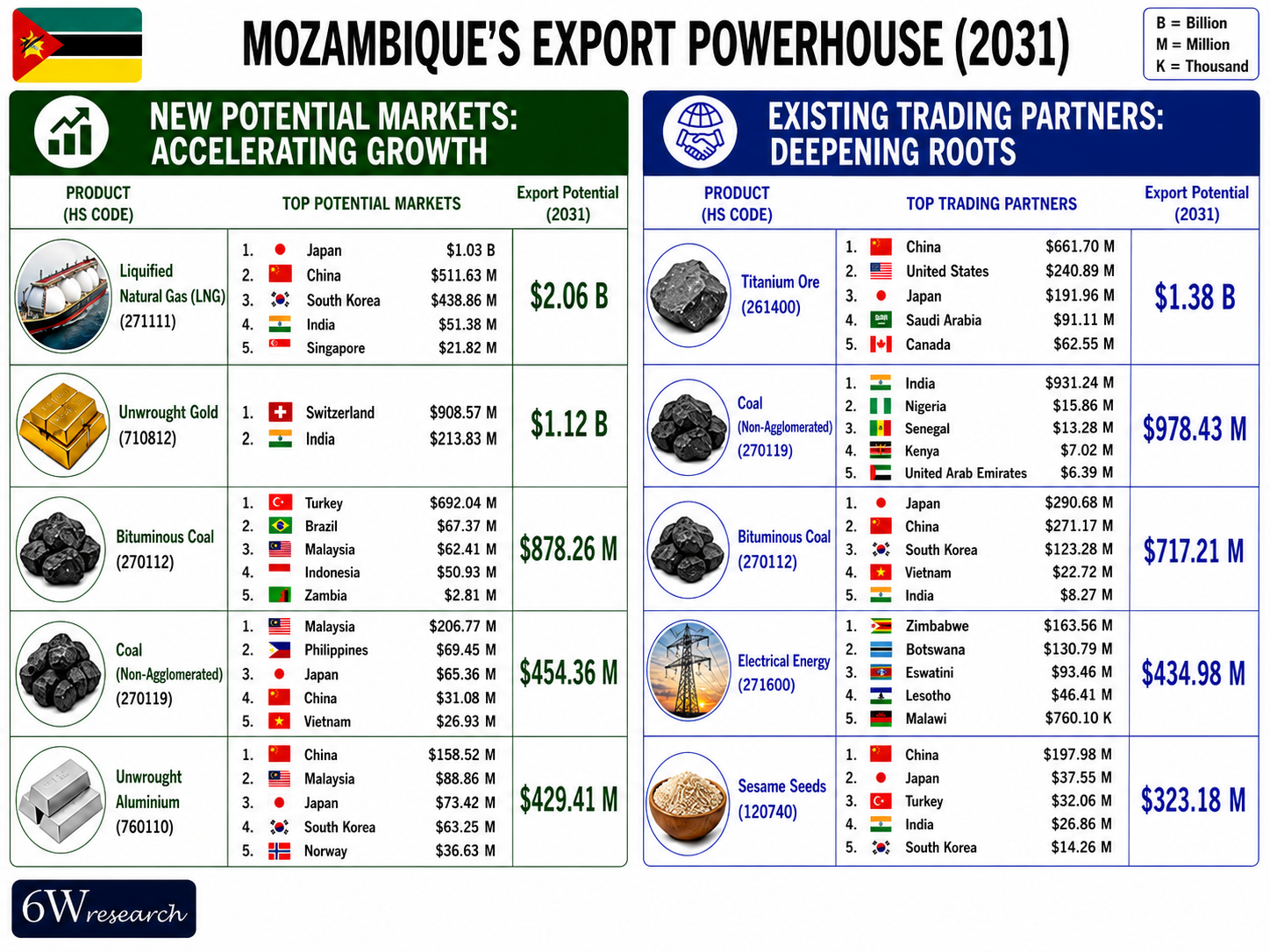
Liquefied natural gas represents Mozambique's largest new-corridor opportunity by a wide margin at USD 2.06 billion, led by Japan at USD 1.03 billion, China at USD 0.51 billion and South Korea at USD 0.44 billion, with India and Singapore contributing smaller volumes. This buyer base of major Northeast Asian LNG importers is consistent with global gas demand patterns generally, but the category's actual realization depends heavily on offshore production capacity that has been delayed for years by security disruptions in northern Mozambique which is a genuine, unresolved risk.
Unwrought gold and a second wave of bituminous coal add a further USD 1.12 billion and USD 0.88 billion. Gold is led overwhelmingly by Switzerland at USD 0.91 billion, with India providing a smaller secondary volume, consistent with Switzerland's established role as a global bullion-refining and trading hub. New-market bituminous coal is led by Turkey at USD 0.69 billion, followed by Brazil, Malaysia and Indonesia, extending a coal-export category where Mozambique already trades at large scale in established markets.
Non-agglomerated coal and unwrought aluminum round out the new-corridor top five. New-market coal contributes USD 0.45 billion, led by Malaysia at USD 0.21 billion, followed by the Philippines, Japan and China. Unwrought aluminum adds USD 0.43 billion, led by China at USD 0.16 billion and Malaysia at USD 0.09 billion, extending Mozambique's Mozal smelter output into new Asian buyers beyond its established markets. Overall, Mozambique's 2031 new-corridor potential is genuinely diverse across energy, precious metals, coal and aluminum, though its single largest number depends on one long-delayed gas project delivering as planned.
Titanium, Coal and Electricity Remain the Foundation of Mozambique's Established Trade
Titanium ore represents Mozambique's largest established export opportunity at USD 1.38 billion, led by China at USD 0.66 billion and the United States at USD 0.24 billion, followed by Japan, Saudi Arabia and Canada. This genuinely global, high-value buyer base reflects Mozambique's position as home to one of the world's largest titanium-minerals mines, supplying feedstock that ultimately reaches pigment, aerospace and specialty-alloy manufacturers well beyond any single regional market.
Non-agglomerated coal and bituminous coal add a further USD 0.98 billion and USD 0.72 billion. Non-agglomerated coal is led overwhelmingly by India at USD 0.93 billion, with Nigeria, Senegal, Kenya and the UAE splitting a small remainder, reflecting a deep, long-standing thermal-coal relationship with Indian power generators. Bituminous coal is led by Japan at USD 0.29 billion and China at USD 0.27 billion, followed by South Korea, Vietnam and India a more genuinely Asian-diversified buyer base than the India-dominated non-agglomerated coal category.
Electrical energy and sesame seeds complete the established top five. Electrical energy contributes USD 0.43 billion, sold to Zimbabwe, Botswana, Eswatini, Lesotho and Malawi entirely regional demand reflecting Mozambique's hydropower generation capacity at the Cahora Bassa dam supplying power-constrained Southern African neighbors. Sesame seeds add USD 0.32 billion, led by China at USD 0.20 billion and Japan at USD 0.04 billion, followed by Turkey, India and South Korea. Collectively, these five categories confirm that Mozambique's established export base rests on three structural pillars heavy-mineral mining, coal exports and regional hydropower each serving a genuinely different set of buyers.
|
Mozambique’s export outlook reflects a country with established strengths across minerals, coal and electricity, while its growth trajectory through 2031 could be shaped significantly by one critical factor: whether its long-delayed offshore LNG capacity comes on stream as planned. 6WExportGTM Analysis |
Top Global Export Opportunities (2031), By Product
| Product | Export Opportunity (USD Billion) |
| Electronic Integrated Circuits | 685.7 |
| Refined Petroleum Oils | 668.4 |
| Light Petroleum Oils | 588.9 |
| Logic Electronic Integrated Circuits | 507.9 |
| Medicines | 381.2 |
| Gasoline Passenger Cars (1.5–3.0L) | 360.9 |
| Smartphones | 343.6 |
| Electronic Integrated Circuits with Memory | 333.2 |
| Data Transmission Equipment | 216.9 |
| Immunological Products | 209.6 |
Excludes naturally occurring products (e.g., crude oil, raw gold). Source: 6WExportGTM
Globally, the largest export opportunities through 2031 are concentrated in electronics, refined energy products, pharmaceuticals and advanced manufacturing. However, Mozambique’s best near-term prospects lie in building on its existing strengths in energy and minerals and resource-based industries, rather than attempting to compete in technology-intensive sectors like semiconductors and automotive manufacturing. According to 6WExportGTM, a part of 6Wresearch, Mozambique should focus on expanding domestic processing, strengthening value addition in mineral and energy exports, and gradually building industrial capabilities that can support broader participation in global value chains.
What Mozambique Already Sells and Where
Oil and gas forms Mozambique's largest established trade sector at USD 2.14 billion, led by liquefied petroleum gas at USD 1.43 billion and a 66.63% share, followed by LNG at USD 0.54 billion and a 25.21% share. Coal ranks second at USD 2.01 billion, with non-agglomerated coal contributing USD 1.75 billion and an 87.10% share, while coke and semi-coke add USD 0.26 billion and 12.78%. Aluminum products follow at USD 1.28 billion, led by unwrought aluminum at USD 1.12 billion and an 86.87% share, with aluminum wire adding USD 0.16 billion and 12.41% together confirming Mozambique's manufacturing and extraction base spans gas processing, coal mining and aluminum smelting.
| Sector | Exports (USD Billion) | Leading Products / Share |
| Oil & Gas | 2.14 | Liquefied Petroleum Gas (66.63%), LNG (25.21%) |
| Coal | 2.01 | Coal, Non-Agglomerated (87.10%), Coke and Semi-Coke (12.78%) |
| Aluminum Products | 1.28 | Unwrought Aluminum (86.87%), Aluminum Wire (12.41%) |
Source: UN Comtrade
India is Mozambique's largest destination market at USD 1.47 billion, led by non-agglomerated coal at 50.64% of exports to the country and liquefied petroleum gas at 16.21%. China ranks second at USD 1.35 billion, with LNG contributing 23.12% and LPG 19.21%. South Africa follows at USD 1.21 billion, supported by electrical energy at 34.48% and LPG at 32.37% a distinctly regional, energy-focused trade relationship. This partner mix shows Mozambique's exports split between deep coal and gas relationships with India and China and a genuinely regional electricity and fuel trade with South Africa.
| Country | Exports (USD Billion) | Leading Products / Share |
| India | 1.47 | Coal, Non-Agglomerated (50.64%), Liquefied Petroleum Gas (16.21%) |
| China | 1.35 | LNG (23.12%), Liquefied Petroleum Gas (19.21%) |
| South Africa | 1.21 | Electrical Energy (34.48%), Liquefied Petroleum Gas (32.37%) |
Source: UN Comtrade
An LNG Restart and a Titanium Mine's Steady Hand: Two Developments Shaping Mozambique's Export Base
Two developments now underway help explain Mozambique’s export outlook: TotalEnergies’ formal restart of the long-delayed Mozambique LNG Area 1 project, which supports the country’s largest new-corridor opportunity, and Kenmare Resources’ steady but market-constrained performance at the Moma titanium mine, which underpins Mozambique’s largest established export category.
TotalEnergies' Mozambique LNG Restart the Single Most Consequential Development
Mozambique's LNG export potential is being reshaped by the formal restart of TotalEnergies' roughly USD 20.5 billion Mozambique LNG Area 1 project in Cabo Delgado. The company lifted its force majeure on November 7, 2025 and announced the full resumption of onshore and offshore activities on January 29, 2026, nearly five years after a deadly insurgent attack on the nearby town of Palma forced a complete construction halt in 2021. More than 4,000 workers, over 80% of them Mozambican, are now mobilized at the Afungi site, with the project roughly 40% complete and first LNG now targeted for 2029 a significant slip from the original pre-suspension timeline. Parallel projects are advancing too, including ExxonMobil's USD 24 billion Rovuma LNG development and Eni's USD 7.2 billion Coral Norte project, pointing to a broader wave of Mozambican gas investment. Security in Cabo Delgado has improved with the support of Rwandan and SADC forces, but isolated insurgent activity persists, and the project's own backers acknowledge that renewed violence remains the central risk to the 2029 timeline. For a new-corridor LNG opportunity worth USD 2.06 billion this restart is a genuine milestone, but one still riding on a security situation that has already derailed the project once.
|
Mozambique's LNG export potential through 2031 hinges almost entirely on whether Cabo Delgado's security holds through construction the restart itself is real progress, but the same risk that halted the project in 2021 has not disappeared, only receded for now. Manish Pant, Senior Data Scientist, Data Science & Market Intelligence, 6Wresearch |
Kenmare's Moma Mine Keeps Shipments on Track Despite Soft Titanium Prices and a Pending Fiscal Renewal
Mozambique's titanium-ore export position is being sustained by steady, if unspectacular, performance at Kenmare Resources' Moma mine, which accounts for roughly 6% of global titanium-mineral supply and a similar share of Mozambique's exports. First-half 2026 shipments reached 556,000 tons, keeping the company on track for annual guidance of more than 1.1 million tons, even as ilmenite prices softened and the commissioning of an upgraded processing plant ran behind schedule. Kenmare has continued constructive but unresolved negotiations with the Mozambican government over renewing Moma's Implementation Agreement, the framework governing the fiscal and regulatory terms of the mine's operations, while also securing a USD 30 million upsize to its credit facility to maintain financial flexibility through the current period of weak market pricing. For an established titanium-ore category’s export potential worth USD 1.38 billion and reaching buyers as far afield as the United States, Saudi Arabia and Canada, Moma's ability to keep shipments on guidance despite soft prices supports the case that the underlying resource and buyer relationships remain sound, even as the mine's long-term fiscal terms stay unsettled.
|
Mozambique's titanium exports through 2031 look operationally secure at Moma, but the unresolved renewal of the mine's Implementation Agreement is worth watching, since fiscal-term uncertainty can weigh on investment decisions even when shipment volumes themselves are holding up. Manisha Gupta, Data Analyst, Data Science & Market Intelligence, 6Wresearch |
The Takeaway
Mozambique should treat the coming years as decisive for its long-term export trajectory, since the country's single largest opportunity LNG depends on a mega-project whose timeline has already slipped once due to security conditions that have only partially stabilized. The path forward requires balancing continued support for the Cabo Delgado restart with steady stewardship of the mining and coal sectors that already generate reliable, diversified established export revenue.
Key strategic priorities for Mozambique include:
- Treat Cabo Delgado security as the central variable determining LNG's 2029 timeline: With USD 2.06 billion in new potential markets’ LNG potential and a further USD 0.54 billion in established LNG trade support the Area 1 restart. Construction should be used to prioritize sustained security cooperation with Rwandan and SADC forces; the clearest risk to the 2029 first-gas target is renewed insurgent activity.
- Resolve Moma's Implementation Agreement renewal to protect Mozambique's largest established category: Titanium ore generates USD 1.38 billion in established export potential and Kenmare have maintained shipments on track at 556,000 tonnes in H1 2026 despite soft pricing. Mozambique should move toward a timely resolution of the mine's fiscal-terms renewal to avoid adding regulatory uncertainty on top of already-challenging market conditions.
- Sustain the regional electricity relationship as a stable, lower-risk export category: Electrical energy exports to Zimbabwe, Botswana, Eswatini and Lesotho generate USD 0.43 billion in established potential, entirely regional and not exposed to the same global-price volatility as coal, gas or titanium. Mozambique should continue investing in Cahora Bassa's generation and transmission capacity to protect this diversified, lower-risk revenue stream.
- Build formal relationships with Switzerland's bullion market rather than treating gold flows as incidental: Switzerland leads new-corridor gold demand at USD 0.91 billion, reflecting Mozambique's mineral output reaching global bullion-trading markets. Mozambique should pursue more direct commercial relationships with Swiss refiners and traders to convert this concentrated flow into a durable, higher-value export relationshi
Overall, Mozambique's export growth through 2031 will be defined more than anything by whether the Mozambique LNG restart holds through construction, while titanium, coal and regional electricity continue providing a genuinely diversified, if individually smaller, foundation of established export revenue.

Leadership Perspectives from Industry Events
Search
6Wresearch in the News
 Forbes
Citing 6Wresearch analytics to map global infrastructure and pharmaceutical industry trajectories.
 Bloomberg Law
Direct syndication of 6Wresearch's macro data points, capturing complex supply chain shifts.
 Reuters
Tracking industrial manufacturing adjustments and electronic security ecosystem scaling.
 Mint
Mint
Utilizing deep-tech sector market sizing to analyze global automation and robotics.
 The Economic Times
Anchoring features on industrial IoT growth metrics and connected smart-grid devices.
 Business Standard
Featuring strategic evaluations of Advanced Driver Assistance Systems (ADAS) and AI road safety.
 The Hindu
Spotlighting core commercial metrics ranging from unmanned aerial vehicles (UAVs) to consumer durables.
 Financial Express
Anchoring quarterly reviews on cross-border real estate tech and structural hardware manufacturing.
 Yahoo Finance
Syndicating the tracker's $30.1 billion untapped-market findings, spotlighting Japan, the US and China as India's top new-potential importers.
 India Today
Carrying the release on smartphones leading India's export potential to $94 billion by 2031, per 6WExportGTM data.
 Dailyhunt
Distributing the tracker findings to its regional readership, framing India's export diversification into Japan and Mexico.
 PR Newswire Original release
Publishing the full India Export Attractiveness Tracker 2026, detailing new trade corridors across iron ore, LCVs and pharmaceuticals.
 The Industrial
Highlighting the tracker's read on India's semiconductor ambitions and long-term chip-assembly export potential.
 PTI News
Reporting on the $66.81 billion pharmaceuticals export opportunity flagged in the tracker, amid looming US generic-drug tariffs.
 Tribune India
Covering the tracker's tariff-versus-regulation analysis across India's mature export markets in the US, China and UAE.
 ANI News
Amplifying the report's findings on polished diamonds, refined petroleum and medicines as India's core export engines.
 International Business Magazine
Covering the report's insight into how AEB, blind spot detection, and driver monitoring are reshaping India's ADAS market.
 Focus Gaming News
Highlighting the research forecast for Egypt's gambling market, projecting steady growth through 2032.
Thought Leadership and Analyst Meet





Our Clients








Latest Reports
- Poland Engine Ignition Components Market (2026-2032)
- Peru Engine Ignition Components Market (2026-2032)
- Pakistan Engine Ignition Components Market (2026-2032)
- Oman Engine Ignition Components Market (2026-2032)
- Nigeria Engine Ignition Components Market (2026-2032)
- Nepal Engine Ignition Components Market (2026-2032)
- Myanmar Engine Ignition Components Market (2026-2032)
- Morocco Engine Ignition Components Market (2026-2032)
- Mexico Engine Ignition Components Market (2026-2032)
- Malaysia Engine Ignition Components Market (2026-2032)
Industry Events and Analyst Meet

EV India Expo 2026

HIMTEX 2026

India Refining Summit 2026

India EV Show 2026

EV tech India Expo 2026
Whitepaper
- Middle East & Africa Commercial Security Market Click here to view more.
- Middle East & Africa Fire Safety Systems & Equipment Market Click here to view more.
- GCC Drone Market Click here to view more.
- Middle East Lighting Fixture Market Click here to view more.
- GCC Physical & Perimeter Security Market Click here to view more.


