New Zealand's Milk and Cream Powder Exports to Existing Partners Could Reach USD 4.20 Billion, While Unwrought Gold Opens USD 1.84 Billion Across New Markets by 2031
China leads New Zealand export potential at 32.39% in total, more than triple the United States' 17.90% in second place. New-corridor markets shift the leader entirely: Switzerland tops the list at 20.31%, driven almost solely by gold, with China still a strong second at 16.41%. Dairy products, forestry and meat anchor New Zealand's established trade, reflecting its position as the world's largest dairy exporter, while gold a category New Zealand is not traditionally known for, headlines a new-corridor opportunity nearly.
 Source: 6WExportGTM
Switzerland Overtakes the Established China-Led Order to Lead New Zealand's New-Corridor Potential
Switzerland leads New Zealand's new potential importers at USD 1.31 billion, narrowly ahead of China at USD 1.06 billion. The United States ranks third at USD 0.56 billion, followed by Japan at USD 0.32 billion and Mexico at USD 0.27 billion. Switzerland's position is driven almost entirely by gold, consistent with its established role as a global bullion-refining and trading center rather than any broader commercial relationship with New Zealand. China's continued strong presence in second place, underscores just how central Chinese demand is to New Zealand's overall export outlook.
| Top 5 Existing Importers | Export Potential (USD Billion) | Top 5 New Potential Importers | Export Potential (USD Billion) |
| China | 12.52 | Switzerland | 1.31 |
| United States | 6.92 | China | 1.06 |
| Japan | 2.28 | United States | 0.56 |
| South Korea | 2.13 | Japan | 0.32 |
| Australia | 1.37 | Mexico | 0.27 |
Source: 6WExportGTM
China accounts for USD 12.52 billion of New Zealand's established export potential, more than the next four markets combined. The United States follows at USD 6.92 billion, with Japan, South Korea and Australia rounding out the top five at USD 2.28 billion, USD 2.13 billion and USD 1.37 billion. This concentration reflects Chinese demand spanning dairy, forestry, beef and lamb simultaneously, while the United States, Japan, South Korea and Australia each draw on a narrower slice of New Zealand's agricultural and horticultural exports.
An Emerging Gold Corridor and Niche Food Exports Define New Zealand's Newest Opportunities
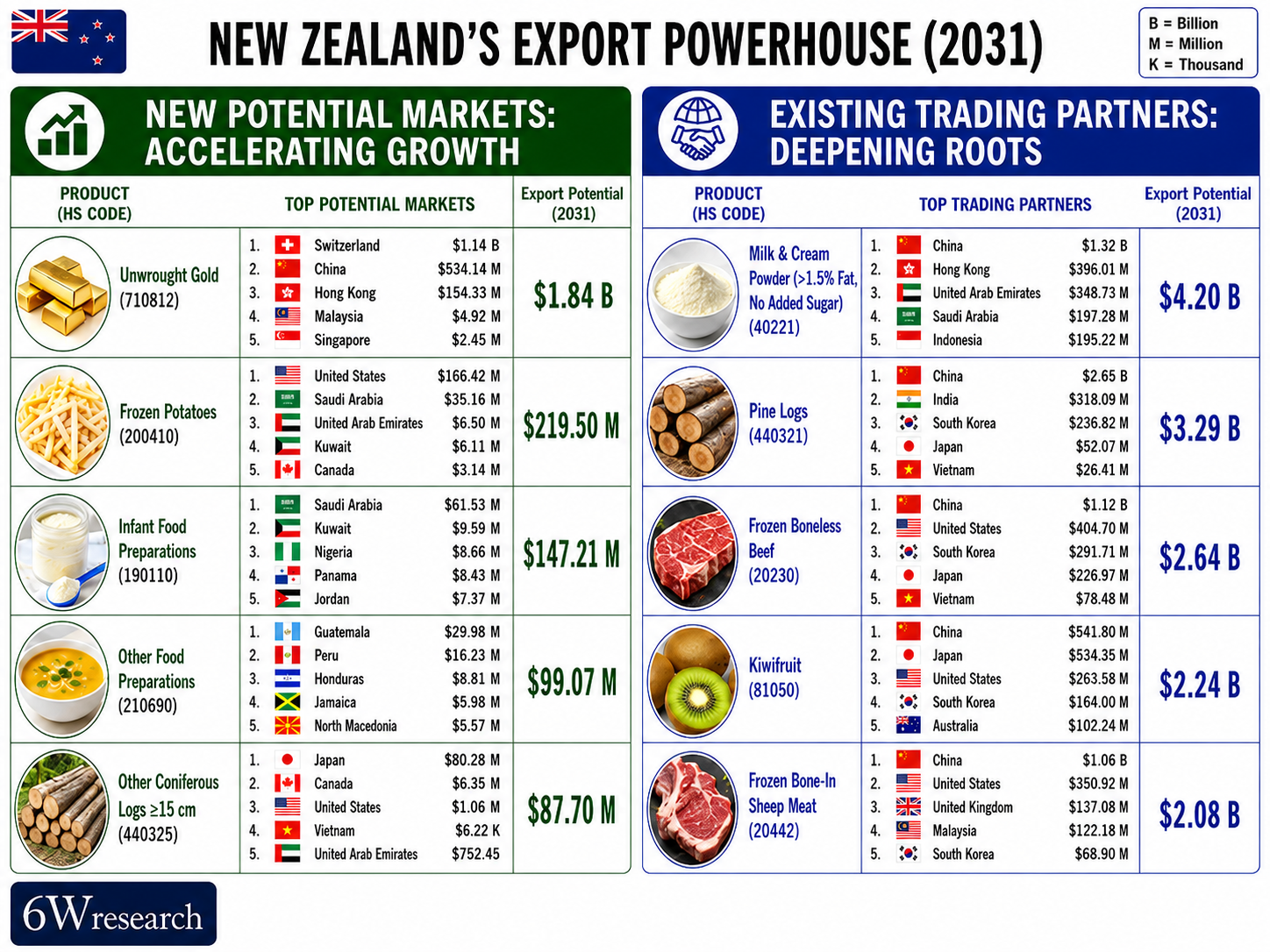
Unwrought gold represents New Zealand’s largest new-corridor opportunity at USD 1.84 billion, led by Switzerland at USD 1.14 billion and China at USD 534.14 million, with Hong Kong, Malaysia, and Singapore contributing additional opportunities. The scale of this potential highlights New Zealand’s growing ability to participate in international precious-metals trade, supported by its established domestic gold-mining base, including OceanaGold’s Macraes and Waihi operations, as well as broader refining, processing, and trading activities. Together, these strengths position New Zealand to capture a larger share of high-value gold flows across both established financial hubs and emerging Asian markets.
Frozen potatoes and infant food preparations add a further USD 219.49 million and USD 147.21 million. Frozen potatoes are led by the United States at USD 166.42 million and Saudi Arabia at USD 35.16 million, extending New Zealand's processed-food export base into new markets. Infant food preparations are led by Saudi Arabia at USD 61.53 million, followed by Kuwait, Nigeria, Panama and Jordan a genuinely global, if individually small, spread of buyers for New Zealand's dairy-based infant nutrition products.
Other food preparations and coniferous logs round out the new-market top five at USD 99.07 million and USD 87.70 million. Other food preparations are led by Guatemala, Peru and Honduras an unusually Latin American-weighted buyer base for a New Zealand export category. Coniferous logs are led almost entirely by Japan, extending New Zealand's established forestry trade into a market beyond its dominant Chinese buyer. Overall, New Zealand's 2031 new-corridor potential is dominated by the gold opportunity, with food and forestry categories offering smaller, more incremental gains.
Dairy, Forestry and Meat Remain the Foundation of New Zealand's Established Export Base
Milk and cream powder represent New Zealand's largest established export opportunity at USD 4.20 billion, led by China at USD 1.32 billion and Hong Kong at USD 396.01 million, followed by the UAE, Saudi Arabia and Indonesia. This globally diversified buyer base reflects New Zealand's position as the world's largest dairy exporter, anchored by Fonterra's cooperative supply chain reaching mature and emerging markets across Asia and the Middle East alike.
Pine logs and frozen boneless beef add a further USD 3.29 billion and USD 2.64 billion. Pine logs are led overwhelmingly by China at USD 2.65 billion, with India, South Korea, Japan and Vietnam trailing far behind, reflecting New Zealand's plantation-forestry industry feeding Chinese construction and processing demand almost exclusively. Frozen boneless beef is led by China at USD 1.12 billion and the United States at USD 404.70 million, followed by South Korea, Japan and Vietnam, showing a more genuinely diversified buyer base than the log trade.
Kiwifruit and frozen bone-in sheep meat complete the established top five. Kiwifruit contributes USD 2.24 billion, led almost evenly by China at USD 541.80 million and Japan at USD 0534.35 million, followed by the United States, South Korea and Australia, reflecting Zespri's globally coordinated marketing and distribution of New Zealand-grown fruit. Frozen bone-in sheep meat adds USD 2.08 billion, led by China at USD 1.06 billion and the United States at USD 350.92 million, followed by the United Kingdom, Malaysia and South Korea. Collectively, New Zealand’s established export advantage rests overwhelmingly on its agricultural and forestry comparative strengths, with China serving as a key destination across several major categories, particularly dairy and forestry, alongside significant demand from the United States, Japan and other major markets.
|
New Zealand's export edge continues to rest on genuine agricultural comparative advantage dairy, forestry, meat and fruit production built on some of the world's most productive pastoral land. That strength comes with real concentration risk, given how dominant Chinese demand is across nearly every established category, even as a fast-emerging gold corridor to Switzerland points to a genuinely different kind of new-market opportunity. 6WExportGTM Analysis |
Top Global Export Opportunities (2031), By Product
| Product | Export Opportunity (USD Billion) |
| Electronic Integrated Circuits | 685.7 |
| Refined Petroleum Oils | 668.4 |
| Light Petroleum Oils | 588.9 |
| Logic Electronic Integrated Circuits | 507.9 |
| Medicines | 381.2 |
| Gasoline Passenger Cars (1.5–3.0L) | 360.9 |
| Smartphones | 343.6 |
| Electronic Integrated Circuits with Memory | 333.2 |
| Data Transmission Equipment | 216.9 |
| Immunological Products | 209.6 |
Excludes naturally occurring products (e.g., crude oil, raw gold). Source: 6WExportGTM
For New Zealand, the global opportunity landscape is dominated by sectors such as electronic integrated circuits, refined petroleum products, medicines and automobiles, which are not the country’s primary export strengths. Among these, medicines and immunological products, with global opportunities of USD 381.2 billion and USD 209.6 billion, offer the most relevant diversification potential through New Zealand’s life-sciences and healthcare capabilities. However, the country’s stronger near-term export prospects remain concentrated in high-value food, dairy, meat, horticulture and forestry products, suggesting that future growth will be driven more by value addition within established primary-sector strengths than by large-scale entry into electronics or automotive manufacturing.
New Zealand’s Current Export Strengths and Key Markets
Dairy products form New Zealand's largest established trade sector at USD 12.15 billion, led by milk and cream powder at 38.46% share, followed by butter at14.16% share. Animal products rank second at USD 5.94 billion, with frozen boneless beef contributing 34.19% share, while frozen bone-in sheep meat adds a share of 22.98%. Food preparations follow at USD 2.98 billion, led by infant food preparations 41.30% share, with other food preparations adding 24.15% together confirming that New Zealand's manufacturing base is overwhelmingly built around processing its own pastoral and agricultural output.
| Sector | Exports (USD Billion) | Leading Products / Share |
| Dairy Products | 12.15 | Milk & Cream Powder (38.46%), Butter (14.16%) |
| Animal Products | 5.94 | Frozen Boneless Beef (34.19%), Frozen Bone-In Sheep Meat (22.98%) |
| Food Preparations | 2.98 | Infant Food Preparations (41.30%), Other Food Preparations (24.15%) |
Source: UN Comtrade
China is New Zealand's largest destination market at USD 10.74 billion, led by pine logs at 12.85% of exports to the country and milk and cream powder at 12.49% a relationship spanning both forestry and dairy. The United States ranks second at USD 5.43 billion, with frozen boneless beef contributing 18.46% and whey products 6.28%. Australia follows closely at USD 5.35 billion, supported by unwrought gold at 8.47% and other food preparations at 4.14% the gold share here consistent with the broader new-corridor gold trade covered above. This partner mix confirms China's outsized role across New Zealand's core commodity exports, with the United States and Australia each drawing on a narrower, more specific set of categories.
| Country | Exports (USD Billion) | Leading Products / Share |
| China | 10.74 | Pine Logs (12.85%), Milk & Cream Powder (12.49%) |
| United States | 5.43 | Frozen Boneless Beef (18.46%), Whey Products (6.28%) |
| Australia | 5.35 | Unwrought Gold (8.47%), Other Food Preparations (4.14%) |
Source: UN Comtrade
A Softening Milk Price and an Expanding Gold District: Two Developments Shaping New Zealand's Export Base
Two developments now underway help explain the figures above: Fonterra's downward revision to its milk price forecast amid softening global dairy prices, which weighs on New Zealand's largest established category, and continued expansion at OceanaGold's Waihi and Macraes operations, which reinforces the country's fast-growing new-corridor gold opportunity.
Fonterra Cuts Its Milk Price Forecast as Global Dairy Prices Soften
New Zealand’s dairy export outlook is facing near-term pricing pressure, but the underlying fundamentals remain supportive of longer-term growth. Fonterra lowered its 2026/27 farmgate milk-price forecast as stronger global milk supply and softer demand weighed on international dairy prices, including whole milk powder. However, this reflects a cyclical pricing adjustment rather than a weakening of New Zealand’s production or export capability, with dairy volumes remaining resilient and the country retaining a strong position in global milk-powder trade. Against current exports of around USD 1.38 billion, 6WExportGTM a part of 6Wreseach identifies potential for the category to reach approximately USD 4.20 billion by 2031. Achieving this potential would depend on a recovery in international prices, continued production strength, deeper penetration of Asian and emerging markets, and a greater focus on higher-value dairy products. Thus, current price weakness represents a near-term headwind rather than a contradiction to New Zealand’s longer-term export potential.
|
New Zealand's dairy export value through 2031 will depend heavily on where global milk powder prices settle after this softening the underlying production and market access remain strong, but Fonterra's own forecast cut shows the near-term price environment has genuinely turned less favorable. Manish Pant, Senior Data Scientist, Data Science & Market Intelligence, 6Wresearch |
OceanaGold's Waihi North Expansion Reinforces New Zealand's Emerging Gold Export Corridor
New Zealand’s gold export outlook is being strengthened by continued investment in domestic mining capacity, supporting the longer-term opportunity identified by 6WExportGTM a part of 6Wresearch. OceanaGold’s Macraes mine, the country’s largest active gold operation, reached cumulative production of six million ounces in July 2026, demonstrating the scale and longevity of New Zealand’s existing gold sector. At Waihi, approval of the Waihi North Project and commencement of underground development toward the high-grade Wharekirauponga deposit provide an additional pipeline for future production. Current and planned Waihi operations are expected to produce around 1.6 million ounces between 2024 and 2038, extending the district’s operating life significantly. Against this backdrop, 6WExportGTM’s estimated USD 1.84 billion opportunity across new export markets appears supported by a credible multi-year production pipeline. While some current gold trade may reflect refining or trading activity, continued mine development provides a stronger domestic production base from which New Zealand can gradually expand its gold exports.
|
New Zealand's gold export growth through 2031 looks credible but gradual OceanaGold's Waihi North project extends the country's mining pipeline by more than a decade, but first ore from the new underground mine is still years away, so near-term gold export figures will keep reflecting a mix of mining and trading activity. Manisha Gupta, Data Analyst, Data Science & Market Intelligence, 6Wresearch |
The Takeaway
New Zealand should focus on managing near-term dairy-price softness without losing sight of its underlying production strength, while supporting the multi-year gold-mining pipeline at Waihi and Macraes as a genuine, if gradual, second growth pillar. The path forward depends on maintaining Fonterra's market access and supply-chain flexibility through the current price cycle while continuing to invest in the mining capacity that will determine how much of the gold new-corridor opportunity becomes real production rather than trading flow.
Key strategic priorities for New Zealand include:
- Manage the dairy-price downturn through supply-chain flexibility rather than production cuts: With milk and cream powder worth USD 4.20 billion in established export potential and Fonterra's 2026/27 forecast cut to NZD 9.25/kgMS, the co-operative should continue using its flexible operations footprint to shift product toward the strongest available markets rather than reducing overall output in response to a single season's price softness.
- Support the Waihi North Project through its multi-year development timeline: Unwrought gold represents New Zealand’s largest new-market opportunity, with export potential projected to reach USD 1.84 billion by 2031. Continued investment in gold mining and project development, supported by OceanaGold’s expanding pipeline, could strengthen domestic production capacity and position New Zealand to capture a greater share of high-value precious-metals trade over the coming years.
- Reduce forestry's near-total dependence on a single Chinese buyer: Pine logs generate a massive revenue in established export potential, with China alone accounting for over 80% of that total. New Zealand should pursue the smaller but genuine coniferous-log relationship with Japan and other new-corridor buyers to build real diversification into its forestry-export base.
- Continue building infant-nutrition and processed-food exports into new, smaller markets: Infant food preparations and other food preparations together add USD 0.25 billion in new-corridor potential across Saudi Arabia, Kuwait, Nigeria, Guatemala and Peru. New Zealand should continue supporting this genuinely diversified, if individually small, set of buyer relationships as a complement to its core commodity trade.
Overall, New Zealand's export growth through 2031 will depend on navigating a softer near-term dairy-price cycle while continuing to invest in the multi-year gold, forestry-diversification and processed-food opportunities that offer genuine, if more gradual, paths to reducing the country's heavy reliance on a single dominant Chinese buyer relationship.

Leadership Perspectives from Industry Events
Search
6Wresearch in the News
 Forbes
Citing 6Wresearch analytics to map global infrastructure and pharmaceutical industry trajectories.
 Bloomberg Law
Direct syndication of 6Wresearch's macro data points, capturing complex supply chain shifts.
 Reuters
Tracking industrial manufacturing adjustments and electronic security ecosystem scaling.
 Mint
Mint
Utilizing deep-tech sector market sizing to analyze global automation and robotics.
 The Economic Times
Anchoring features on industrial IoT growth metrics and connected smart-grid devices.
 Business Standard
Featuring strategic evaluations of Advanced Driver Assistance Systems (ADAS) and AI road safety.
 The Hindu
Spotlighting core commercial metrics ranging from unmanned aerial vehicles (UAVs) to consumer durables.
 Financial Express
Anchoring quarterly reviews on cross-border real estate tech and structural hardware manufacturing.
 Yahoo Finance
Syndicating the tracker's $30.1 billion untapped-market findings, spotlighting Japan, the US and China as India's top new-potential importers.
 India Today
Carrying the release on smartphones leading India's export potential to $94 billion by 2031, per 6WExportGTM data.
 Dailyhunt
Distributing the tracker findings to its regional readership, framing India's export diversification into Japan and Mexico.
 PR Newswire Original release
Publishing the full India Export Attractiveness Tracker 2026, detailing new trade corridors across iron ore, LCVs and pharmaceuticals.
 The Industrial
Highlighting the tracker's read on India's semiconductor ambitions and long-term chip-assembly export potential.
 PTI News
Reporting on the $66.81 billion pharmaceuticals export opportunity flagged in the tracker, amid looming US generic-drug tariffs.
 Tribune India
Covering the tracker's tariff-versus-regulation analysis across India's mature export markets in the US, China and UAE.
 ANI News
Amplifying the report's findings on polished diamonds, refined petroleum and medicines as India's core export engines.
 International Business Magazine
Covering the report's insight into how AEB, blind spot detection, and driver monitoring are reshaping India's ADAS market.
 Focus Gaming News
Highlighting the research forecast for Egypt's gambling market, projecting steady growth through 2032.
Thought Leadership and Analyst Meet





Our Clients








Latest Reports
- Namibia Financial Asset Management Market (2026-2032)
- Mozambique Financial Asset Management Market (2026-2032)
- Montenegro Financial Asset Management Market (2026-2032)
- Mongolia Financial Asset Management Market (2026-2032)
- Monaco Financial Asset Management Market (2026-2032)
- Micronesia Financial Asset Management Market (2026-2032)
- Mauritius Financial Asset Management Market (2026-2032)
- Mauritania Financial Asset Management Market (2026-2032)
- Marshall Islands Financial Asset Management Market (2026-2032)
- Malta Financial Asset Management Market (2026-2032)
Industry Events and Analyst Meet

EV India Expo 2026

HIMTEX 2026

India Refining Summit 2026

India EV Show 2026

EV tech India Expo 2026
Whitepaper
- Middle East & Africa Commercial Security Market Click here to view more.
- Middle East & Africa Fire Safety Systems & Equipment Market Click here to view more.
- GCC Drone Market Click here to view more.
- Middle East Lighting Fixture Market Click here to view more.
- GCC Physical & Perimeter Security Market Click here to view more.


