Niger's Sesame Seed Exports to Existing Partners Could Reach USD 0.56 Billion, While Unwrought Gold Opens USD 0.70 Billion Across New Markets by 2031
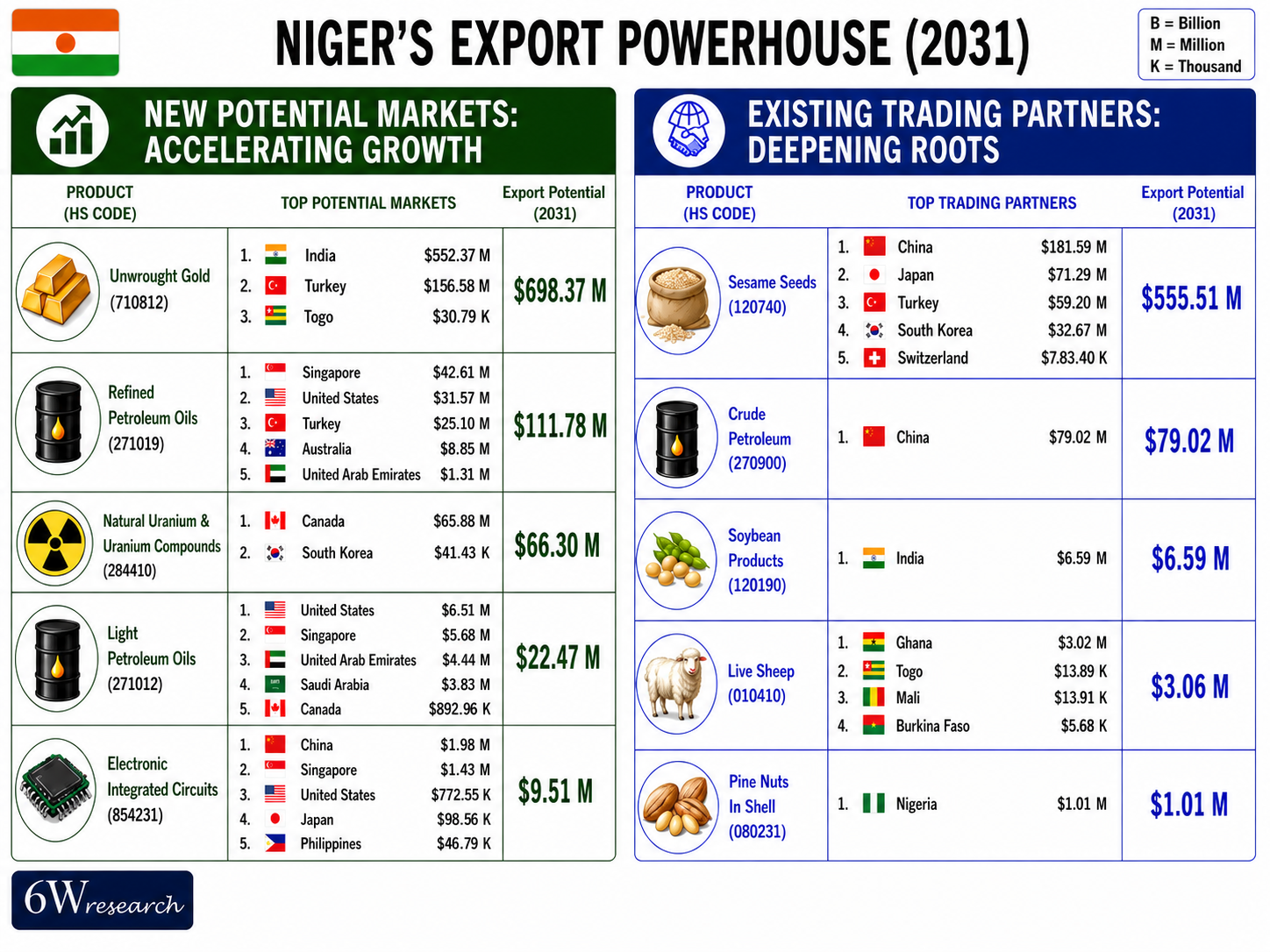
China dominates Niger’s established export base, accounting for 70.93% of total export potential, well ahead of Japan at 10.97%. The new potential market opportunities are led by India with 55.93%, followed by Turkey at 19.95%, highlighting a clear shift toward new destination markets. Niger’s export potential remains anchored by sesame seeds, crude petroleum and soybean products, largely serving Asian buyers, while future diversification is increasingly linked to gold and uranium. These new corridors also highlight the shifting geopolitical and trade relationships of Niger including its changing uranium partnerships and broader regional realignment.
 Source: 6WExportGTM
India and Turkey Replace the China-Led Order to Lead Niger's New-Corridor Potential
India is Niger’s top new potential importer through 2031 with export potential of USD 0.54 billion, backed by demand for gold, energy products and agricultural commodities. Next up is Turkey at USD 0.19 billion with opportunities related to sesame seeds and other food-processing inputs. Canada, Singapore and the United States are smaller, but strategically important, markets with cross potential in uranium, minerals, petroleum and agricultural products. Together, these markets point to a broader diversification of Niger export base beyond its traditional partners, with India and Turkey likely to drive the strongest near-term expansion.
| Top 5 Existing Leading Importers | Export Potential (USD Billion) | Top 5 New Potential Importers | Export Potential (USD Billion) |
| China | 0.46 | India | 0.54 |
| Japan | 0.07 | Turkey | 0.19 |
| Turkey | 0.07 | Canada | 0.07 |
| South Korea | 0.03 | Singapore | 0.05 |
| India | 0.01 | United States | 0.05 |
Source: 6WExportGTM
China accounts for USD 0.46 billion of Niger's established export potential, more than six times Japan's USD 0.07 billion in second place. Turkey ranks third, also at USD 0.07 billion, with South Korea and India contributing USD 0.03 billion and USD 0.01 billion. This concentration reflects Niger's dependence on a narrow sesame seed and crude oil corridor into East Asia, with Japan, Turkey, South Korea and India absorbing smaller volumes of largely the same two commodities.
A New Gold Corridor to India and Canada Anchored Uranium Relationship Headline Niger's New Potential Markets
Unwrought gold represents Niger's largest new corridor opportunity at USD 698.37 million, led by India at USD 532.37 million and Turkey at USD 165.98 million, with a residual flow to Togo. Both destinations line up with global gold-refining and bullion-trading hubs rather than end-use manufacturing, suggesting this reflects Niger's raw gold output being drawn into international refining and trading networks rather than a shift in domestic production capacity.
Refined petroleum oils add a further USD 111.78 million, spread across Singapore, the United States, Turkey, Australia and the UAE a genuinely diversified pattern more typical of re-export and bunkering flows than a single dominant buyer. Natural uranium and uranium compounds contribute USD 66.30 million, sold almost entirely to Canada at USD 65.88 million and a 99.4% share, a striking reversal for a country whose uranium industry was built over seven decades around a single French buyer.
Light petroleum oils and electronic integrated circuits round out the new corridor top five, contributing USD 22.47 million and USD 9.51 million. Light petroleum oils are led by the United States and Singapore, while integrated circuits are led by China and Singapore, both patterns more consistent with transshipment and re-export trade than domestic electronics manufacturing. Overall, Niger's 2031 new corridor potential looks considerably more diversified by geography than its established base, anchored by one large emerging gold and uranium reorientation away from the country's traditional Western partners.
Sesame Seeds and Crude Petroleum Remain the Foundation of Niger's Asia-Anchored Established Trade
Sesame seeds represent Niger's largest established export opportunity at USD 555.51 million, led by China at USD 381.59 million and Japan at USD 71.29 million, followed by Turkey, South Korea and Switzerland. This heavy concentration reflects sesame's role as Niger's leading cash crop and one of its few globally competitive agricultural exports, with East Asian buyers absorbing the overwhelming majority of volume.
Crude petroleum adds a further USD 79.02 million, sold entirely to China, reflecting Niger's still young oil export capacity centered on the Agadem field and the Niger-Benin export pipeline. Soybean products contribute USD 6.59 million, sold entirely to India both categories underscoring how narrow Niger's established export base is relative to the opportunities emerging elsewhere.
Live sheep and pine nuts in shell complete the established top five, though both are modest in scale. Live sheep exports of USD 3.06 million go almost entirely to Ghana, extending Niger's traditional regional livestock trade into neighboring West African markets, while pine nuts in shell add USD 1.01 million, sold entirely to Nigeria. Collectively, these five categories confirm that Niger's established export advantage rests overwhelmingly on two commodities sesame seeds and crude petroleum sold into a small number of Asian markets, making Chinese demand the single most consequential variable in the country's near-term export outlook.
|
Niger's export base is a story of concentrated dependence on two commodities and one dominant buyer: sesame seeds and crude petroleum, sold almost entirely into China. That concentration has been a source of stability, but it also means Niger's trajectory through 2031 will be shaped as much by Chinese demand as by anything happening inside the country's own fields and oil wells. 6WExportGTM Analysis |
Top Global Export Opportunities (2031), By Product
| Product | Export Opportunity (USD Billion) |
| Electronic Integrated Circuits | 685.7 |
| Refined Petroleum Oils | 668.4 |
| Light Petroleum Oils | 588.9 |
| Logic Electronic Integrated Circuits | 507.9 |
| Medicines | 381.2 |
| Gasoline Passenger Cars (1.5–3.0L) | 360.9 |
| Smartphones | 343.6 |
| Electronic Integrated Circuits with Memory | 333.2 |
| Data Transmission Equipment | 216.9 |
| Immunological Products | 209.6 |
Excludes naturally occurring products (e.g., crude oil, raw gold). Source: 6WExportGTM
Globally, the largest export opportunities through 2031 are concentrated in electronics, refined energy products, pharmaceuticals and advanced manufacturing. For Niger, however, the strongest near-term potential lies in sectors connected to its existing resource and agricultural base rather than technologically intensive manufacturing. According to 6WExportGTM, a part of 6Wresearch, Niger should prioritize expanding value addition in petroleum processing, agricultural products and mineral-based exports, while gradually developing domestic processing capacity and stronger trade infrastructure to reduce reliance on raw commodity exports and capture a larger share of future global demand.
What Niger Already Sells and Where
Oil & Gas forms Niger's largest established trade sector at USD 0.89 billion, led by crude petroleum at an 84.46% share, followed by refined petroleum oils at 15.43% share. Construction Machinery ranks a distant second at USD 0.02 billion, with underground boring machines contributing a 28.95% share, while mechanical excavators at 12.43%. Vegetables follow closely at USD 0.02 billion, led by onions at 62.82% share, with dried white beans and 27.44% together confirming Niger's export base spans a dominant oil-and-gas sector alongside a genuine, if still small, agricultural and machinery re-export trade.
| Sector | Exports (USD Billion) | Leading Products / Share |
| Oil & Gas | 0.89 | Crude Petroleum (84.46%), Refined Petroleum Oils (15.43%) |
| Construction Machinery | 0.02 | Underground Boring Machines (28.95%), Mechanical Excavators (12.43%) |
| Vegetables | 0.02 | Onions (62.82%), Beans Dried White (27.44%) |
Source: UN Comtrade
Singapore is Niger's largest destination market at USD 0.30 billion, driven entirely by crude petroleum. Malaysia ranks a close second at USD 0.29 billion, also almost entirely crude petroleum, while Togo follows at USD 0.09 billion, led by crude petroleum at a 79.93% share and printed matter at 6.76% a pattern that shows Niger's current oil-export capacity being absorbed almost entirely by Southeast Asian refining hubs, with a smaller volume moving through the regional Togolese corridor.
| Country | Exports (USD Billion) | Leading Products / Share |
| Singapore | 0.30 | Crude Petroleum (100.00%) |
| Malaysia | 0.29 | Crude Petroleum (100.00%) |
| Togo | 0.09 | Crude Petroleum (79.93%), Printed Matter (6.76%) |
Source: UN Comtrade
A Sahel Realignment and a Broken Uranium Partnership: Two Developments Shaping Niger's Export Base
Two developments now underway help explain the pressures and opportunities for Niger: Niger's departure from ECOWAS and the continued closure of its border with Benin, which keeps regional trade routes constrained even after the broader West African sanctions were lifted, and the collapse of Niger's decades-old uranium partnership with France, which has opened the door to new buyers such as Canada.
ECOWAS Sanctions Have Lifted, but Niger's Exit from the Bloc and the Still-Closed Benin Border Continue to Constrain Regional Trade
ECOWAS lifted the sweeping economic and border sanctions it had imposed on Niger after the July 2023 coup at an extraordinary summit in Abuja on 24 February 2024, restoring cross-border transactions, financial institution access and electricity supply from Nigeria, whose own land and air borders with Niger reopened shortly after. Niger, however, formally withdrew from ECOWAS alongside Mali and Burkina Faso to form the Alliance of Sahel States, and its border with Benin historically a key transit route for Nigerien trade, including uranium bound for the port of Cotonou remains closed on the Nigerien side more than two years after regional sanctions were lifted, a standoff estimated to cost Benin around USD 30 million a year in lost transit fees and to continue disrupting regional supply chains. For an established export opportunity worth USD 645.18 million, this partial normalization removes some of the acute disruption of 2023-24 without fully restoring Niger's traditional West African trade corridors.
|
Niger's regional trade position has only partly normalized: ECOWAS sanctions are gone, but Niger's own exit from the bloc and its refusal to reopen the Benin border show that political realignment, not just economic policy, will keep shaping the country's trade routes through 2031. Manish Pant, Senior Data Scientist, Data Science & Market Intelligence, 6Wresearch |
Niger's Uranium Partnership with France Has Collapsed, Opening an Emerging Corridor to Canada
Unlike the partial normalization of regional trade, Niger's uranium-export relationship with France has broken down entirely. Niger's military government revoked French nuclear group Orano's operating permit at the Imouraren deposit in 2024 and nationalized the Somaïr joint venture in June 2025 amid accusations of unequal profit-sharing, leaving Orano with an estimated USD 210 million in stranded assets and an ongoing ICSID arbitration case. France, which sourced roughly a fifth of its natural uranium from Niger before the 2023 coup, has effectively lost access to the supply. Into this vacuum has stepped a new set of buyers: Canada's Global Atomic is bringing its Dasa uranium project into production in early 2026, and Niger's government has separately proposed that Russia helps develop its uranium deposits, while Russian, Chinese and Middle Eastern firms are reportedly among the parties eyeing Orano's stranded Niger assets. For a new-corridor natural uranium category already worth USD 66.30 million and led almost entirely by Canada, this reorientation represents one of the most consequential shifts in Niger's entire export base a genuine change in trading partner, not merely in trade terms.
|
Niger's uranium industry shows how quickly a trade relationship built over seven decades can be replaced France's near-monopoly on Nigerien uranium has given way to a Canadian project entering production and a Russian courtship, and that reorientation looks less like a temporary disruption than a permanent redrawing of Niger's uranium map. Manisha Gupta, Data Analyst, Data Science & Market Intelligence, 6Wresearch |
The Takeaway
Niger should treat its export outlook through 2031 as one of structural reorientation rather than simple recovery, since the unwinding of ECOWAS-era sanctions has not restored the country's pre-coup trade geography, and its most valuable resource relationship uranium has moved to entirely new partners rather than returning to its historic buyer. The path forward depends on consolidating the sesame seed and crude oil trade that anchors current exports while managing a genuinely uncertain transition in gold and uranium, all while regional trade routes remain only partially restored.
Key strategic priorities for Niger include:
- Diversify the established base beyond dependence on China: Sesame seeds (USD 0.56 billion, 68.7% China) and crude petroleum (USD 0.08 billion, 100% China) together account for the overwhelming majority of Niger's USD 0.65 billion established export potential. Niger should invest in soybean products, livestock and other established categories to hedge against concentrated Chinese demand.
- Formalize new uranium buyers before Canada becomes a durable replacement for France: The new potential market natural uranium category, worth USD 0.06 billion, is now 99.4% dependent on Canada, indicating a quick pivot away from France. Niger must ensure that the Dasa project and any future Russian partnership evolve into long-term production and diversified offtake agreements, rather than simply swapping one dominant buyer for another.
- Capture more value from the gold corridor to India: Unwrought gold is Niger’s single largest new corridor opportunity at USD 0.70 billion, almost exclusively bound for India and Turkey. Niger should pursue direct trading and refining relationships rather than routing bullion through intermediary hubs, to capture more value domestically.
- Resolve the Benin border standoff to restore regional trade capacity: With ECOWAS sanctions lifted but Niger's own border with Benin still closed, Niger should prioritize a diplomatic resolution, since the Cotonou transit route is essential to both agricultural exports and the uranium trade historically routed through the port.
Overall, Niger's export growth through 2031 will depend less on any single tariff decision and more on whether the country can convert emerging relationships with India, Canada and other new partners into durable trade corridors a reminder that political rupture, as much as economic policy, is reshaping where Niger's exports go next.

Leadership Perspectives from Industry Events
Search
6Wresearch in the News
 Forbes
Citing 6Wresearch analytics to map global infrastructure and pharmaceutical industry trajectories.
 Bloomberg Law
Direct syndication of 6Wresearch's macro data points, capturing complex supply chain shifts.
 Reuters
Tracking industrial manufacturing adjustments and electronic security ecosystem scaling.
 Mint
Mint
Utilizing deep-tech sector market sizing to analyze global automation and robotics.
 The Economic Times
Anchoring features on industrial IoT growth metrics and connected smart-grid devices.
 Business Standard
Featuring strategic evaluations of Advanced Driver Assistance Systems (ADAS) and AI road safety.
 The Hindu
Spotlighting core commercial metrics ranging from unmanned aerial vehicles (UAVs) to consumer durables.
 Financial Express
Anchoring quarterly reviews on cross-border real estate tech and structural hardware manufacturing.
 Yahoo Finance
Syndicating the tracker's $30.1 billion untapped-market findings, spotlighting Japan, the US and China as India's top new-potential importers.
 India Today
Carrying the release on smartphones leading India's export potential to $94 billion by 2031, per 6WExportGTM data.
 Dailyhunt
Distributing the tracker findings to its regional readership, framing India's export diversification into Japan and Mexico.
 PR Newswire Original release
Publishing the full India Export Attractiveness Tracker 2026, detailing new trade corridors across iron ore, LCVs and pharmaceuticals.
 The Industrial
Highlighting the tracker's read on India's semiconductor ambitions and long-term chip-assembly export potential.
 PTI News
Reporting on the $66.81 billion pharmaceuticals export opportunity flagged in the tracker, amid looming US generic-drug tariffs.
 Tribune India
Covering the tracker's tariff-versus-regulation analysis across India's mature export markets in the US, China and UAE.
 ANI News
Amplifying the report's findings on polished diamonds, refined petroleum and medicines as India's core export engines.
 International Business Magazine
Covering the report's insight into how AEB, blind spot detection, and driver monitoring are reshaping India's ADAS market.
 Focus Gaming News
Highlighting the research forecast for Egypt's gambling market, projecting steady growth through 2032.
Thought Leadership and Analyst Meet





Our Clients








Latest Reports
- Poland Engine Ignition Components Market (2026-2032)
- Peru Engine Ignition Components Market (2026-2032)
- Pakistan Engine Ignition Components Market (2026-2032)
- Oman Engine Ignition Components Market (2026-2032)
- Nigeria Engine Ignition Components Market (2026-2032)
- Nepal Engine Ignition Components Market (2026-2032)
- Myanmar Engine Ignition Components Market (2026-2032)
- Morocco Engine Ignition Components Market (2026-2032)
- Mexico Engine Ignition Components Market (2026-2032)
- Malaysia Engine Ignition Components Market (2026-2032)
Industry Events and Analyst Meet

EV India Expo 2026

HIMTEX 2026

India Refining Summit 2026

India EV Show 2026

EV tech India Expo 2026
Whitepaper
- Middle East & Africa Commercial Security Market Click here to view more.
- Middle East & Africa Fire Safety Systems & Equipment Market Click here to view more.
- GCC Drone Market Click here to view more.
- Middle East Lighting Fixture Market Click here to view more.
- GCC Physical & Perimeter Security Market Click here to view more.


