Norway's Crude Petroleum Exports to Existing Partners Could Reach USD 90.14 Billion, While Liquefied Natural Gas Opens USD 4.90 Billion Across New Markets by 2031
China leads Norway’s export potential across both established and new-corridor markets, accounting for 29.62% and 24.35%, respectively. The United States remains a key established partner, while South Korea emerges as a notable new-corridor market. Norway’s export strength is anchored by crude petroleum, natural gas, salmon, cod and nickel, with future opportunities expanding into LNG and broader energy exports across Asian markets.
 Source: 6WExportGTM
China Extends Its Established Lead into Norway's New-Corridor Potential, With South Korea Overtaking the US
Norway’s new export potential is led by China at USD 7.39 billion, followed by South Korea at USD 2.95 billion and the United States at USD 2.66 billion. These markets reflect growing demand for Norway’s core strengths in energy, seafood, and industrial raw materials, including LNG, petroleum products, salmon, cod and metals. Mexico and Hong Kong, with opportunities of USD 1.95 billion and USD 1.77 billion, further expand Norway’s diversification potential across Asia and North America.
| Top 5 Existing Leading Importers | Export Potential (USD Billion) | Top 5 New Potential Importers | Export Potential (USD Billion) |
| China | 43.84 | China | 7.39 |
| United States | 41.15 | South Korea | 2.95 |
| India | 18.37 | United States | 2.66 |
| South Korea | 11.70 | Mexico | 1.95 |
| Canada | 4.88 | Hong Kong | 1.77 |
Source: 6WExportGTM
China accounts for USD 43.84 billion of Norway's established export potential, narrowly ahead of the United States at USD 41.15 billion. India ranks third at USD 18.37 billion, with South Korea and Canada rounding out the top five at USD 11.70 billion and USD 4.88 billion. This spread reflects crude-oil demand spanning the world's largest energy importers simultaneously, with India's substantial presence in the established top five reflecting its growing refining capacity absorbing Norwegian crude alongside its traditional Middle Eastern suppliers.
LNG and a Second Wave of Gas Products Define Norway's Newest Export Corridors
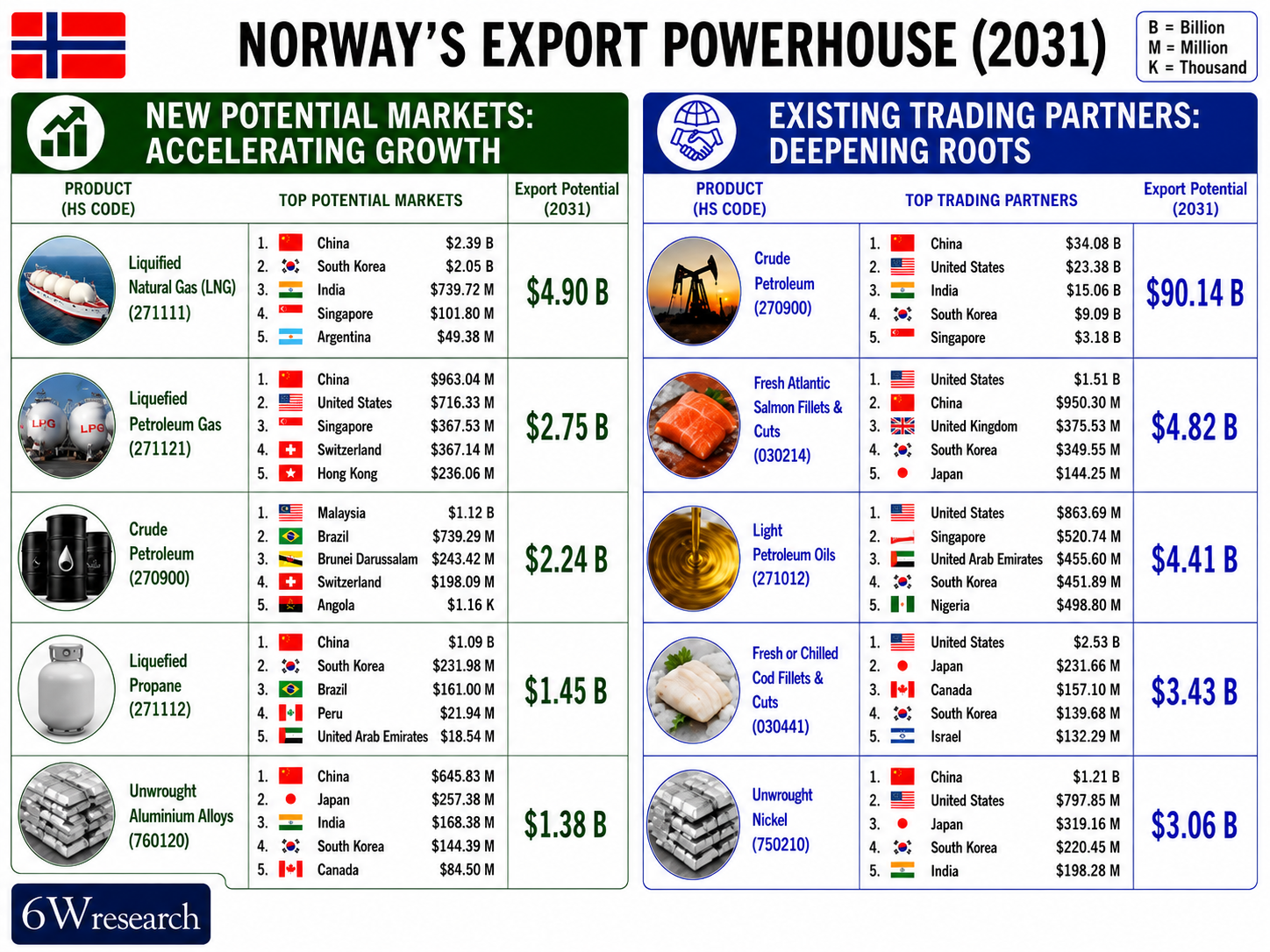
Liquefied natural gas (LNG) is Norway’s biggest opportunity in new corridors, worth $4.90 billion, with China ($2.39 billion) and South Korea ($2.05 billion) leading the way, supported by additional demand from India ($239.72 million) and other Asian markets. The opportunity shows an increasing demand for secure energy sources across Asia, where LNG remains vital to energy security, industrial development and diversification of sources of gas. With a strong background in natural gas, Norway has a good foundation to increase its role in the global LNG trade.
Liquefied petroleum gas and crude petroleum add USD 2.75 billion and USD 2.24 billion to the total, respectively. LPG opportunities are led by China at USD 963.04 million, followed by the United States at USD 716.33 million, Singapore at USD 267.53 million and Switzerland at USD 267.14 million, based on demand from petrochemical, industrial and residential energy markets. Opportunities are primarily in crude petroleum in Malaysia (USD 1.12 billion) and Brazil (USD 732.29 million) indicating the potential for Norway to diversify crude sales to emerging energy importing economies away from traditional European markets.
Liquefied propane and unwrought aluminium alloys contribute USD 1.45 billion and USD 1.38 billion, respectively. Propane opportunities in China lead at USD 1.09 billion, followed by South Korea at USD 281.98 million as demand for cleaner-burning fuels and petrochemical feedstocks grow. China (USD 645.83 million), Japan (USD 257.38 million) and India (USD 160.38 million) are leading the aluminum alloy opportunities with a strong demand from automotive, construction, renewable energy and advanced manufacturing industries. These opportunities point to Norway’s great potential to increase exports on the back of its core strengths in energy resources and low carbon industrial materials.
Oil, Salmon and Cod Define the Foundation of Norway's Established Export Base
The biggest export opportunity for Norway in 2030 is crude petroleum (USD 90.14 billion), led by China (USD 34.08 billion), the United States (USD 23.38 billion) and India (USD 15.06 billion). It demonstrates Norway’s continued position as a major global energy supplier, with Asian and North American markets seeking reliable sources of crude supply. Strong demand from China, India, South Korea and other energy importing economies strengthens Norway’s position in the global petroleum trade. China, India, South Korea and other energy-importing economies are showing strong demand, strengthening Norway's position in the global petroleum trade.
Fresh Atlantic salmon filets and cuts and light petroleum oils account for USD 4.82 billion and USD 4.41 billion respectively. The United States leads the way in salmon opportunities, with a value of USD 1.51 billion, followed by China at USD 950.30 million and the United Kingdom at USD 875.93 million. This is attributed to Norway’s globally competitive aquaculture industry and increasing demand for premium seafood. Light petroleum oils offer a diversified opportunity landscape with the United States at USD 863.09 million, Singapore at USD 510.74 million, UAE at USD 455.60 million, South Korea at USD 453.89 million and Nigeria at USD 408.80 million. This is reflecting the continuous demand for refined energy products.
Fresh or chilled cod filets and unwrought nickel were valued at USD 3.43 billion and USD 3.06 billion, respectively. The main exporter of cod is the USA at 2.53 billion USD, followed by Japan (253.06 million USD), Canada (157.10 million USD), South Korea (139.08 million USD) and Israel (132.93 million USD) due to a high demand for quality seafood. China leads nickel opportunities at USD 1.21 billion, followed by the United States at USD 767.85 million, Japan at USD 310.16 million, South Korea at USD 220.45 million and India at USD 180.28 million, reflecting growing industrial and battery-material demand. For the future, Norway’s potential exports are still focused on its core areas of energy, seafood and strategic industrial materials, with room for growth in Asia and North America.
|
Norway's export edge rests on a rare combination of scale and diversification: the North Sea's energy output has made the country Europe's most important gas supplier since Russia's invasion of Ukraine, while its aquaculture industry has simultaneously built the world's largest Atlantic salmon export business. That pairing gives Norway room to defend its dominant Chinese and American relationships while building genuinely new Asian energy corridors, even as both pillars face their own distinct policy pressures. 6WExportGTM Analysis |
Top Global Export Opportunities (2031), By Product
| Product | Export Opportunity (USD Billion) |
| Electronic Integrated Circuits | 685.7 |
| Refined Petroleum Oils | 668.4 |
| Light Petroleum Oils | 588.9 |
| Logic Electronic Integrated Circuits | 507.9 |
| Medicines | 381.2 |
| Gasoline Passenger Cars (1.5–3.0L) | 360.9 |
| Smartphones | 343.6 |
| Electronic Integrated Circuits with Memory | 333.2 |
| Data Transmission Equipment | 216.9 |
| Immunological Products | 209.6 |
Excludes naturally occurring products (e.g., crude oil, raw gold). Source: 6WExportGTM
By 2031, Norway’s diversification potential extends well beyond its traditional energy and commodity base, with electronic integrated circuits, refined petroleum oils and light petroleum oils representing the largest global export opportunities. High-value technology and healthcare categories—including smartphones, data transmission equipment, medicines and immunological products—also present sizeable addressable markets, highlighting opportunities for Norwegian exporters to expand into more technology-intensive and value-added international trade segments.
What Norway Already Sells and Where
Oil and gas forms Norway's dominant established trade sector at USD 108.39 billion, split almost evenly between liquefied petroleum gas at 45.54% share and crude petroleum at 45.48% share. Seafood and fisheries rank a distant second at USD 15.78 billion, led by fresh Atlantic salmon fillets and cuts at 51.04% share, with fresh or chilled cod fillets adding 12.49%. Aluminum products follow at USD 4.76 billion, led by unwrought aluminium alloys at 75.93% share, with aluminium sheets adding 8.32% together confirming Norway's export base spans world-class energy production, aquaculture and metals processing.
| Sector | Exports (USD Billion) | Leading Products / Share |
| Oil & Gas | 108.39 | Liquefied Petroleum Gas (45.54%), Crude Petroleum (45.48%) |
| Seafood & Fisheries | 15.78 | Fresh Atlantic Salmon Fillets & Cuts (51.04%), Fresh/Chilled Cod Fillets & Cuts (12.49%) |
| Aluminum Products | 4.76 | Unwrought Aluminium Alloys (75.93%), Aluminium Sheets (8.32%) |
Source: UN Comtrade
The United Kingdom is Norway's largest destination market at USD 32.03 billion, led by liquefied petroleum gas at 40.30% of exports to the country and crude petroleum at 39.99% a relationship anchored by the extensive North Sea pipeline network connecting Norwegian fields directly to British terminals. Germany ranks second at USD 26.24 billion, with LPG contributing 62.62% and crude petroleum 18.52%, reflecting Germany's position as Europe's largest gas market and its post-2022 pivot away from Russian supply. The Netherlands follows at USD 17.82 billion, supported by crude petroleum at 41.10% and LPG at 21.39%, tied to Rotterdam's role as a major European energy-distribution hub. This partner mix confirms Norway's central role in Northern European energy security, with the UK, Germany and the Netherlands together forming the backbone of its pipeline-connected export base.
| Country | Exports (USD Billion) | Leading Products / Share |
| United Kingdom | 32.03 | Liquefied Petroleum Gas (40.30%), Crude Petroleum (39.99%) |
| Germany | 26.24 | Liquefied Petroleum Gas (62.62%), Crude Petroleum (18.52%) |
| Netherlands | 17.82 | Crude Petroleum (41.10%), Liquefied Petroleum Gas (21.39%) |
Source: UN Comtrade
A Reopened Gas Field and a Salmon Tax's Consolidation Effect: Two Developments Shaping Norway's Export Base
Two developments now underway help explain Norway’s export growth: Norway's decision to reopen North Sea gasfields shut for nearly three decades in order to boost supply to Europe, which reinforces the country's dominant energy export base, and continued Industry consolidation in Norwegian salmon farming under an aquaculture resource-rent tax, which is reshaping the structure of the country's second-largest established sector.
Norway Reopens Decades-Old Gasfields as Europe's Energy Security Concerns Persist
Norway's gas export position is being reinforced by a series of supply-side moves aimed at sustaining Europe's post-2022 pivot away from Russian energy. Norway supplied roughly 89.3 billion cubic meters of gas to Europe in 2025, making it the EU's top supplier at almost a third of all imports as Russia's share fell from around 40% in 2021 to roughly 6% by 2025. Pipeline operator Gassco reported 2025 exports of 114.9 billion cubic meters, slightly below 2024's record of 117.6 Bcm, with 2026 deliveries expected to hold in a range of 110 to 120 Bcm. In a notable and somewhat controversial move announced in May 2026, Norway's government decided to reopen three North Sea gasfields Albuskjell, Vest Ekofisk and Tommeliten Gamma, near the giant Ekofisk field that had been shut for almost 30 years, with production targeted to restart in late 2028 amid gas shortages linked to the US-Israel-Iran conflict. Equinor separately brought its Eirin field online in May 2026, extending production from the Gina Krog platform by seven years, while European utilities including Germany's LichtBlick have signed new long-term pipeline-gas contracts as LNG price volatility pushes buyers back toward stable Norwegian supply. For an established crude-petroleum and gas base’s potential worth well over USD 90 billion, this combination of near-term stability and a genuinely new, multi-year field-reopening commitment supports that Norway's role as Europe's primary energy supplier is deepening rather than fading.
|
Norway's decision to reopen gasfields shut for three decades is a striking signal of how seriously the country is treating its role as Europe's primary energy supplier this isn't incremental maintenance, it's a genuinely new, multi-year supply commitment aimed squarely at 2028 and beyond. Manish Pant, Senior Data Scientist, Data Science & Market Intelligence, 6Wresearch |
Norway's Salmon Resource-Rent Tax Is Reshaping the Industry Toward Fewer, Larger Players
Norway's salmon export position is working through a genuine structural shift driven by domestic tax policy. The government's aquaculture resource-rent tax, set at an effective 25% on the seawater growth phase of production since January 2023 and reaching a marginal rate of roughly 47% when combined with corporate tax, triggered an immediate chilling effect on investment, with major producers including Mowi, SalMar and Nova Sea pausing or cancelling planned hatchery, slaughterhouse and licensing investments. That pressure has continued into 2026: in March, smaller operator Torghatten Aqua agreed to sell its entire sea-based salmon-farming business in northern Norway to Mowi, choosing instead to concentrate on land-based farming, in a deal that will let Mowi harvest an additional 4,500 tonnes annually. Industry analysts have noted the tax structurally favors large, vertically integrated players like Mowi the world's largest salmon producer, which published its 2026 Salmon Farming Industry Handbook in June over smaller independent farmers, pushing the sector toward consolidation. For a seafood sector generating USD 15.78 billion in established exports, this consolidation trend is expected to continue reshaping value capture across Norway’s seafood industry, with larger integrated players gaining greater influence through scale, processing capabilities and global market access, even as overall production volumes remain resilient.
|
Norway's salmon tax hasn't reduced the country's export capacity, but it is clearly reshaping who owns that capacity Torghatten Aqua's exit from sea farming and sale to Mowi in March 2026 is a concrete example of the consolidation the policy has been driving since 2023. Manisha Gupta, Data Analyst, Data Science & Market Intelligence, 6Wresearch |
The Takeaway
Norway should continue leveraging its position as Europe's primary energy supplier by following through on the newly announced gasfield reopenings, while monitoring whether continued salmon-industry consolidation under the resource-rent tax preserves the sector's long-term competitiveness or simply concentrates value among fewer large players. The path forward depends on converting genuine energy-security demand into durable new-corridor relationships in Asia while ensuring aquaculture policy does not undermine Norway's position as the world's leading salmon exporter.
Key strategic priorities for Norway include:
- Follow through on the North Sea gasfield reopenings to maintain Europe’s energy security role: With crude petroleum and gas worth together well over USD 90 billion in established export potential and Europe still recovering from Russian supply disruption, Norway should stick with the committed timeline for restarting Albuskjell, Vest Ekofisk and Tommeliten Gamma by late 2028.
- Turn the LNG new-corridor opportunity into sustainable Asian offtake contracts: LNG alone is generating USD 4.90 billion in new-corridor potential, led by China and South Korea. Norway should seek longer-term supply contracts with these buyers to diversify its current European gas trade, which is overwhelmingly pipeline-based.
- Monitor whether salmon-industry consolidation preserves long-term sector competitiveness: With the resource-rent tax pushing smaller operators like Torghatten Aqua out of sea-based farming and toward Mowi, Norway should track whether this consolidation trend maintains innovation and investment across the USD 4.82 billion salmon category or simply concentrates value among fewer large players.
- Build on India's substantial established crude-oil relationship: India already represents USD 18.37 billion in established crude-petroleum potential, Norway's third-largest buyer. Norway should deepen this relationship as India's refining capacity continues expanding, given the country's growing weight in global energy demand.
Overall, Norway's export growth through 2031 will be shaped by how successfully it executes two very different but simultaneous transitions expanding gas supply through newly reopened North Sea fields to sustain its role as Europe's primary energy supplier, and navigating a salmon industry being reshaped by domestic tax policy into a smaller number of larger, more concentrated players.

Leadership Perspectives from Industry Events
Search
6Wresearch in the News
 Forbes
Citing 6Wresearch analytics to map global infrastructure and pharmaceutical industry trajectories.
 Bloomberg Law
Direct syndication of 6Wresearch's macro data points, capturing complex supply chain shifts.
 Reuters
Tracking industrial manufacturing adjustments and electronic security ecosystem scaling.
 Mint
Mint
Utilizing deep-tech sector market sizing to analyze global automation and robotics.
 The Economic Times
Anchoring features on industrial IoT growth metrics and connected smart-grid devices.
 Business Standard
Featuring strategic evaluations of Advanced Driver Assistance Systems (ADAS) and AI road safety.
 The Hindu
Spotlighting core commercial metrics ranging from unmanned aerial vehicles (UAVs) to consumer durables.
 Financial Express
Anchoring quarterly reviews on cross-border real estate tech and structural hardware manufacturing.
 Yahoo Finance
Syndicating the tracker's $30.1 billion untapped-market findings, spotlighting Japan, the US and China as India's top new-potential importers.
 India Today
Carrying the release on smartphones leading India's export potential to $94 billion by 2031, per 6WExportGTM data.
 Dailyhunt
Distributing the tracker findings to its regional readership, framing India's export diversification into Japan and Mexico.
 PR Newswire Original release
Publishing the full India Export Attractiveness Tracker 2026, detailing new trade corridors across iron ore, LCVs and pharmaceuticals.
 The Industrial
Highlighting the tracker's read on India's semiconductor ambitions and long-term chip-assembly export potential.
 PTI News
Reporting on the $66.81 billion pharmaceuticals export opportunity flagged in the tracker, amid looming US generic-drug tariffs.
 Tribune India
Covering the tracker's tariff-versus-regulation analysis across India's mature export markets in the US, China and UAE.
 ANI News
Amplifying the report's findings on polished diamonds, refined petroleum and medicines as India's core export engines.
 International Business Magazine
Covering the report's insight into how AEB, blind spot detection, and driver monitoring are reshaping India's ADAS market.
 Focus Gaming News
Highlighting the research forecast for Egypt's gambling market, projecting steady growth through 2032.
Thought Leadership and Analyst Meet





Our Clients








Latest Reports
- Namibia Financial Asset Management Market (2026-2032)
- Mozambique Financial Asset Management Market (2026-2032)
- Montenegro Financial Asset Management Market (2026-2032)
- Mongolia Financial Asset Management Market (2026-2032)
- Monaco Financial Asset Management Market (2026-2032)
- Micronesia Financial Asset Management Market (2026-2032)
- Mauritius Financial Asset Management Market (2026-2032)
- Mauritania Financial Asset Management Market (2026-2032)
- Marshall Islands Financial Asset Management Market (2026-2032)
- Malta Financial Asset Management Market (2026-2032)
Industry Events and Analyst Meet

EV India Expo 2026

HIMTEX 2026

India Refining Summit 2026

India EV Show 2026

EV tech India Expo 2026
Whitepaper
- Middle East & Africa Commercial Security Market Click here to view more.
- Middle East & Africa Fire Safety Systems & Equipment Market Click here to view more.
- GCC Drone Market Click here to view more.
- Middle East Lighting Fixture Market Click here to view more.
- GCC Physical & Perimeter Security Market Click here to view more.


