Crude Petroleum and Petroleum Oils Continue to Anchor Saudi Arabia's Trade with Existing Trading Partners, with USD 30.57 Billion Emerging from Untapped Markets Beyond Established Trade Corridors
Saudi Arabia’s existing export potential in 2031 is led by China, which accounts for 24.99%, followed closely by the United States at 17.33%. Across entirely new product lines, however, Australia emerges as the leading market with an 18.98% share, ahead of China. With crude petroleum representing well over half of the Saudi’s established export potential, petrochemicals and downstream chemicals are expected to play a growing role in Saudi Arabia Export Potential, supporting a more diversified trade base.
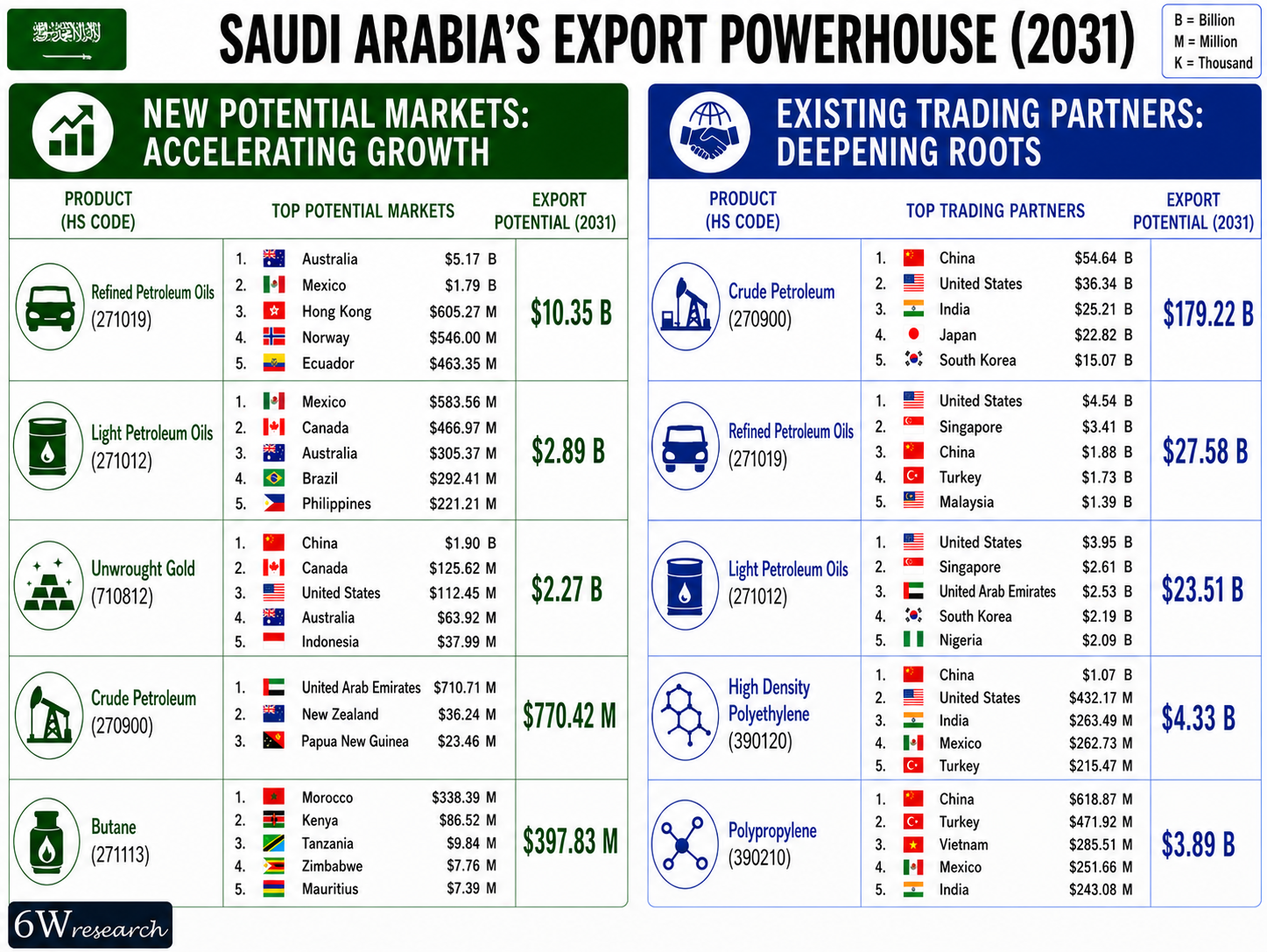 Established Demand Remains Crude-Led, but Australia Emerges as the Largest Market for New Saudi Product Lines
Saudi Arabia's export strategy for 2031 is, first and foremost, a story about crude oil and second, a story about how hard the Saudi Arabia is working to make sure it isn't only that. In established trade relationships, export potential reaches USD 288.24 billion, led by China at 24.99% (USD 72.04 billion) and the United States close behind at 17.33% (USD 49.95 billion). India, Japan and South Korea round out the top five, and together these five buyers every one of them a major crude oil importer account for over seven in every ten dollars of the Saudi Arabia's established export potential.
| Top 5 Current Leading Importers | Export Potential (USD Billion) | Top 5 New Potential Importers for New Product Lines | Export Potential (USD Billion) |
| China | 72.04 | Australia | 5.80 |
| United States | 49.95 | China | 3.94 |
| India | 35.64 | Mexico | 3.21 |
| Japan | 26.62 | United States | 2.92 |
| South Korea | 20.07 | Canada | 1.47 |
Source: 6WExportGTM
Australia emerges as the leading market, accounting for 18.98% or USD 5.80 billion, followed by China at 12.88% or USD 3.94 billion, with Mexico, the United States and Canada also representing notable opportunities. Growth is concentrated in refined and light petroleum oils supplied to energy-importing markets where Saudi Arabia currently has limited direct penetration, creating a distinctly different opportunity from expanding crude exports to established customers.
Refined Petroleum Oils Drive USD 10.35 Billion in New-Corridor Potential, Led by Australia and Mexico
Refined petroleum oils, light petroleum oils and unwrought gold lead the way. While Saudi Arabia currently has minimal trade with several of these destinations, analysis by 6WExportGTM shows real untapped export opportunity emerging by 2031 concentrated in refined fuel products rather than crude itself, a sign that the Saudi Arabia's downstream refining capacity, not just its oil reserves, is what opens these new markets.
Refined petroleum oils represent the largest new-corridor opportunity at USD 10.35 billion, led decisively by Australia (USD 5.17 billion) exactly half the total followed by Mexico (USD 1.79 billion), Hong Kong, Norway and Ecuador. Light petroleum oils add a further USD 2.89 billion, led by Mexico (USD 0.58 billion) and Canada (USD 0.47 billion), with Australia, Brazil and the Philippines rounding out a genuinely global spread of buyers. Unwrought gold contributes USD 2.27 billion, led overwhelmingly by China (USD 1.90 billion) a reminder that Saudi Arabia's gold trade, like its oil, still gravitates toward the same handful of major economies even in categories framed as "new."
Crude petroleum itself appears even within the rest-of-world bracket, worth USD 0.77 billion and led by the UAE (USD 0.71 billion) a modest but logical addition given the two countries' shared refining infrastructure. Liquefied propane closes out the top five at USD 0.40 billion, led by Morocco (USD 0.34 billion), with Kenya, Tanzania and Zimbabwe showing the Saudi Arabia's LPG reach extending into East and Southern African markets that barely register in its current trade statistics.
Crude Petroleum Alone Accounts for USD 179.22 Billion, Leaving Petrochemicals Far Behind Saudi Arabia’s Core Export Engine
Crude petroleum, refined petroleum oils and light petroleum oils dominate Saudi Arabia's established export potential so completely that everything else in this report is, in dollar terms, a rounding error by comparison though not in strategic importance.
Crude petroleum alone carries USD 179.22 billion in export potential more than 60% of the entire established-trade total led by China (USD 54.64 billion), the United States (USD 36.34 billion), India (USD 25.21 billion), Japan (USD 22.82 billion) and South Korea (USD 15.07 billion). Refined petroleum oils add USD 27.58 billion, this time led by the United States (USD 4.54 billion) and Singapore (USD 3.41 billion), with China, Turkey and Malaysia following. Light petroleum oils contribute a further USD 23.51 billion, again led by the United States (USD 3.95 billion) and Singapore (USD 2.61 billion), with the UAE, South Korea and Nigeria completing the top five.
Beyond hydrocarbons, the petrochemical products that anchor Saudi Arabia's Vision 2030 diversification agenda show up much further down the list. High density polyethylene carries USD 4.33 billion in potential, led by China (USD 1.07 billion) and the United States (USD 0.43 billion), while polypropylene adds USD 3.89 billion, led by China (USD 0.62 billion) and Turkey (USD 0.47 billion). Together these two products are worth less than 5% of what crude petroleum alone is worth a gap that puts real numbers behind the scale of the diversification challenge the Saudi Arabia has set for itself.
|
Saudi Arabia's export base remains a hydrocarbon story by an enormous margin crude and refined petroleum products together account for well over three-quarters of established export potential with petrochemicals and gold offering genuine but comparatively modest diversification. 6WExportGTM Analysis |
Saudi Arabia Is Pursuing Two Parallel Bets: Securing Long-Term Crude Demand and Scaling Higher-Value Petrochemicals
Saudi Arabia's path to 2031 is being shaped by a strategy that runs in two directions simultaneously: locking in long-term demand for the crude oil that still generates the overwhelming majority of export value, while building out a petrochemicals sector large enough to matter on its own terms. Both bets are backed by real capital and real deals, not just policy language, and both carry real execution risk of their own.
Aramco Anchors Up to 1.2 million Barrels per Day of Chinese Refining Capacity Through Equity-Backed Offtake
Rather than simply selling crude and hoping demand holds, Aramco has spent the past several years buying equity stakes directly into the refineries that process its oil. The company holds roughly 10% positions in Rongsheng Petrochemical, Hengli Petrochemical and Shandong Yulong Petrochemical, plus its Huajin Aramco joint venture in Liaoning and a long-standing stake in the Fujian Refining and Petrochemical joint venture together tying an estimated 1.0-1.2 million barrels a day of Chinese refining capacity to long-term Saudi crude offtake agreements. This matters directly for the USD 54.64 billion in crude-petroleum export potential this report attributes to China: it isn't a forecast built on hope, but on contractually anchored demand, even as Russia has periodically outcompeted Saudi Arabia on price for the marginal barrel.
|
Equity stakes in the buyer's own refineries are a structurally different kind of export strategy than selling on the spot market Aramco isn't just hoping China keeps buying, it has bought its way into China's decision to keep buying. Manish Pant, Senior Data Scientist, Data Science & Market Intelligence, 6Wresearch |
USD 11 Billion Amiral and New Jubail Complexes Aim to Narrow the USD 175 Billion Gap Between Crude and Petrochemicals
Saudi Arabia is already the world's fourth-largest petrochemicals producer, with installed capacity exceeding 120 million tons a year and a sector contributing 8-10% of non-oil GDP, but the more interesting story is where that capacity is headed next. SABIC and Tasnee received feedstock approval in March 2025 for two new Jubail complexes, with Tasnee's 3.3-million-ton polyethylene, MTBE and specialty chemicals project targeting a Q4 2030 launch, while Aramco and TotalEnergies are separately building the USD 11 billion Amiral complex, integrated with the SATORP refinery, to push output further up the value chain from commodity plastics toward specialty chemicals and performance materials for automotive, aerospace and electronics customers.
|
The gap between crude petroleum's USD 179 billion in export potential and polyethylene's USD 4.33 billion shows exactly how much runway the Vision 2030 petrochemical pivot still has to cover these new Jubail complexes are the first real attempt to close that gap rather than just talk about it. Manisha Gupta, Data Analyst, Data Science & Market Intelligence, 6Wresearch |
Top Global Export Opportunities (2031), By Product
| Product | Export Opportunity (USD Billion) |
| Electronic Integrated Circuits | 685.7 |
| Refined Petroleum Oils | 668.4 |
| Light Petroleum Oils | 588.9 |
| Logic electronic integrated circuits | 507.9 |
| Medicines | 381.2 |
| Gasoline Passenger Cars (1.5–3.0L) | 360.9 |
| Smartphones | 343.6 |
| Electronic integrated circuits with memories | 333.2 |
| Data Transmission Equipment | 216.9 |
| Human Vaccines | 209.6 |
Excludes naturally occurring products (e.g., crude oil, raw gold). Source: 6WExportGTM
Globally, the largest export opportunities beyond naturally occurring products are concentrated in electronics, energy and pharmaceuticals highlighting the growing dominance of semiconductors, advanced manufacturing and high-value technology products in global trade. Japan already sits inside several of these categories, but its real priority through 2031 is defending semiconductor-equipment leadership, stabilizing its auto industry through a difficult transition, and using energy and metals diversification to reduce the geopolitical exposure that comes with a resource-poor, trade-dependent economy.
The Saudi Arabia's Established Trade, Line by Line
Oil and gas overwhelmingly dominate Saudi Arabia’s established trade base, reaching USD 213 billion. Crude petroleum accounts for 84.09% of the sector, while refined petroleum oils contribute a further 10.99%. Plastic raw materials follow at USD 17.37 billion, led by polypropylene at 26.88% and polyethylene at 26.66%. Organic chemicals rank third at USD 11.22 billion, with ethylene glycol industrial representing 24.81% of exports and styrene accounting for 12.78%.
| Sector | Exports (USD Billion) | Leading Products / Share |
| Oil & Gas | 213 | Crude Petroleum(84.09%), Refined Petroleum Oils (10.99%) |
| Plastic Raw Materials | 17.37 | Polypropylene (26.88%), Polyethylene (26.66%) |
| Organic Chemicals | 11.22 | Ethylene Glycol Industrial (24.81%), Styrene (12.78%) |
Source: UN Comtrade
By trading value, the United Arab Emirates leads at USD 18.75 billion, driven by smartphones at 23.04% and cellular handsets at 10.62%, reflecting the importance of regional distribution and re-export activity. China follows at USD 7.47 billion, led by ethylene glycol industrial at 20.84% and polyethylene at 12.46%. India ranks third at USD 6.39 billion, with nitrogen potassium fertilizers accounting for 17.04% and unwrought gold contributing 8.42%.
| Country | Exports (USD Billion) | Leading Products / Share |
| United Arab Emirates | 18.75 | Smartphones 23.04%, Cellular Handsets 10.62% |
| China | 7.47 | Ethylene Glycol Industrial (20.84%), Polyethylene (12.46%) |
| India | 6.39 | Nitrogen Potassium Fertilizers (17.04%), Unwrought Gold (8.42%) |
Source: UN Comtrade
Saudi Arabia’s Next Export Gains Depend on Converting Crude Relationships into Captive Demand and Petrochemical Capacity into Output
Saudi Arabia's next decade of export growth will be won less by finding new crude buyers China and the US already anchor USD 90.98 billion of that single product between them and more by closing the enormous gap between crude's USD 179.22 billion in potential and petrochemicals' still-modest few billion. The playbook is threefold: keep converting spot-market crude relationships into the kind of equity-anchored demand Aramco has built in China; push the Jubail specialty-chemicals pipeline from approval to actual output on the Tasnee and Amiral timelines; and take advantage of oil and gas's exemption from the new US Section 301 tariff to expand refined-fuel trade into new corridors like Australia and Mexico, where this report already shows real, if still-untapped, demand. Together, these three moves are where the next USD 30.57 billion in new-corridor potential and a meaningful share of the existing USD 288.24 billion will actually be won.

Leadership Perspectives from Industry Events
Search
6Wresearch in the News
 Forbes
Citing 6Wresearch analytics to map global infrastructure and pharmaceutical industry trajectories.
 Bloomberg Law
Direct syndication of 6Wresearch's macro data points, capturing complex supply chain shifts.
 Reuters
Tracking industrial manufacturing adjustments and electronic security ecosystem scaling.
 Mint
Mint
Utilizing deep-tech sector market sizing to analyze global automation and robotics.
 The Economic Times
Anchoring features on industrial IoT growth metrics and connected smart-grid devices.
 Business Standard
Featuring strategic evaluations of Advanced Driver Assistance Systems (ADAS) and AI road safety.
 The Hindu
Spotlighting core commercial metrics ranging from unmanned aerial vehicles (UAVs) to consumer durables.
 Financial Express
Anchoring quarterly reviews on cross-border real estate tech and structural hardware manufacturing.
 Yahoo Finance
Syndicating the tracker's $30.1 billion untapped-market findings, spotlighting Japan, the US and China as India's top new-potential importers.
 India Today
Carrying the release on smartphones leading India's export potential to $94 billion by 2031, per 6WExportGTM data.
 Dailyhunt
Distributing the tracker findings to its regional readership, framing India's export diversification into Japan and Mexico.
 PR Newswire Original release
Publishing the full India Export Attractiveness Tracker 2026, detailing new trade corridors across iron ore, LCVs and pharmaceuticals.
 The Industrial
Highlighting the tracker's read on India's semiconductor ambitions and long-term chip-assembly export potential.
 PTI News
Reporting on the $66.81 billion pharmaceuticals export opportunity flagged in the tracker, amid looming US generic-drug tariffs.
 Tribune India
Covering the tracker's tariff-versus-regulation analysis across India's mature export markets in the US, China and UAE.
 ANI News
Amplifying the report's findings on polished diamonds, refined petroleum and medicines as India's core export engines.
 International Business Magazine
Covering the report's insight into how AEB, blind spot detection, and driver monitoring are reshaping India's ADAS market.
 Focus Gaming News
Highlighting the research forecast for Egypt's gambling market, projecting steady growth through 2032.
Thought Leadership and Analyst Meet





Our Clients








Latest Reports
- Austria X-ray Imaging Devices Market (2026-2032)
- Armenia X-ray Imaging Devices Market (2026-2032)
- Antigua and Barbuda X-ray Imaging Devices Market (2026-2032)
- Angola X-ray Imaging Devices Market (2026-2032)
- Andorra X-ray Imaging Devices Market (2026-2032)
- Albania X-ray Imaging Devices Market (2026-2032)
- Afghanistan X-ray Imaging Devices Market (2026-2032)
- United States (US) X-ray Imaging Devices Market (2026-2032)
- United Kingdom (UK) X-ray Imaging Devices Market (2026-2032)
- United Arab Emirates (UAE) X-ray Imaging Devices Market (2026-2032)
Industry Events and Analyst Meet

EV India Expo 2026

HIMTEX 2026

India Refining Summit 2026

India EV Show 2026

EV tech India Expo 2026
Whitepaper
- Middle East & Africa Commercial Security Market Click here to view more.
- Middle East & Africa Fire Safety Systems & Equipment Market Click here to view more.
- GCC Drone Market Click here to view more.
- Middle East Lighting Fixture Market Click here to view more.
- GCC Physical & Perimeter Security Market Click here to view more.


