Slovakia’s Gasoline Passenger Cars (>3.0L) Exports to Existing Partners Could Reach USD 17.05 Billion, While Medium Petrol Cars Open USD 1.98 Billion Across New Markets by 2031.
Gasoline passenger cars dominate Slovakia’s established export base, with the United States alone taking nearly 43% of established demand versus just 12.6% for China. The new-corridor picture is more contested: the United States still leads at under 18%, but China (12%), Hong Kong (11%) and Canada (7%) trail closely, reflecting a far more distributed buyer base than Slovakia’s combustion-engine-heavy established trade.
Source: 6WExportGTM
The United States Commands Both Established and New-Corridor Demand, But Far More Narrowly in the Latter
Slovakia’s export opportunities are led by the United States, China, Hong Kong, Canada, and South Korea, representing significant untapped market potential. The United States ranks first with USD 5.80 billion in export potential, driven by opportunities in automotive, machinery, and advanced industrial products. China and Hong Kong follow with USD 3.92 billion and USD 3.66 billion, respectively, supported by demand across manufacturing, electronics, and automotive supply chains. Canada and South Korea present further opportunities with USD 2.13 billion and USD 1.78 billion, respectively, highlighting potential growth in high-value industrial goods, automotive components, and technology-driven exports.
| Top 5 Existing Importers | Export Potential (USD Billion) | Top 5 New Potential Importers | Export Potential (USD Billion) |
| United States | 33.59 | United States | 5.80 |
| China | 9.94 | China | 3.92 |
| Canada | 5.53 | Hong Kong | 3.66 |
| United Arab Emirates | 2.89 | Canada | 2.13 |
| South Korea | 2.55 | South Korea | 1.78 |
Source: 6WExportGTM
Slovakia’s existing export base is primarily concentrated across the United States, China, Canada, the United Arab Emirates, and South Korea, highlighting its strong integration with global industrial supply chains. The US is out in front by a wide margin, sitting at USD 33.59 billion in export potential, backed by steady demand for Slovak automotive products, machinery, and advanced manufacturing goods. China comes in next at USD 9.94 billion, mostly tied to industrial equipment, components, and technology-related exports. Canada, the UAE, and South Korea add further established opportunity at USD 5.53 billion, USD 2.89 billion, and USD 2.55 billion respectively, which really just underscores how far Slovakia's reach has extended into North America, the Middle East, and Asia over time.
U.S. Demand for Medium Petrol Cars and China’s Electronics Supply Chain Create New Export Opportunities
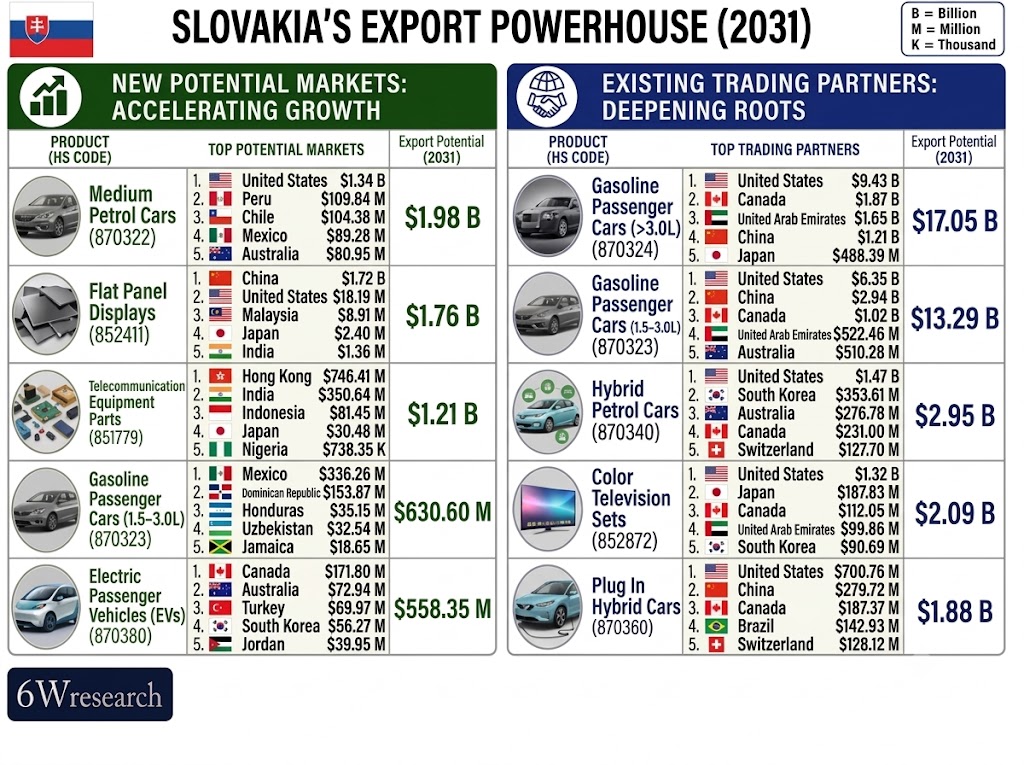
Medium petrol cars are the leading new-corridor product at USD 1.98 billion, led again by the United States (USD 1.34 billion), followed by Peru (USD 109.84 million) and Chile (USD 104.38 million). The US share likely reflects demand for a smaller-displacement trim distinct from the larger-engine classes that dominate established trade, while Peru and Chile represent genuinely new Latin American markets, where limited domestic auto manufacturing and growing middle-class demand for imported compact sedans create fresh openings under regional trade preferences.
Flat panel displays and telecommunication equipment parts together account for another USD 2.97 billion of new-corridor potential. Flat panel displays’ USD 1.76 billion is overwhelmingly a single relationship with China (USD 1.72 billion), reflecting China’s vast electronics-assembly base absorbing Slovak-made display components as inputs into its own consumer-electronics supply chains an upstream-component relationship rather than a finished-goods export. Telecommunication equipment parts’ USD 1.21 billion is led by Hong Kong (USD 746.41 million) and India (USD 350.64 million), reflecting Hong Kong’s role as a regional electronics-trading and re-export hub and India’s growing domestic telecom-manufacturing and network-buildout demand.
Gasoline passenger cars (1.5–3.0L) and electric passenger vehicles close out the new-corridor’s top five products. The gasoline-car line’s USD 630.60 million in new-corridor value is led by Mexico (USD 336.26 million) and the Dominican Republic (USD 153.87 million), markets distinct from the US buyers who dominate this same product in established trade. Electric passenger vehicles’ USD 558.35 million is led by Canada (USD 171.80 million), Australia (USD 72.94 million) and Turkey (USD 69.97 million) markets with accelerating EV-adoption incentives. Taken together, the five products show a new-market opportunity that mixes genuinely new vehicle markets in Latin America and Turkey with a growing component trade feeding Asian electronics manufacturing a meaningfully different composition, not simply the same cars reaching new buyers.
U.S. Automotive Partnerships Continue to Drive Slovakia’s Export Strength in Passenger Vehicles
Gasoline passenger cars (>3.0L) represent Slovakia’s largest established export opportunity at USD 17.05 billion, led by the United States (USD 9.43 billion), Canada (USD 1.87 billion), and the United Arab Emirates (USD 1.65 billion). Demand in these markets is supported by strong consumer preference for larger vehicles such as SUVs and premium sedans. Slovakia’s position as a major European manufacturing hub for global automotive brands enables it to supply these high-value vehicles to North American and Middle Eastern markets.
Gasoline passenger cars (1.5–3.0L, USD 13.29 billion) and hybrid petrol cars (USD 2.95 billion) together add another USD 16.24 billion. The gasoline class is led by the United States (USD 6.35 billion), China (USD 2.94 billion) and Canada (USD 1.02 billion), with China’s substantial share reflecting continued demand for imported European combustion vehicles. Hybrid petrol cars are led by the United States (USD 1.47 billion), South Korea (USD 353.61 million) and Australia (USD 276.78 million), three markets with strong hybrid-vehicle adoption and compatible emissions and safety regimes.
Color television sets (USD 2.09 billion) and plug-in hybrid cars (USD 1.88 billion) close out the top five. Television sets are led by the United States (USD 1.32 billion), Japan (USD 187.83 million) and Canada (USD 112.05 million), reflecting Slovakia’s significant consumer-electronics assembly base feeding directly into large export retail markets. Plug-in hybrid cars repeat the familiar United States (USD 700.76 million), China (USD 279.72 million) and Canada (USD 187.37 million) buyer triangle seen across nearly every established product. altogether, the established base reveals concentration less by product than by country: the same US, Canada, China and UAE cluster absorbs combustion, hybrid and electronics exports alike, leaving Slovakia’s established trade more exposed to shifts in a handful of markets than its product diversity might suggest.
|
Slovakia’s established trade looks diversified by product combustion cars, hybrids, plug-ins, televisions but it is really concentrated by country: the same United States, Canada and China buyers show up at the top. The new-corridor opportunity is where genuine diversification is happening, in Latin American vehicle markets and in a component trade with China and Hong Kong that barely resembles the established base at all. 6WExportGTM Analysis |
Top Global Export Opportunities (2031), By Product
| Product | Export Opportunity (USD Billion) |
| Electronic Integrated Circuits | 685.7 |
| Refined Petroleum Oils | 668.4 |
| Light Petroleum Oils | 588.9 |
| Logic Electronic Integrated Circuits | 507.9 |
| Medicines | 381.2 |
| Gasoline Passenger Cars (1.5–3.0L) | 360.9 |
| Smartphones | 343.6 |
| Electronic Integrated Circuits with Memory | 333.2 |
| Data Transmission Equipment | 216.9 |
| Immunological Products | 209.6 |
Excludes naturally occurring products (e.g., crude oil, raw gold). Source: 6WExportGTM
Global export opportunities toward 2031 highlight strong growth potential in sectors aligned with Slovakia’s industrial capabilities, particularly automotive, electronics, and advanced manufacturing. Growing global demand for semiconductors, integrated circuits, smartphones, and data transmission equipment provides opportunities for Slovakia to expand its electronics export base. At the same time, continued demand for gasoline passenger cars, electric vehicles, and automotive components supports Slovakia’s position as a key European automotive manufacturing hub. These trends also create opportunities for Slovakia to diversify beyond traditional vehicle exports and strengthen its role in high-value global supply chains.
What Slovakia Already Sells and Where
By sector, Slovakia's current export base is dominated by automotive — passenger vehicles alone bring in USD 31.75 billion, led primarily by gasoline passenger cars in the 1.5-3.0L range along with hybrid petrol models. Automotive parts add a further USD 9.57 billion, driven largely by exports of vehicle safety components and signal lighting equipment, which reinforces just how central Slovakia is to Europe's automotive manufacturing base. Beyond autos, telecommunications equipment accounts for USD 5.15 billion in exports, led mainly by smartphones and data transmission equipment — a reminder that Slovakia's role in electronics and technology manufacturing has been growing alongside its traditional automotive strength.
| Sector | Exports (USD Billion) | Leading Products (USD Million/Billion) |
| Passenger Vehicles | 31.75 | Gasoline Passenger Cars (1.5–3.0L)(24.27%); Hybrid Petrol Cars(22.71%) |
| Automotive Parts | 9.57 | Vehicle Safety Parts (17.74%); Signal Lighting Equipment (17.74%) |
| Telecommunications Equipment | 5.15 | Smartphones (88.46%); Data Transmission Equipment (7.89%) |
Source: UN Comtrade
By destinations, Slovakia's export relationships stay heavily anchored in Europe, with Germany, Czechia, and Hungary standing out as the three markets that matter most. Germany leads at USD 24.73 billion, driven mainly by gasoline passenger cars in the 1.5-3.0L range along with plug-in hybrids — which really just reflects how tightly woven the two countries' automotive industries already are. Czechia accounts for USD 14.01 billion, supported by exports of military ammunition and large petrol engines, pointing more toward industrial and manufacturing ties than pure consumer trade. Hungary contributes USD 8.98 billion, led by electrical energy and smartphones, which speaks to how connected the region is when it comes to energy and electronics supply chains.
| Country | Exports (USD Billion) | Leading Products (USD Million/Billion) |
| Germany | 24.73 | Gasoline Passenger Cars (1.5–3.0L) (10.39%); Plug In Hybrid Cars (6.03%) |
| Czechia | 14.01 | Military Ammunition (4.70%); Large Petrol Engines (3.69%) |
| Hungary | 8.98 | Electrical Energy (21.55%); Smartphones (5.85%) |
Source: UN Comtrade
Two Developments Shaping Slovakia’s Export Base: A US Tariff Shock and an EV Pivot at Košice
Two key developments are shaping Slovakia’s export outlook. First, changes in global trade conditions and US tariff uncertainty are creating challenges for Slovakia’s automotive exports, particularly its strong dependence on traditional combustion-engine vehicle demand. Second, the expansion of Volvo’s electric vehicle manufacturing facility near Košice is expected to accelerate Slovakia’s transition toward electric mobility, creating new growth opportunities and strengthening its position in future-oriented automotive exports
A US Tariff Shock Tests Slovakia’s USD 33.59 Billion American Relationship
Slovakia entered 2025 as one of the EU economies most exposed to US auto tariffs, given the sector's outsized share of national GDP and exports relative to any other European country. US tariffs on imported cars rose to 25% from April 2025, with an expansion to auto parts the following month, directly threatening a trading relationship in which vehicles make up roughly 80% of Slovakia’s US-bound exports. Relief came in July 2025, when the EU and US reached a framework trade deal that reduced tariffs on most EU goods to 15% down from a threatened 30% and cut the auto-sector rate down from 27.5%, though still well above pre-2025 levels. The stakes are concentrated: gasoline passenger cars in the >3.0L and 1.5–3.0L classes alone represent USD 30.34 billion of established 2031 potential, with the United States taking USD 9.43 billion and USD 6.35 billion of those two lines respectively together nearly half of Slovakia’s entire USD 33.59 billion established US relationship. Industry voices have also flagged a second, less-discussed pressure: intensifying competition from Chinese manufacturers redirecting output toward Europe as they too face US tariff barriers, compounding the direct tariff impact with tighter competition at home.
|
Slovakia’s strong reliance on automotive exports exposes it to tariff risks and rising Chinese competition, highlighting the need to diversify markets and accelerate EV manufacturing capabilities. Manish Pant, Senior Data Scientist, Data Science & Market Intelligence, 6Wresearch |
Volvo’s All-Electric Košice Plant Could Reshape Slovakia’s USD 558 Million EV Line
Volvo’s €1.2 billion EV-only factory near Košice marks a significant transformation in Slovakia’s automotive industry, expanding its manufacturing base beyond the traditional western cluster of global automakers. The facility will bring dedicated EV production capacity to boost Slovakia’s position in the European electric vehicle ecosystem, create thousands of skilled jobs and attract supporting suppliers across the automotive value chain. The plant will be used for pre-series production from 2026, followed by mass production, and the Polestar 7 SUV will join from 2028, putting the plant in a position to boost Slovakia’s EV exports. As capacity scales toward its planned annual output, electric vehicles are expected to become an important future growth segment within Slovakia’s export portfolio.
|
Volvo’s EV-only investment positions Slovakia to capture future automotive growth by expanding beyond traditional combustion-engine vehicles and creating a new foundation for electric vehicle exports, supply chain development, and advanced manufacturing capabilities. Manisha Gupta, Data Analyst, Data Science & Market Intelligence, 6Wresearch |
The Takeaway
Slovakia’s export base remains highly concentrated, with automotive exports heavily dependent on the US market and a limited group of key buyers. While new opportunities are emerging across EVs, components, and Asian markets, they remain smaller compared with traditional vehicle exports. The key priority for Slovakia is to reduce market concentration risks while leveraging the Košice EV plant to build a more diversified and future-ready export base.
Key strategic priorities for Slovakia include:
-
Counter the US dominance in the traditional combustion-vehicle trade, where the >3.0L and 1.5–3.0L gasoline passenger car categories alone have an established value of USD 30.34 billion, and the US accounts for USD 33.59 billion (42.71%) of the total USD established demand. This means that Slovakia will remain exposed to further policy changes even after the July 2025 EU-US framework reduces tariff rates.
-
Prepare for the Volvo Košice ramp-up to reshape the EV export line, given electric passenger vehicles currently register in new-corridor trade at USD 558.35 million with no established presence at all, and the plant is moving from pre-series testing in 2026 toward full production in 2027 with the Polestar 7 to follow in 2028.
-
Build on the China and Hong Kong component relationships, since flat panel displays’ USD 1.76 billion new-corridor value is 98% dependent on China alone and telecommunication equipment parts’ USD 1.21 billion is led by Hong Kong, both distinct, scalable relationships worth deepening independent of the vehicle-tariff story.
-
Diversify new-corridor vehicle markets in Latin America, since medium petrol cars and gasoline passenger cars (1.5–3.0L) are already finding meaningful demand in Mexico, Peru, Chile and the Dominican Republic markets with limited domestic auto manufacturing and no significant presence among Slovakia’s established top-five buyers.
Ultimately, Slovakia’s 2031 export outlook depends on managing a decades-long dependence on US combustion-vehicle demand through a period of tariff uncertainty, while using the Košice EV plant and its already visible new-corridor demand to build the more diversified export base the country will need as the global auto industry electrifies.

Leadership Perspectives from Industry Events
Search
6Wresearch in the News
 Forbes
Citing 6Wresearch analytics to map global infrastructure and pharmaceutical industry trajectories.
 Bloomberg Law
Direct syndication of 6Wresearch's macro data points, capturing complex supply chain shifts.
 Reuters
Tracking industrial manufacturing adjustments and electronic security ecosystem scaling.
 Mint
Mint
Utilizing deep-tech sector market sizing to analyze global automation and robotics.
 The Economic Times
Anchoring features on industrial IoT growth metrics and connected smart-grid devices.
 Business Standard
Featuring strategic evaluations of Advanced Driver Assistance Systems (ADAS) and AI road safety.
 The Hindu
Spotlighting core commercial metrics ranging from unmanned aerial vehicles (UAVs) to consumer durables.
 Financial Express
Anchoring quarterly reviews on cross-border real estate tech and structural hardware manufacturing.
 Yahoo Finance
Syndicating the tracker's $30.1 billion untapped-market findings, spotlighting Japan, the US and China as India's top new-potential importers.
 India Today
Carrying the release on smartphones leading India's export potential to $94 billion by 2031, per 6WExportGTM data.
 Dailyhunt
Distributing the tracker findings to its regional readership, framing India's export diversification into Japan and Mexico.
 PR Newswire Original release
Publishing the full India Export Attractiveness Tracker 2026, detailing new trade corridors across iron ore, LCVs and pharmaceuticals.
 The Industrial
Highlighting the tracker's read on India's semiconductor ambitions and long-term chip-assembly export potential.
 PTI News
Reporting on the $66.81 billion pharmaceuticals export opportunity flagged in the tracker, amid looming US generic-drug tariffs.
 Tribune India
Covering the tracker's tariff-versus-regulation analysis across India's mature export markets in the US, China and UAE.
 ANI News
Amplifying the report's findings on polished diamonds, refined petroleum and medicines as India's core export engines.
 International Business Magazine
Covering the report's insight into how AEB, blind spot detection, and driver monitoring are reshaping India's ADAS market.
 Focus Gaming News
Highlighting the research forecast for Egypt's gambling market, projecting steady growth through 2032.
Thought Leadership and Analyst Meet





Our Clients








Latest Reports
- Austria X-ray Imaging Devices Market (2026-2032)
- Armenia X-ray Imaging Devices Market (2026-2032)
- Antigua and Barbuda X-ray Imaging Devices Market (2026-2032)
- Angola X-ray Imaging Devices Market (2026-2032)
- Andorra X-ray Imaging Devices Market (2026-2032)
- Albania X-ray Imaging Devices Market (2026-2032)
- Afghanistan X-ray Imaging Devices Market (2026-2032)
- United States (US) X-ray Imaging Devices Market (2026-2032)
- United Kingdom (UK) X-ray Imaging Devices Market (2026-2032)
- United Arab Emirates (UAE) X-ray Imaging Devices Market (2026-2032)
Industry Events and Analyst Meet

EV India Expo 2026

HIMTEX 2026

India Refining Summit 2026

India EV Show 2026

EV tech India Expo 2026
Whitepaper
- Middle East & Africa Commercial Security Market Click here to view more.
- Middle East & Africa Fire Safety Systems & Equipment Market Click here to view more.
- GCC Drone Market Click here to view more.
- Middle East Lighting Fixture Market Click here to view more.
- GCC Physical & Perimeter Security Market Click here to view more.


