Slovenia's Medicines Exports to Existing Partners Could Reach USD 33.09 Billion, While Gasoline Passenger Cars Open USD 978.31 Million Across New Markets by 2031
Through 2031, the United States is Slovenia’s greatest export opportunity, making up 40.71% of the established market potential and 28.84% of new potential markets. Switzerland is the second-largest established destination, with China and Hong Kong supporting the Asian opportunity set. Pharmaceuticals and medicines dominate the outlook of Slovenia’s export potential, with passenger vehicles, memory integrated circuits, and electric vehicles opening up new ways to diversify and grow in the long run.
 Source: 6WExportGTM
United States Anchors Slovenia's Export Opportunity, as China and Hong Kong Expand the Asian Growth Corridor
Slovenia's new export corridors are led by the United States with USD 3.17 billion in potential, followed by China (USD 1.45 billion) and Hong Kong (USD 0.62 billion). Mexico and Japan add further opportunities at USD 0.60 billion and USD 0.55 billion, respectively. The mix spans passenger vehicles, memory integrated circuits, electric vehicles, infrared diodes and lithium-ion batteries, highlighting a new-market profile increasingly linked to mobility and technology demand across North America and Asia through 2031.
| Top 5 Existing Importers | Export Potential (USD Billion) | Top 5 New Potential Importers | Export Potential (USD Billion) |
| United States | 17.86 | United States | 3.17 |
| Switzerland | 5.84 | China | 1.45 |
| China | 3.92 | Hong Kong | 0.62 |
| Japan | 2.35 | Mexico | 0.60 |
| Canada | 1.61 | Japan | 0.55 |
Source: 6WExportGTM
The United States accounts for USD 17.86 billion of Slovenia's established export potential, well ahead of Switzerland at USD 5.84 billion. China ranks third at USD 3.92 billion, with Japan and Canada contributing USD 2.35 billion and USD 1.61 billion, respectively. This concentration reflects the international reach of Slovenia's pharmaceutical manufacturing base, supported by additional trade in electronics, refined petroleum products and industrial components across a broad mix of developed and emerging markets.
Slovenia Expands New Market Opportunities Across Automotive and Advanced Electronics
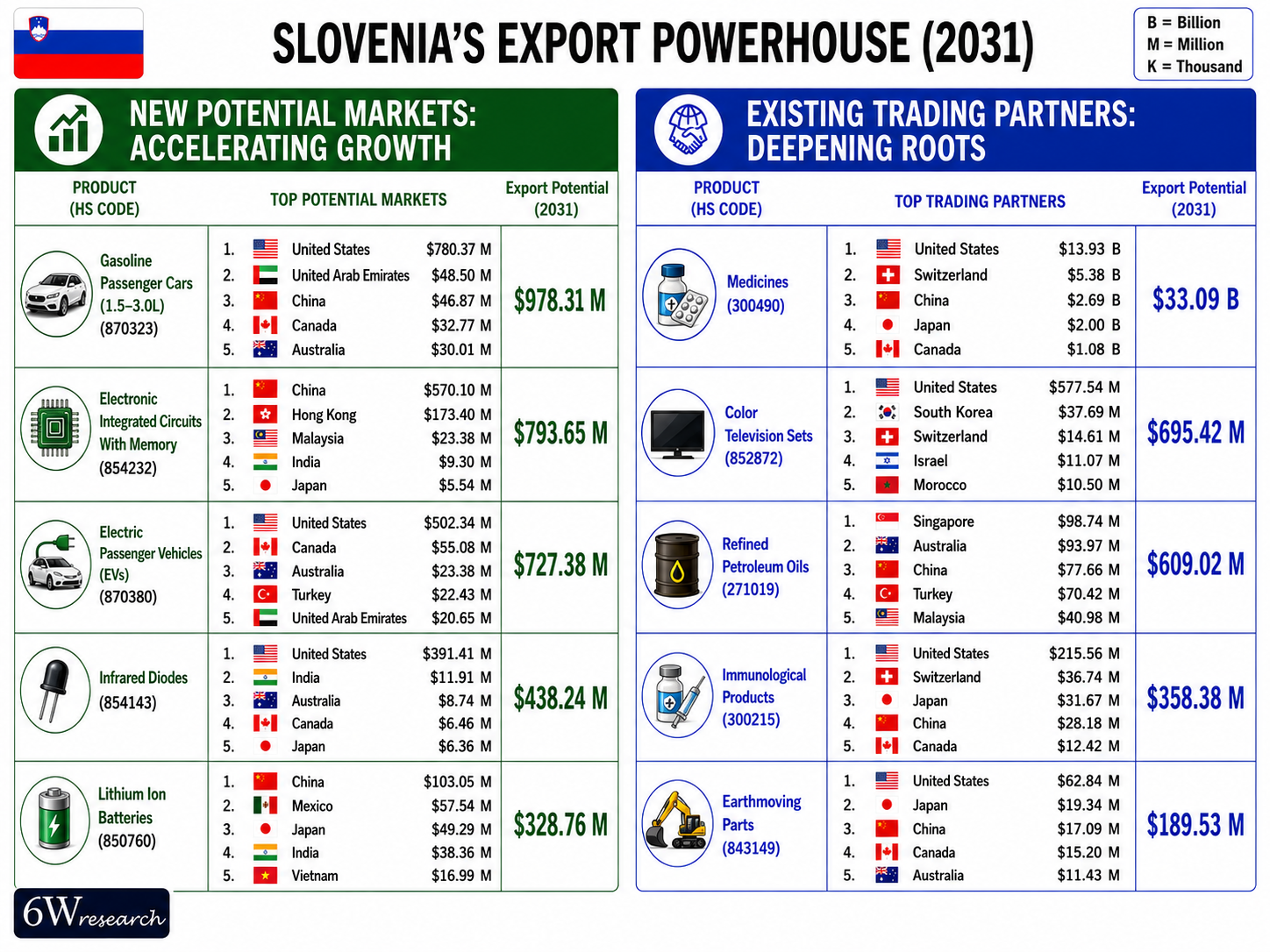
Gasoline passenger cars (1.5-3.0L) represent Slovenia's largest new-corridor opportunity at USD 978.31 million, led overwhelmingly by the United States at USD 780.37 million. The United Arab Emirates and China add USD 48.50 million and USD 46.87 million, followed by Canada and Australia. This buyer mix gives Slovenia a sizeable North American anchor while opening additional vehicle export channels across the Gulf and Asia.
Electronic integrated circuits with memory and electric passenger vehicles represent additional high-potential opportunities at USD 793.65 million and USD 727.38 million, respectively. Memory integrated circuits are led by China at USD 570.10 million and Hong Kong at USD 173.40 million, while electric passenger vehicles are led by the United States at USD 502.34 million, followed by Canada, Australia, Turkey and the United Arab Emirates. Together, the two categories broaden Slovenia's opportunity base beyond its traditional pharmaceutical strength.
Infrared diodes and lithium-ion batteries complete the top five new potential markets. In general, infrared diodes contribute approximately USD 438.24 million, with the United States represents USD 391.41 million. Apart from this, lithium-ion batteries account for USD 328.76 million, led by China at USD 103.05 million and Mexico at USD 57.54 million. In total, Slovenia’s new export market profile combines automotive manufacturing with semiconductor and battery-linked products, creating a more technology-intensive path for export diversification by 2031.
Pharmaceuticals Anchor Slovenia's Established Export Strengths, with Electronics and Refined Fuels Adding Depth
Medicines represent Slovenia's largest established export opportunity by a wide margin at USD 33.09 billion. The United States leads at USD 13.93 billion, followed by Switzerland at USD 5.38 billion, China at USD 2.69 billion, Japan at USD 2.00 billion and Canada at USD 1.08 billion. The scale and geographic spread of this opportunity underline Slovenia's role as a deeply integrated pharmaceutical production and export base serving major healthcare markets across North America, Europe and Asia.
Color television sets and refined petroleum oils add a further USD 695.42 million and USD 609.02 million. Color television sets are led by the United States at USD 577.54 million, while refined petroleum oils show a more diversified buyer base led by Singapore at USD 98.74 million and Australia at USD 93.97 million, followed by China, Turkey and Malaysia. These categories add electronics and energy-linked trade to an export platform otherwise dominated by pharmaceuticals.
Immunological products and earthmoving parts complete the established top five at USD 358.38 million and USD 189.53 million, respectively. Immunological products are led by the United States at USD 215.56 million and Switzerland at USD 36.74 million, while earthmoving parts are led by the United States (USD 62.84 million), Japan (USD 31.67 million) and China. Collectively, the five categories show that Slovenia's established advantage is pharmaceutical-led but reinforced by electronics, refined fuels and specialized industrial manufacturing.
|
Slovenia's export competitiveness is underpinned by a globally integrated pharmaceutical base, complemented by automotive, electronics and industrial manufacturing. Its dominant medicines corridor to the United States and Switzerland, together with emerging passenger-vehicle, memory-chip, EV and battery opportunities, gives the country a credible path to deepen established trade while broadening its reach across North American and Asian markets through 2031. 6WExportGTM Analysis |
What Slovenia Already Sells and Where
Pharmaceuticals dominate Slovenia's current export structure at approximately USD 27.59 billion, with medicines accounting for 87.16% of sector exports and immunological products adding 6.52%. Passenger vehicles rank next among the supplied sectors at about USD 3.07 billion, led by medium diesel cars at 28.78% and small petrol cars at 24.93%. Automotive parts contribute approximately USD 2.20 billion along with vehicle parts at 25.63% and signal lighting equipment 16.98%. This confirms a trade base which is at present heavily concentrated in high value pharmaceuticals and automotive manufacturing.
| Sector | Exports (USD Billion) | Leading Products / Share |
| Pharmaceuticals | 27.59 | Medicines (87.16%), Immunological Products (6.52%) |
| Passenger Vehicles | 3.07 | Medium Diesel Cars (28.78%), Small Petrol Cars (24.93%) |
| Automotive Parts | 2.20 | Vehicle Parts (25.63%), Signal Lighting Equipment (16.98%) |
Source: UN Comtrade
Switzerland is the largest destination at approximately USD 22.46 billion, with medicines accounting for 91.79% of exports to the country and immunological products adding 3.90%. Germany follows at about USD 7.91 billion, where large diesel cars and vehicle parts contribute 4.65% and 3.92%, respectively. Croatia adds approximately USD 5.11 billion, led by refined petroleum oils at 11.08% and electrical energy at 9.02%, illustrating the breadth of Slovenia's European trade relationships across pharmaceuticals, vehicles and energy-linked products.
| Country | Exports (USD Billion) | Leading Products / Share |
| Switzerland | 22.46 | Medicines (91.79%), Immunological Products (3.90%) |
| Germany | 7.91 | Large Diesel Cars (4.65%), Vehicle Parts (3.92%) |
| Croatia | 5.11 | Refined Petroleum Oils (11.08%), Electrical Energy (9.02%) |
Source: UN Comtrade
Biosimilars and Electric Vehicles: Two Developments Shaping Slovenia's Export Base
Slovenia's export base is being reinforced by two high-value industrial developments: Sandoz is expanding its end-to-end biosimilar manufacturing footprint through major new pharmaceutical capacity, while Renault is transitioning the Revoz plant in Novo Mesto toward production of the Twingo E-Tech electric. Together, the projects strengthen two of the country’s key export capabilities, pharmaceuticals and passenger vehicles, while expanding advanced manufacturing technologies and creating additional high-skill production capacity.
Sandoz's Brnik Investment Deepens Slovenia's Pharmaceutical Export Base
In July 2025, Lek, a member of the Sandoz Group, laid the foundation stone for a state-of-the-art biosimilar medicines production facility at Brnik, representing an investment of approximately USD 462.27 million. The project forms part of Sandoz’s broader expansion in Slovenia and is the company’s third major investment in the country within two years, following new pharmaceutical and biopharmaceutical projects in Lendava and Ljubljana. Overall, Sandoz’s investments in Slovenia are expected to exceed USD 1.15 billion over a five-year period, significantly expanding the country’s pharmaceutical production, development and quality-control capabilities.
The Brnik facility is particularly important because it strengthens Slovenia’s position in higher-value biologic and biosimilar medicine manufacturing rather than conventional pharmaceutical production alone. By integrating advanced production capabilities with development and quality functions, the investment is expected to deepen the domestic pharmaceutical value chain and reinforce the manufacturing base supporting Slovenia’s medicines and immunological-product exports. With pharmaceuticals already representing one of the country’s most significant export categories, continued investment by Sandoz is further positioning Slovenia as an increasingly important European hub for complex pharmaceutical and biopharmaceutical manufacturing, with stronger capabilities to serve major international markets.
|
Slovenia's pharmaceutical opportunity is increasingly tied to advanced biologics and biosimilars rather than scale alone. Sandoz's Brnik facility, alongside its Lendava and Ljubljana investments, expands the country's ability to move from development through production and quality within one high-value biopharmaceutical ecosystem. Manish Pant, Senior Data Scientist, Data Science & Market Intelligence, 6Wresearch |
Renault's Twingo E-Tech Electric Repositions Slovenia's Vehicle Export Base
Renault Group is assigning production of the Twingo E-Tech electric to its Revoz plant in Novo Mesto, with the manufacturer identifying 2026 as the start of production. The project follows a memorandum between the Slovenian government and Renault supporting the development and production of the new electric city car and includes investment in new manufacturing equipment, upgraded production processes, digitalization, decarbonization initiatives and workforce training. The program therefore represents more than the introduction of a new vehicle model, as it requires Revoz to adapt its manufacturing platform for the technological and operational requirements of electric-vehicle production.
Revoz remains Slovenia’s only passenger-car manufacturer and one of the country’s major exporters, making the Twingo E-Tech project strategically important for the country’s automotive export base. The transition toward electric-vehicle manufacturing is expected to strengthen Slovenia’s capabilities in higher-value mobility production while supporting modernization across its automotive supplier ecosystem. As Slovenia continues to maintain established export activity in passenger vehicles and automotive parts, the addition of a new-generation electric city car provides the country with a stronger platform to participate in Europe’s transition toward electrified mobility and diversify its vehicle exports beyond conventional petrol and diesel models.
|
Revoz's transition toward the Twingo E-Tech electric gives Slovenia a practical bridge from its established passenger-vehicle base into high value electric mobility. New equipment, digital production processes and EV-specific workforce skills can strengthen the country's vehicle-export proposition as buyers increasingly shift toward electrified platforms. Manisha Gupta, Data Analyst, Data Science & Market Intelligence, 6Wresearch |
The Takeaway
Slovenia should build its next phase of export growth around the industrial capabilities it already possesses rather than pursue unrelated sectors. Pharmaceuticals remain the country's clear anchor, supported by a deep relationship with the United States and Switzerland, while passenger vehicles, semiconductors and battery-linked products provide credible routes into new markets. The strategic priority is to convert ongoing pharmaceutical and automotive investment into higher-value, more diversified trade corridors through 2031.
Key strategic priorities for Slovenia include:
- Scale pharmaceutical capacity around medicines and biosimilars: Medicines represent USD 33.09 billion in established export potential, while current pharmaceutical exports in the supplied trade data reach about USD 27.59 billion. Slovenia should use Sandoz and other high-value biopharma investments to deepen manufacturing, development and quality capabilities serving the United States, Switzerland and other major healthcare markets.
- Use Revoz electrification to broaden the passenger-vehicle export mix: Gasoline passenger cars provide USD 978.31 million in new potential markets and electric passenger vehicles add USD 727.38 million. Twingo E-Tech electric production at Novo Mesto gives Slovenia a platform to strengthen EV manufacturing skills while retaining its established passenger-vehicle industrial base.
- Develop the China-Hong Kong technology corridor deliberately: China and Hong Kong together account for more than USD 2.0 billion of new potential markets, with memory integrated circuits forming a major part of the opportunity. Slovenia should deepen relationships with Asian electronics and component buyers while expanding opportunities in infrared diodes and lithium-ion batteries.
- Protect the United States relationship while keeping Switzerland central to pharmaceuticals: The United States accounts for USD 17.86 billion, or 40.71%, of established export potential and also leads new-market potential at USD 3.17 billion. Switzerland remains the second-largest established destination at USD 5.84 billion and dominates the supplied current-trade table, making both markets central to Slovenia's export strategy through 2031.
Overall, Slovenia's export growth through 2031 should be driven by deepening its pharmaceutical leadership while using new automotive, semiconductor and battery opportunities to broaden the export mix. The United States should remain the core commercial relationship to protect, while Switzerland's pharmaceutical link and expanding Asian technology demand provide complementary routes for diversification and higher-value growth.

Leadership Perspectives from Industry Events
Search
6Wresearch in the News
 Forbes
Citing 6Wresearch analytics to map global infrastructure and pharmaceutical industry trajectories.
 Bloomberg Law
Direct syndication of 6Wresearch's macro data points, capturing complex supply chain shifts.
 Reuters
Tracking industrial manufacturing adjustments and electronic security ecosystem scaling.
 Mint
Mint
Utilizing deep-tech sector market sizing to analyze global automation and robotics.
 The Economic Times
Anchoring features on industrial IoT growth metrics and connected smart-grid devices.
 Business Standard
Featuring strategic evaluations of Advanced Driver Assistance Systems (ADAS) and AI road safety.
 The Hindu
Spotlighting core commercial metrics ranging from unmanned aerial vehicles (UAVs) to consumer durables.
 Financial Express
Anchoring quarterly reviews on cross-border real estate tech and structural hardware manufacturing.
 Yahoo Finance
Syndicating the tracker's $30.1 billion untapped-market findings, spotlighting Japan, the US and China as India's top new-potential importers.
 India Today
Carrying the release on smartphones leading India's export potential to $94 billion by 2031, per 6WExportGTM data.
 Dailyhunt
Distributing the tracker findings to its regional readership, framing India's export diversification into Japan and Mexico.
 PR Newswire Original release
Publishing the full India Export Attractiveness Tracker 2026, detailing new trade corridors across iron ore, LCVs and pharmaceuticals.
 The Industrial
Highlighting the tracker's read on India's semiconductor ambitions and long-term chip-assembly export potential.
 PTI News
Reporting on the $66.81 billion pharmaceuticals export opportunity flagged in the tracker, amid looming US generic-drug tariffs.
 Tribune India
Covering the tracker's tariff-versus-regulation analysis across India's mature export markets in the US, China and UAE.
 ANI News
Amplifying the report's findings on polished diamonds, refined petroleum and medicines as India's core export engines.
 International Business Magazine
Covering the report's insight into how AEB, blind spot detection, and driver monitoring are reshaping India's ADAS market.
 Focus Gaming News
Highlighting the research forecast for Egypt's gambling market, projecting steady growth through 2032.
Thought Leadership and Analyst Meet





Our Clients








Latest Reports
- Poland Engine Ignition Components Market (2026-2032)
- Peru Engine Ignition Components Market (2026-2032)
- Pakistan Engine Ignition Components Market (2026-2032)
- Oman Engine Ignition Components Market (2026-2032)
- Nigeria Engine Ignition Components Market (2026-2032)
- Nepal Engine Ignition Components Market (2026-2032)
- Myanmar Engine Ignition Components Market (2026-2032)
- Morocco Engine Ignition Components Market (2026-2032)
- Mexico Engine Ignition Components Market (2026-2032)
- Malaysia Engine Ignition Components Market (2026-2032)
Industry Events and Analyst Meet

EV India Expo 2026

HIMTEX 2026

India Refining Summit 2026

India EV Show 2026

EV tech India Expo 2026
Whitepaper
- Middle East & Africa Commercial Security Market Click here to view more.
- Middle East & Africa Fire Safety Systems & Equipment Market Click here to view more.
- GCC Drone Market Click here to view more.
- Middle East Lighting Fixture Market Click here to view more.
- GCC Physical & Perimeter Security Market Click here to view more.


