Spain's Medicines Exports to Existing Partners Could Approach USD 11.23 Billion, While Refined Copper Cathodes Open USD 2.65 Billion Across New Markets by 2031
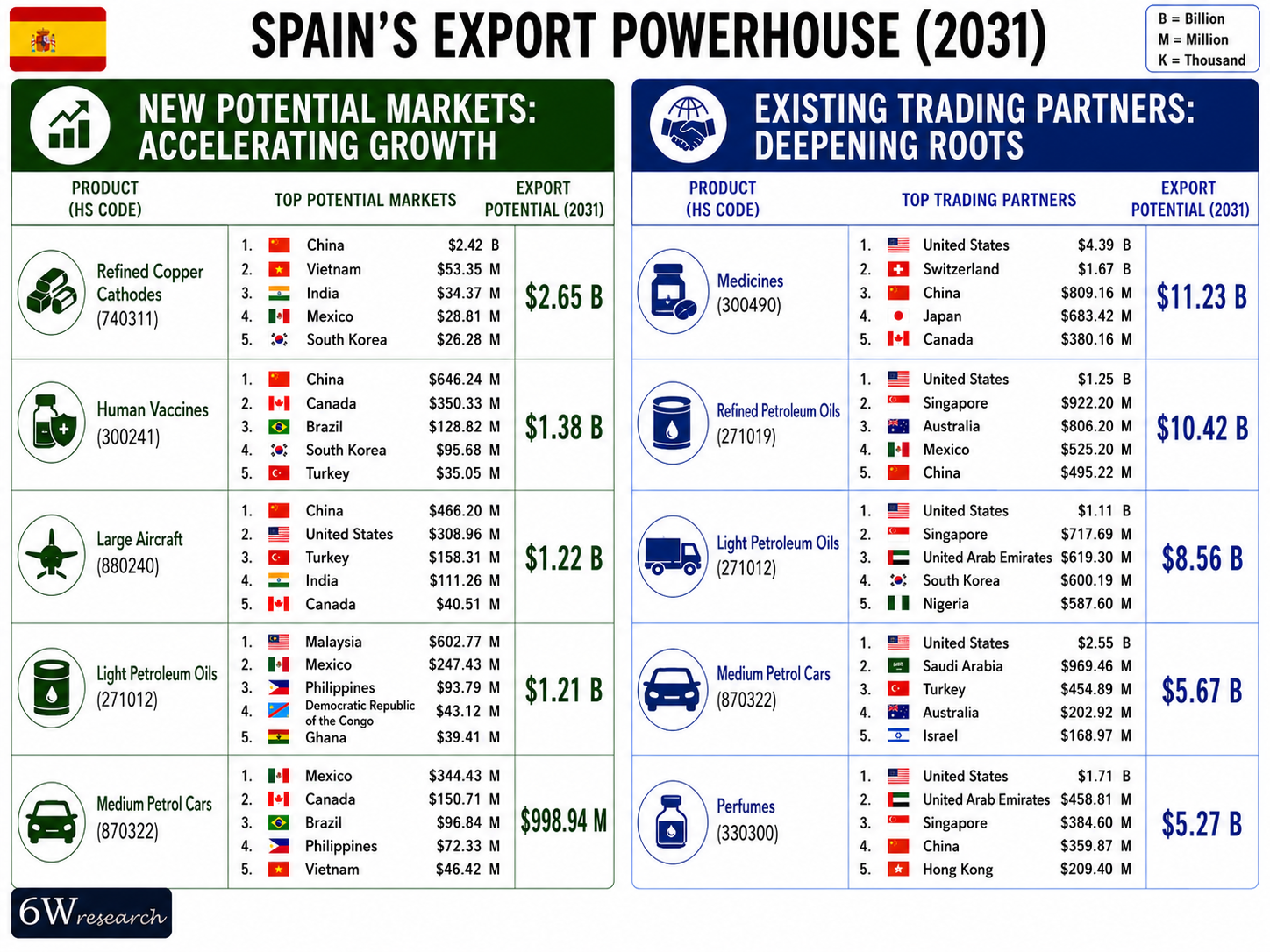
The United States remains Spain's largest existing export market, accounting for 27.55% of total Spain export potential, with China following at 9.71%. The outlook shifts when new and underdeveloped export corridors are examined: China emerges as the leading destination for new export opportunities, accounting for 24.23% of the category, well ahead of the United States at 7.23%. Medicines, refined petroleum oils and medium petrol cars continue to anchor Spain's established export portfolio, highlighting the country's strengths in pharmaceuticals, fuel processing and automotive manufacturing, while refined copper cathodes and human vaccines are emerging as the product categories most likely to expand Spain's global trade footprint through 2031.
 Source: 6WExportGTM
China Overtakes the Established US-Led Order to Lead Spain's New-Corridor Potential
China stands out as Spain's largest new potential buyer, carrying export potential of USD 10.87 billion, more than triple the United States' USD 3.25 billion opportunity in the same new-corridor category. Canada follows at USD 2.69 billion, with Hong Kong and Mexico rounding out the top five at USD 2.44 billion and USD 2.26 billion. This mix points to a market where Spain's next wave of growth leans heavily on deeper industrial ties with China spanning refined metals, vaccines and aviation-linked demand while the United States, Canada, Hong Kong and Mexico offer smaller but still meaningful openings for diversification beyond Spain's traditional European base.
| Top 5 Existing Leading Importers | Export Potential (USD Billion) | Top 5 New Potential Importers | Export Potential (USD Billion) |
| United States | 112.69 | China | 10.87 |
| China | 39.73 | United States | 3.25 |
| Canada | 20.51 | Canada | 2.69 |
| Japan | 18.20 | Hong Kong | 2.44 |
| Mexico | 15.35 | Mexico | 2.26 |
Source: 6WExportGTM
The United States remains Spain's single largest established buyer, with export potential of USD 112.69 billion, well ahead of China's USD 39.73 billion. Canada holds third position at USD 20.51 billion, while Japan and Mexico contribute USD 18.20 billion and USD 15.35 billion respectively. This importer spread reflects a trade base that leans on the United States as its principal growth engine while China, Canada, Japan and Mexico add ballast across pharmaceuticals, energy products, automotive goods and consumer categories keeping Spain from leaning too heavily on any one destination.
Copper Cathodes, Vaccines and Aviation Define Spain's Newest Export Corridors
Refined copper cathodes, human vaccines, large aircraft, and light petroleum oils and medium petrol cars directed at non-traditional destinations make up Spain's five biggest new-corridor opportunities through 2031. Where Spain's established strength sits in pharmaceuticals and refined fuels, these emerging categories trace a different story one built on the country's growing role in metals recycling, biologics manufacturing and aerospace supply chains reaching further into Asia and the Americas.
Refined copper cathodes represent Spain's single largest new-corridor opportunity at USD 2.65 billion, led overwhelmingly by China at USD 2.42 billion, with Vietnam, India, Mexico and South Korea trailing far behind; this pattern fits a refining base built to process concentrate and recovered metal into LME-grade cathodes rather than one dependent on domestic mine output alone. Human vaccines add USD 1.38 billion, led by China at USD 646.24 million, followed by Canada, Brazil, South Korea and Turkey a corridor consistent with Spain's established biologics manufacturing footprint extending to new public-health buyers. Large aircraft offer USD 1.22 billion in export potential, led by China at USD 466.20 million, followed by the United States, Turkey, India and Canada, reflecting Spain’s established role in European aerostructure and final-assembly supply chains.
Light petroleum oils directed at new destinations and medium petrol cars entering non-traditional markets round out the new-corridor top five. Light petroleum oils into new markets add USD 1.21 billion, led by Malaysia at USD 602.77 million, followed by Mexico, Philippines, Democratic Republic of the Congo and Ghana an extension of a fuels category where Spain already trades at far larger scale elsewhere. Medium petrol cars into new markets contribute USD 998.94 million, led by Mexico at USD 344.43 million, with Canada, Brazil, the Philippines and Vietnam supplying smaller pockets of demand. Taken together, these five opportunities suggest Spain's next stretch of export growth will come less from new industries than from routing existing refining, biologics and aerospace capacity toward buyers it has only lightly served so far.
Pharmaceuticals, Refined Fuels and Passenger Vehicles Anchor Spain's Established Trade
Medicines, refined petroleum oils, light petroleum oils, medium petrol cars and perfumes make up Spain's highest-value established export categories through 2031. Together they show a trade base still concentrated in pharmaceutical manufacturing, fuel refining and automotive production, with the United States, Singapore, the UAE, Saudi Arabia and Switzerland standing out as recurring destination markets across these categories.
Medicines represent Spain's largest established export opportunity at USD 11.23 billion, led by the United States at USD 4.39 billion and Switzerland at USD 1.67 billion, with China, Japan and Canada completing the top five a spread that fits Spain's position as a European pharmaceutical manufacturing base serving both mature Western and growing Asian buyers. Refined petroleum oils rank second at USD 10.42 billion, led by the United States at USD 1.25 billion and Singapore at USD 922.20 million, followed by Australia, Mexico and China, consistent with Spain's Mediterranean refining capacity feeding both European and long-haul markets. Light petroleum oils add USD 8.56 billion, again led by the United States at USD 1.11 billion, followed by Singapore, UAE, South Korea and Nigeria.
Medium petrol cars and Perfumes complete the established top five. Medium petrol cars contribute USD 5.67 billion, led by the United States at USD 2.55 billion and Saudi Arabia at USD 969.46 million, followed by Turkey, Australia and Israel, reflecting Spain's position as one of Europe's largest passenger-vehicle production bases. Perfumes add USD 5.27 billion, led by the United States at USD 1.71 billion and the UAE at USD 458.81 million, followed by Singapore, China and Hong Kong evidence of Spain's fragrance and cosmetics manufacturing reaching well beyond its home continent. Collectively, these five categories point to an established export base carried by pharmaceutical scale, refining capacity and automotive manufacturing depth, with fragrance and personal-care goods adding a lighter, higher-margin layer on top.
|
Spain's export advantage is increasingly driven by the evolution of its manufacturing and refining capabilities rather than cost competitiveness alone. Strong foundations in pharmaceuticals, vehicle electrification and copper processing position the country to sustain established demand while capturing emerging trade corridors, strengthening its role as one of Southern Europe's most resilient industrial exporters. 6WExportGTM Analysis |
What Spain Already Sells and Where
Passenger vehicles form Spain's largest established trade sector at USD 38.88 billion, led by medium petrol cars at USD 11.28 billion and a 29.00% share of the sector, followed by small petrol cars at USD 6.86 billion and a 17.64% share. Pharmaceuticals rank second at USD 23.52 billion, with medicines contributing USD 10.35 billion and a 43.98% share, while lactam products add USD 1.83 billion and 7.78%. Oil and gas follow at USD 20.28 billion, led by refined petroleum oils at USD 11.31 billion and a 55.76% share, with light petroleum oils adding USD 3.03 billion and 14.93% together underscoring Spain's manufacturing weight across vehicle assembly, pharmaceutical production and fuel refining.
| Sector | Exports (USD Billion) | Leading Products / Share |
| Passenger Vehicles | 38.88 | Medium Petrol Cars (29.00%), Small Petrol Cars (17.64%) |
| Pharmaceuticals | 23.52 | Medicines (43.98%), Lactam Products (7.78%) |
| Oil & Gas | 20.28 | Refined Petroleum Oils (55.76%), Light Petroleum Oils (14.93%) |
Source: 6WExportGTM
France is Spain's largest destination market at USD 58.67 billion, led by medium petrol cars at 5.11% of exports to the country and hybrid petrol cars at 2.41%. Germany ranks second at USD 40.50 billion, with small petrol cars contributing 4.77% and medicines 4.28%. Italy follows at USD 33.74 billion, supported by medium petrol cars at 3.49% and refined olive oil at 3.20%. This partner mix shows Spain's exports still running mainly along well-worn European corridors, with France, Germany and Italy absorbing a broad mix of vehicles, pharmaceuticals and, in Italy's case, a distinctly agricultural product.
| Country | Exports (USD Billion) | Leading Products / Share |
| France | 58.67 | Medium Petrol Cars (5.11%), Hybrid Petrol Cars (2.41%) |
| Germany | 40.50 | Small Petrol Cars (4.77%), Medicines (4.28%) |
| Italy | 33.74 | Medium Petrol Cars (3.49%), Refined Olive Oil (3.20%) |
Source: 6WExportGTM
A Battery Gigafactory and a Copper Recycling Plant: Two Projects Shaping Spain's Export Base
Volkswagen's PowerCo battery gigafactory in Sagunto is strengthening Spain's position in passenger-vehicle manufacturing and the transition toward electrified-vehicle exports, while Atlantic Copper's CirCular recycling plant in Huelva is expanding the country’s refined-copper capabilities and supporting its access to high-growth markets such as China.
PowerCo's Sagunto Gigafactory Deepens Spain's Automotive Export Base
Spain's passenger-vehicle export strength is entering a new phase through Volkswagen's PowerCo battery gigafactory in Sagunto, which will supply battery cells to the group's Spanish vehicle plants as hybrid and electric vehicle production accelerates. With an initial annual capacity of 40 GWh, expandable to 60 GWh, the project strengthens Spain's domestic battery supply chain and reduces reliance on imported cells. Spain's passenger-vehicle manufacturing base continues to provide a strong foundation for export growth, while investments such as the Sagunto battery gigafactory are accelerating the shift toward electrified mobility. With medium petrol cars already representing a key export category, the expansion of hybrid and electric vehicle capabilities is expected to create new opportunities across markets including China, the United States and Canada through 2031, supporting Spain’s transition toward higher-value automotive exports.
|
Spain's 2031 export growth will stay concentrated in vehicles and refined fuels, but the Sagunto gigafactory and a firm copper-recycling base give the country a credible on-ramp into higher-value electrified exports and metals reuse over the same period. Manish Pant, Senior Data Scientist, Data Science & Market Intelligence, 6Wresearch |
Atlantic Copper's Huelva Recycling Plant Reinforces the Refined-Copper Opportunity
Atlantic Copper's EUR 500 million CirCular recycling project in Huelva strengthens Spain's position in refined copper production by expanding its ability to process both primary concentrates and recycled electronic waste, supporting the country’s growing presence in high-value copper export markets. The additional feedstock improves the resilience and scalability of Spain's refining industry while reducing dependence on mined ore alone. The expansion of Spain’s refined copper processing capabilities reinforces the outlook for refined copper cathodes as one of the country’s largest emerging export corridors, supported by strong demand from China. By strengthening domestic production capacity rather than relying primarily on trading activity, Spain is better positioned to increase exports of high-purity cathodes into growing industrial markets. Together with the country's established pharmaceutical, refining and automotive industries, this investment highlights that Spain's future export growth will be driven by strengthening existing industrial capabilities rather than building entirely new sectors.
|
Spain's export growth through 2031 looks set to stay industrially grounded pharmaceuticals, refined fuels and vehicles carrying the established base, while copper recycling and early-stage battery manufacturing open room for new corridors across a wider set of global markets. Manisha Gupta, Data Analyst, Data Science & Market Intelligence, 6Wresearch |
The Takeaway
Spain should focus on transforming its established industrial strengths into higher-value export opportunities by accelerating electrified mobility, strengthening advanced manufacturing capabilities and expanding access to emerging global markets. The country’s next phase of export growth will come less from creating entirely new industries and more from upgrading existing advantages across automotive production, pharmaceuticals, refining and metals processing.
Key strategic priorities for Spain include:
- Accelerate the transition toward electrified vehicle exports: With passenger vehicles representing Spain’s largest established export sector at USD 38.88 billion, Spain should leverage investments such as the Sagunto battery gigafactory to strengthen domestic battery supply chains and capture growing demand for hybrid and electric vehicles across markets including China, the United States and Canada.
- Expand refined copper and critical material capabilities: Refined copper cathodes represent Spain’s largest new-corridor opportunity at USD 2.65 billion, driven primarily by China. Strengthening recycling capacity and copper processing capabilities will help Spain capture rising demand linked to electrification, renewable energy infrastructure and industrial supply chains.
- Deepen penetration in emerging export corridors: China has emerged as Spain’s largest new potential market with USD 10.87 billion in export potential, followed by the United States, Canada, Hong Kong and Mexico. Spain should focus on converting these emerging opportunities across metals, vaccines, aerospace and automotive products into long-term trade relationships.
- Build on pharmaceutical and refining leadership: Medicines, refined petroleum oils and passenger vehicles remain key pillars of Spain’s established export base. Maintaining competitiveness in these sectors while expanding into higher-value products such as vaccines, advanced automotive components and recycled materials will be essential for sustained export growth.
Overall, Spain’s export strategy through 2031 should prioritize upgrading existing industrial ecosystems, strengthening global supply-chain integration and using new investments in batteries, copper recycling and advanced manufacturing to diversify beyond traditional European markets.

Leadership Perspectives from Industry Events
Search
6Wresearch in the News
 Forbes
Citing 6Wresearch analytics to map global infrastructure and pharmaceutical industry trajectories.
 Bloomberg Law
Direct syndication of 6Wresearch's macro data points, capturing complex supply chain shifts.
 Reuters
Tracking industrial manufacturing adjustments and electronic security ecosystem scaling.
 Mint
Mint
Utilizing deep-tech sector market sizing to analyze global automation and robotics.
 The Economic Times
Anchoring features on industrial IoT growth metrics and connected smart-grid devices.
 Business Standard
Featuring strategic evaluations of Advanced Driver Assistance Systems (ADAS) and AI road safety.
 The Hindu
Spotlighting core commercial metrics ranging from unmanned aerial vehicles (UAVs) to consumer durables.
 Financial Express
Anchoring quarterly reviews on cross-border real estate tech and structural hardware manufacturing.
 Yahoo Finance
Syndicating the tracker's $30.1 billion untapped-market findings, spotlighting Japan, the US and China as India's top new-potential importers.
 India Today
Carrying the release on smartphones leading India's export potential to $94 billion by 2031, per 6WExportGTM data.
 Dailyhunt
Distributing the tracker findings to its regional readership, framing India's export diversification into Japan and Mexico.
 PR Newswire Original release
Publishing the full India Export Attractiveness Tracker 2026, detailing new trade corridors across iron ore, LCVs and pharmaceuticals.
 The Industrial
Highlighting the tracker's read on India's semiconductor ambitions and long-term chip-assembly export potential.
 PTI News
Reporting on the $66.81 billion pharmaceuticals export opportunity flagged in the tracker, amid looming US generic-drug tariffs.
 Tribune India
Covering the tracker's tariff-versus-regulation analysis across India's mature export markets in the US, China and UAE.
 ANI News
Amplifying the report's findings on polished diamonds, refined petroleum and medicines as India's core export engines.
 International Business Magazine
Covering the report's insight into how AEB, blind spot detection, and driver monitoring are reshaping India's ADAS market.
 Focus Gaming News
Highlighting the research forecast for Egypt's gambling market, projecting steady growth through 2032.
Thought Leadership and Analyst Meet





Our Clients








Latest Reports
- Peru Holistic Health Market (2026-2032)
- Pakistan Holistic Health Market (2026-2032)
- Oman Holistic Health Market (2026-2032)
- Nigeria Holistic Health Market (2026-2032)
- Nepal Holistic Health Market (2026-2032)
- Myanmar Holistic Health Market (2026-2032)
- Morocco Holistic Health Market (2026-2032)
- Mexico Holistic Health Market (2026-2032)
- Malaysia Holistic Health Market (2026-2032)
- Lebanon Holistic Health Market (2026-2032)
Industry Events and Analyst Meet

12th IVASS 2026

EV India Expo 2026

HIMTEX 2026

India Refining Summit 2026

India EV Show 2026
Whitepaper
- Middle East & Africa Commercial Security Market Click here to view more.
- Middle East & Africa Fire Safety Systems & Equipment Market Click here to view more.
- GCC Drone Market Click here to view more.
- Middle East Lighting Fixture Market Click here to view more.
- GCC Physical & Perimeter Security Market Click here to view more.


