Hybrid Petrol Cars Lead New-Market Export Opportunities with USD 2.72 Billion in Export Potential by 2031
Turkey's next export growth wave looks set to come from markets it already knows well. The United States accounts for 28.01% of Turkey's export potential in 2031, while China leads on entirely new product lines at 24.02%, with the United States close behind at 16.61%. Together, this points to a strategy of deepening long-standing anchor relationships while carefully building out newer, more diversified corridors alongside them.
Source: 6WExportGTM
United States Anchors Turkey's Export Potential, While China Leads Untapped New-Market Opportunities
On established product lines through 2031, Turkey's export potential stays concentrated with long-standing partners, led by the United States at USD 74.97 billion, China follows at USD 24.84 billion, with Canada (USD 12.57 billion), Japan (USD 10.14 billion) and Mexico (USD 8.98 billion) rounding out a top five spanning energy, automotive and precious-metals trade.
| Top 5 Current Leading Importers | Export Potential (USD Billion) | Top 5 New Potential Importers | Export Potential (USD Billion) |
| United States | 74.97 | China | 10.14 |
| China | 24.84 | United States | 7.01 |
| Canada | 12.57 | Japan | 2.71 |
| Japan | 10.14 | Mexico | 2.21 |
| Mexico | 8.98 | Canada | 1.79 |
Source: 6WExportGTM
Shift to product lines Turkey has barely developed, and China moves from second place to first: USD 10.14 billion of entirely new-potential trade, ahead of the United States at USD 7.01 billion. Japan (USD 2.71 billion), Mexico (USD 2.21 billion, 5.23%) and Canada (USD 1.79 billion, 4.24%) complete a top five where four of five names already appear among Turkey's established partners suggesting the more realistic growth path runs through selling different products to familiar buyers, rather than finding entirely new ones.
New Markets for Turkey's Hybrid Cars and Light Petroleum Oils
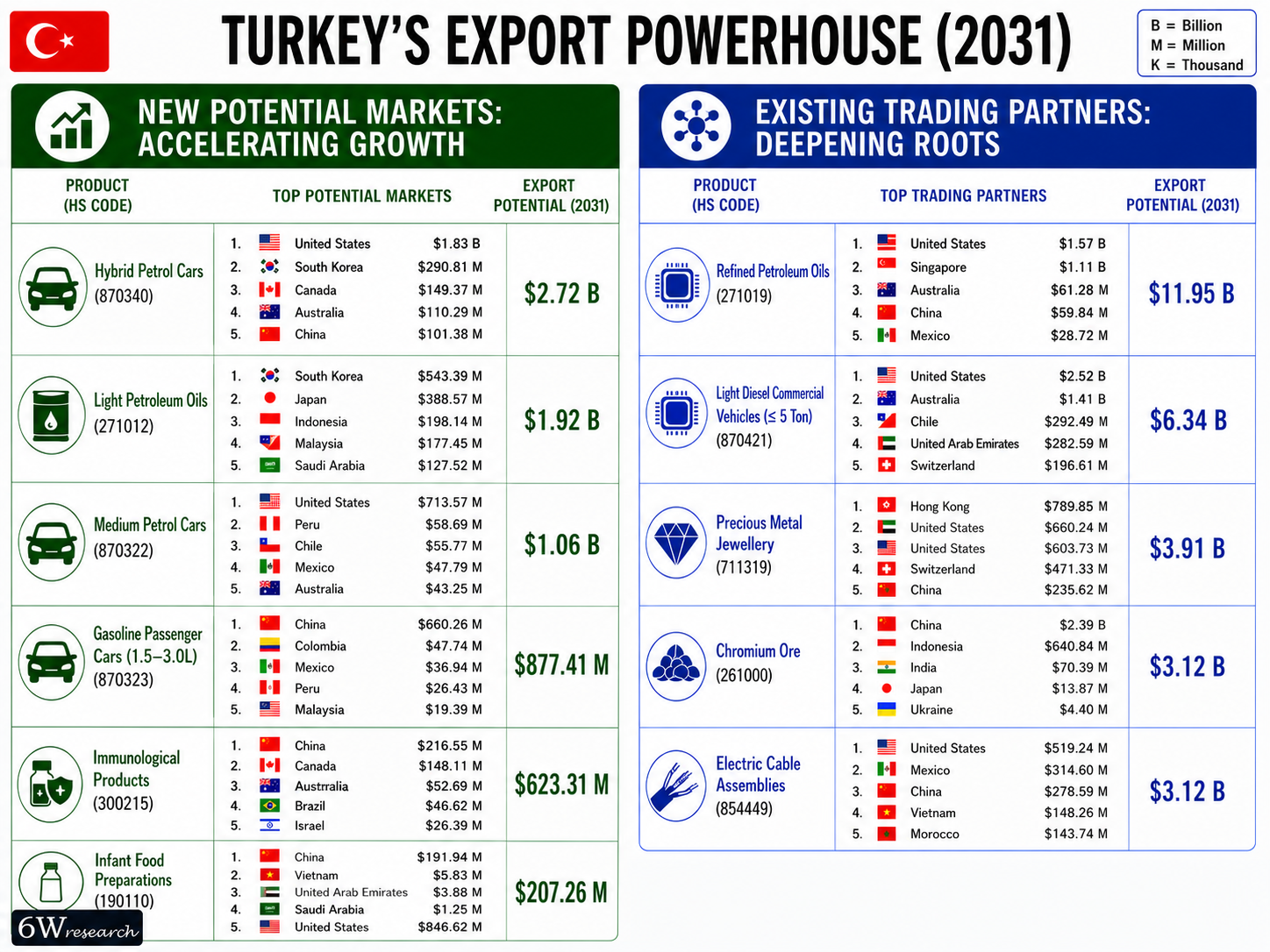
Hybrid petrol cars, light petroleum oils and medium petrol cars lead the list of untapped export corridors. Turkey currently ships little of these specific product lines to the countries below for example, Hybrid Petrol Cars into the United States, or Light Petroleum Oils into South Korea yet 6WExportGTM's modeling points to meaningful, largely unclaimed demand building through 2031.
Hybrid Petrol Cars represent the single largest such opening, worth USD 2.72 billion, with the United States alone accounting for USD 1.89 billion, South Korea at USD 280.81 million, Canada (USD 149.37 million), Australia (USD 110.29 million) and China (USD 101.38 million) trailing well behind. Light Petroleum Oils add USD 1.92 billion, this time led from Asia: South Korea (USD 543.39 million) and Japan (USD 388.57 million) together account for close to half the total, with Indonesia, Malaysia and Saudi Arabia filling out a genuinely global spread.
Medium Petrol Cars contribute a further USD 1.06 billion, again anchored by the United States (USD 713.57 million); Gasoline Passenger Cars (1.5–3.0L) add USD 877.41 million, this time led by China (USD 660.26 million) rather than the US; and Immunological Products the one line on this list unrelated to autos or fuel close out the group at USD 621.65 million, led by China (USD 216.55 million) and Canada (USD 147.87 million), hinting at an early, still-small pharmaceutical export opening alongside Turkey's automotive push.
Turkey's Core Export Engines: Refined Petroleum, Diesel Trucks and Precious Metal Jewellery Across Established Markets
Refined petroleum oils, diesel trucks, precious metal jewellery, chromium ore and electric cable assemblies form the backbone of Turkey's highest-value 2031 export potential a genuinely varied mix spanning energy refining, automotive manufacturing, jewelry and mining, rather than dependence on any single industry. Forecasts show substantial scale across the board, led by the United States on refined petroleum (USD 1.57B) and diesel trucks (USD 2.52B), Hong Kong and the UAE on precious metal jewellery, and China on chromium ore (USD 2.39B).
Refined Petroleum Oils sit at the top, worth USD 11.95 billion by 2031, led by the United States (USD 1.57 billion), Singapore (USD 1.11 billion) and Australia (USD 961.28 million) a genuinely global buyer base rather than a regional one. Diesel Trucks (under 5 tons) add USD 6.34 billion, led again by the United States (USD 2.52 billion) and Australia (USD 1.41 billion), reflecting Turkey's position as a serious light-commercial-vehicle manufacturing base.
Precious Metal Jewellery contributes USD 3.91 billion, spread more evenly than most other lines Hong Kong (USD 789.85 million), the UAE (USD 660.24 million) and the United States (USD 609.73 million) each play a meaningful role, consistent with Istanbul's long-standing position as a global gold and jewelry trading center. Chromium Ore adds USD 3.12 billion, almost entirely destined for China (USD 2.39 billion), while Electric Cable Assemblies close out the top five at USD 3.12 billion, led by the United States (USD 519.24 million) and Mexico (USD 314.60 million).
|
Turkey's strongest export priorities span energy, automotive and precious metals rather than one dominant sector refined fuels and diesel trucks into the United States, jewellery into Hong Kong and the UAE, and chromium ore feeding China's steel industry. 6WExportGTM Analysis |
Electric Vehicles and Aerospace Exports Position Turkey for Its Next Growth Wave, Led by a USD 1 Billion-Plus EV Buildout and the KAAN Fighter Program
Two structural shifts, largely absent from Turkey's historical export mix, are already visible in the 2031 data and in the investment, decisions being made today. The first is electric and hybrid vehicles, showing up directly in the new-potential numbers as Hybrid Petrol Cars, Medium Petrol Cars and Gasoline Passenger Cars aimed at the United States, South Korea and China. The second is aerospace and defense, which doesn't yet appear as a standalone line in the export-potential tables but already sits inside Turkey's established Aircraft Parts sector turbine engine parts and components worth well over a billion dollars in current trade and is scaling fast enough to reshape the picture within a few years.
BYD, Ford and Hyundai's Combined Investment Positions Turkey as Europe's Emerging EV Manufacturing Hub
Turkey's domestic EV champion TOGG has moved from a standing start in 2022 to real export ambitions, opening pre-orders for its T10F sedan and T10X SUV in Germany in September 2025 and passing Euro NCAP crash testing with top scores. It isn't alone: BYD is building a USD 1 billion, 150,000-unit-capacity plant in Gebze targeted to begin production by the end of 2026, Ford has committed USD 2.4 billion to an EV and battery plant in Kocaeli its largest commercial-vehicle hub in Europe and Hyundai is preparing to build the Ioniq 3 in Izmit, becoming the first global automaker to assemble battery-electric passenger cars in Turkey after TOGG. Turkey already ranked fourth in European EV sales in the first half of 2025, behind only Germany, the UK and France.
KAAN Fighter Deliveries Push Turkey's Aerospace Exports Past USD 10 Billion, Led by Turkish Aerospace Industries
Turkey's aerospace and defense sector crossed USD 10 billion in annual exports for the first time in 2025, growing roughly 48% year-on-year, led by Turkish Aerospace Industries' KAAN fifth-generation fighter program. The Turkish Air Force signed a contract for an initial batch of 20 jets in May 2026, Indonesia ordered 48 the following month, and the United States cleared export of GE's F110 engines to power the aircraft's first production batches removing a key bottleneck to serial output. None of this shows up yet in the HS-code-level export-potential data underpinning this report, since finished military aircraft rarely register the same way as their component parts, but the turbine engine parts and components already inside Turkey's Aircraft Parts sector are the raw material feeding this build-out.
|
Turkey's automotive export story is being rewritten by four separate global carmakers building EV capacity on its soil at once that kind of simultaneous, multi-brand investment is a stronger signal of durable demand than any single company's plans. Manish Pant, Senior Data Scientist, Data Science & Market Intelligence, 6Wresearch |
|
Crossing USD 10 billion in annual defense and aerospace exports is a genuine milestone, but the more interesting number is the growth rate behind it nearly 50% year-on-year is not a mature industry coasting on legacy programs, it's one still in its early scaling phase. Manisha Gupta, Data Analyst, Data Science & Market Intelligence, 6Wresearch |
For 6WExportGTM, the implication is that Turkey's next export chapter will be written substantially outside its current top-five product lines by an EV and hybrid-vehicle push aimed at the United States, South Korea and China, running in parallel with an aerospace and defense sector whose export value is compounding fast enough that it may soon warrant its own dedicated tracking, separate from the traditional energy, jewelry and mining base covered here.
Top Global Export Opportunities (2031), By Product
| Product | Export Opportunity (USD Billion) |
| Electronic Integrated Circuits | 685.7 |
| Refined Petroleum Oils | 668.4 |
| Light Petroleum Oils | 588.9 |
| Logic electronic integrated circuits | 507.9 |
| Medicines | 381.2 |
| Gasoline Passenger Cars (1.5–3.0L) | 360.9 |
| Smartphones | 343.6 |
| Electronic integrated circuits with memory | 333.2 |
| Data Transmission Equipment | 216.9 |
| Immunological Products | 209.6 |
Excludes naturally occurring products (e.g., crude oil, raw gold). Source: 6WExportGTM
Globally, the largest export opportunities beyond naturally occurring products are concentrated in electronics, energy and pharmaceuticals highlighting the growing dominance of semiconductors, advanced manufacturing and high-value technology products in global trade. Japan already sits inside several of these categories, but its real priority through 2031 is defending semiconductor-equipment leadership, stabilizing its auto industry through a difficult transition, and using energy and metals diversification to reduce the geopolitical exposure that comes with a resource-poor, trade-dependent economy.
The Trade Base Turkey Has Already Built
A small set of established sectors, built on Turkey's refining, mining and jewelry-manufacturing capacity, does most of the work in its current trade. Jewelry leads at USD 6.36 billion, almost entirely precious metal jewellery. Oil & Gas follows at USD 4.48 billion, led by refined petroleum oils (95.59%) and light petroleum oils (4.41%), while Precious Metals contributes USD 3.60 billion, led by unwrought gold (98.39%).
| Sector | Exports (USD Billion) | Leading Products / Share |
| Jewelry | 6.36 | Precious Metal Jewellery (98.99%) |
| Oil & Gas | 4.48 | Refined Petroleum Oils (95.59%), Light Petroleum Oils (4.41%) |
| Precious Metals | 3.60 | Unwrought Gold (98.39%) |
Source: UN Comtrade
Three markets account for the bulk of current trading value. The United States tops the list at USD 16.83 billion, led by precious metal jewellery and turbine engine parts (5.14%) an early sign of the aerospace relationship described above. The UAE follows at USD 9.73 billion, led overwhelmingly by unwrought gold (33.67%) and precious metal jewellery (30.21%), together accounting for close to two-thirds of the entire relationship. Egypt rounds out the top three at USD 4.01 billion, led by refined petroleum oils (10.48%) and precious metal jewellery (3.49%).
| Country | Exports (USD Billion) | Leading Products / Share |
| United States | 16.83 | Precious Metal Jewellery (6.18%), Turbine Engine Parts (5.14%) |
| United Arab Emirates | 9.73 | Unwrought Gold (33.67%), Precious Metal Jewellery (30.21%) |
| Egypt | 4.01 | Refined Petroleum Oils (10.48%), Precious Metal Jewellery (3.49%) |
Source: UN Comtrade
Where Turkey's Export Story Goes from Here
Turkey's existing export base is already unusually well diversified energy, jewelry, automotive parts and mining each contribute meaningfully rather than one sector carrying the whole economy and that spread is a genuine strength heading into 2031. But the more consequential story may be the two shifts still forming: an EV and hybrid-vehicle manufacturing base being built simultaneously by TOGG, BYD, Ford and Hyundai, aimed squarely at the United States, South Korea and China corridors already flagged as new-potential markets; and an aerospace and defense sector that just crossed USD 10 billion in annual exports and is compounding at close to 50% a year, anchored by the KAAN fighter program. Neither shows up fully in the product-level tables driving this report's headline numbers, which is precisely why they matter the next USD 42.21 billion in untapped potential is likely to be shaped as much by these emerging categories as by the refined fuels, diesel trucks and jewellery that anchor Turkey's trade today. A closer look at tariff exposure and regulatory friction across these corridors will follow in a later update.

Leadership Perspectives from Industry Events
Search
6Wresearch in the News
 Forbes
Citing 6Wresearch analytics to map global infrastructure and pharmaceutical industry trajectories.
 Bloomberg Law
Direct syndication of 6Wresearch's macro data points, capturing complex supply chain shifts.
 Reuters
Tracking industrial manufacturing adjustments and electronic security ecosystem scaling.
 Mint
Mint
Utilizing deep-tech sector market sizing to analyze global automation and robotics.
 The Economic Times
Anchoring features on industrial IoT growth metrics and connected smart-grid devices.
 Business Standard
Featuring strategic evaluations of Advanced Driver Assistance Systems (ADAS) and AI road safety.
 The Hindu
Spotlighting core commercial metrics ranging from unmanned aerial vehicles (UAVs) to consumer durables.
 Financial Express
Anchoring quarterly reviews on cross-border real estate tech and structural hardware manufacturing.
 Yahoo Finance
Syndicating the tracker's $30.1 billion untapped-market findings, spotlighting Japan, the US and China as India's top new-potential importers.
 India Today
Carrying the release on smartphones leading India's export potential to $94 billion by 2031, per 6WExportGTM data.
 Dailyhunt
Distributing the tracker findings to its regional readership, framing India's export diversification into Japan and Mexico.
 PR Newswire Original release
Publishing the full India Export Attractiveness Tracker 2026, detailing new trade corridors across iron ore, LCVs and pharmaceuticals.
 The Industrial
Highlighting the tracker's read on India's semiconductor ambitions and long-term chip-assembly export potential.
 PTI News
Reporting on the $66.81 billion pharmaceuticals export opportunity flagged in the tracker, amid looming US generic-drug tariffs.
 Tribune India
Covering the tracker's tariff-versus-regulation analysis across India's mature export markets in the US, China and UAE.
 ANI News
Amplifying the report's findings on polished diamonds, refined petroleum and medicines as India's core export engines.
 International Business Magazine
Covering the report's insight into how AEB, blind spot detection, and driver monitoring are reshaping India's ADAS market.
 Focus Gaming News
Highlighting the research forecast for Egypt's gambling market, projecting steady growth through 2032.
Thought Leadership and Analyst Meet





Our Clients








Latest Reports
- Austria X-ray Imaging Devices Market (2026-2032)
- Armenia X-ray Imaging Devices Market (2026-2032)
- Antigua and Barbuda X-ray Imaging Devices Market (2026-2032)
- Angola X-ray Imaging Devices Market (2026-2032)
- Andorra X-ray Imaging Devices Market (2026-2032)
- Albania X-ray Imaging Devices Market (2026-2032)
- Afghanistan X-ray Imaging Devices Market (2026-2032)
- United States (US) X-ray Imaging Devices Market (2026-2032)
- United Kingdom (UK) X-ray Imaging Devices Market (2026-2032)
- United Arab Emirates (UAE) X-ray Imaging Devices Market (2026-2032)
Industry Events and Analyst Meet

EV India Expo 2026

HIMTEX 2026

India Refining Summit 2026

India EV Show 2026

EV tech India Expo 2026
Whitepaper
- Middle East & Africa Commercial Security Market Click here to view more.
- Middle East & Africa Fire Safety Systems & Equipment Market Click here to view more.
- GCC Drone Market Click here to view more.
- Middle East Lighting Fixture Market Click here to view more.
- GCC Physical & Perimeter Security Market Click here to view more.


