How Will Gujarat and Rajasthan Lead the Next Wave of Industrial Automation Innovation in Western India?
India Western Region Industrial Automation Market
Objective
This study looked at where India's Western region — Gujarat, Rajasthan, Maharashtra — is headed on industrial automation between 2025 and 2031: market size, growth drivers, and how the picture differs state by state. We wanted to understand what's pulling demand in each region, how the competitive field breaks down among players like Siemens, ABB, and Schneider Electric, and what automation actually looks like sector by sector — automotive, chemicals, textiles, pharma. Beyond the numbers, we wanted a clear picture of the region's industrial hubs and who the customers really are, so clients could make sharper calls on market entry, positioning, and where to put investment first. We leaned on 6Wresearch's usual toolkit for expert interviews through 6WForum, structured primary data via 6WSurveyIQ, and Python/SQL-based analysis — to turn all of that into something clients could actually act on.
Business Challenge
Western India's industrial base is anything but uniform — automotive, chemicals, textiles, and pharma all have distinct automation needs, and that alone makes the market hard to approach with a single playbook. Vendors are dealing with a fragmented landscape, uneven adoption across regions, and technology standards that keep shifting as Industry 4.0 matures. Add in state-level initiatives around green hydrogen, smart ports, and "desert-tech" innovation, and the automation solutions required start to look pretty specialized — which complicates both market entry and how you position a product. Labor shortages and a shortage of skilled operators are slowing the pace of deployment on the ground. And with established multinationals sitting alongside local players, the competitive picture is genuinely fragmented, which makes market-share analysis harder than it should be. Together, these factors leave stakeholders without a clear read on where to prioritize investment or how to build a region-specific go-to-market plan.
How We Did It
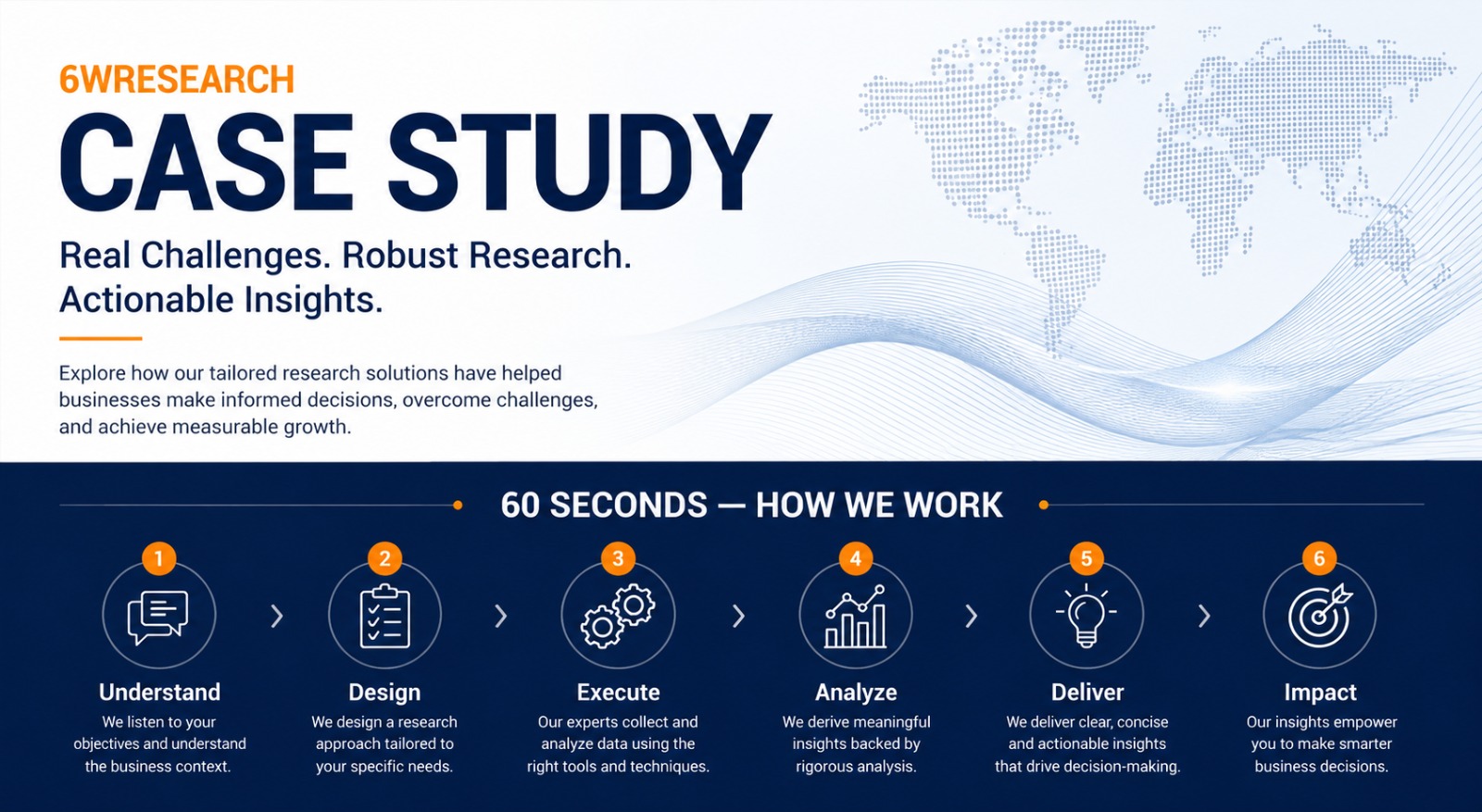
We combined primary and secondary research to build out a full picture of the Western India automation market. On the primary side, we spoke with CXOs, industry leaders, and distributors through 6WForum to get a direct read on market trends, customer needs, and how the competitive dynamics actually play out on the ground. Secondary research drew on industry reports, company filings, and market publications, backed by our in-house databases. To size the market, we used both top-down and bottom-up models, working from historical company data and local statistics. The regression analysis and segmentation work that helped us tease apart demand drivers and regional differences was done in Python and SQL. We then used Power BI and Tableau to turn that into interactive dashboards for the client’s own decision-making. Projections are grounded in trend extrapolation coupled with scenario analysis and expert validation. The whole process was treated as an iterative one, validating and refining as we went rather than locking in assumptions early, to ensure that the final output actually reflected regional nuance.
Key Findings
- The Western India industrial automation market is projected to grow at a CAGR of 10.8% from 2025 to 2031, driven by sectoral automation upgrades and regional innovation hubs.
- Gujarat leads in automation revenue share, particularly in life sciences and chemicals, supported by strong policy incentives and infrastructure development.
- Rajasthan exhibits a rising automation demand, especially in cement, mining, and agro-processing sectors, leveraging the Delhi-Mumbai Industrial Corridor.
- Maharashtra maintains the highest revenue share due to its mature automotive and aerospace industries, with ongoing investments in EV and drone logistics automation.
- Siemens and ABB dominate the regional automation landscape, holding significant market shares, while Rajasthan displays a more fragmented vendor landscape.
- Key industrial clusters such as Sanand, Vadodara, and Jaipur are focal points for automation deployment, with automotive, textiles, and chemical industries leading adoption.
- The regional market is witnessing increased integration of AI, IoT, and blockchain technologies, especially in Gujarat’s smart ports and Rajasthan’s desert-tech solutions.
Findings
Gujarat is clearly emerging as the fastest-growing automation hub in the region, riding aggressive state policy and heavy infrastructure investment in life sciences, chemicals, and gigafactory-scale manufacturing. Its growth rate is set to outpace the national average, helped along by green hydrogen projects and smart-port development that lean on AI and blockchain. Maharashtra keeps its lead in absolute terms, thanks to a mature automotive and aerospace sector that's steadily adopting Industry 4.0 to improve productivity and stay compliant. Rajasthan tells a different story — it's pivoting away from purely resource-based industry toward AI-driven mining, solar-linked agro-processing, and desert-tech innovation, with the Delhi-Mumbai Industrial Corridor acting as a real enabler. Siemens and ABB are still the vendors to beat, but the more fragmented field in Rajasthan leaves room for local and niche players to carve out a position. Growth of this industry is further accelerated by the rising adoption of advanced automation technologies, including growing demand for robotics, sensors and control systems tailored to specific sectors -- driven by labor shortages as much as competitive pressure.
Automation adoption in the region is increasingly tied to two things: operational efficiency and sustainability. Companies are prioritizing cost reduction, quality, and environmental compliance in roughly that order. Pharma and chemical companies in Gujarat are seeking IoT-enabled process automation, while cement and mining companies in Rajasthan are looking for AI-driven predictive maintenance and water-efficient solutions. Buyers want integrated, scalable platforms built to Industry 4.0 standards, and deployment tends to be a close collaboration between OEMs and end-users, not a hand-off. Siemens and ABB are the technology leaders - strong service networks, broad product lines - but local vendors are gaining traction in Rajasthan, because they're more agile and willing to tailor offerings. Ultimately, investment is driven by government incentives, availability of skilled labor and the strength of the ROI case. Looking forward, demand is shifting toward AI, machine learning, digital twin technology with sustainability and resilience emerging as core themes – especially in relation to Gujarat’s green hydrogen ambitions and Rajasthan’s desert-tech push.
Business Impact
The projected 10.8% CAGR points to real growth ahead in chemicals, pharma, and automotive — useful input for anyone shaping product development or portfolio strategy in the region. Siemens and ABB's dominance underlines how much technological credibility and service quality matter for market entry and partnership decisions. The regional emphasis on Gujarat's green hydrogen work and Rajasthan's desert-tech initiatives points to where investment should be targeted first, in line with what state governments are already prioritizing. A better understanding of how consumers actually shop and what they think of the various brands should lead to sharper marketing and sales approaches, and thus help with acquisition and retention. With AI, IoT and digital twins continuing to grow in influence, ongoing innovation and the right technology relationships are no longer nice-to-haves, but are becoming the differentiator in winning deals. This suggests better resource allocation, region-specific go-to-market strategies and faster digital transformation for companies looking to strengthen their position in India’s changing industrial landscape.


