Hungary Alcohol Testing Market (2026-2032) | Trends, Outlook, Share, Industry, Companies, Value, Forecast, Size, Revenue, Growth & Analysis
Market Forecast By Testing Equipment Types (Infrared Based Breathalyzer, Semi-conductor Based Breathalyzer, Immunoassay Analyzers, Fuel Cell Based Breathalyzer, Oral Fluid Testing Devices, Hair Testing Devices, Urine Testing Devices, Others), By Applications (Alcohol Detection, Drug Detection) And Competitive Landscape
| Product Code: ETC013719 | Publication Date: Oct 2020 | Updated Date: Jun 2026 | Product Type: Report | |
| Publisher: 6Wresearch | Author: Dhaval Chaurasia | No. of Pages: 70 | No. of Figures: 35 | No. of Tables: 5 |
Hungary Alcohol Testing Market Summary
The hungary alcohol testing market was estimated at USD 209 Million in 2025 and is projected to reach USD 290 Million by 2032, growing at a CAGR of 5.7% from 2026 to 2032.
Hungary Alcohol Testing Market Year-wise Growth Rate and Key Drivers
This graph highlights how the Hungary Alcohol Testing Market has steadily grown over the past five years, supported by major growth factors.
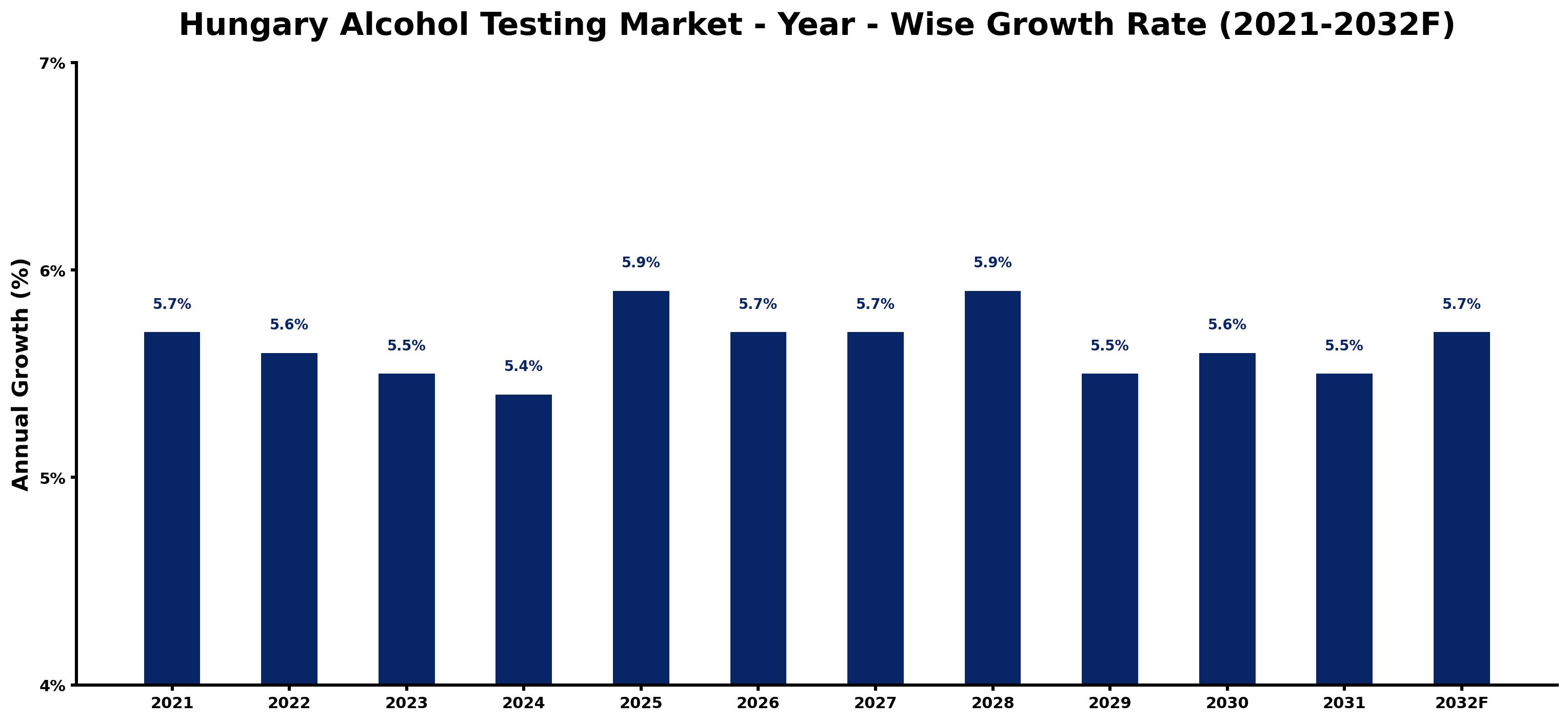
The table below presents the year wise growth rates along with the key drivers influencing the market
| Year | Growth Rate | Major Drivers |
| 2021 | 5.7% | Post-lockdown retail projects led to increased demand for alcohol testing solutions. |
| 2022 | 5.6% | Corporate responsibility initiatives highlighted the need for workplace alcohol testing devices. |
| 2023 | 5.5% | Public awareness campaigns reduced the stigma associated with alcohol testing measures. |
| 2024 | 5.4% | Technological advancements improved the accuracy and efficiency of testing equipment. |
| 2025 | 5.9% | Emerging startups introduced innovative testing methodologies to capture market interest. |
| 2026 | 5.7% | Partnerships between health organizations and testing companies expanded outreach efforts significantly. |
| 2027 | 5.7% | Increased traffic incidents prompted municipalities to enforce stricter alcohol testing regulations. |
| 2028 | 5.9% | Evolving consumer preferences shifted towards portable, user-friendly testing devices. |
| 2029 | 5.5% | Healthcare providers began integrating alcohol testing into routine health assessments. |
| 2030 | 5.6% | Insurance companies offered discounts for businesses implementing comprehensive alcohol testing programs. |
| 2031 | 5.5% | Cross-border trade agreements facilitated easier access to advanced testing technologies. |
| 2032 | 5.7% | Heightened concerns about public safety fueled demand for rigorous alcohol testing standards. |
Note - Market size estimations and growth projections presented in this report are based on 6Wresearch's advanced forecasting approach, validated with industry datasets as of June 2026.
Hungary Alcohol Testing Market Synopsis
The Hungary Alcohol Testing Market is projected to reach 5.7% and witness significant growth during the forecast period (2026-2032). This growth is fueled by the increasing emphasis on public safety, stringent regulations related to alcohol consumption, and a rising awareness of the dangers associated with drunk driving.
Hungary Alcohol Testing Market Growth Drivers
Several factors are driving the expansion of the Hungary Alcohol Testing Market. Firstly, the government has implemented stringent laws aimed at reducing alcohol-related incidents, which has heightened the demand for reliable testing methods. Secondly, educational campaigns have raised public awareness about the risks of excessive drinking, thus promoting a culture of responsible consumption. Thirdly, advancements in technology are producing more accurate and user-friendly testing devices, which are appealing to both law enforcement and individual consumers. Additionally, the increasing need for workplace safety protocols has led organizations to adopt regular alcohol testing to ensure employee well-being. Finally, initiatives to reduce road fatalities, which include random alcohol testing checkpoints, have further stimulated market growth.
Hungary Alcohol Testing Market Trends and Opportunities
The Hungary Alcohol Testing Market is witnessing several key trends that present substantial investment opportunities. One prominent trend is the growing popularity of portable breathalyzers, which offer convenience and immediate results. These devices are becoming increasingly sophisticated, featuring technologies that enhance their accuracy and ease of use. Another notable trend is the integration of alcohol testing equipment with smartphone applications, allowing users to monitor their consumption and receive real-time data. Moreover, the market is also seeing an inclination towards non-invasive testing methods, such as saliva and sweat tests, creating alternative options for diverse consumer needs. The focus on innovation in testing technology is likely to shape the market landscape and offer lucrative avenues for investment. There is also a significant opportunity for public-private partnerships aimed at facilitating widespread alcohol testing in high-risk areas.
Hungary Alcohol Testing Market Challenges and Restraints
Despite the positive outlook, the Hungary Alcohol Testing Market faces several challenges. One of the major obstacles is the lack of standardized regulations governing alcohol testing procedures, which can result in inconsistencies and confusion regarding testing methodologies. Further complicating the landscape is the prevalence of counterfeit alcohol testing devices that provide unreliable results and endanger public safety. Limited public awareness about the importance of routine alcohol testing poses an additional challenge, potentially stifling market growth. Furthermore, the high costs associated with purchasing and maintaining testing equipment may deter some entities from investing in reliable solutions. Addressing these challenges is imperative for harnessing the full potential of the Hungary Alcohol Testing Market.
Hungary Alcohol Testing Market Investment Opportunities
The Hungary Alcohol Testing Market offers multiple avenues for investment, particularly in the realm of advanced breathalyzer technologies. As regulatory frameworks around alcohol consumption tighten, there exists a burgeoning demand for innovative and accurate testing solutions. Potential investors can benefit from focusing on the development of portable devices and technologies that connect to smartphones, enhancing user engagement and data tracking. Additionally, collaboration with government agencies and private enterprises aimed at expanding testing initiatives presents a viable investment strategy in this market. The ongoing concern for road safety coupled with strict enforcement of alcohol-related legislation indicates a promising trajectory for stakeholders looking to capitalize in this sector.
Hungary Alcohol Testing Market Government Investment and Initiatives
The Hungarian government has established a comprehensive framework of policies and initiatives focused on the reduction of alcohol-related incidents. This includes setting a legal blood alcohol limit of 0.00% for drivers under 24 years and 0.02% for all other drivers. Moreover, random alcohol testing conducted by law enforcement serves as a deterrent against drunk driving. Government mandates require commercial vehicle operators to undergo regular alcohol screening, reinforcing a culture of accountability and safety on public roads. Public spending towards alcohol awareness campaigns further complements these regulatory measures, indicating a concerted effort to educate citizens about the consequences of alcohol consumption and enhance road safety. These initiatives are pivotal in creating a supportive environment for the Hungary Alcohol Testing Market.
Hungary Alcohol Testing Market Latest Developments (May 2025 - June 2026)
The period from May 2025 to June 2026 has been marked by notable developments within the Hungary Alcohol Testing Market. There has been an increasing focus on regulatory enhancements, with authorities examining the implementation of more stringent testing procedures aimed at ensuring accuracy. Furthermore, advancements in technology have resulted in the introduction of innovative testing devices that utilize non-invasive methods, further expanding the range of options available to consumers and businesses alike. Collaborations between law enforcement and technology firms have increased, aimed at producing state-of-the-art breathalyzers and alcohol testing solutions that align with modern safety needs. Additionally, there has been increased funding allocated towards public safety campaigns, reflecting an ongoing commitment by the government to address alcohol-related issues proactively.
Hungary Alcohol Testing Market - Key Attractiveness of the Report
- 10 Years of Market Numbers
- Historical Data Starting from 2022 to 2025
- Base Year: 2025
- Forecast Data until 2032
- Key Performance Indicators Impacting the Market
- Major Upcoming Developments and Projects
Key Highlights of the Report:
- Hungary Alcohol Testing Market Outlook
- Market Size of Hungary Alcohol Testing Market, 2025
- Forecast of Hungary Alcohol Testing Market, 2032F
- Historical Data and Forecast of Hungary Alcohol Testing Revenues & Volume for the Period 2022-2032F
- Hungary Alcohol Testing Market Trend Evolution
- Hungary Alcohol Testing Market Drivers and Challenges
- Hungary Alcohol Testing Price Trends
- Hungary Alcohol Testing Porter's Five Forces
- Hungary Alcohol Testing Industry Life Cycle
- Historical Data and Forecast of Hungary Alcohol Testing Market Revenues & Volume By Testing Equipment Types for the Period 2022-2032F
- Historical Data and Forecast of Hungary Alcohol Testing Market Revenues & Volume By Infrared Based Breathalyzer for the Period 2022-2032F
- Historical Data and Forecast of Hungary Alcohol Testing Market Revenues & Volume By Semi-conductor Based Breathalyzer for the Period 2022-2032F
- Historical Data and Forecast of Hungary Alcohol Testing Market Revenues & Volume By Immunoassay Analyzers for the Period 2022-2032F
- Historical Data and Forecast of Hungary Alcohol Testing Market Revenues & Volume By Fuel Cell Based Breathalyzer for the Period 2022-2032F
- Historical Data and Forecast of Hungary Alcohol Testing Market Revenues & Volume By Oral Fluid Testing Devices for the Period 2022-2032F
- Historical Data and Forecast of Hungary Alcohol Testing Market Revenues & Volume By Hair Testing Devices for the Period 2022-2032F
- Historical Data and Forecast of Hungary Alcohol Testing Market Revenues & Volume By Urine Testing Devices for the Period 2022-2032F
- Historical Data and Forecast of Hungary Infrared Based Breathalyzer Alcohol Testing Market Revenues & Volume By Others for the Period 2022-2032F
- Historical Data and Forecast of Hungary Alcohol Testing Market Revenues & Volume By Applications for the Period 2022-2032F
- Historical Data and Forecast of Hungary Alcohol Testing Market Revenues & Volume By Alcohol Detection for the Period 2022-2032F
- Historical Data and Forecast of Hungary Alcohol Testing Market Revenues & Volume By Drug Detection for the Period 2022-2032F
- Hungary Alcohol Testing Import Export Trade Statistics
- Market Opportunity Assessment By Testing Equipment Types
- Market Opportunity Assessment By Applications
- Hungary Alcohol Testing Top Companies Market Share
- Hungary Alcohol Testing Competitive Benchmarking By Technical and Operational Parameters
- Hungary Alcohol Testing Company Profiles
- Hungary Alcohol Testing Key Strategic Recommendations
Frequently Asked Questions About the Market Study (FAQs):
A: Growth is primarily driven by government regulations, increasing awareness of the dangers of alcohol, and advancements in testing technologies.
A: Major challenges include lack of standardized testing procedures, counterfeit devices, and limited public awareness regarding alcohol testing.
A: The government is implementing stringent regulations, conducting random tests, and promoting public awareness campaigns to enhance road safety.
A: Investment opportunities lie in innovative testing technologies, partnerships with law enforcement, and the development of portable devices.
6Wresearch actively monitors the Hungary Alcohol Testing Market and publishes its comprehensive annual report, highlighting emerging trends, growth drivers, revenue analysis, and forecast outlook. Our insights help businesses to make data-backed strategic decisions with ongoing market dynamics. Our analysts track relevent industries related to the Hungary Alcohol Testing Market, allowing our clients with actionable intelligence and reliable forecasts tailored to emerging regional needs.
Yes, we provide customisation as per your requirements. To learn more, feel free to contact us on sales@6wresearch.com
1 Executive Summary |
2 Introduction |
2.1 Key Highlights of the Report |
2.2 Report Description |
2.3 Market Scope & Segmentation |
2.4 Research Methodology |
2.5 Assumptions |
3 Hungary Alcohol Testing Market Overview |
3.1 Hungary Country Macro Economic Indicators |
3.2 Hungary Alcohol Testing Market Revenues & Volume, 2022 & 2032F |
3.3 Hungary Alcohol Testing Market - Industry Life Cycle |
3.4 Hungary Alcohol Testing Market - Porter's Five Forces |
3.5 Hungary Alcohol Testing Market Revenues & Volume Share, By Testing Equipment Types, 2022 & 2032F |
3.6 Hungary Alcohol Testing Market Revenues & Volume Share, By Applications, 2022 & 2032F |
4 Hungary Alcohol Testing Market Dynamics |
4.1 Impact Analysis |
4.2 Market Drivers |
4.3 Market Restraints |
5 Hungary Alcohol Testing Market Trends |
6 Hungary Alcohol Testing Market, By Types |
6.1 Hungary Alcohol Testing Market, By Testing Equipment Types |
6.1.1 Overview and Analysis |
6.1.2 Hungary Alcohol Testing Market Revenues & Volume, By Testing Equipment Types, 2022-2032F |
6.1.3 Hungary Alcohol Testing Market Revenues & Volume, By Infrared Based Breathalyzer, 2022-2032F |
6.1.4 Hungary Alcohol Testing Market Revenues & Volume, By Semi-conductor Based Breathalyzer, 2022-2032F |
6.1.5 Hungary Alcohol Testing Market Revenues & Volume, By Immunoassay Analyzers, 2022-2032F |
6.1.6 Hungary Alcohol Testing Market Revenues & Volume, By Fuel Cell Based Breathalyzer, 2022-2032F |
6.1.7 Hungary Alcohol Testing Market Revenues & Volume, By Oral Fluid Testing Devices, 2022-2032F |
6.1.8 Hungary Alcohol Testing Market Revenues & Volume, By Hair Testing Devices, 2022-2032F |
6.1.9 Hungary Alcohol Testing Market Revenues & Volume, By Others, 2022-2032F |
6.1.10 Hungary Alcohol Testing Market Revenues & Volume, By Others, 2022-2032F |
6.2 Hungary Alcohol Testing Market, By Applications |
6.2.1 Overview and Analysis |
6.2.2 Hungary Alcohol Testing Market Revenues & Volume, By Alcohol Detection, 2022-2032F |
6.2.3 Hungary Alcohol Testing Market Revenues & Volume, By Drug Detection, 2022-2032F |
7 Hungary Alcohol Testing Market Import-Export Trade Statistics |
7.1 Hungary Alcohol Testing Market Export to Major Countries |
7.2 Hungary Alcohol Testing Market Imports from Major Countries |
8 Hungary Alcohol Testing Market Key Performance Indicators |
9 Hungary Alcohol Testing Market - Opportunity Assessment |
9.1 Hungary Alcohol Testing Market Opportunity Assessment, By Testing Equipment Types, 2022 & 2032F |
9.2 Hungary Alcohol Testing Market Opportunity Assessment, By Applications, 2022 & 2032F |
10 Hungary Alcohol Testing Market - Competitive Landscape |
10.1 Hungary Alcohol Testing Market Revenue Share, By Companies, 2025 |
10.2 Hungary Alcohol Testing Market Competitive Benchmarking, By Operating and Technical Parameters |
11 Company Profiles |
12 Recommendations |
13 Disclaimer |
Global Go To Market Strategy - 2030
Export potential enables firms to identify high-growth global markets with greater confidence by combining advanced trade intelligence with a structured quantitative methodology. The framework analyzes emerging demand trends and country-level import patterns while integrating macroeconomic and trade datasets such as GDP and population forecasts, bilateral import–export flows, tariff structures, elasticity differentials between developed and developing economies, geographic distance, and import demand projections. Using weighted trade values from 2020–2024 as the base period to project country-to-country export potential for 2030, these inputs are operationalized through calculated drivers such as gravity model parameters, tariff impact factors, and projected GDP per-capita growth. Through an analysis of hidden potentials, demand hotspots, and market conditions that are most favorable to success, this method enables firms to focus on target countries, maximize returns, and global expansion with data, backed by accuracy.
By factoring in the projected importer demand gap that is currently unmet and could be potential opportunity, it identifies the potential for the Exporter (Country) among 190 countries, against the general trade analysis, which identifies the biggest importer or exporter.
To discover high-growth global markets and optimize your business strategy:
Click Here
Pricing
- Single User License$ 1,995
- Department License$ 2,400
- Site License$ 3,120
- Global License$ 3,795

Leadership Perspectives from Industry Events
Search
Thought Leadership and Analyst Meet





Our Clients








6WResearch In News
- India Air Conditioner Market Set for Strong Rebound in 2026 After Weather-Led Correction and GST-Driven Recovery: 6Wresearch
- ADAS in India: How Automatic Emergency Braking, Blind Spot Detection & Driver Monitoring are Transforming Road Safety
- Doha a strategic location for EV manufacturing hub: IPA Qatar
- Demand for luxury TVs surging in the GCC, says Samsung
- Empowering Growth: The Thriving Journey of Bangladesh’s Cable Industry
- Demand for luxury TVs surging in the GCC, says Samsung
Latest Reports
- Nicaragua RPG Gaming Market (2026-2032)
- New Zealand RPG Gaming Market (2026-2032)
- Netherlands RPG Gaming Market (2026-2032)
- Nauru RPG Gaming Market (2026-2032)
- Namibia RPG Gaming Market (2026-2032)
- Mozambique RPG Gaming Market (2026-2032)
- Montenegro RPG Gaming Market (2026-2032)
- Mongolia RPG Gaming Market (2026-2032)
- Monaco RPG Gaming Market (2026-2032)
- Micronesia RPG Gaming Market (2026-2032)
Industry Events and Analyst Meet

EV India Expo 2026

HIMTEX 2026

India Refining Summit 2026

India EV Show 2026

EV tech India Expo 2026
Whitepaper
- Middle East & Africa Commercial Security Market Click here to view more.
- Middle East & Africa Fire Safety Systems & Equipment Market Click here to view more.
- GCC Drone Market Click here to view more.
- Middle East Lighting Fixture Market Click here to view more.
- GCC Physical & Perimeter Security Market Click here to view more.


