Pakistan Two Wheeler Market Summary
The pakistan two wheeler market was estimated at USD 733 Million in 2025 and is projected to reach USD 1063 Million by 2032, growing at a CAGR of 6.3% from 2026 to 2032.
Pakistan Two Wheeler Market Year-wise Growth Rate and Key Drivers
This graph highlights how the Pakistan Two Wheeler Market has steadily grown over the past five years, supported by major growth factors.
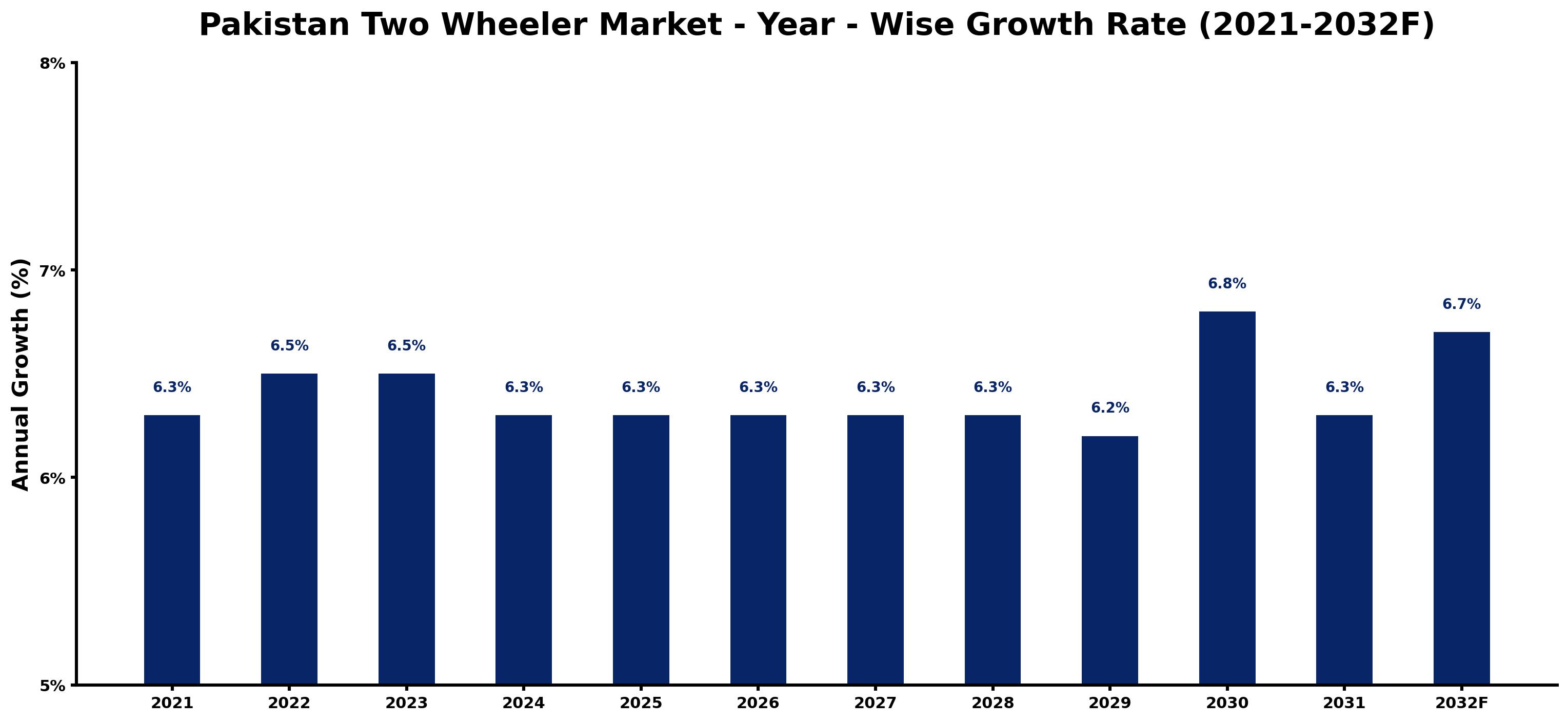
The table below presents the year wise growth rates along with the key drivers influencing the market
| Year | Growth Rate | Major Drivers |
| 2021 | 6.3% | Persistent urban congestion prompts consumers to seek more efficient transportation alternatives. |
| 2022 | 6.5% | Two-wheeler manufacturers increasingly introduce affordable electric models to attract buyers. |
| 2023 | 6.5% | The emergence of ride-sharing platforms fuels interest in two-wheeler ownership among youth. |
| 2024 | 6.3% | Rising fuel prices motivate users to explore cost-effective commuting solutions like scooters. |
| 2025 | 6.3% | Infrastructure improvements enhance road safety, encouraging families to consider two-wheelers. |
| 2026 | 6.3% | Local production ramps up, reducing costs and increasing accessibility for potential buyers. |
| 2027 | 6.3% | Younger generations value mobility, shifting preferences towards stylish, compact two-wheeler options. |
| 2028 | 6.3% | Increased availability of financing options makes purchasing two-wheelers more feasible for customers. |
| 2029 | 6.2% | Growing concerns about air pollution lead to greater interest in fuel-efficient two-wheelers. |
| 2030 | 6.8% | Cultural shifts see two-wheelers becoming symbols of independence among urban residents. |
| 2031 | 6.3% | Technological innovations enhance the appeal of two-wheelers with smart features and connectivity. |
| 2032 | 6.7% | Sustainable practices in manufacturing gain traction, attracting environmentally conscious consumers. |
Note - Market size estimations and growth projections presented in this report are based on 6Wresearch's advanced forecasting approach, validated with industry datasets as of June 2026.
Pakistan Two Wheeler Market Synopsis
The Pakistan Two Wheeler Market is projected to reach 6.3% and witness significant growth during the forecast period (2026-2032). This market is driven by various economic factors, including rising incomes and changing consumer preferences, particularly in urban areas where congestion and fuel prices have led to a shift towards two-wheelers as a preferred mode of transportation. The anticipated CAGR of 8.5% during this period underscores the growing popularity and acceptance of two-wheelers in the country.
Pakistan Two Wheeler Market Growth Drivers
Several key factors are propelling growth in the Pakistan Two Wheeler Market. Firstly, the growing frustration with traffic congestion in urban centers is compelling consumers to opt for two-wheelers over cars, which are often seen as cumbersome in busy environments. Secondly, a rising disposable income among the middle class is enabling more consumers to afford two-wheelers, which are generally more economical than other vehicles.
- Government policies favoring local manufacturing are expected to enhance the market landscape, making two-wheelers more accessible to consumers.
- The influx of innovative features in newer models, including improved fuel efficiency and advanced safety features, is attracting a diverse consumer base.
- There is a strong push towards environmentally friendly vehicles, with two-wheelers being perceived as a more sustainable option compared to larger vehicles.
- Consumer preferences are shifting away from vehicles that are costly to maintain, leading to increased sales of two-wheelers which offer lower operational costs.
- Rising fuel prices are prompting consumers to seek alternatives to fuel-intensive vehicles, facilitating increased demand for two-wheelers.
Pakistan Two Wheeler Market Government Investment and Initiatives
The role of government initiatives in shaping the Pakistan Two Wheeler Market cannot be overstated. The Auto Development Policy (ADP) 2016-2021 has established a framework that supports local automobile manufacturers by providing necessary incentives and protective measures. This policy is aimed at fostering an environment conducive to the growth of the automotive sector, particularly for two-wheelers.
- Investment in infrastructure development, such as dedicated motorcycle lanes, is expected to enhance the appeal of two-wheelers for everyday commutes.
- The government is also looking to promote electric two-wheelers through subsidies and incentives, aligning with global trends towards sustainability.
- Plans to enhance public transport can indirectly support the two-wheeler market by alleviating congestion, making personal two-wheeler use more appealing.
- Public awareness campaigns focused on the economic benefits of two-wheeler usage are likely to increase consumer interest and adoption rates.
- Regulatory frameworks aimed at enhancing manufacturing capabilities are expected to lead to increased local production, contributing to long-term market growth.
Pakistan Two Wheeler Market Latest Developments (May 2025 - June 2026)
The period from May 2025 to June 2026 has witnessed several significant developments in the Pakistan Two Wheeler Market. Notably, there has been an increase in the introduction of models featuring advanced technologies aimed at boosting fuel efficiency and rider safety. Major manufacturers have been focusing on launching electric two-wheelers in response to the rising demand for eco-friendly transportation options.
- Several new entrants have begun to explore the market, introducing competitive pricing strategies that have intensified competition among existing players.
- Consumer preferences have shifted notably towards scooters and other compact models, which offer convenience and ease of use in urban settings.
- Local manufacturers have ramped up production capacity to meet the growing demand, driven by favorable government policies aimed at enhancing local manufacturing.
- There has been a noticeable increase in aftermarket services and accessory sales, as consumers seek to customize their two-wheelers for enhanced performance and aesthetics.
- Discussions around further regulatory support for the two-wheeler sector have gained momentum, with stakeholders advocating for policies that incentivize research and development in the industry.
Pakistan Two Wheeler Market - Key Attractiveness of the Report
- 10 Years of Market Numbers
- Historical Data Starting from 2022 to 2025
- Base Year: 2025
- Forecast Data until 2032
- Key Performance Indicators Impacting the Market
- Major Upcoming Developments and Projects
Key Highlights of the Report:
- Pakistan Two Wheeler Market Outlook
- Market Size of Pakistan Two Wheeler Market, 2025
- Forecast of Pakistan Two Wheeler Market, 2032F
- Historical Data and Forecast of Pakistan Two Wheeler Revenues & Volume for the Period 2022-2032F
- Pakistan Two Wheeler Market Trend Evolution
- Pakistan Two Wheeler Market Drivers and Challenges
- Pakistan Two Wheeler Price Trends
- Pakistan Two Wheeler Porter's Five Forces
- Pakistan Two Wheeler Industry Life Cycle
- Historical Data and Forecast of Pakistan Two Wheeler Market Revenues & Volume By Vehicle Type for the Period 2022-2032F
- Historical Data and Forecast of Pakistan Two Wheeler Market Revenues & Volume By Motorcycle for the Period 2022-2032F
- Historical Data and Forecast of Pakistan Two Wheeler Market Revenues & Volume By Scooter/Moped for the Period 2022-2032F
- Historical Data and Forecast of Pakistan Two Wheeler Market Revenues & Volume By Engine Capacity for the Period 2022-2032F
- Historical Data and Forecast of Pakistan Two Wheeler Market Revenues & Volume By Up to 125cc for the Period 2022-2032F
- Historical Data and Forecast of Pakistan Two Wheeler Market Revenues & Volume By 126-250cc for the Period 2022-2032F
- Historical Data and Forecast of Pakistan Two Wheeler Market Revenues & Volume By 251-500cc for the Period 2022-2032F
- Historical Data and Forecast of Pakistan Two Wheeler Market Revenues & Volume By Above 500cc for the Period 2022-2032F
- Pakistan Two Wheeler Import Export Trade Statistics
- Market Opportunity Assessment By Vehicle Type
- Market Opportunity Assessment By Engine Capacity
- Pakistan Two Wheeler Top Companies Market Share
- Pakistan Two Wheeler Competitive Benchmarking By Technical and Operational Parameters
- Pakistan Two Wheeler Company Profiles
- Pakistan Two Wheeler Key Strategic Recommendations






































