Afghanistan Fruit Market Size Growth Rate
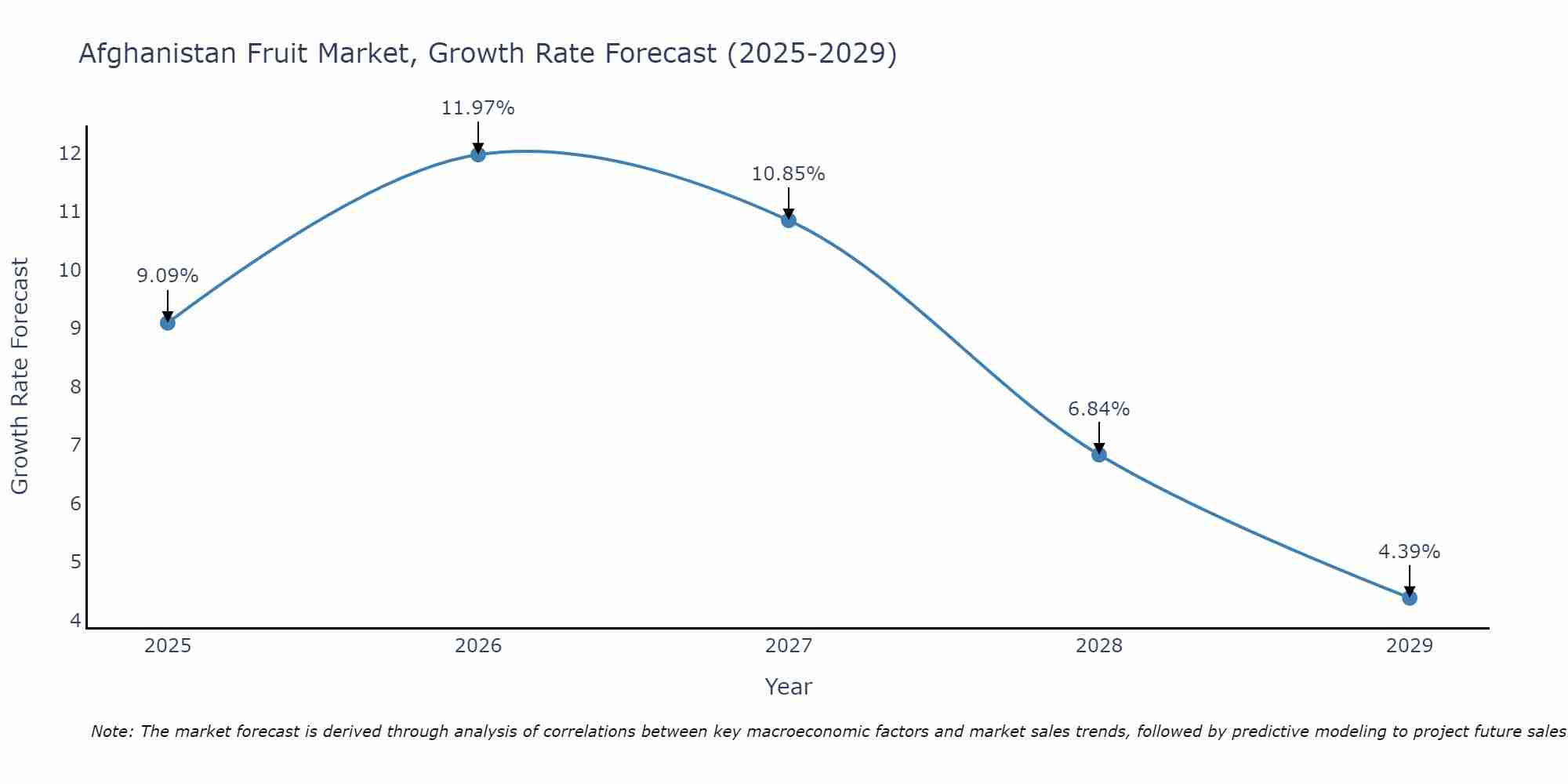
The Afghanistan Fruit Market is projected to witness mixed growth rate patterns during 2025 to 2029. Growth accelerates to 11.97% in 2026, following an initial rate of 9.09%, before easing to 4.39% at the end of the period.
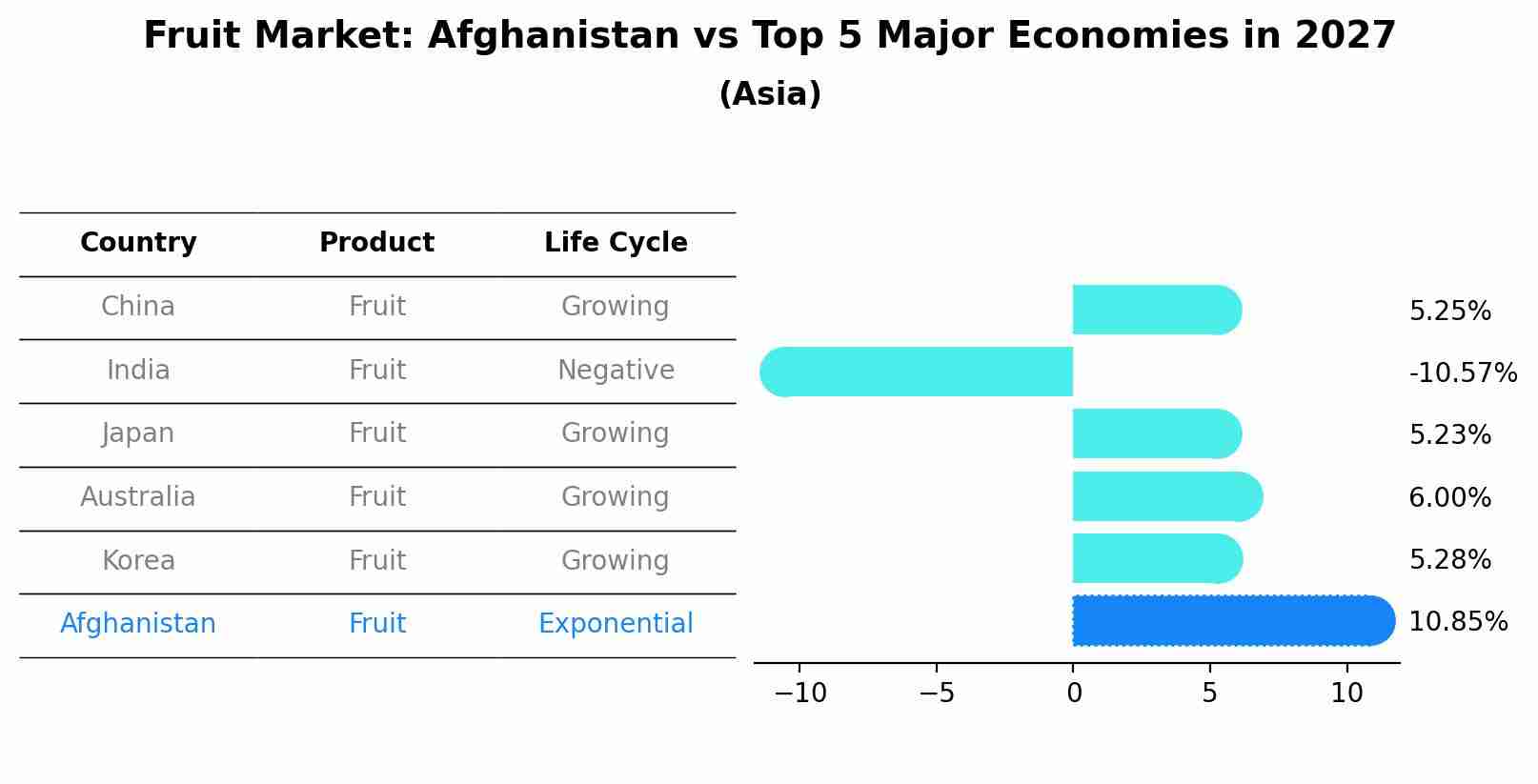
Fruit Market: Afghanistan vs Top 5 Major Economies in 2027 (Asia)
The Fruit market in Afghanistan is projected to grow at a high growth rate of 10.85% by 2027, within the Asia region led by China, along with other countries like India, Japan, Australia and South Korea, collectively shaping a dynamic and evolving market environment driven by innovation and increasing adoption of emerging technologies.
Afghanistan Fruit Market Growth Rate
According to 6Wresearch internal database and industry insights, the Afghanistan Fruit Market is projected to grow at a compound annual growth rate (CAGR) of 6.9% during the forecast period (2026–2032).
Five-Years Growth Trajectory of the Afghanistan Fruit Market with Core Drivers
Below is the evaluation of the year-wise growth rate along with key drivers:
| Year | Est. Annual Growth (%) | Growth Drivers |
| 2021 | 2.1 | Higher household demand for staple fresh fruits, greater reliance on neighborhood fruit shops for daily purchases. |
| 2022 | 3 | Improved supply continuity for apples, grapes, and citrus through trading routes, higher sales through specialty fruit stores in cities. |
| 2023 | 4.1 | Development in packaged dried fruits and nuts for gifting and travel, stronger cross-border trade activity for raisins and apricots. |
| 2024 | 4.9 | Growing cold storage discussion and gradual capacity additions reduce spoilage, improved sorting and packaging at trader level. |
| 2025 | 5.6 | Modern retail shelves broaden in key urban clusters, higher preference for graded fresh produce and branded dried fruit packs for quality assurance. |
Topics Covered in the Afghanistan Fruit Market Report
The Afghanistan Fruit Market report thoroughly covers the market by Applications and Type. The report provides an unbiased and detailed analysis of ongoing market trends, opportunities/high-growth areas, and market drivers that will help stakeholders devise and align strategies according to current and future market dynamics.
Afghanistan Fruit Market Highlights
| Report Name | Afghanistan Fruit Market |
| Forecast period | 2026–2032 |
| CAGR | 6.9% |
| Growing Sector | Retail Grocery |
Afghanistan Fruit Market Synopsis
Afghanistan Fruit Industry is expected to grow steadily, supported by rising urban consumption, increasing preference for graded produce, and improving availability of packaged fruit offerings through formal trade channels. In addition, demand is increasing for fresh fruits used in daily household consumption, dried fruits used in gifting and export-linked trade, and frozen fruits used by select food service and smoothie/juice outlets.
Evaluation of Growth Drivers in the Afghanistan Fruit Market
Below are some prominent drivers and their influence on the Afghanistan Fruit Market dynamics:
| Drivers | Primary Segments Affected | Why it Matters (Evidence) |
| Urban consumption and daily fresh fruit buying habits | By Type | Supports steady movement of fresh fruits through frequent purchases from city retailers and specialty fruit shops. |
| Packaged dried fruits and export-linked trading activity | By Type | Improves value realization for raisins, apricots, figs, and nuts through better sorting, packaging, and repeat orders. |
| Cold storage activation and investment push | By Applications | Reduces spoilage and extends selling windows, supporting modern retail and organized supply in key cities. |
| Food standards focus and quality compliance | By Applications | Higher attention to labeling, packaging, and quality controls supports trusted products in formal channels. |
The Afghanistan Fruit Market Size is projected to grow at a CAGR of 6.9% during the forecast period (2026–2032). The expansion is supported by steady demand for daily fresh fruit consumption, higher acceptance of packaged dried fruits, and improving availability of graded produce in urban trade. In addition, cold storage activation and investment-linked upgrades are expected to reduce wastage, improve shelf-life, and strengthen retail supply continuity. Along with that, expansion of specialty fruit retail and gradual modern retail penetration in key cities are supporting better price realization for quality assortments, thereby maintaining steady Afghanistan Fruit Market Growth. Also, exporter-driven packaging improvements and trader-led procurement cycles are strengthening the movement of dried fruit categories into regional demand corridors.
Evaluation of Restraints in the Afghanistan Fruit Market
Below are some major restraints and their influence on the Afghanistan Fruit Market dynamics:
| Restraints | Primary Segments Affected | What this Means (Evidence) |
| Cold chain gaps and post-harvest losses | By Type | Short shelf-life increases wastage and limits premium fresh fruit reach beyond major cities. |
| Price sensitivity for graded and packaged assortments | By Applications | Exorbitant packaged prices can change buyers to loose produce, slowing premium product sales. |
| Trade route disruptions and border delays | By Type | Border and route delays disrupt supply and exports, leading to price fluctuations. |
| Quality inconsistency and weak labeling in informal trade | By Applications | Weak labeling and uneven quality decrease trust and repeat purchases in formal channels. |
Afghanistan Fruit Market Challenges
The market comes across multiple challenges, seasonal oversupply can depress farmgate prices while off-season gaps lift retail prices, cold storage coverage remains uneven, and traders face high logistics and working-capital pressure. Along with that, quality difference across lots can reduce buyer confidence, retailers require more consistent grading, and export corridors remain sensitive to documentation, inspection, and transit delays, which can affect shipment schedules and realization.
Afghanistan Fruit Market Trends
Several key trends are shaping the growth of the Afghanistan Fruit Market:
- Shift to graded produce: Retailers prefer sorted fruits to improve consistency and reduce complaints.
- Packaged dried fruits growing: Branded packs support gifting, travel needs, and steady repeat demand.
- Cold storage focus rising: More investment is helping reduce spoilage and improve year-round availability.
- Preference for verified quality: Better packaging, labeling, and compliance are strengthening buyer confidence.
Investment Opportunities in the Afghanistan Fruit Market
Some notable investment opportunities include:
- Build cold chain capacity: Cold storage and reefer logistics can cut losses and improve fresh fruit pricing.
- Scale packaged dried fruits: Grading and retail packs can boost repeat buying and export readiness.
- Strengthen modern retail supply: Better procurement and QA can grow supermarket and hypermarket sales.
- Expand value-added processing: Concentrates and pulps can reduce seasonal waste and support year-round demand.
Top 5 Leading Players in the Afghanistan Fruit Market
Some leading players operating in the Afghanistan Fruit Market include:
1. Kanda Fruits Process Company (Kanda Fruit)
| Company Name | Kanda Fruits Process Company (Kanda Fruit) |
| Headquarters | Kandahar, Afghanistan |
| Established | 2000 |
| Website | Click Here |
Kanda Fruit supports Afghanistan’s fruit value chain through processing and standardized packaging for fresh and dried categories, strengthening quality-led supply for trade and export needs.
2. Tak Dana Dry and Fresh Fruit Process Company
| Company Name | Tak Dana Dry and Fresh Fruit Process Company |
| Headquarters | Kabul, Afghanistan |
| Established | 2010 |
| Website | Click Here |
Tak Dana supplies and exports fresh and dried fruits with processing and packaging focus, supporting consistent product flow through trade channels and buyer confidence in key markets.
3. Raoufi Global Group Company (RGGC)
| Company Name | Raoufi Global Group Company (RGGC) |
| Headquarters | Afghanistan (multi-trading exporter/importer operations) |
| Established | 1989 |
| Website | Click Here |
RGGC operates as an exporter and importer of Afghan dry fruits and nuts, supporting international market access for key fruit categories such as raisins, apricots, and figs.
4. Omaid Bahar Fruit Processing Co. Ltd.
| Company Name | Omaid Bahar Fruit Processing Co. Ltd. |
| Headquarters | Kabul, Afghanistan |
| Established | 2012 |
| Website | Click Here |
Omaid Bahar operates fruit processing capability in Kabul, supporting value-added formats such as concentrates and processing-led utilization of fruit supply beyond fresh retail cycles.
5. Khalid Walid Ghalibi LTD (KWG-LTD)
| Company Name | Khalid Walid Ghalibi LTD (KWG-LTD) |
| Headquarters | Mazar-e-Sharif, Afghanistan |
| Established | 2014 |
| Website | Click Here |
KWG-LTD focuses on processing, packaging, and export of Afghan dried fruits, supporting standardized shipment quality and wider market reach for core dried fruit categories.
Government Regulations Introduced in the Afghanistan Fruit Market
According to Afghan Government Data, myriad of policies are shaping the demand for fruits as it is influenced by policies aimed at improving standards, conducting quality checks at ports, and protecting consumers. Afghanistan National Standards Authority (ANSA) is in full support of the standards and certifications that enhance packaging, labeling, and compliance in legal trade. Cold storage is increasingly being utilized through government projects like the reconstruction and reopening of facilities.
Future Insights of the Afghanistan Fruit Market
Afghanistan fruit market share is anticipated to rise higher due to stronger urban demand, retail focusing on quality, and reducing losses through better post-harvest handling. The adoption of wider grading practices, the use of improved packaging for dried fruits, and enhanced cold chain access can create buyer confidence and increase repeat purchases in the formal market. Firms that are funding in stable supply programs, practical pack sizes, and export-ready processing standards will attract customers in major cities.
Market Segmentation Analysis
The report offers a comprehensive study of the following market segments and their leading categories:
Supermarket to Dominate the Market - By Applications
According to Rashika, Senior Research Analyst, 6Wresearch, Specialty Stores are the leading application in the Afghanistan Fruit Market due to the strong presence of dedicated fruit shops and bazaar-linked retailers that drive high-frequency purchases, flexible assortment rotation, and quick adaptation to seasonal supply.
Fresh to Lead the Market - By Type
Fresh is the leading type in the Afghanistan Fruit Market due to its daily household consumption role and strong cultural preference for routine fruit intake across urban and semi-urban areas.
Key Attractiveness of the Report
- 10 Years of Market Numbers.
- Historical Data Starting from 2022 to 2025.
- Base Year: 2025.
- Forecast Data until 2032.
- Key Performance Indicators Impacting the Market.
- Major Upcoming Developments and Projects.
Key Highlights of the Report:
- Afghanistan Fruit Market Outlook
- Market Size of Afghanistan Fruit Market, 2025
- Forecast of Afghanistan Fruit Market, 2032
- Historical Data and Forecast of Afghanistan Fruit Revenues & Volume for the Period 2022-2032
- Afghanistan Fruit Market Trend Evolution
- Afghanistan Fruit Market Drivers and Challenges
- Afghanistan Fruit Price Trends
- Afghanistan Fruit Porter`s Five Forces
- Afghanistan Fruit Industry Life Cycle
- Historical Data and Forecast of Afghanistan Fruit Market Revenues & Volume By Applications for the Period 2022-2032
- Historical Data and Forecast of Afghanistan Fruit Market Revenues & Volume By Supermarkets and Hypermarkets for the Period 2022-2032
- Historical Data and Forecast of Afghanistan Fruit Market Revenues & Volume By Specialty Stores for the Period 2022-2032
- Historical Data and Forecast of Afghanistan Fruit Market Revenues & Volume By Online for the Period 2022-2032
- Historical Data and Forecast of Afghanistan Fruit Market Revenues & Volume By Type for the Period 2022-2032
- Historical Data and Forecast of Afghanistan Fruit Market Revenues & Volume By Fresh for the Period 2022-2032
- Historical Data and Forecast of Afghanistan Fruit Market Revenues & Volume By Dried for the Period 2022-2032
- Historical Data and Forecast of Afghanistan Fruit Market Revenues & Volume By Frozen for the Period 2022-2032
- Historical Data and Forecast of Afghanistan Fruit Market Revenues & Volume By Others for the Period 2022-2032
- Afghanistan Fruit Import Export Trade Statistics
- Market Opportunity Assessment By Applications
- Market Opportunity Assessment By Type
- Afghanistan Fruit Top Companies Market Share
- Afghanistan Fruit Competitive Benchmarking By Technical and Operational Parameters
- Afghanistan Fruit Company Profiles
- Afghanistan Fruit Key Strategic Recommendations
Markets Covered
The report offers a comprehensive study of the following market segments:
By Applications
- Supermarkets and Hypermarkets
- Specialty Stores
- Online
By Type
- Fresh
- Dried
- Frozen
- Others






































