Algeria Aerostructures Market Size, Share & Growth Rate
The Algeria Aerostructures Market was estimated at USD 1253 Million in 2025 and is projected to reach USD 1831 Million by 2032, growing at a CAGR of 5.6% from 2026 to 2032. This robust growth trajectory is primarily driven by the region's increasing demand for modern commercial aircraft and the government's commitment to bolstering the aerospace sector. As Algeria pursues enhanced self-sufficiency in aerospace manufacturing, both domestic and foreign investments are expected to surge, further accelerating market dynamics.
Algeria Aerostructures Market Year-wise Growth Rate and Key Drivers
This graph highlights how the Algeria Aerostructures Market has steadily grown over the years, supported by major growth factors.
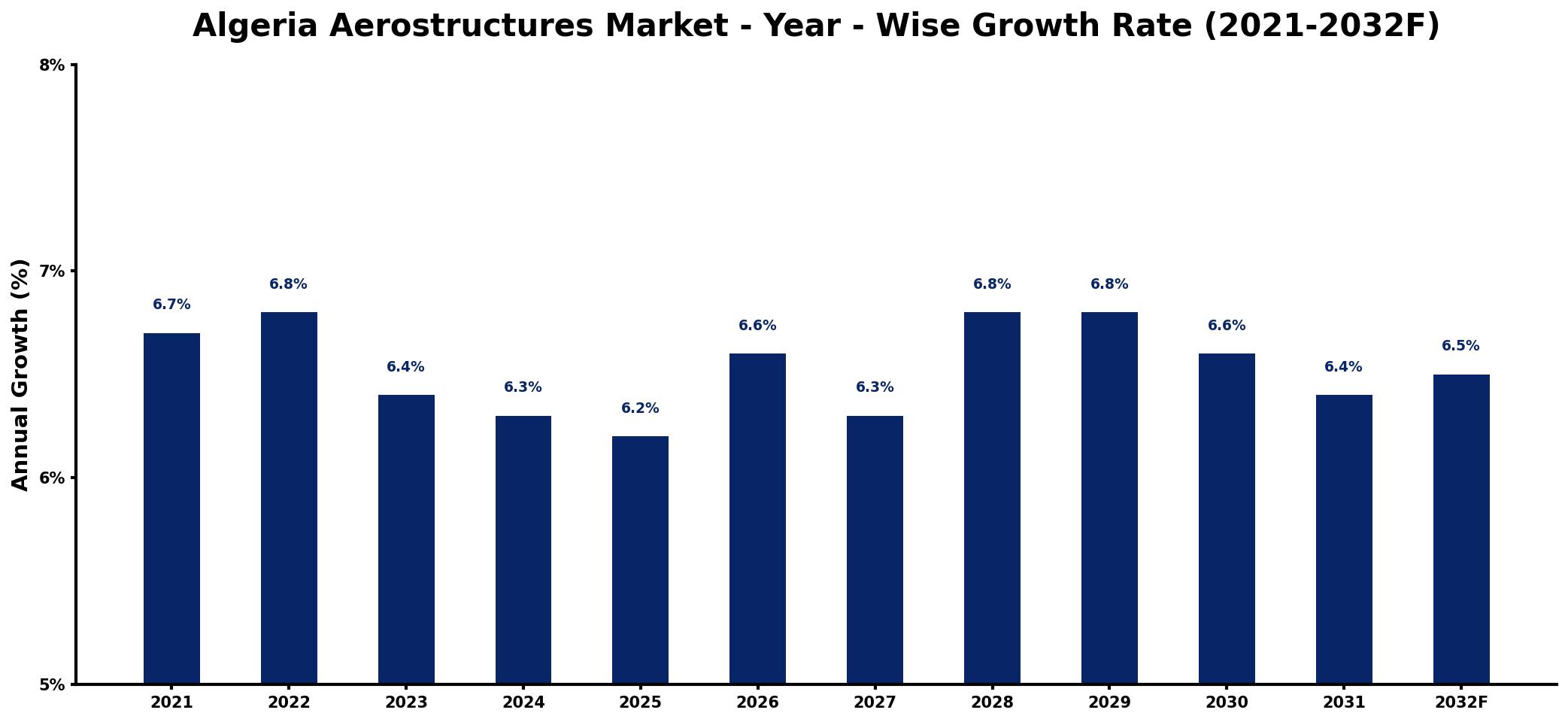
The table below presents the year‑wise growth rates along with the key drivers influencing the market
| Year | Growth Rate | Major Drivers |
| 2021 | 6.7% | Increased defense spending initiatives |
| 2022 | 6.8% | Expansion of aviation manufacturing facilities |
| 2023 | 6.4% | Growing demand for regional aircraft |
| 2024 | 6.3% | Rising investments in aerospace technology |
| 2025 | 6.2% | Strengthening partnerships with global firms |
| 2026 | 6.6% | Emerging trends in sustainable aviation |
| 2027 | 6.3% | Focus on upgrades and retrofits |
| 2028 | 6.8% | Increased procurement of commercial fleets |
| 2029 | 6.8% | Technological advancements in manufacturing |
| 2030 | 6.6% | Growing interest in unmanned systems |
| 2031 | 6.4% | Enhanced workforce training programs |
| 2032 | 6.5% | Development of new aerospace regulations |
Note: Market size estimations and growth projections presented in this report are based on 6Wresearch's proprietary forecasting methodology, utilizing the latest available industry data, government publications, and primary research inputs.
Algeria Aerostructures Market Synopsis
The demand for lightweight and fuel-efficient aerostructures is currently the strongest force shaping the Algeria Aerostructures Market. With airlines seeking to enhance operational efficiency and minimize environmental footprints, there is a marked shift towards advanced materials and innovative design solutions.
In parallel, the expansion of local manufacturing capabilities is facilitating the production of essential aerostructure components like fuselages and wings. This aligns with government initiatives aimed at fostering technological advancements and creating a competitive landscape within the regional aerospace sector.
Algeria Aerostructures Market Key Takeaways
- The market is projected to reach USD 1831 Million by 2032, reflecting robust growth.
- Government policies are promoting local production and skills development in aerospace.
- Investment in R&D is driving innovation in aerostructure design and manufacturing processes.
- The shift towards composite materials is enhancing the performance and efficiency of aerostructures.
- Strategic partnerships with international firms are critical for advancing technology transfer.
Evaluation of Restraints in Algeria Aerostructures Market
Despite its promising outlook, the Algeria Aerostructures Market faces significant restraints that could impede growth. Limited infrastructure for high-quality manufacturing remains a critical barrier, as do challenges in attracting a skilled workforce adept in modern aerospace technologies. Regulatory complexities further exacerbate these issues, creating hurdles for both local and foreign players striving to meet international standards. Moreover, the competition from established global manufacturers adds pressure on local entities, necessitating targeted efforts to elevate operational capabilities and market positioning.
Algeria Aerostructures Market Trends
A notable trend shaping the Algeria Aerostructures Market is the increasing adoption of composite materials in manufacturing processes. These materials provide a superior strength-to-weight ratio, thereby enhancing aircraft performance while reducing fuel consumption. Additionally, advancements in additive manufacturing and automation technologies are revolutionizing production techniques, allowing for more complex designs and streamlined operations.
Moreover, there is a heightened focus on sustainability, driving aerospace companies to innovate and create environmentally friendly aerostructures. This combination of performance enhancement and environmental consciousness is expected to define the market landscape moving forward.
Algeria Aerostructures Market Opportunities
Investment opportunities abound in the Algeria Aerostructures Market, especially in the establishment of local manufacturing facilities for critical aircraft components. As demand for air travel rises, the need for domestic production to support the aerospace ecosystem becomes increasingly urgent. Furthermore, partnerships with international aerospace firms can facilitate technology transfer and skill enhancement, fostering a competitive local industry. The emphasis on innovation and the exploration of new materials also present avenues for growth, as companies seek to differentiate their offerings in a dynamic market.
Government Initiatives in the Algeria Aerostructures Market
The Algerian government is actively promoting the growth of the domestic aerospace industry through a series of strategic initiatives. Key policies focus on enhancing local capabilities in aerostructures manufacturing, as well as maintenance, repair, and overhaul (MRO) services. To stimulate investment, the government provides incentives such as tax breaks and partnerships aimed at improving technological prowess and workforce skills. Collaborative ventures with global aerospace leaders are also encouraged to strengthen local knowledge and capacity.
Future Insights of the Algeria Aerostructures Market
Looking ahead to 2026-2032, the Algeria Aerostructures Market is poised for steady expansion, bolstered by continued government investment and an increasing appetite for air travel. The nations strategic position as a bridge between Europe and Africa further enhances its role in the global aerospace industry. However, addressing existing infrastructure limitations and regulatory challenges will be crucial in unlocking the full potential of the market. A focus on innovation and partnerships is expected to drive growth, ensuring that Algeria remains competitive in this dynamic sector.
Algeria Aerostructures Market Latest Developments (2025 - 2026)
In recent months, the Algeria Aerostructures Market has witnessed notable developments aimed at enhancing local manufacturing capabilities. Various industry stakeholders are exploring new collaborative frameworks to leverage international expertise while investing in cutting-edge technologies. These efforts are geared towards establishing advanced manufacturing facilities that meet global standards, ultimately positioning Algeria as a competitive player in the aerostructures domain.
Algeria Aerostructures Market - Key Attractiveness of the Report
- 10 Years of Market Numbers
- Historical Data Starting from 2022 to 2025
- Base Year: 2025
- Forecast Data until 2032
- Key Performance Indicators Impacting the Market
- Major Upcoming Developments and Projects
Key Highlights of the Report:
- Algeria Aerostructures Market Outlook
- Market Size of Algeria Aerostructures Market, 2025
- Forecast of Algeria Aerostructures Market, 2032
- Historical Data and Forecast of Algeria Aerostructures Revenues & Volume for the Period 2022-2032F
- Algeria Aerostructures Market Trend Evolution
- Algeria Aerostructures Market Drivers and Challenges
- Algeria Aerostructures Price Trends
- Algeria Aerostructures Porter's Five Forces
- Algeria Aerostructures Industry Life Cycle
- Historical Data and Forecast of Algeria Aerostructures Market Revenues & Volume By Component for the Period 2022-2032F
- Historical Data and Forecast of Algeria Aerostructures Market Revenues & Volume By Wings for the Period 2022-2032F
- Historical Data and Forecast of Algeria Aerostructures Market Revenues & Volume By Nose for the Period 2022-2032F
- Historical Data and Forecast of Algeria Aerostructures Market Revenues & Volume By Fuselage for the Period 2022-2032F
- Historical Data and Forecast of Algeria Aerostructures Market Revenues & Volume By Nacelle and Pylon for the Period 2022-2032F
- Historical Data and Forecast of Algeria Aerostructures Market Revenues & Volume By Empennage for the Period 2022-2032F
- Historical Data and Forecast of Algeria Aerostructures Market Revenues & Volume By Others for the Period 2022-2032F
- Historical Data and Forecast of Algeria Aerostructures Market Revenues & Volume By Material for the Period 2022-2032F
- Historical Data and Forecast of Algeria Aerostructures Market Revenues & Volume By Alloys for the Period 2022-2032F
- Historical Data and Forecast of Algeria Aerostructures Market Revenues & Volume By Metal for the Period 2022-2032F
- Historical Data and Forecast of Algeria Aerostructures Market Revenues & Volume By Composite for the Period 2022-2032F
- Historical Data and Forecast of Algeria Aerostructures Market Revenues & Volume By Platform for the Period 2022-2032F
- Historical Data and Forecast of Algeria Aerostructures Market Revenues & Volume By Fixed-wing aircraft for the Period 2022-2032F
- Historical Data and Forecast of Algeria Aerostructures Market Revenues & Volume By Rotary-wing aircraft for the Period 2022-2032F
- Historical Data and Forecast of Algeria Aerostructures Market Revenues & Volume By End-Use for the Period 2022-2032F
- Historical Data and Forecast of Algeria Aerostructures Market Revenues & Volume By Aftermarket for the Period 2022-2032F
- Historical Data and Forecast of Algeria Aerostructures Market Revenues & Volume By OEM for the Period 2022-2032F
- Algeria Aerostructures Import Export Trade Statistics
- Market Opportunity Assessment By Component
- Market Opportunity Assessment By Material
- Market Opportunity Assessment By Platform
- Market Opportunity Assessment By End-Use
- Algeria Aerostructures Top Companies Market Share
- Algeria Aerostructures Competitive Benchmarking By Technical and Operational Parameters
- Algeria Aerostructures Company Profiles
- Algeria Aerostructures Key Strategic Recommendations






































