Algeria Bath Supplies Market Summary
The algeria bath supplies market was estimated at USD 297 Million in 2025 and is projected to reach USD 391 Million by 2032, growing at a CAGR of 4.6% from 2026 to 2032.
Algeria Bath Supplies Market Year-wise Growth Rate and Key Drivers
This graph highlights how the Algeria Bath Supplies Market has steadily grown over the past five years, supported by major growth factors.
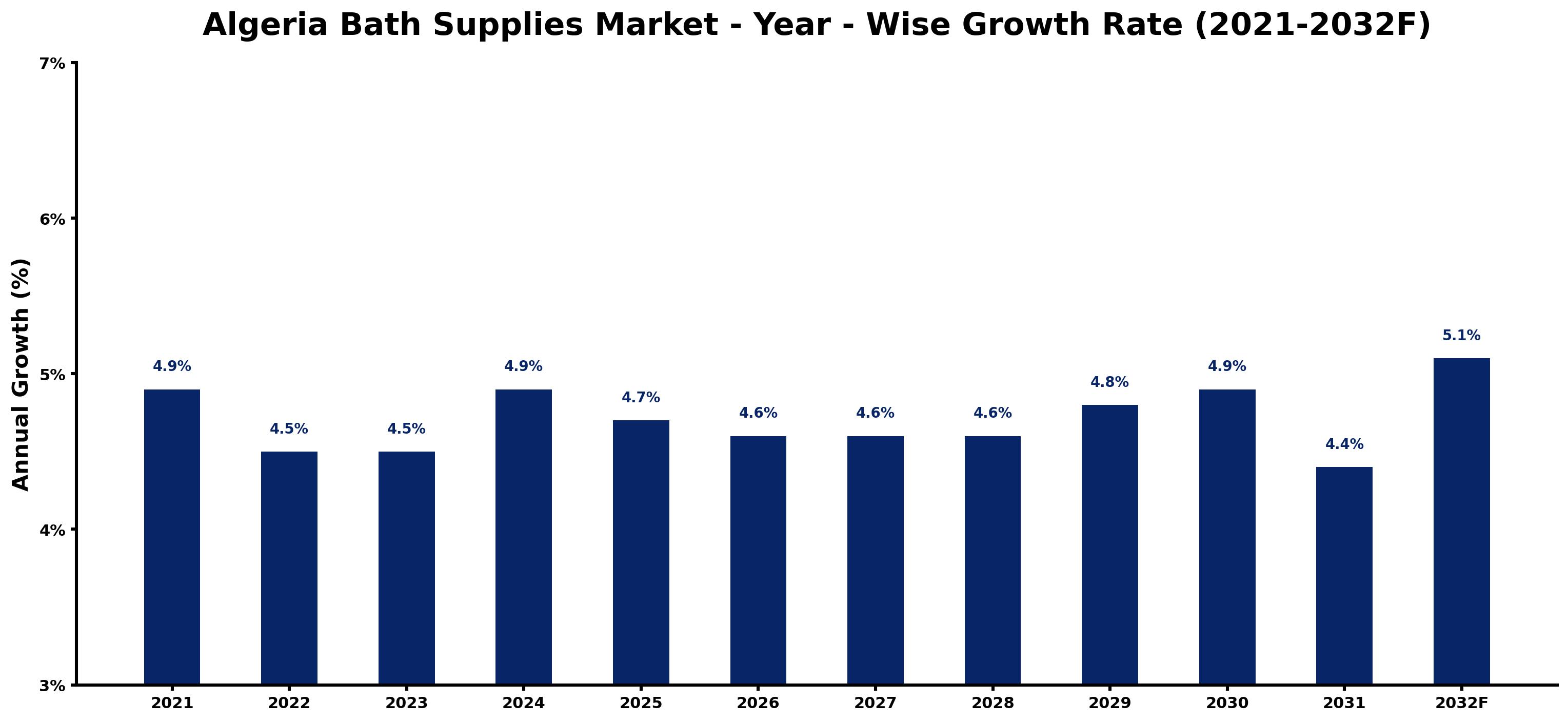
The table below presents the year wise growth rates along with the key drivers influencing the market
| Year | Growth Rate | Major Drivers |
| 2021 | 4.9% | Increased urbanization across Algeria encourages higher demand for modern bath supplies. |
| 2022 | 4.5% | Consumers increasingly prefer eco-friendly products that align with sustainable living practices. |
| 2023 | 4.5% | Emerging local brands gain market traction by providing affordable, quality bath solutions. |
| 2024 | 4.9% | Expansion of e-commerce channels simplifies access to a wider range of bath products. |
| 2025 | 4.7% | Growing emphasis on health and wellness drives interest in therapeutic bath supplies. |
| 2026 | 4.6% | Urban infrastructure projects stimulate demand for modern bath installations in new developments. |
| 2027 | 4.6% | Rising middle-class income levels enable consumer spending on premium bath goods. |
| 2028 | 4.6% | Awareness of hygiene and sanitation standards increases demand for bathroom essentials. |
| 2029 | 4.8% | Innovative design trends inspire consumers to invest in stylish and functional bath spaces. |
| 2030 | 4.9% | Collaborations with international brands enhance product variety and consumer choice. |
| 2031 | 4.4% | Incentives for sustainable manufacturing attract investments into the bath supplies sector. |
| 2032 | 5.1% | Technological advancements in production processes reduce costs for bath product manufacturers. |
Note - Market size estimations and growth projections presented in this report are based on 6Wresearch's advanced forecasting approach, validated with industry datasets as of June 2026.
Algeria Bath Supplies Market Synopsis
The Algeria Bath Supplies Market is projected to reach 4.6% and witness significant growth during the forecast period (2026-2032). The anticipated expansion of this market arises from a combination of increasing consumer spending and a heightened demand for hygiene products such as soaps, body washes, and shampoos. A notable driving factor behind this growth is the escalating awareness regarding personal hygiene, which has become a priority for consumers across various demographics.
In recent years, a rise in disposable incomes amongst middle-class families has further propelled the sales of bath supplies in Algeria. Consumers are increasingly inclined to invest in quality hygiene products, reflecting a shift in societal values towards health and wellness. The market also observes a growing preference for innovative products that feature natural and organic ingredients, as modern consumers gravitate towards healthier alternatives that align with their lifestyles.
Algeria Bath Supplies Market Growth Drivers
The growth of the Algeria Bath Supplies Market is underpinned by several key drivers:
- Increasing disposable incomes are enabling consumers to purchase a wider range of bath and hygiene products, thus enriching their shopping experience.
- The rising awareness about the importance of personal hygiene has resulted in stronger demand for a variety of bath supplies, from basic soaps to luxury body washes.
- The shift towards organic and natural formulations is gaining traction, catering to a demographic that is concerned about health and environmental impacts.
- The proliferation of e-commerce platforms provides consumers with convenient access to a broader selection of hygiene products, effectively enhancing market reach.
- Government initiatives aimed at promoting foreign investments in local manufacturing are facilitating a more competitive market landscape.
Algeria Bath Supplies Market Trends and Opportunities
The Algeria Bath Supplies Market is currently experiencing several trends that create new opportunities for growth:
- A notable trend is the increasing consumer interest in eco-friendly packaging, which resonates with environmentally conscious buyers.
- The rise in online shopping has led to enhanced customer engagement through digital marketing strategies, allowing brands to tailor their offerings more effectively.
- Promotional campaigns focusing on health and wellness through various media channels are effectively educating consumers about the benefits of quality bath supplies.
- Global trends in beauty and personal care are influencing local markets, prompting Algerian consumers to explore a diversity of international brands and products.
- Increased investment in local production capabilities is anticipated, thereby reducing reliance on imports and supporting national economic growth.
Algeria Bath Supplies Market Challenges and Restraints
Despite its growth prospects, the Algeria Bath Supplies Market faces various challenges:
- Price sensitivity among consumers can limit the adoption of premium products, challenging manufacturers to offer competitive pricing strategies.
- Import dependence for certain raw materials may pose supply chain vulnerabilities, especially in fluctuating economic conditions.
- The presence of counterfeit products in the market undermines brand integrity and consumer trust, necessitating regulatory action.
- Consumer education regarding product benefits continues to be essential in a market where misinformation can lead to poor purchasing decisions.
- The ongoing economic fluctuations may impact overall consumer spending, thereby affecting the growth trajectory of the market.
Algeria Bath Supplies Market Government Investment and Initiatives
The Algerian government has implemented various policies and initiatives aimed at bolstering the local bath supplies market. These initiatives involve public investment in domestic manufacturing facilities and infrastructure, which creates job opportunities and enhances self-sufficiency. Additionally, the government is actively encouraging foreign direct investments (FDI) to stimulate competition and innovation within the sector. Such policies are expected to foster a conducive environment for both local and international firms, culminating in a more dynamic market landscape.
Moreover, the government is focusing on regulatory measures to ensure product safety and quality, which are integral to consumer confidence. These initiatives help establish standards that align with global best practices, thus enhancing the reputation of Algerian products on the international stage. The overall emphasis on developing local industries is anticipated to drive growth in the Algeria Bath Supplies Market during the forecast period.
Algeria Bath Supplies Market Latest Developments (May 2025 - June 2026)
Recent developments within the Algeria Bath Supplies Market between May 2025 and June 2026 indicate a shift towards increased product innovation and sustainability. Companies are focusing on the formulation of organic and all-natural products, reflecting consumer preferences for healthier options. The rise of online sales platforms has also transformed traditional distribution methods, leading to improved access for consumers.
Market stakeholders are likely to increase their investments in marketing and brand positioning to build awareness of unique product offerings. There has also been a notable rise in collaborations with local influencers and health advocates, aimed at promoting the benefits of personal care and hygiene products. Additionally, advancements in technology are facilitating enhanced manufacturing processes, which will likely aid in meeting growing consumer demands.
Algeria Bath Supplies Market - Key Attractiveness of the Report
- 10 Years of Market Numbers
- Historical Data Starting from 2022 to 2025
- Base Year: 2025
- Forecast Data until 2032
- Key Performance Indicators Impacting the Market
- Major Upcoming Developments and Projects
Key Highlights of the Report:
- Algeria Bath Supplies Market Outlook
- Market Size of Algeria Bath Supplies Market, 2025
- Forecast of Algeria Bath Supplies Market, 2032F
- Historical Data and Forecast of Algeria Bath Supplies Revenues & Volume for the Period 2022-2032F
- Algeria Bath Supplies Market Trend Evolution
- Algeria Bath Supplies Market Drivers and Challenges
- Algeria Bath Supplies Price Trends
- Algeria Bath Supplies Porter's Five Forces
- Algeria Bath Supplies Industry Life Cycle
- Historical Data and Forecast of Algeria Bath Supplies Market Revenues & Volume By Product Types for the Period 2022-2032F
- Historical Data and Forecast of Algeria Bath Supplies Market Revenues & Volume By Shower Products for the Period 2022-2032F
- Historical Data and Forecast of Algeria Bath Supplies Market Revenues & Volume By Liquid Bath Products for the Period 2022-2032F
- Historical Data and Forecast of Algeria Bath Supplies Market Revenues & Volume By Bath Additives for the Period 2022-2032F
- Historical Data and Forecast of Algeria Bath Supplies Market Revenues & Volume By Bar Soaps for the Period 2022-2032F
- Historical Data and Forecast of Algeria Bath Supplies Market Revenues & Volume By Application? for the Period 2022-2032F
- Historical Data and Forecast of Algeria Bath Supplies Market Revenues & Volume By Supermarkets for the Period 2022-2032F
- Historical Data and Forecast of Algeria Bath Supplies Market Revenues & Volume By Hypermarkets for the Period 2022-2032F
- Historical Data and Forecast of Algeria Bath Supplies Market Revenues & Volume By Specialist Stores for the Period 2022-2032F
- Historical Data and Forecast of Algeria Bath Supplies Market Revenues & Volume By Drug Stores for the Period 2022-2032F
- Historical Data and Forecast of Algeria Bath Supplies Market Revenues & Volume By Others for the Period 2022-2032F
- Algeria Bath Supplies Import Export Trade Statistics
- Market Opportunity Assessment By Product Types
- Market Opportunity Assessment By Application?
- Algeria Bath Supplies Top Companies Market Share
- Algeria Bath Supplies Competitive Benchmarking By Technical and Operational Parameters
- Algeria Bath Supplies Company Profiles
- Algeria Bath Supplies Key Strategic Recommendations






































