Algeria Christmas Tree Market Size, Share & Growth Rate
The Algeria Christmas Tree Market was estimated at USD 230 Million in 2025 and is projected to reach USD 319 Million by 2032, growing at a CAGR of 4.8% from 2026 to 2032. This growth trajectory is fueled by an increasing cultural adoption of Western holiday traditions among Algerian consumers and the rise in disposable incomes across households. As more families embrace the celebration of Christmas, there is a marked uptick in demand for both real and artificial Christmas trees, along with a wide array of festive decorations.
Algeria Christmas Tree Market Year-wise Growth Rate and Key Drivers
This graph highlights how the Algeria Christmas Tree Market has steadily grown over the years, supported by major growth factors.
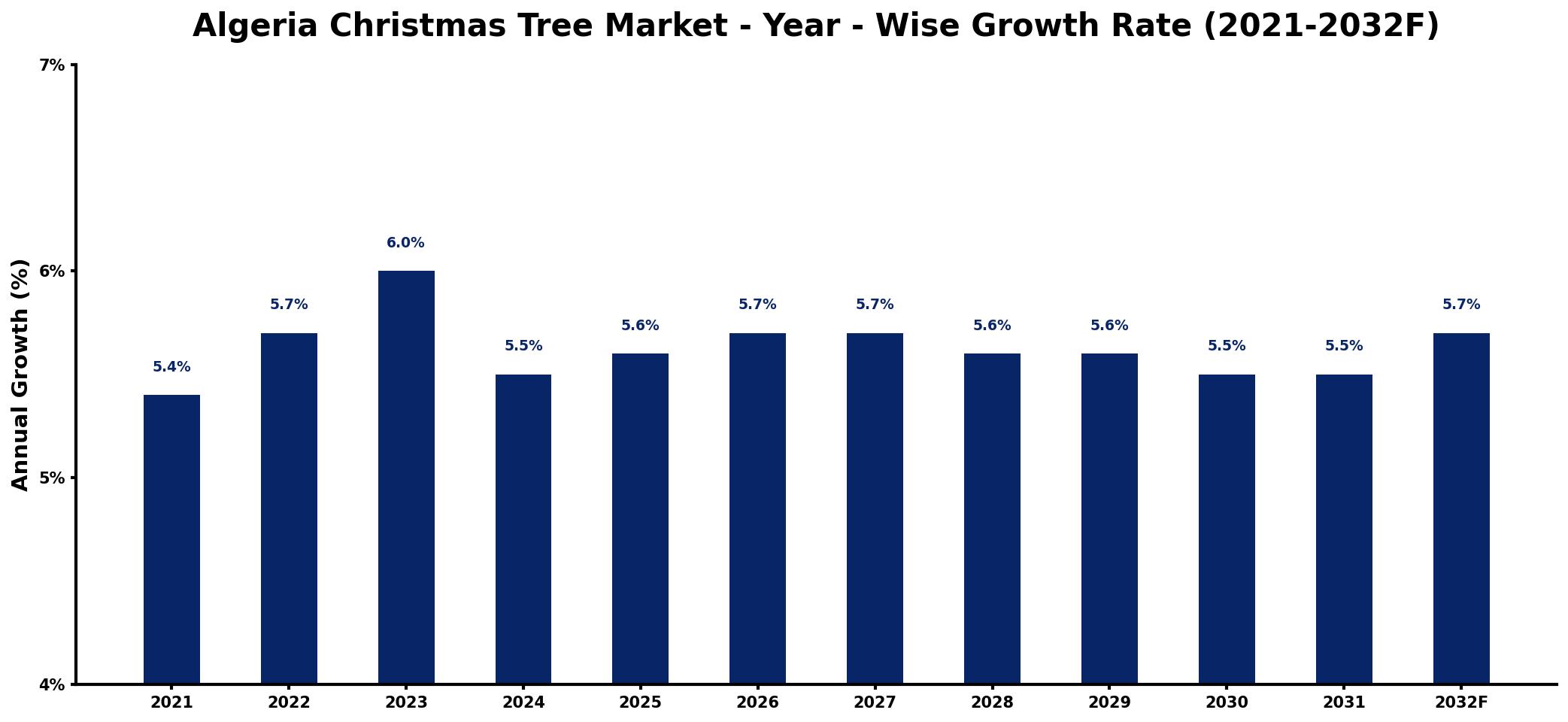
The table below presents the year‑wise growth rates along with the key drivers influencing the market
| Year | Growth Rate | Major Drivers |
| 2021 | 5.4% | Growing consumer interest in festivities |
| 2022 | 5.7% | Increased disposable income levels |
| 2023 | 6.0% | Expansion of retail distribution networks |
| 2024 | 5.5% | Rise in holiday celebration trends |
| 2025 | 5.6% | Enhanced marketing strategies implemented |
| 2026 | 5.7% | Boost in online shopping platforms |
| 2027 | 5.7% | Strengthening of local manufacturing capabilities |
| 2028 | 5.6% | Surge in seasonal tourism activities |
| 2029 | 5.6% | Development of eco-friendly alternatives |
| 2030 | 5.5% | Increase in social media promotions |
| 2031 | 5.5% | Growth in community celebration initiatives |
| 2032 | 5.7% | Rising popularity of themed events |
Note: Market size estimations and growth projections presented in this report are based on 6Wresearch's proprietary forecasting methodology, utilizing the latest available industry data, government publications, and primary research inputs.
Algeria Christmas Tree Market Synopsis
The most significant force shaping the Algeria Christmas Tree Market is the growing enthusiasm for Christmas celebrations, reflecting broader cultural shifts towards Western holiday customs. Consumers are increasingly eager to invest in festive decorations, which underscores the importance of the holiday season in contemporary Algerian society.
Moreover, rising disposable incomes are empowering more households to purchase Christmas trees and decorations, thereby enhancing the overall market landscape. This financial flexibility supports a wider range of choices, from premium artificial trees to sustainably sourced real trees, catering to diverse consumer preferences.
Algeria Christmas Tree Market Key Takeaways
- The market is experiencing robust growth due to the increased popularity of Christmas in Algeria.
- There is a notable shift towards purchasing both artificial and real trees among consumers.
- Rising disposable incomes are enabling consumers to invest more in holiday decorations.
- Environmental concerns are fostering a demand for sustainably sourced Christmas trees.
- Government initiatives are supporting sustainable forestry management to preserve cultural heritage.
Evaluation of Restraints in Algeria Christmas Tree Market
While the Algeria Christmas Tree Market shows promising growth potential, several restraints exist. Seasonal fluctuations in demand can lead to pricing pressures that affect tree cultivation and distribution. Additionally, competition from artificial trees continues to rise, as they are perceived as more convenient and environmentally friendly alternatives. Concerns over the environmental impacts of tree harvesting and the management of natural resources also pose challenges for the sustainable growth of the market.
Algeria Christmas Tree Market Trends
Current trends in the Algeria Christmas Tree Market indicate a shift towards eco-friendly and sustainable practices. Many consumers are now prioritizing purchases of locally sourced or sustainably cultivated trees, reflecting a broader global trend towards environmental consciousness. Furthermore, the market is seeing a rise in innovative decorative solutions, including eco-friendly ornaments and LED lighting, which enhance the festive experience while minimizing environmental impact.
Algeria Christmas Tree Market Opportunities
Opportunities for growth in the Algeria Christmas Tree Market lie in the burgeoning middle class, which is increasingly willing to spend on holiday-related products. E-commerce also presents a significant opportunity for retailers, allowing them to reach a wider audience and cater to the growing demand for online shopping. In addition, partnerships with local artisans for unique and culturally relevant decorations can enhance product offerings and attract more consumers.
Government Initiatives in the Algeria Christmas Tree Market
The Algerian government is actively promoting sustainable forestry management and environmental conservation within the Christmas tree market. Policies focus on regulating tree harvesting practices and encouraging reforestation efforts to maintain ecological balance. Additionally, government initiatives aim to support local communities that rely on seasonal tree farming, fostering cultural heritage preservation while promoting responsible consumption practices.
Future Insights of the Algeria Christmas Tree Market
Looking ahead to 2026-2032, the Algeria Christmas Tree Market is poised for substantial growth driven by continued cultural adoption of Christmas celebrations. Increased awareness of sustainability will likely shape consumer preferences, leading to higher demand for eco-friendly products. Technological advancements in product offerings and distribution channels, particularly in e-commerce, will also play a crucial role in capturing the expanding market potential.
Algeria Christmas Tree Market Latest Developments (2025 - 2026)
Recent developments in the Algeria Christmas Tree Market have shown a notable increase in local tree farms adopting sustainable practices, aiming to meet the rising consumer demand for eco-friendly products. Retailers are also expanding their online presence to cater to the growing trend of e-commerce, reflecting a shift in consumer purchasing habits. Innovative decorative solutions, including energy-efficient lighting options, are becoming more popular, further enhancing the holiday experience.
Algeria Christmas Tree Market - Key Attractiveness of the Report
- 10 Years of Market Numbers
- Historical Data Starting from 2022 to 2025
- Base Year: 2025
- Forecast Data until 2032
- Key Performance Indicators Impacting the Market
- Major Upcoming Developments and Projects
Key Highlights of the Report:
- Algeria Christmas Tree Market Outlook
- Market Size of Algeria Christmas Tree Market, 2025
- Forecast of Algeria Christmas Tree Market, 2032
- Historical Data and Forecast of Algeria Christmas Tree Revenues & Volume for the Period 2022-2032F
- Algeria Christmas Tree Market Trend Evolution
- Algeria Christmas Tree Market Drivers and Challenges
- Algeria Christmas Tree Price Trends
- Algeria Christmas Tree Porter's Five Forces
- Algeria Christmas Tree Industry Life Cycle
- Historical Data and Forecast of Algeria Christmas Tree Market Revenues & Volume By Type for the Period 2022-2032F
- Historical Data and Forecast of Algeria Christmas Tree Market Revenues & Volume By Horizontal Tree for the Period 2022-2032F
- Historical Data and Forecast of Algeria Christmas Tree Market Revenues & Volume By Vertical Tree for the Period 2022-2032F
- Historical Data and Forecast of Algeria Christmas Tree Market Revenues & Volume By Location of Deployment for the Period 2022-2032F
- Historical Data and Forecast of Algeria Christmas Tree Market Revenues & Volume By Onshore for the Period 2022-2032F
- Historical Data and Forecast of Algeria Christmas Tree Market Revenues & Volume By Offshore for the Period 2022-2032F
- Algeria Christmas Tree Import Export Trade Statistics
- Market Opportunity Assessment By Type
- Market Opportunity Assessment By Location of Deployment
- Algeria Christmas Tree Top Companies Market Share
- Algeria Christmas Tree Competitive Benchmarking By Technical and Operational Parameters
- Algeria Christmas Tree Company Profiles
- Algeria Christmas Tree Key Strategic Recommendations






































