Algeria Dill Seed Oil Market Size, Share & Growth Rate
The Algeria Dill Seed Oil Market was estimated at USD 312 Million in 2025 and is projected to reach USD 435 Million by 2032, growing at a CAGR of 4.9% from 2026 to 2032. This growth trajectory is fueled by an increasing preference among consumers for natural and organic products across various sectors, particularly in food, cosmetics, and healthcare. As awareness of the health benefits of dill seed oil continues to rise, driven by its anti-inflammatory and digestive properties, the market is positioned for a robust expansion.
Algeria Dill Seed Oil Market Year-wise Growth Rate and Key Drivers
This graph highlights how the Algeria Dill Seed Oil Market has steadily grown over the years, supported by major growth factors.
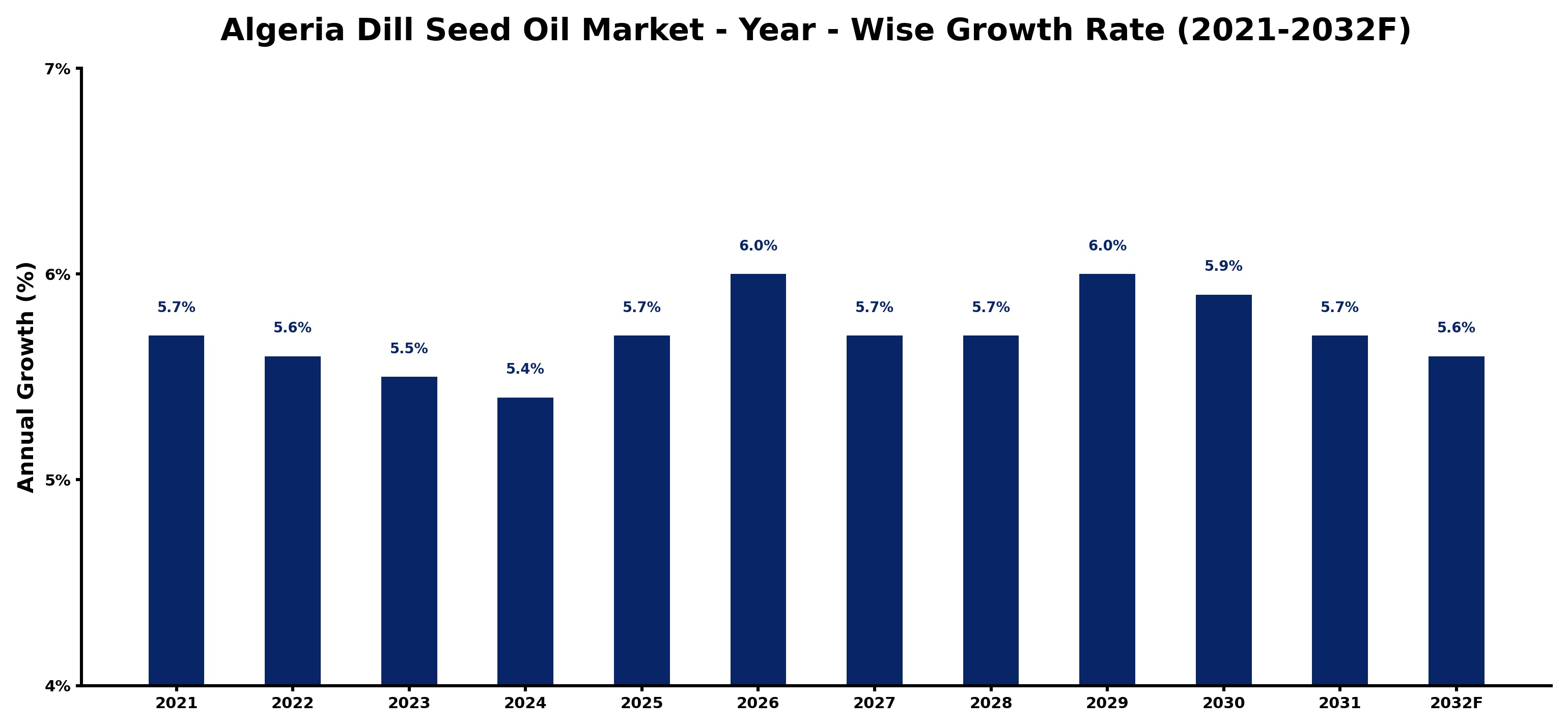
The table below presents the year‑wise growth rates along with the key drivers influencing the market
| Year | Growth Rate | Major Drivers |
| 2021 | 5.7% | Increasing industrial infrastructure investments |
| 2022 | 5.6% | Government infrastructure modernization initiatives |
| 2023 | 5.5% | Expansion of transportation and logistics networks |
| 2024 | 5.4% | Increasing industrial infrastructure investments |
| 2025 | 5.7% | Expansion of commercial construction activities |
| 2026 | 6.0% | Increasing smart city development projects |
| 2027 | 5.7% | Growing urbanization and commercial development |
| 2028 | 5.7% | Rising electricity demand across industries |
| 2029 | 6.0% | Increasing industrial infrastructure investments |
| 2030 | 5.9% | Increasing adoption of advanced technologies |
| 2031 | 5.7% | Increasing industrial automation investments |
| 2032 | 5.6% | Growing urbanization and commercial development |
Note - Market size estimations and growth projections presented in this report are based on 6Wresearch’s advanced forecasting approach, validated with industry datasets as of June 2026.
Algeria Dill Seed Oil Market Synopsis
In recent years, the Algeria Dill Seed Oil Market has gained momentum, reflecting a growing inclination toward organic ingredients and natural remedies. Consumers are becoming more educated about the positive impacts of dill seed oil, which is enhancing its reputation in both personal care and food applications.
However, while the market's growth is promising, it is still in a phase of potential development, with opportunities for further penetration in sectors such as aromatherapy and sustainable personal care products. As the market matures, it is likely to see an influx of innovative products and applications, driven by consumer demand and industry collaboration.
Algeria Dill Seed Oil Market Key Takeaways
- The market is experiencing steady growth driven by increasing consumer awareness of health benefits.
- There is a notable trend toward natural and organic products across food, cosmetics, and pharmaceuticals.
- Challenges such as inconsistent quality and limited consumer education remain prevalent.
- Sustainable sourcing and production practices are becoming essential for competitive differentiation.
- The government's supportive policies are paving the way for market expansion and investment opportunities.
Evaluation of Restraints in Algeria Dill Seed Oil Market
Despite its growth potential, the Algeria Dill Seed Oil Market faces several restraints that could impede its overall development. A primary concern is the limited consumer awareness surrounding the benefits and uses of dill seed oil, which can contribute to lower adoption rates compared to other essential oils. Additionally, inconsistent quality in production and supply chain challenges may hinder manufacturers' ability to meet market demands effectively. Lastly, the absence of standardized regulations and quality control measures creates uncertainty, which can negatively affect both consumer trust and market competitiveness.
Algeria Dill Seed Oil Market Trends
Current trends in the Algeria Dill Seed Oil Market reflect a strong consumer preference for products that emphasize wellness and sustainability. The demand for dill seed oil as a key ingredient in skincare and haircare formulations is on the rise, primarily due to its recognized anti-inflammatory and antibacterial properties. Moreover, the integration of dill seed oil into aromatherapy practices is gaining traction, attributed to its calming effects. Manufacturers are increasingly focused on enhancing product quality and innovating formulations to capture the growing market segment that seeks natural remedies.
Algeria Dill Seed Oil Market Opportunities
The Algeria Dill Seed Oil Market presents several lucrative investment opportunities. As the preference for natural and organic products continues to surge, there is substantial potential for growth in the production and processing of dill seed oil. Collaboration with local farmers for sustainable raw material sourcing could enhance quality and consistency. Furthermore, leveraging advanced extraction technologies and developing new product formulations targeted at both domestic and international markets could significantly boost market reach. Investors may also find value in exploring export channels to countries where demand for essential oils is robust, creating a strategic advantage in a competitive landscape.
Government Initiatives in the Algeria Dill Seed Oil Market
The Algerian government has introduced several initiatives aimed at bolstering the Dill Seed Oil Market. These include subsidies and incentives to encourage local cultivation of dill, which is vital for ensuring a consistent supply of high-quality raw materials. Additionally, government support for research and development is enhancing production efficiency and quality standards. Regulatory measures aimed at aligning with international certifications are also in place, promoting both domestic growth and export opportunities. Such initiatives are instrumental in fostering a favorable environment for investment and innovation within the market.
Future Insights of the Algeria Dill Seed Oil Market
Looking ahead, the future of the Algeria Dill Seed Oil Market appears bright. Increased consumer awareness of the health benefits associated with dill seed oil will likely drive steady growth through 2032. The market is expected to expand as traditional remedies and aromatherapy practices gain popularity, coupled with a continued shift toward natural and organic ingredients across various applications. As companies enhance their sustainability practices and product innovation, the market stands to attract further investment, positioning Algeria as a key player in the global dill seed oil landscape.
Algeria Dill Seed Oil Market Latest Developments (May 2025 - June 2026)
Recent developments in the Algeria Dill Seed Oil Market highlight an increasing focus on product innovation and quality enhancement. Companies are investing in advanced extraction technologies to optimize the production process, ensuring the preservation of beneficial properties in dill seed oil. Additionally, there is a growing trend among manufacturers to develop product lines that align with sustainability objectives, attracting environmentally conscious consumers. Collaborative efforts within the industry are expected to strengthen the supply chain and improve overall market stability.
Algeria Dill Seed Oil Market - Key Attractiveness of the Report
- 10 Years of Market Numbers
- Historical Data Starting from 2022 to 2025
- Base Year: 2025
- Forecast Data until 2032
- Key Performance Indicators Impacting the Market
- Major Upcoming Developments and Projects
Key Highlights of the Report:
- Algeria Dill Seed Oil Market Outlook
- Market Size of Algeria Dill Seed Oil Market, 2025
- Forecast of Algeria Dill Seed Oil Market, 2032
- Historical Data and Forecast of Algeria Dill Seed Oil Revenues & Volume for the Period 2022-2032F
- Algeria Dill Seed Oil Market Trend Evolution
- Algeria Dill Seed Oil Market Drivers and Challenges
- Algeria Dill Seed Oil Price Trends
- Algeria Dill Seed Oil Porter's Five Forces
- Algeria Dill Seed Oil Industry Life Cycle
- Historical Data and Forecast of Algeria Dill Seed Oil Market Revenues & Volume By Type for the Period 2022-2032F
- Historical Data and Forecast of Algeria Dill Seed Oil Market Revenues & Volume By Anethum Graveolens Seed Oil for the Period 2022-2032F
- Historical Data and Forecast of Algeria Dill Seed Oil Market Revenues & Volume By Anethum Sowa Seed Oil for the Period 2022-2032F
- Historical Data and Forecast of Algeria Dill Seed Oil Market Revenues & Volume By Application for the Period 2022-2032F
- Historical Data and Forecast of Algeria Dill Seed Oil Market Revenues & Volume By Flavor for the Period 2022-2032F
- Historical Data and Forecast of Algeria Dill Seed Oil Market Revenues & Volume By Fragrance for the Period 2022-2032F
- Historical Data and Forecast of Algeria Dill Seed Oil Market Revenues & Volume By Pharmaceutical for the Period 2022-2032F
- Historical Data and Forecast of Algeria Dill Seed Oil Market Revenues & Volume By Skincare for the Period 2022-2032F
- Historical Data and Forecast of Algeria Dill Seed Oil Market Revenues & Volume By Aromatherapy for the Period 2022-2032F
- Algeria Dill Seed Oil Import Export Trade Statistics
- Market Opportunity Assessment By Type
- Market Opportunity Assessment By Application
- Algeria Dill Seed Oil Top Companies Market Share
- Algeria Dill Seed Oil Competitive Benchmarking By Technical and Operational Parameters
- Algeria Dill Seed Oil Company Profiles
- Algeria Dill Seed Oil Key Strategic Recommendations






































