Algeria Gas Sensors Market Size, Share & Growth Rate
The Algeria Gas Sensors Market was estimated at USD 163 Million in 2025 and is projected to reach USD 223 Million by 2032, growing at a CAGR of 4.6% from 2026 to 2032. This upward trajectory is primarily fueled by the growing industrialization and the urgent need for enhanced safety regulations across sectors such as oil and gas, manufacturing, and automotive. As Algeria's industries become increasingly aware of the critical role of gas monitoring for worker safety and compliance, the market is poised for significant expansion.
Algeria Gas Sensors Market Year-wise Growth Rate and Key Drivers
This graph highlights how the Algeria Gas Sensors Market has steadily grown over the years, supported by major growth factors.
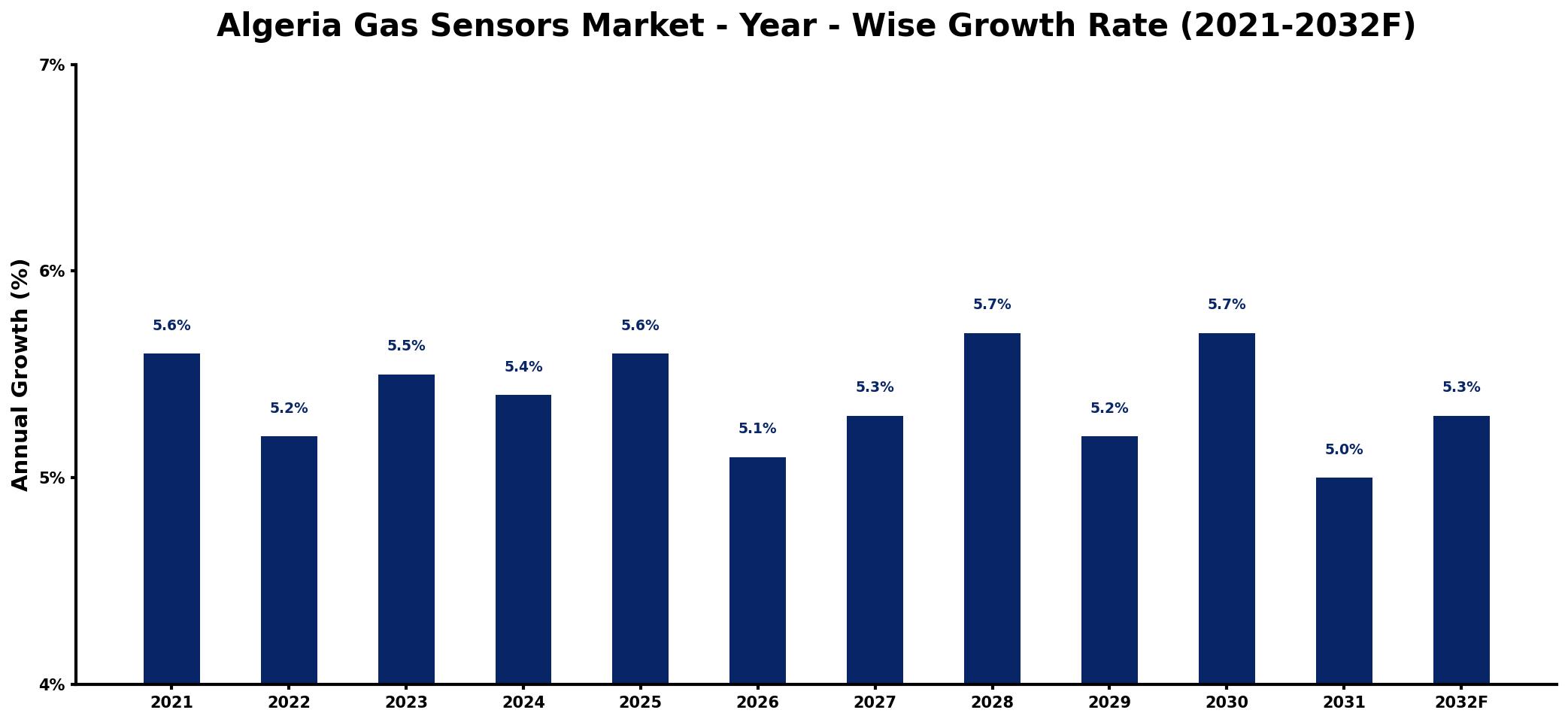
The table below presents the year‑wise growth rates along with the key drivers influencing the market
| Year | Growth Rate | Major Drivers |
| 2021 | 5.6% | Rising industrial safety regulations |
| 2022 | 5.2% | Growing environmental protection initiatives |
| 2023 | 5.5% | Increased investments in infrastructure |
| 2024 | 5.4% | Expansion of manufacturing facilities |
| 2025 | 5.6% | Higher demand for energy efficiency |
| 2026 | 5.1% | Emerging renewable energy projects |
| 2027 | 5.3% | Strengthening urban development plans |
| 2028 | 5.7% | Surge in residential applications |
| 2029 | 5.2% | Advancements in monitoring technology |
| 2030 | 5.7% | Focus on public health awareness |
| 2031 | 5.0% | Integration of smart city solutions |
| 2032 | 5.3% | Development of research partnerships |
Note: Market size estimations and growth projections presented in this report are based on 6Wresearch's proprietary forecasting methodology, utilizing the latest available industry data, government publications, and primary research inputs.
Algeria Gas Sensors Market Synopsis
In recent years, the Algeria Gas Sensors Market has gained momentum, driven by an urgent focus on worker safety and environmental protection. However, as the country continues to navigate its regulatory landscape, the market is set to evolve, with a stronger emphasis on technological advancements and innovative solutions.
The push for improved air quality and reduced emissions has catalyzed the demand for gas sensing technologies. Local manufacturers are stepping up to meet this demand, while international players bring innovation to the forefront, creating a diverse product offering tailored to the unique needs of Algeria's industrial landscape.
Algeria Gas Sensors Market Key Takeaways
- Growing industrialization and regulatory requirements are key drivers of market growth.
- Technological advancements are enhancing the accuracy and reliability of gas sensors.
- Wireless and IoT-enabled gas sensors are increasingly being adopted for real-time monitoring.
- Investment in local manufacturing capabilities is crucial for market penetration.
- The government's focus on safety and environmental standards is creating new opportunities.
Evaluation of Restraints in Algeria Gas Sensors Market
Despite its growth potential, the Algeria Gas Sensors Market faces significant challenges that could impede progress. One of the primary constraints is the limited awareness among industries about the benefits that gas sensors offer, which hinders widespread adoption. Coupled with this is the economic instability and political uncertainties that may deter investment and innovation. Furthermore, the prevalence of counterfeit products creates an additional layer of difficulty for businesses, as it undermines consumer trust and affects overall market credibility. To overcome these hurdles, a concerted effort is needed to raise awareness, improve education around sensor technology, and enforce stricter regulations against counterfeit goods.
Algeria Gas Sensors Market Trends
The Algeria Gas Sensors Market is undergoing several transformative trends. A prominent trend is the growing demand for advanced gas sensor technologies that offer enhanced accuracy, sensitivity, and reliability for detecting hazardous gases. Additionally, the market is witnessing a notable shift toward wireless gas sensors, which enable real-time monitoring and seamless data analytics, crucial for timely decision-making. Moreover, miniaturization of gas sensors is becoming increasingly prevalent, reflecting the industry's push for portability and convenience, thereby expanding their application range across various sectors.
Algeria Gas Sensors Market Opportunities
The market offers numerous growth opportunities driven by burgeoning demand for gas sensing technologies across critical sectors such as oil & gas, healthcare, and environmental monitoring. Investors can explore cutting-edge gas sensor technologies that emphasize high sensitivity and rapid response times to capture substantial market share. Furthermore, establishing partnerships with local distributors and manufacturers can facilitate effective market entry, enhancing distribution channels. With the government's commitment to industrial development and sustainable practices, the Algeria Gas Sensors Market is set for robust growth and offers attractive prospects for investment.
Government Initiatives in the Algeria Gas Sensors Market
Government policies in Algeria are geared toward promoting safety and environmental sustainability, significantly impacting the gas sensors market. Regulations mandate the use of gas sensors across multiple industries to monitor emissions, reinforcing compliance with environmental standards. The government has also introduced incentives and subsidies to encourage the adoption of advanced gas sensor technologies, facilitating improvements in workplace safety and operational efficiency. These initiatives aim to foster a supportive environment for growth, encouraging innovation and local manufacturing within the sector.
Future Insights of the Algeria Gas Sensors Market
Looking ahead to 2026-2032, the future of the Algeria Gas Sensors Market appears promising, bolstered by the ongoing industrialization and rising regulatory pressures for workplace safety and environmental protection. The market is expected to thrive as sectors such as oil and gas, chemicals, and manufacturing ramp up their focus on gas monitoring solutions. Moreover, technological advancements such as the proliferation of IoT-enabled gas sensors will further drive growth, enhancing monitoring capabilities and providing valuable data analytics. With the government prioritizing safety and emission reduction, the market's expansion seems inevitable, offering ample opportunities for stakeholders.
Algeria Gas Sensors Market Latest Developments (2025 - 2026)
In the most recent months, the Algeria Gas Sensors Market has observed significant activity, characterized by a heightened focus on technological innovation and enhanced product offerings. Companies are increasingly investing in R&D to create advanced gas sensors that are both efficient and compliant with safety regulations. Additionally, collaborations among local manufacturers and international firms have become more frequent, aimed at leveraging collective expertise to address market demands effectively. The ongoing governmental push for improved air quality and safety standards is also prompting an uptick in public and private sector partnerships aimed at expanding gas sensor deployment.
Algeria Gas Sensors Market - Key Attractiveness of the Report
- 10 Years of Market Numbers
- Historical Data Starting from 2022 to 2025
- Base Year: 2025
- Forecast Data until 2032
- Key Performance Indicators Impacting the Market
- Major Upcoming Developments and Projects
Key Highlights of the Report:
- Algeria Gas Sensors Market Outlook
- Market Size of Algeria Gas Sensors Market, 2025
- Forecast of Algeria Gas Sensors Market, 2032
- Historical Data and Forecast of Algeria Gas Sensors Revenues & Volume for the Period 2022-2032F
- Algeria Gas Sensors Market Trend Evolution
- Algeria Gas Sensors Market Drivers and Challenges
- Algeria Gas Sensors Price Trends
- Algeria Gas Sensors Porter's Five Forces
- Algeria Gas Sensors Industry Life Cycle
- Historical Data and Forecast of Algeria Gas Sensors Market Revenues & Volume By Product for the Period 2022-2032F
- Historical Data and Forecast of Algeria Gas Sensors Market Revenues & Volume By Hydrogen for the Period 2022-2032F
- Historical Data and Forecast of Algeria Gas Sensors Market Revenues & Volume By Ammonia for the Period 2022-2032F
- Historical Data and Forecast of Algeria Gas Sensors Market Revenues & Volume By Hydrogen Sulfide for the Period 2022-2032F
- Historical Data and Forecast of Algeria Gas Sensors Market Revenues & Volume By Methyl Mercaptan Sensor for the Period 2022-2032F
- Historical Data and Forecast of Algeria Gas Sensors Market Revenues & Volume By NOx Sensor for the Period 2022-2032F
- Historical Data and Forecast of Algeria Gas Sensors Market Revenues & Volume By Carbon Monoxide Sensor for the Period 2022-2032F
- Historical Data and Forecast of Algeria Gas Sensors Market Revenues & Volume By Carbon Dioxide Sensor for the Period 2022-2032F
- Historical Data and Forecast of Algeria Hydrogen Gas Sensors Market Revenues & Volume By Oxygen/Lambda Sensor for the Period 2022-2032F
- Historical Data and Forecast of Algeria Gas Sensors Market Revenues & Volume By Technology for the Period 2022-2032F
- Historical Data and Forecast of Algeria Gas Sensors Market Revenues & Volume By Infrared for the Period 2022-2032F
- Historical Data and Forecast of Algeria Gas Sensors Market Revenues & Volume By Catalytic for the Period 2022-2032F
- Historical Data and Forecast of Algeria Gas Sensors Market Revenues & Volume By Photo-Ionization Detector for the Period 2022-2032F
- Historical Data and Forecast of Algeria Gas Sensors Market Revenues & Volume By Solid State/MOS for the Period 2022-2032F
- Historical Data and Forecast of Algeria Gas Sensors Market Revenues & Volume By Semiconductor for the Period 2022-2032F
- Historical Data and Forecast of Algeria Gas Sensors Market Revenues & Volume By Electrochemical for the Period 2022-2032F
- Algeria Gas Sensors Import Export Trade Statistics
- Market Opportunity Assessment By Product
- Market Opportunity Assessment By Technology
- Algeria Gas Sensors Top Companies Market Share
- Algeria Gas Sensors Competitive Benchmarking By Technical and Operational Parameters
- Algeria Gas Sensors Company Profiles
- Algeria Gas Sensors Key Strategic Recommendations






































