Algeria Glass Tiles Market Size, Share & Growth Rate
The Algeria Glass Tiles Market was estimated at USD 289 Million in 2025 and is projected to reach USD 386 Million by 2032, growing at a CAGR of 4.2% from 2026 to 2032. This positive trajectory is propelled by a robust demand for decorative surface materials, driven largely by the burgeoning construction and renovation activities across residential and commercial sectors. Furthermore, advancements in manufacturing technology are enhancing product offerings, thereby making glass tiles more appealing to architects and interior designers alike.
Algeria Glass Tiles Market Year-wise Growth Rate and Key Drivers
This graph highlights how the Algeria Glass Tiles Market has steadily grown over the years, supported by major growth factors.
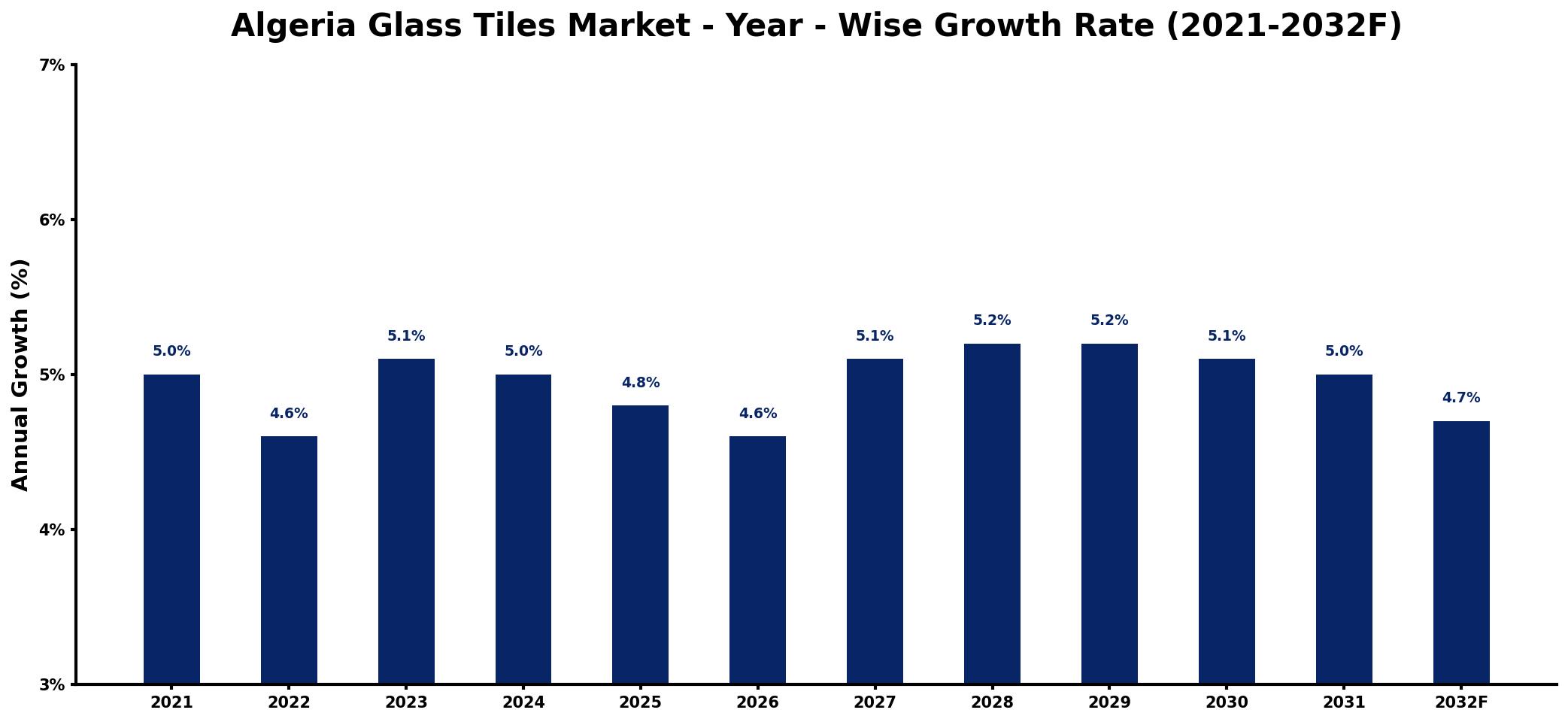
The table below presents the year‑wise growth rates along with the key drivers influencing the market
| Year | Growth Rate | Major Drivers |
| 2021 | 5.0% | Rising construction sector investments |
| 2022 | 4.6% | Growing demand for sustainable materials |
| 2023 | 5.1% | Increased focus on interior design |
| 2024 | 5.0% | Expansion of renovation projects |
| 2025 | 4.8% | Emerging trends in home decor |
| 2026 | 4.6% | Surge in eco-friendly initiatives |
| 2027 | 5.1% | Boost in luxury residential developments |
| 2028 | 5.2% | Heightened interest in artistic applications |
| 2029 | 5.2% | Growth in commercial building projects |
| 2030 | 5.1% | Investment in urban infrastructure upgrades |
| 2031 | 5.0% | Popularity of DIY home improvement |
| 2032 | 4.7% | Demand for innovative design solutions |
Note: Market size estimations and growth projections presented in this report are based on 6Wresearch's proprietary forecasting methodology, utilizing the latest available industry data, government publications, and primary research inputs.
Algeria Glass Tiles Market Synopsis
Recent trends indicate an uptick in the use of glass tiles in various architectural projects, providing not just functional benefits but also significant aesthetic value. However, as the market evolves, it faces the challenge of meeting customization demands and navigating competition from traditional materials like ceramic and porcelain tiles.
Looking ahead, the market is likely to experience a diversification in design trends, alongside an increased emphasis on sustainable production practices. This evolution may pave the way for innovative products that align with both aesthetic desires and environmental considerations, reinforcing the glass tile's position in the broader market.
Algeria Glass Tiles Market Key Takeaways
- The market is fueled by rising demand for aesthetic and versatile building materials in both residential and commercial sectors.
- Technological advancements are expected to drive innovation in manufacturing processes and installation techniques.
- Regulatory support from the government is fostering a conducive environment for industry growth.
- Challenges include overcoming customization needs and the competitive landscape with alternative tile materials.
- Collaboration with designers and architects remains critical to market penetration and customer engagement.
Evaluation of Restraints in Algeria Glass Tiles Market
Despite its growth potential, the Algeria Glass Tiles Market faces significant hurdles. Customization requirements can create complexities that slow down the production process and elongate lead times. Additionally, installation challenges often deter contractors and consumers, who may opt for more conventional materials that are perceived as easier to work with. The established market presence of ceramic and porcelain tiles poses an ongoing competitive threat. Hence, companies will need to focus on providing comprehensive installation training and enhancing their design flexibility to fully capture market share.
Algeria Glass Tiles Market Trends
Current trends in the Algeria Glass Tiles Market reveal a growing preference for eco-friendly products, reflecting the global shift towards sustainability. Manufacturers are responding by adopting greener production processes and utilizing recyclable materials. Moreover, design trends are increasingly leaning towards geometric patterns and bold colors, which resonate with modern architectural aesthetics. As architects and designers seek to create unique spaces, the versatility of glass tiles is likely to become more pronounced.
Algeria Glass Tiles Market Opportunities
Significant growth and investment opportunities lie within niche segments such as custom glass tile designs and large-scale commercial applications. The rise of smart home technologies also offers an avenue for integrating glass tiles into modern design concepts, making them even more desirable. Additionally, expanding partnerships with local architects and designers can provide valuable insights into market needs, paving the way for tailored product offerings that enhance both form and function.
Government Initiatives in the Algeria Glass Tiles Market
The Algerian government recognizes the potential of the glass tiles market and has initiated several policies aimed at fostering its development. These initiatives include financial incentives to encourage investment in local tile manufacturing and stringent regulations to uphold quality and safety standards. Collaborative efforts with architects and designers are also being promoted to inspire innovative tile designs that align with modern sustainability practices.
Future Insights of the Algeria Glass Tiles Market
Looking forward to the period between 2026 and 2032, the Algeria Glass Tiles Market is poised for substantial evolution. As the construction landscape grows more competitive, the demand for aesthetically pleasing and durable materials will likely drive innovation. The integration of smart technologies and the continuing push for sustainable practices will also play a pivotal role in shaping market dynamics. Companies that adapt quickly to these trends will be better positioned to capitalize on emerging opportunities.
Algeria Glass Tiles Market Latest Developments (2025 - 2026)
The industry is currently witnessing a wave of advancements aimed at improving production efficiencies and reducing environmental impact. Collaborations between manufacturers and technology firms are leading to innovative solutions in glass tile design and installation processes. Furthermore, several industry exhibitions and trade shows are scheduled, providing platforms for showcasing new products and establishing crucial partnerships that can further enhance market visibility.
Algeria Glass Tiles Market - Key Attractiveness of the Report
- 10 Years of Market Numbers
- Historical Data Starting from 2022 to 2025
- Base Year: 2025
- Forecast Data until 2032
- Key Performance Indicators Impacting the Market
- Major Upcoming Developments and Projects
Key Highlights of the Report:
- Algeria Glass Tiles Market Outlook
- Market Size of Algeria Glass Tiles Market, 2025
- Forecast of Algeria Glass Tiles Market, 2032
- Historical Data and Forecast of Algeria Glass Tiles Revenues & Volume for the Period 2022-2032F
- Algeria Glass Tiles Market Trend Evolution
- Algeria Glass Tiles Market Drivers and Challenges
- Algeria Glass Tiles Price Trends
- Algeria Glass Tiles Porter's Five Forces
- Algeria Glass Tiles Industry Life Cycle
- Historical Data and Forecast of Algeria Glass Tiles Market Revenues & Volume By Manufacturing Process for the Period 2022-2032F
- Historical Data and Forecast of Algeria Glass Tiles Market Revenues & Volume By Smalti Tiles for the Period 2022-2032F
- Historical Data and Forecast of Algeria Glass Tiles Market Revenues & Volume By Fused Tiles for the Period 2022-2032F
- Historical Data and Forecast of Algeria Glass Tiles Market Revenues & Volume By Sintered Tiles for the Period 2022-2032F
- Historical Data and Forecast of Algeria Glass Tiles Market Revenues & Volume By Cast Tiles for the Period 2022-2032F
- Historical Data and Forecast of Algeria Glass Tiles Market Revenues & Volume By Other for the Period 2022-2032F
- Historical Data and Forecast of Algeria Glass Tiles Market Revenues & Volume By Product Type for the Period 2022-2032F
- Historical Data and Forecast of Algeria Glass Tiles Market Revenues & Volume By Matte-finished Glass Tile for the Period 2022-2032F
- Historical Data and Forecast of Algeria Glass Tiles Market Revenues & Volume By Smooth Glass Tile for the Period 2022-2032F
- Historical Data and Forecast of Algeria Glass Tiles Market Revenues & Volume By End-User Industry for the Period 2022-2032F
- Historical Data and Forecast of Algeria Glass Tiles Market Revenues & Volume By Residential for the Period 2022-2032F
- Historical Data and Forecast of Algeria Glass Tiles Market Revenues & Volume By Commercial for the Period 2022-2032F
- Historical Data and Forecast of Algeria Glass Tiles Market Revenues & Volume By Infrastructure for the Period 2022-2032F
- Algeria Glass Tiles Import Export Trade Statistics
- Market Opportunity Assessment By Manufacturing Process
- Market Opportunity Assessment By Product Type
- Market Opportunity Assessment By End-User Industry
- Algeria Glass Tiles Top Companies Market Share
- Algeria Glass Tiles Competitive Benchmarking By Technical and Operational Parameters
- Algeria Glass Tiles Company Profiles
- Algeria Glass Tiles Key Strategic Recommendations






































