Algeria Milk Protein Market Size, Share & Growth Rate
The Algeria Milk Protein Market was estimated at USD 335 Million in 2025 and is projected to reach USD 471 Million by 2032, growing at a CAGR of 5.0% from 2026 to 2032. This growth trajectory is propelled by rising health consciousness among Algerian consumers, who are increasingly recognizing the importance of dairy proteins for muscle building and overall wellness. Furthermore, the expanding applications of milk proteins in nutrition products, infant formula, and sports nutrition are playing a significant role in shaping market dynamics.
Algeria Milk Protein Market Year-wise Growth Rate and Key Drivers
This graph highlights how the Algeria Milk Protein Market has steadily grown over the years, supported by major growth factors.
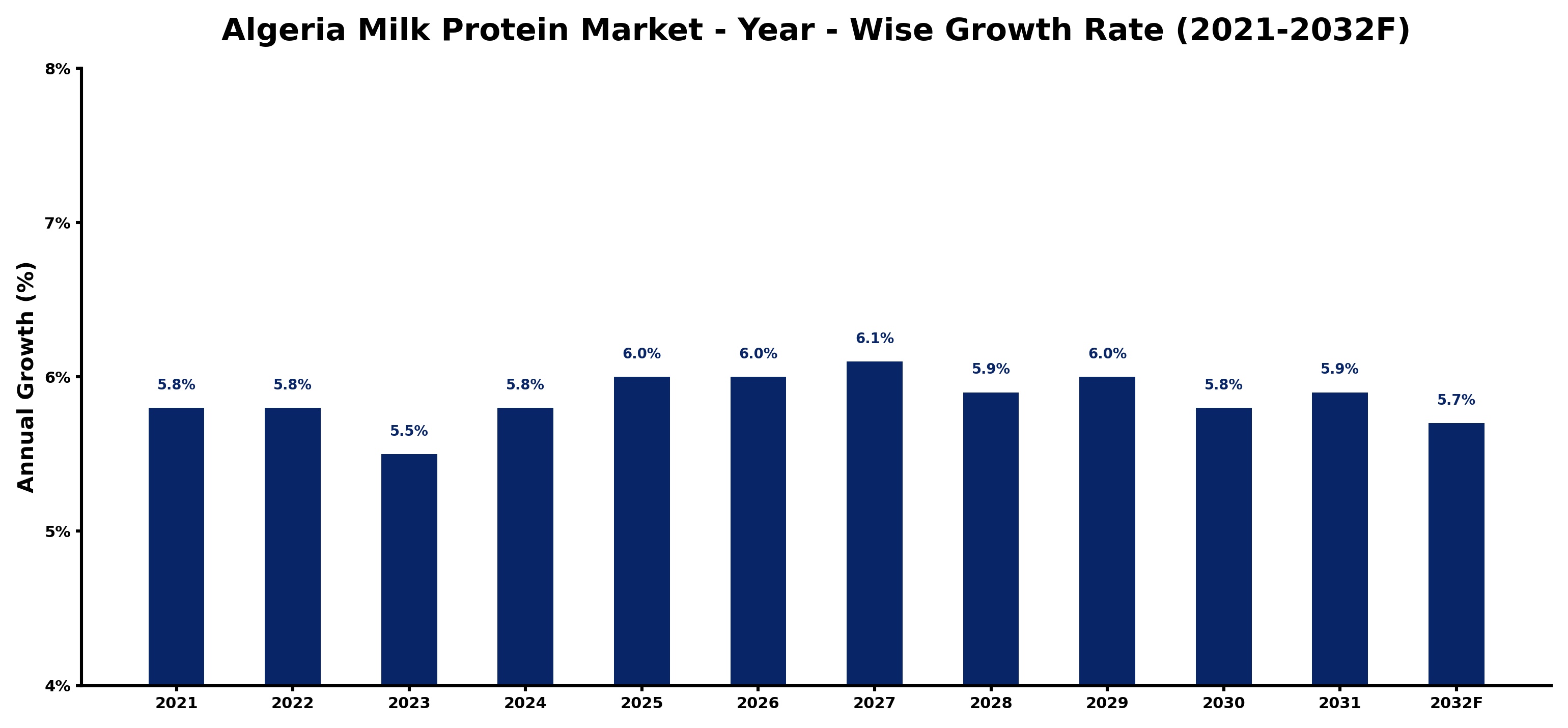
The table below presents the year‑wise growth rates along with the key drivers influencing the market
| Year | Growth Rate | Major Drivers |
| 2021 | 5.8% | Local dairy farms expand processing capacity to meet demand |
| 2022 | 5.8% | Improved pasteurization technology boosts milk protein quality standards |
| 2023 | 5.5% | Dairy processing facility upgrades drive increased milk protein production |
| 2024 | 5.8% | Optimized dairy processing facilities enhanced milk protein production efficiency |
| 2025 | 6.0% | Foreign investments boosted local dairy processing facility capacities |
| 2026 | 6.0% | Export driven dairy investments boosted local milk protein production capabilities |
| 2027 | 6.1% | Local dairy processing upgrades boosted milk protein production capacity |
| 2028 | 5.9% | Milk processing upgrades bolster local dairy product competitiveness |
| 2029 | 6.0% | Technology integration in processing facilities boosts milk protein yields |
| 2030 | 5.8% | Accelerated milk processing upgrades boosted protein production capacity |
| 2031 | 5.9% | Milk processing facilities adopt advanced filtration technology for efficiency |
| 2032 | 5.7% | Milk processing plant upgrades optimize dairy protein production efficiency |
Note - Market size estimations and growth projections presented in this report are based on 6Wresearch’s advanced forecasting approach, validated with industry datasets as of June 2026.
Algeria Milk Protein Market Synopsis
Consumer awareness regarding the health benefits of milk proteins, such as whey and casein, is the most significant force shaping the Algeria Milk Protein Market today. This awareness is fostering a robust demand for protein-rich products, from dietary supplements to fortified food items.
Additionally, the trend of fitness and wellness is gaining traction among Algerian consumers, contributing to the increasing adoption of protein-enriched diets. As manufacturers innovate to diversify their offerings, the market is poised for substantial growth over the coming years.
Algeria Milk Protein Market Key Takeaways
- The market is witnessing a growing preference for protein-based products among health-conscious consumers.
- Technological advancements are enhancing the quality and functionality of milk protein ingredients.
- Government initiatives are supporting domestic dairy farmers to increase milk protein production.
- The evolving fitness culture is driving demand for sports nutrition and dietary supplements.
- Strategic investments in processing capabilities are essential to meet increasing market demands.
Evaluation of Restraints in Algeria Milk Protein Market
Despite its robust growth potential, the Algeria Milk Protein Market faces significant constraints. One major challenge is the fluctuating supply of milk, which can impact production capacity and, consequently, market availability. Additionally, logistical issues in distribution can hinder the timely delivery of milk protein products. These factors, combined with the need for enhanced processing efficiency, present hurdles that stakeholders must navigate to capitalize on market opportunities.
Algeria Milk Protein Market Trends
Several key trends are shaping the Algeria Milk Protein Market. The rise of plant-based diets has prompted traditional dairy manufacturers to innovate and offer hybrid products that incorporate both plant and milk proteins. Additionally, the increasing popularity of personalized nutrition solutions is influencing product formulation, pushing brands to develop tailored protein products. There is also a noticeable shift towards sustainable and ethically sourced dairy ingredients, as consumers become more environmentally conscious.
Algeria Milk Protein Market Opportunities
The evolving landscape presents numerous growth and investment opportunities within the Algeria Milk Protein Market. Companies that focus on research and development to create specialized formulations for niche markets, such as vegan and lactose-free options, are likely to benefit. Moreover, collaborations with health and wellness influencers can further amplify consumer outreach. Investment in advanced processing technologies can also enhance product quality and expand offerings in the nutritional supplements segment.
Government Initiatives in the Algeria Milk Protein Market
The Algerian government recognizes the significance of dairy products, including milk proteins, in enhancing public health and nutrition. As a result, various initiatives have been implemented to bolster domestic production and processing. These initiatives involve subsidies for dairy farmers, support for equipment acquisition, and programs aimed at improving livestock management practices. Furthermore, the government has actively engaged in public awareness campaigns to promote the nutritional advantages of milk protein consumption.
Future Insights of the Algeria Milk Protein Market
Looking ahead to 2026-2032, the Algeria Milk Protein Market is expected to experience continued growth driven by increasing consumer demand for healthier food options and the proliferation of innovative products. As manufacturers leverage technology to enhance the quality and functional attributes of milk proteins, the market is set to witness an influx of new applications across various sectors. Additionally, ongoing government support for the dairy industry will play a crucial role in sustaining production capacity and fostering market expansion.
Algeria Milk Protein Market Latest Developments (May 2025 - June 2026)
Recent developments in the Algeria Milk Protein Market indicate a strong momentum toward innovation and diversification. Companies are increasingly focusing on developing protein-enriched snacks and meal replacements to cater to the health-focused consumer segment. Additionally, there has been a notable rise in partnerships between dairy producers and nutritional supplement brands, aimed at expanding product offerings and enhancing market reach. Efforts to improve sustainability practices within the industry are also gaining traction, reflecting a growing consumer preference for environmentally friendly products.
Algeria Milk Protein Market - Key Attractiveness of the Report
- 10 Years of Market Numbers
- Historical Data Starting from 2022 to 2025
- Base Year: 2025
- Forecast Data until 2032
- Key Performance Indicators Impacting the Market
- Major Upcoming Developments and Projects
Key Highlights of the Report:
- Algeria Milk Protein Market Outlook
- Market Size of Algeria Milk Protein Market, 2025
- Forecast of Algeria Milk Protein Market, 2032
- Historical Data and Forecast of Algeria Milk Protein Revenues & Volume for the Period 2022-2032F
- Algeria Milk Protein Market Trend Evolution
- Algeria Milk Protein Market Drivers and Challenges
- Algeria Milk Protein Price Trends
- Algeria Milk Protein Porter's Five Forces
- Algeria Milk Protein Industry Life Cycle
- Historical Data and Forecast of Algeria Milk Protein Market Revenues & Volume By Type for the Period 2022-2032F
- Historical Data and Forecast of Algeria Milk Protein Market Revenues & Volume By Whey Protein Isolates for the Period 2022-2032F
- Historical Data and Forecast of Algeria Milk Protein Market Revenues & Volume By Whey Protein Concentrates for the Period 2022-2032F
- Historical Data and Forecast of Algeria Milk Protein Market Revenues & Volume By Milk Protein Hydrolysates for the Period 2022-2032F
- Historical Data and Forecast of Algeria Milk Protein Market Revenues & Volume By Milk Protein Isolates for the Period 2022-2032F
- Historical Data and Forecast of Algeria Milk Protein Market Revenues & Volume By Milk Protein Concentrates for the Period 2022-2032F
- Historical Data and Forecast of Algeria Milk Protein Market Revenues & Volume By Others for the Period 2022-2032F
- Historical Data and Forecast of Algeria Milk Protein Market Revenues & Volume By Form for the Period 2022-2032F
- Historical Data and Forecast of Algeria Milk Protein Market Revenues & Volume By Liquid for the Period 2022-2032F
- Historical Data and Forecast of Algeria Milk Protein Market Revenues & Volume By Dry for the Period 2022-2032F
- Historical Data and Forecast of Algeria Milk Protein Market Revenues & Volume By Applications for the Period 2022-2032F
- Historical Data and Forecast of Algeria Milk Protein Market Revenues & Volume By Dairy Products for the Period 2022-2032F
- Historical Data and Forecast of Algeria Milk Protein Market Revenues & Volume By Sports Nutrition for the Period 2022-2032F
- Historical Data and Forecast of Algeria Milk Protein Market Revenues & Volume By Infant Formula for the Period 2022-2032F
- Historical Data and Forecast of Algeria Milk Protein Market Revenues & Volume By Others for the Period 2022-2032F
- Algeria Milk Protein Import Export Trade Statistics
- Market Opportunity Assessment By Type
- Market Opportunity Assessment By Form
- Market Opportunity Assessment By Applications
- Algeria Milk Protein Top Companies Market Share
- Algeria Milk Protein Competitive Benchmarking By Technical and Operational Parameters
- Algeria Milk Protein Company Profiles
- Algeria Milk Protein Key Strategic Recommendations






































