Algeria Passwordless Authentication Market Size & Growth Rate (2026-2032)
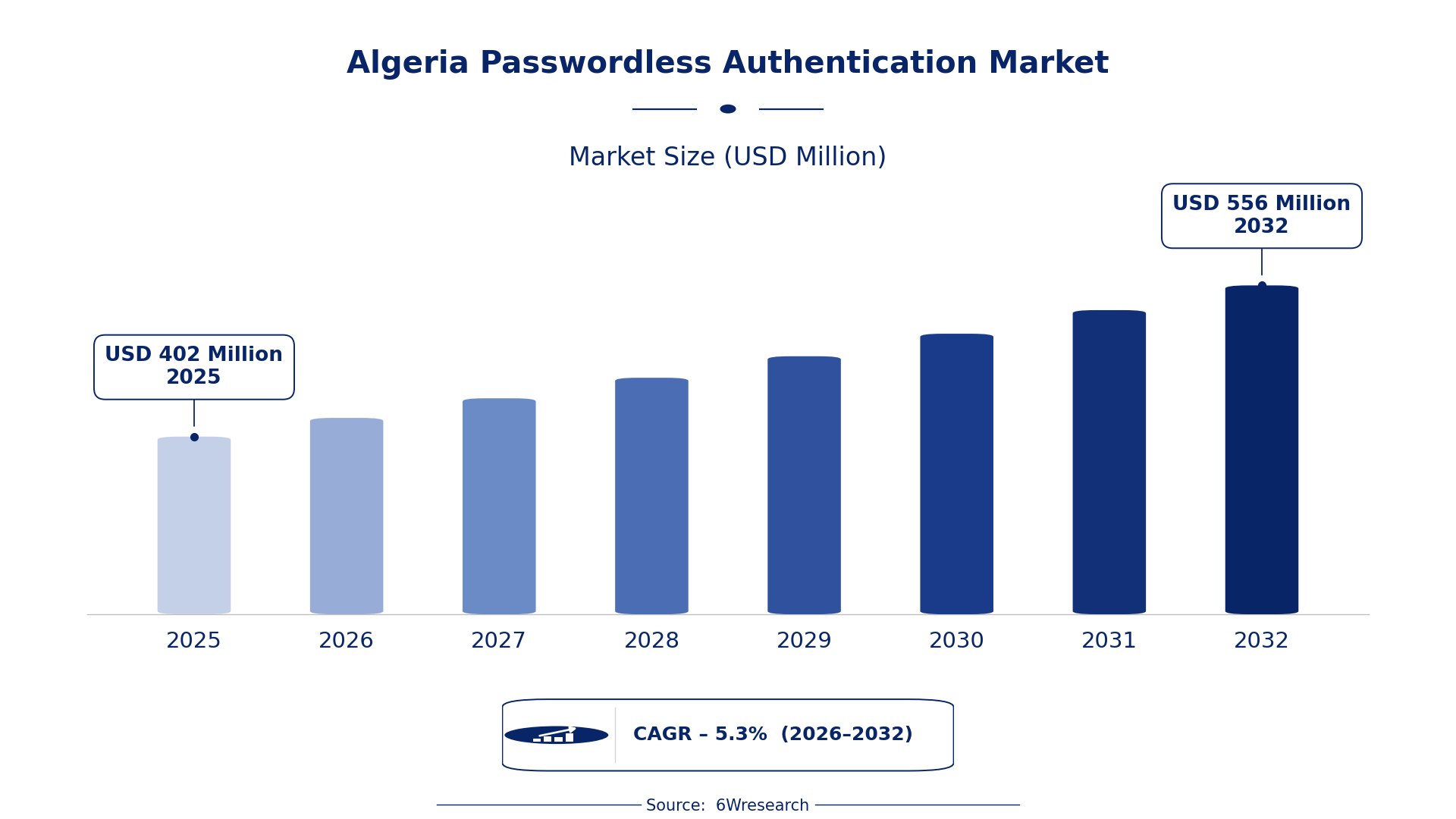
The Algeria Passwordless Authentication Market was estimated at USD 402 Million in 2025 and is projected to reach USD 556 Million by 2032, growing at a CAGR of 5.3% from 2026 to 2032.
Algeria Passwordless Authentication Market Synopsis
The push for enhanced security and the decline of traditional password systems are driving a notable shift in the Algeria Passwordless Authentication Market. As organizations in Algeria look to improve their cybersecurity frameworks, innovative technologies such as biometrics and multi-factor authentication are gaining traction.
The growing dependence on digital solutions and remote work is accelerating the demand for authentication methods that balance security with user convenience. This trend reflects a broader movement within the region, where the need for seamless access control systems is becoming increasingly critical.
Algeria Passwordless Authentication Market Year-wise Growth Rate and Key Drivers
This graph illustrates the annual growth rates of the Algeria Passwordless Authentication Market from 2021 to 2032, highlighting a steady upward trajectory and projected expansion over the forecast period.
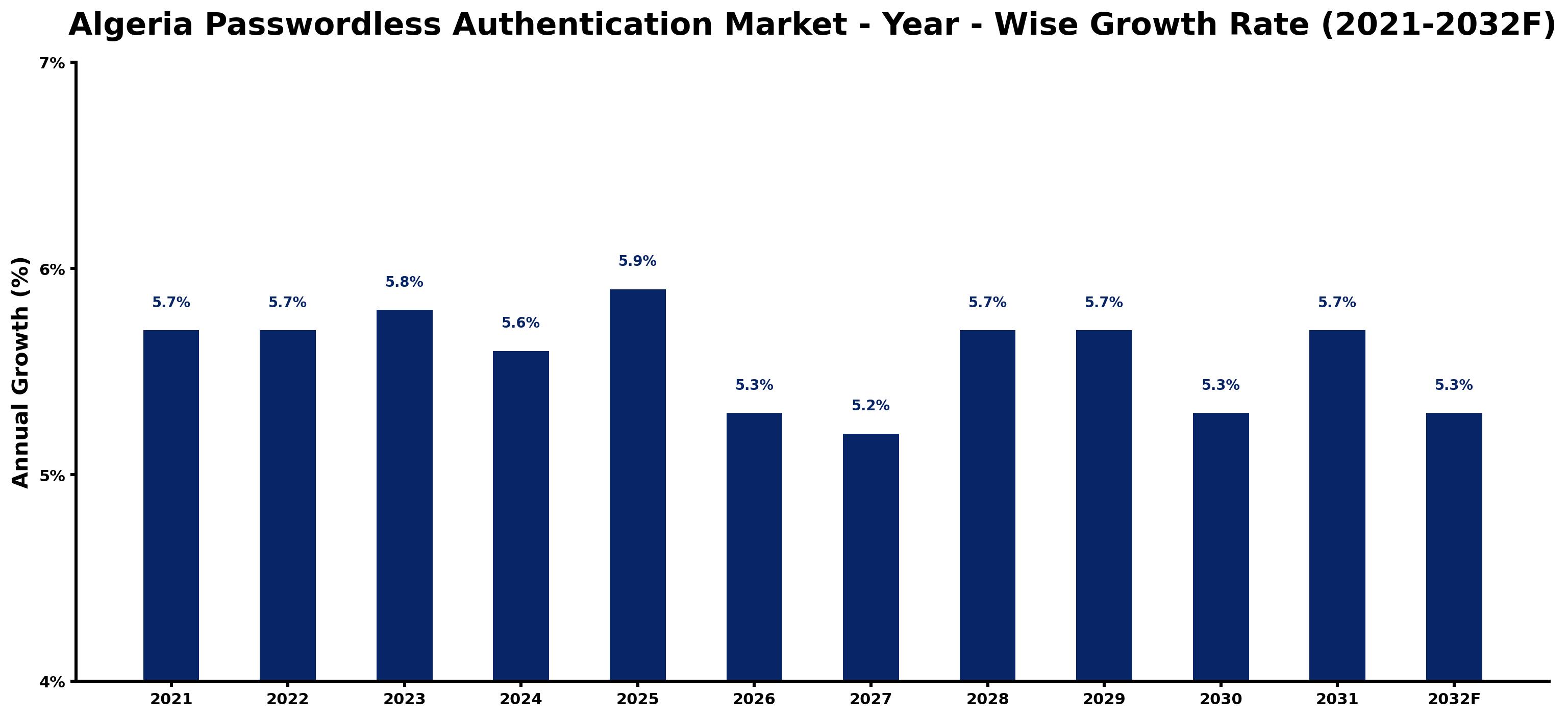
The table below presents the year‑wise growth rates along with the key drivers influencing the market
| Year | Growth Rate | Major Drivers |
| 2021 | 5.7% | Government cybersecurity strategy promotes passwordless solutions. |
| 2022 | 5.7% | Adoption of biometric ID regulations increases digital security. |
| 2023 | 5.8% | Rise in mobile payments drives authentication technology demand. |
| 2024 | 5.6% | Local fintech innovations push for seamless user experiences. |
| 2025 | 5.9% | Increased e-commerce activities elevate needs for secure login. |
| 2026 | 5.3% | Cybersecurity awareness campaigns boost passwordless service adoption. |
| 2027 | 5.2% | National initiative supports digital identity verification services. |
| 2028 | 5.7% | Growth in remote work enhances need for secure access. |
| 2029 | 5.7% | Emerging tech startups focus on advanced authentication methods. |
| 2030 | 5.3% | National data protection laws stimulate passwordless technology adoption. |
| 2031 | 5.7% | Rising internet penetration fosters demand for secure authentication. |
| 2032 | 5.3% | Local educational programs emphasize importance of cybersecurity. |
Note: Market size estimations and growth projections presented in this report are based on 6Wresearch's proprietary forecasting methodology, utilizing the latest available industry data, government publications, and primary research inputs.
Algeria Passwordless Authentication Market Key Takeaways
Below are some of the specific key takeaways from the market, including:
- The market is primarily driven by increasing cybersecurity concerns and the shift from traditional password systems.
- Biometric authentication solutions, like fingerprint and facial recognition, are rapidly gaining acceptance.
- Regulatory frameworks are being established to promote the adoption of secure authentication measures.
- The rise of mobile devices and remote work is significantly influencing the demand for passwordless solutions.
- Investment opportunities are expanding as businesses prioritize cybersecurity and seek innovative authentication technologies.
Evaluation of Restraints in Algeria Passwordless Authentication Market
Several factors are curtailing the growth of the Algeria Passwordless Authentication Market. Technological challenges persist, particularly due to insufficient digital infrastructure in some areas. Limited internet connectivity and the lack of advanced hardware can impede the implementation of sophisticated authentication systems.
Additionally, concerns regarding data privacy, especially with biometric data, create hesitation among potential users. User acceptance is also a critical hurdle; many individuals remain unfamiliar with these technologies, leading to resistance in adoption. Regulatory inconsistencies further complicate the landscape, necessitating a careful navigation of compliance issues.
Algeria Passwordless Authentication Market Trends
A significant trend in the Algeria Passwordless Authentication Market is the surge in biometric technologies. Organizations are increasingly gravitating towards solutions that provide both security and convenience. Facial recognition, iris scanning, and fingerprint technology are all making their mark.
Multi-factor authentication, particularly involving one-time passwords delivered via SMS or email, is also on the rise. This growing trend highlights a shift in user preferences towards more secure yet user-friendly access control methods, reflecting broader global movements in authentication practices.
Algeria Passwordless Authentication Market Opportunities
The market presents several promising investment opportunities, fueled by the increasing emphasis on cybersecurity. Companies that focus on developing advanced biometric solutions or multi-factor authentication tools are likely to see significant demand.
Partnerships with local businesses can also yield fruitful results. Organizations that align with governmental initiatives to enhance digital security will likely find support and incentives for their developments. As Algeria's digital economy evolves, innovative authentication technologies are positioned for growth.
Government Initiatives in the Algeria Passwordless Authentication Market
Government actions are crucial in shaping the adoption of passwordless authentication in Algeria. The state is actively promoting secure digital practices through policies aimed at enhancing cybersecurity. This regulatory environment not only supports businesses in modernizing their authentication methods but also fosters a culture of security awareness.
- A recently completed initiative includes the launch of the National Cybersecurity Strategy, emphasizing modern authentication methods.
- Currently ongoing efforts involve the National Agency for the Promotion and Development of Technological Parks providing incentives for technology firms focused on cybersecurity.
- Upcoming plans include a regulatory framework set to mandate stronger authentication measures for digital services by 2026.
- Recent discussions have surfaced about public-private partnerships to improve the country’s cybersecurity infrastructure.
- The government is also expected to roll out educational programs to increase public awareness regarding passwordless authentication solutions.
Future Insights of the Algeria Passwordless Authentication Market
Looking ahead to 2026-2032, the Algeria Passwordless Authentication Market is likely to see robust growth. As digital transformation accelerates, organizations will increasingly turn to authentication methods that do away with traditional passwords, opting for more secure alternatives.
With the continued rise of mobile technology and remote work, industries such as finance, healthcare, and government are expected to lead the charge. Growing awareness of security vulnerabilities associated with password reliance will further bolster the demand for innovative authentication solutions.
Algeria Passwordless Authentication Market Latest Developments
In the past year, activity within the Algeria Passwordless Authentication Market has intensified as organizations seek to modernize their security protocols. The focus has shifted towards establishing robust authentication systems that meet both user needs and regulatory requirements.
- A major technology vendor launched a new biometric authentication platform in early 2025, attracting considerable interest from various sectors.
- An ongoing initiative began in mid-2025, aiming to pilot multi-factor authentication solutions across key government agencies.
- Plans are underway for an industry-wide conference set to take place in late 2026, focusing on the future of authentication technologies in Algeria.
- A pilot project for integrating biometric verification in banking services is currently being executed, aimed at completion by early 2026.
- In Q2 2025, a collaboration was announced between technology firms to develop secure authentication tools specifically tailored for remote work settings.
Algeria Passwordless Authentication Market - Key Attractiveness of the Report
- 10 Years of Market Numbers
- Historical Data Starting from 2022 to 2025
- Base Year: 2025
- Forecast Data until 2032
- Key Performance Indicators Impacting the Market
- Major Upcoming Developments and Projects
Key Highlights of the Report:
- Algeria Passwordless Authentication Market Outlook
- Market Size of Algeria Passwordless Authentication Market, 2025
- Forecast of Algeria Passwordless Authentication Market, 2032
- Historical Data and Forecast of Algeria Passwordless Authentication Revenues & Volume for the Period 2022-2032F
- Algeria Passwordless Authentication Market Trend Evolution
- Algeria Passwordless Authentication Market Drivers and Challenges
- Algeria Passwordless Authentication Price Trends
- Algeria Passwordless Authentication Porter's Five Forces
- Algeria Passwordless Authentication Industry Life Cycle
- Historical Data and Forecast of Algeria Passwordless Authentication Market Revenues & Volume By Offering for the Period 2022-2032F
- Historical Data and Forecast of Algeria Passwordless Authentication Market Revenues & Volume By Hardware for the Period 2022-2032F
- Historical Data and Forecast of Algeria Passwordless Authentication Market Revenues & Volume By Software for the Period 2022-2032F
- Historical Data and Forecast of Algeria Passwordless Authentication Market Revenues & Volume By Services for the Period 2022-2032F
- Historical Data and Forecast of Algeria Passwordless Authentication Market Revenues & Volume By Motility for the Period 2022-2032F
- Historical Data and Forecast of Algeria Passwordless Authentication Market Revenues & Volume By Fixed/Rack Mounted for the Period 2022-2032F
- Historical Data and Forecast of Algeria Passwordless Authentication Market Revenues & Volume By Mobile/Portable for the Period 2022-2032F
- Historical Data and Forecast of Algeria Passwordless Authentication Market Revenues & Volume By Authentication Type for the Period 2022-2032F
- Historical Data and Forecast of Algeria Passwordless Authentication Market Revenues & Volume By Single-factor for the Period 2022-2032F
- Historical Data and Forecast of Algeria Passwordless Authentication Market Revenues & Volume By Multi-factor for the Period 2022-2032F
- Historical Data and Forecast of Algeria Passwordless Authentication Market Revenues & Volume By End User for the Period 2022-2032F
- Historical Data and Forecast of Algeria Passwordless Authentication Market Revenues & Volume By BFSI for the Period 2022-2032F
- Historical Data and Forecast of Algeria Passwordless Authentication Market Revenues & Volume By IT and ITeS for the Period 2022-2032F
- Historical Data and Forecast of Algeria Passwordless Authentication Market Revenues & Volume By Government and Law Enforcement for the Period 2022-2032F
- Historical Data and Forecast of Algeria Passwordless Authentication Market Revenues & Volume By Healthcare for the Period 2022-2032F
- Historical Data and Forecast of Algeria Passwordless Authentication Market Revenues & Volume By Manufacturing for the Period 2022-2032F
- Historical Data and Forecast of Algeria Passwordless Authentication Market Revenues & Volume By Retail and Consumer Electronics for the Period 2022-2032F
- Historical Data and Forecast of Algeria Passwordless Authentication Market Revenues & Volume By Travel and Hospitality for the Period 2022-2032F
- Historical Data and Forecast of Algeria Passwordless Authentication Market Revenues & Volume By Other Verticals (Education; Energy and Utilities; Aerospace and Defense; Media and Entertainment; Online Gaming; and Transportation and Logistics) for the Period 2022-2032F
- Algeria Passwordless Authentication Import Export Trade Statistics
- Market Opportunity Assessment By Offering
- Market Opportunity Assessment By Motility
- Market Opportunity Assessment By Authentication Type
- Market Opportunity Assessment By End User
- Algeria Passwordless Authentication Top Companies Market Share
- Algeria Passwordless Authentication Competitive Benchmarking By Technical and Operational Parameters
- Algeria Passwordless Authentication Company Profiles
- Algeria Passwordless Authentication Key Strategic Recommendations






































