Algeria Plastic Bottles Market Size, Share & Growth Rate
The Algeria Plastic Bottles Market was estimated at USD 393 Million in 2025 and is projected to reach USD 516 Million by 2032, growing at a CAGR of 4.0% from 2026 to 2032. This upward trajectory is propelled by various sectors, notably food and beverage, pharmaceuticals, and personal care products, that increasingly rely on plastic bottles for packaging. The convergence of rising urbanization, a growing population, and evolving consumer preferences for lightweight and convenient packaging solutions underpins this growth.
Algeria Plastic Bottles Market Year-wise Growth Rate and Key Drivers
This graph highlights how the Algeria Plastic Bottles Market has steadily grown over the years, supported by major growth factors.
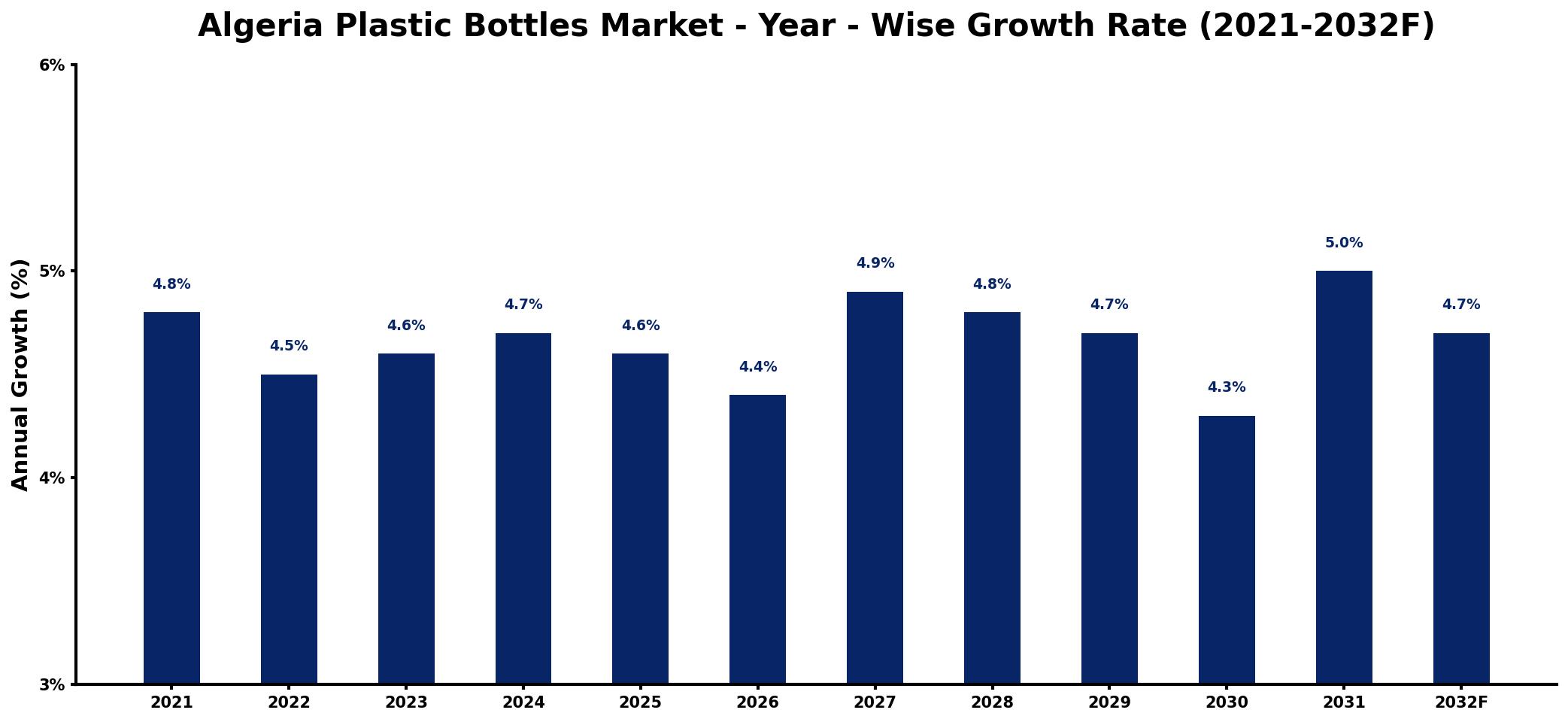
The table below presents the year‑wise growth rates along with the key drivers influencing the market
| Year | Growth Rate | Major Drivers |
| 2021 | 4.8% | Increased consumer beverage demand |
| 2022 | 4.5% | Growth in packaged food sector |
| 2023 | 4.6% | Rising health and wellness trends |
| 2024 | 4.7% | Expansion of e-commerce platforms |
| 2025 | 4.6% | Investment in recycling technologies |
| 2026 | 4.4% | Surge in export opportunities |
| 2027 | 4.9% | Emergence of new market segments |
| 2028 | 4.8% | rising export shipment volumes |
| 2029 | 4.7% | Rising awareness of sustainability |
| 2030 | 4.3% | Increased government regulation support |
| 2031 | 5.0% | Boom in home delivery services |
| 2032 | 4.7% | Adoption of innovative packaging solutions |
Note: Market size estimations and growth projections presented in this report are based on 6Wresearch's proprietary forecasting methodology, utilizing the latest available industry data, government publications, and primary research inputs.
Algeria Plastic Bottles Market Synopsis
The Algeria Plastic Bottles Market has exhibited steady growth in recent years, driven by heightened demand across multiple industries. However, the future landscape of this market is shifting towards sustainability, as consumer awareness regarding environmental impact intensifies.
While local and international manufacturers are expanding their foothold, the emphasis is increasingly on innovative and eco-friendly solutions. This focus indicates a robust response to the dual pressures of consumer demand for convenience and the necessity for environmental accountability.
Algeria Plastic Bottles Market Key Takeaways
- Steady growth attributed to increasing demand in food & beverage, pharmaceuticals, and personal care sectors.
- Environmental sustainability is becoming a central theme, influencing both consumer choices and manufacturing practices.
- Innovation in design and functionality of bottles is critical for brand differentiation.
- Government policies are increasingly promoting eco-friendly materials and practices within the industry.
- Investment in recycling technologies presents lucrative opportunities for growth in the market.
Evaluation of Restraints in Algeria Plastic Bottles Market
Despite its growth potential, the Algeria Plastic Bottles Market faces several restraints. Heightened competition from alternative materials, such as glass and metal, threatens market share. Moreover, fluctuations in raw material prices can disrupt cost structures, adding pressure on manufacturers. The lack of advanced production technologies hinders efficiency, while regulatory challenges regarding plastic use and recycling further complicate the operational landscape. Thus, companies must navigate these barriers strategically to maintain competitiveness.
Algeria Plastic Bottles Market Trends
Several trends are currently shaping the Algeria Plastic Bottles Market. A notable demand for eco-friendly packaging solutions has emerged, with consumers actively seeking biodegradable and recyclable alternatives. Additionally, theres an increasing emphasis on innovative bottle design, with features that enhance user experience, such as ergonomic shapes and easy-to-use caps. Customization is also on the rise, as brands look to differentiate their products and engage consumers more effectively, reflecting a shift towards customer-centric approaches in the market.
Algeria Plastic Bottles Market Opportunities
The current landscape offers numerous investment opportunities within the Algeria Plastic Bottles Market. The production of eco-friendly and biodegradable bottles is particularly promising, catering to a growing consumer preference for sustainable packaging. Additionally, investments in advanced recycling infrastructure could significantly enhance recycling capabilities, addressing both environmental concerns and regulatory mandates. Theres also potential in exploring innovative packaging materials and designs that focus on convenience and functionality, appealing to both consumers and manufacturers alike.
Government Initiatives in the Algeria Plastic Bottles Market
The Algerian government has introduced various policies to regulate the plastic bottles market, aiming to mitigate environmental pollution. Significant measures include a ban on the production and importation of non-biodegradable plastic bottles. Additionally, regulations encourage the utilization of biodegradable and recyclable materials. Incentives are also provided for companies adopting sustainable technologies, reflecting a governmental push towards eco-friendly practices within the packaging industry. These initiatives highlight a commitment to promoting sustainability and responsible manufacturing in Algeria.
Future Insights of the Algeria Plastic Bottles Market
Looking ahead to the period from 2026 to 2032, the Algeria Plastic Bottles Market is positioned for positive growth. Population increases and urbanization will continue to fuel demand, particularly in bottled beverages and personal care products. However, the industry must address growing environmental concerns, pushing for innovations in recycling and the development of biodegradable alternatives. Companies investing in sustainable practices and technology will likely thrive in this evolving landscape, aligning with consumer expectations for eco-friendly solutions.
Algeria Plastic Bottles Market Latest Developments (2025 - 2026)
In recent months, the Algeria Plastic Bottles Market has witnessed a shift towards more sustainable practices as companies seek to align with evolving consumer preferences. Manufacturers are increasingly adopting eco-friendly materials and exploring innovations in bottle design. Concurrently, advancements in recycling technologies have garnered attention, indicating a collective industry effort to address environmental concerns. These developments signal a proactive response to both consumer demands and regulatory frameworks aimed at promoting sustainability in packaging.
Algeria Plastic Bottles Market - Key Attractiveness of the Report
- 10 Years of Market Numbers
- Historical Data Starting from 2022 to 2025
- Base Year: 2025
- Forecast Data until 2032
- Key Performance Indicators Impacting the Market
- Major Upcoming Developments and Projects
Key Highlights of the Report:
- Algeria Plastic Bottles Market Outlook
- Market Size of Algeria Plastic Bottles Market, 2025
- Forecast of Algeria Plastic Bottles Market, 2032
- Historical Data and Forecast of Algeria Plastic Bottles Revenues & Volume for the Period 2022-2032F
- Algeria Plastic Bottles Market Trend Evolution
- Algeria Plastic Bottles Market Drivers and Challenges
- Algeria Plastic Bottles Price Trends
- Algeria Plastic Bottles Porter's Five Forces
- Algeria Plastic Bottles Industry Life Cycle
- Historical Data and Forecast of Algeria Plastic Bottles Market Revenues & Volume By Raw Material Type for the Period 2022-2032F
- Historical Data and Forecast of Algeria Plastic Bottles Market Revenues & Volume By Polyethylene Terephthalate (PET) for the Period 2022-2032F
- Historical Data and Forecast of Algeria Plastic Bottles Market Revenues & Volume By Poly Propylene (PP) for the Period 2022-2032F
- Historical Data and Forecast of Algeria Plastic Bottles Market Revenues & Volume By Low-density Polyethylene (LDPE) for the Period 2022-2032F
- Historical Data and Forecast of Algeria Plastic Bottles Market Revenues & Volume By High-density Polyethylene (HDPE) for the Period 2022-2032F
- Historical Data and Forecast of Algeria Plastic Bottles Market Revenues & Volume By Other Raw Materials for the Period 2022-2032F
- Historical Data and Forecast of Algeria Plastic Bottles Market Revenues & Volume By End-user for the Period 2022-2032F
- Historical Data and Forecast of Algeria Plastic Bottles Market Revenues & Volume By Beverage for the Period 2022-2032F
- Historical Data and Forecast of Algeria Plastic Bottles Market Revenues & Volume By Food for the Period 2022-2032F
- Historical Data and Forecast of Algeria Plastic Bottles Market Revenues & Volume By Cosmetics for the Period 2022-2032F
- Historical Data and Forecast of Algeria Plastic Bottles Market Revenues & Volume By Pharmaceutical for the Period 2022-2032F
- Historical Data and Forecast of Algeria Plastic Bottles Market Revenues & Volume By Household Care for the Period 2022-2032F
- Historical Data and Forecast of Algeria Plastic Bottles Market Revenues & Volume By Other for the Period 2022-2032F
- Algeria Plastic Bottles Import Export Trade Statistics
- Market Opportunity Assessment By Raw Material Type
- Market Opportunity Assessment By End-user
- Algeria Plastic Bottles Top Companies Market Share
- Algeria Plastic Bottles Competitive Benchmarking By Technical and Operational Parameters
- Algeria Plastic Bottles Company Profiles
- Algeria Plastic Bottles Key Strategic Recommendations






































