Algeria Silicon Alloys Market Size, Share & Growth Rate
The Algeria Silicon Alloys Market was estimated at USD 633 Million in 2025 and is projected to reach USD 916 Million by 2032, growing at a CAGR of 5.4% from 2026 to 2032. This upward trajectory is primarily driven by the robust expansion of the automotive and construction sectors, which are increasingly reliant on silicon alloys for steel production. As manufacturers seek to improve the mechanical properties of steel, the demand for ferrosilicon and silicon manganese is expected to continue its upward trend, presenting significant opportunities for growth.
Algeria Silicon Alloys Market Year-wise Growth Rate and Key Drivers
This graph highlights how the Algeria Silicon Alloys Market has steadily grown over the years, supported by major growth factors.
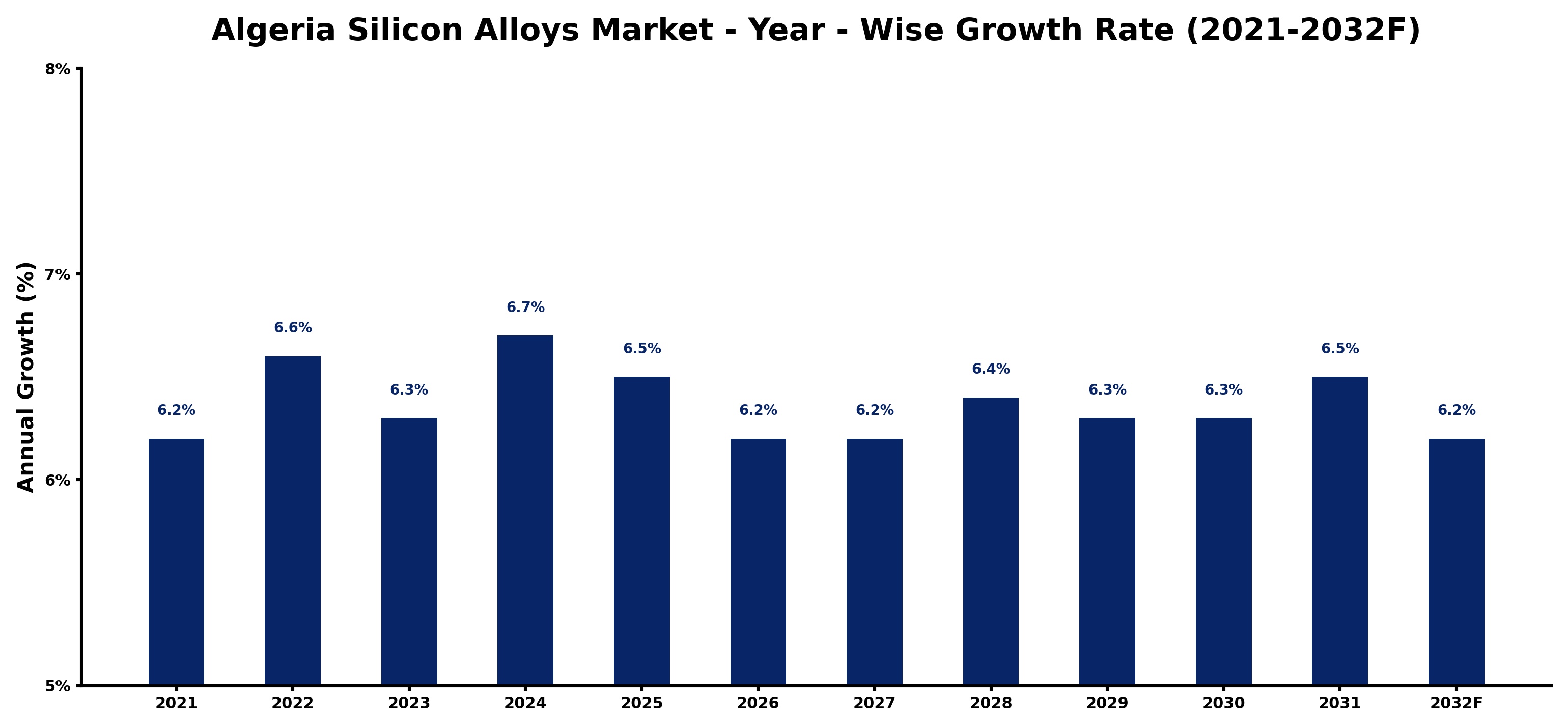
The table below presents the year‑wise growth rates along with the key drivers influencing the market
| Year | Growth Rate | Major Drivers |
| 2021 | 6.2% | Steel production boost stimulates silicon alloy consumption in automotive sector |
| 2022 | 6.6% | Silicon alloy manufacturers ramp up investments in advanced processing technology |
| 2023 | 6.3% | Local silicon alloy producers expanded capacity to meet export demands |
| 2024 | 6.7% | Higher energy efficiency measures boost local silicon alloy production rates |
| 2025 | 6.5% | Improved metallurgical processes boosted silicon alloy production efficiency |
| 2026 | 6.2% | Silicon alloy manufacturing investments boosted local automotive supply chain capacity |
| 2027 | 6.2% | Manufacturing investments in green energy technologies boost silicon alloy demand |
| 2028 | 6.4% | Domestic silicon alloy manufacturers invest in advanced production technologies |
| 2029 | 6.3% | High demand for construction materials boosted silicon alloy production capacity |
| 2030 | 6.3% | Increased steel production fuels demand for silicon alloy imports |
| 2031 | 6.5% | Domestic silicon alloy production upgrades enhance local metallurgy capabilities |
| 2032 | 6.2% | Silicon alloy production expansion boosts domestic automotive manufacturing efficiency |
Note - Market size estimations and growth projections presented in this report are based on 6Wresearch’s advanced forecasting approach, validated with industry datasets as of June 2026.
Algeria Silicon Alloys Market Synopsis
The strongest force shaping the Algeria Silicon Alloys Market currently is the surge in infrastructure development. As the nation invests heavily in construction and industrial projects, silicon alloys have become essential for enhancing material performance and longevity. This increasing focus on quality in production processes is pushing manufacturers to innovate and improve their offerings.
In addition, a rising awareness of sustainability practices is impacting the market landscape. Manufacturers are beginning to adopt eco-friendly production methods and increasingly incorporate recycled materials into their processes. This shift not only meets the evolving demands of environmentally-conscious consumers but also aligns with global trends toward more sustainable industrial practices.
Algeria Silicon Alloys Market Key Takeaways
- The Algeria Silicon Alloys Market is anticipated to grow steadily due to rising industrial demands.
- Innovations in high-purity silicon alloys are addressing stringent quality requirements in manufacturing.
- The shift towards sustainable practices is shaping production methodologies across the sector.
- Government initiatives are designed to bolster domestic production and reduce import reliance.
- Investment in research and development is crucial for improving production efficiency and competitiveness.
Evaluation of Restraints in Algeria Silicon Alloys Market
Despite the positive growth outlook, the Algeria Silicon Alloys Market faces several restraints. One major concern is the fluctuation of global silicon prices, which can affect production costs and profit margins. Additionally, the market experiences challenges stemming from an inconsistent supply of raw materials, particularly silicon metal, which is exacerbated by limited domestic production capabilities. This dependence on imports can lead to disruptions in the supply chain, impacting the availability and cost-effectiveness of silicon alloy manufacturing. Furthermore, bureaucratic hurdles can impede investment and innovation, making it essential for stakeholders to navigate these challenges to maintain growth momentum.
Algeria Silicon Alloys Market Trends
Several trends are currently shaping the Algeria Silicon Alloys Market. A noteworthy trend is the increasing demand for high-purity silicon alloys, which are becoming essential in industries like automotive and electronics. Manufacturers are also exploring innovative alloy compositions to enhance product performance and durability. Moreover, sustainability initiatives are gaining traction, with a growing number of producers looking to integrate eco-friendly practices into their production processes.
Algeria Silicon Alloys Market Opportunities
The Algeria Silicon Alloys Market is rich with investment opportunities, particularly as the industrial sector continues to expand. There is substantial demand for silicon alloys across various sectors, including automotive and construction, driven by ongoing infrastructure projects. Investors can explore partnerships with local manufacturers or invest directly in production facilities. Additionally, the burgeoning renewable energy sector, especially solar and electric vehicles, offers promising avenues for growth, further enhancing the market's potential.
Government Initiatives in the Algeria Silicon Alloys Market
Government policies are increasingly supportive of the Algeria Silicon Alloys Market. Initiatives aimed at promoting domestic production include import tariffs and financial incentives for local manufacturers. These measures not only encourage self-sufficiency in silicon alloys but also stimulate economic growth by creating job opportunities. Additionally, environmental regulations are being enforced to ensure that production aligns with international standards, reflecting a commitment to sustainability within the industry.
Future Insights of the Algeria Silicon Alloys Market
Looking ahead, the Algeria Silicon Alloys Market is set for continuous growth, fueled by the evolving demands from key industries such as automotive and electronics. The emphasis on energy efficiency and sustainable production methods is likely to drive innovation and quality improvements in silicon alloys. While challenges such as fluctuating raw material prices persist, the overall outlook remains positive, with opportunities for strategic partnerships and technological advancements paving the way for future developments.
Algeria Silicon Alloys Market Latest Developments (May 2025 - June 2026)
In recent months, the Algeria Silicon Alloys Market has seen a notable shift toward the adoption of advanced production technologies aimed at increasing efficiency. Several manufacturers are investing in upgrading their facilities to incorporate state-of-the-art equipment, resulting in improved output and product quality. Additionally, the trend toward sustainability is prompting discussions among industry stakeholders about the potential for collaborative efforts in recycling and eco-friendly production methods.
Algeria Silicon Alloys Market - Key Attractiveness of the Report
- 10 Years of Market Numbers
- Historical Data Starting from 2022 to 2025
- Base Year: 2025
- Forecast Data until 2032
- Key Performance Indicators Impacting the Market
- Major Upcoming Developments and Projects
Key Highlights of the Report:
- Algeria Silicon Alloys Market Outlook
- Market Size of Algeria Silicon Alloys Market, 2025
- Forecast of Algeria Silicon Alloys Market, 2032
- Historical Data and Forecast of Algeria Silicon Alloys Revenues & Volume for the Period 2022-2032F
- Algeria Silicon Alloys Market Trend Evolution
- Algeria Silicon Alloys Market Drivers and Challenges
- Algeria Silicon Alloys Price Trends
- Algeria Silicon Alloys Porter's Five Forces
- Algeria Silicon Alloys Industry Life Cycle
- Historical Data and Forecast of Algeria Silicon Alloys Market Revenues & Volume By Type for the Period 2022-2032F
- Historical Data and Forecast of Algeria Silicon Alloys Market Revenues & Volume By Ferrosilicon for the Period 2022-2032F
- Historical Data and Forecast of Algeria Silicon Alloys Market Revenues & Volume By Deoxidizers for the Period 2022-2032F
- Historical Data and Forecast of Algeria Silicon Alloys Market Revenues & Volume By Inoculants for the Period 2022-2032F
- Historical Data and Forecast of Algeria Silicon Alloys Market Revenues & Volume By Others for the Period 2022-2032F
- Historical Data and Forecast of Algeria Silicon Alloys Market Revenues & Volume By Application for the Period 2022-2032F
- Historical Data and Forecast of Algeria Silicon Alloys Market Revenues & Volume By Carbon Steel & Other Alloy Steel for the Period 2022-2032F
- Historical Data and Forecast of Algeria Silicon Alloys Market Revenues & Volume By Stainless Steel for the Period 2022-2032F
- Historical Data and Forecast of Algeria Silicon Alloys Market Revenues & Volume By Electrical Steel for the Period 2022-2032F
- Historical Data and Forecast of Algeria Silicon Alloys Market Revenues & Volume By Cast Iron for the Period 2022-2032F
- Historical Data and Forecast of Algeria Silicon Alloys Market Revenues & Volume By Others for the Period 2022-2032F
- Algeria Silicon Alloys Import Export Trade Statistics
- Market Opportunity Assessment By Type
- Market Opportunity Assessment By Application
- Algeria Silicon Alloys Top Companies Market Share
- Algeria Silicon Alloys Competitive Benchmarking By Technical and Operational Parameters
- Algeria Silicon Alloys Company Profiles
- Algeria Silicon Alloys Key Strategic Recommendations






































