Algeria Zinc Sulphate Market Size, Share & Growth Rate
The Algeria Zinc Sulphate Market was estimated at USD 431 Million in 2025 and is projected to reach USD 576 Million by 2032, growing at a CAGR of 4.2% from 2026 to 2032. This growth is primarily driven by the increasing application of zinc sulfate as a micronutrient in fertilizers, essential for addressing widespread zinc deficiencies in Algerian soils. Additionally, the expansion of the livestock sector, which is fueled by a growing awareness of the importance of animal nutrition, is set to further bolster market demand.
Algeria Zinc Sulphate Market Year-wise Growth Rate and Key Drivers
This graph highlights how the Algeria Zinc Sulphate Market has steadily grown over the years, supported by major growth factors.
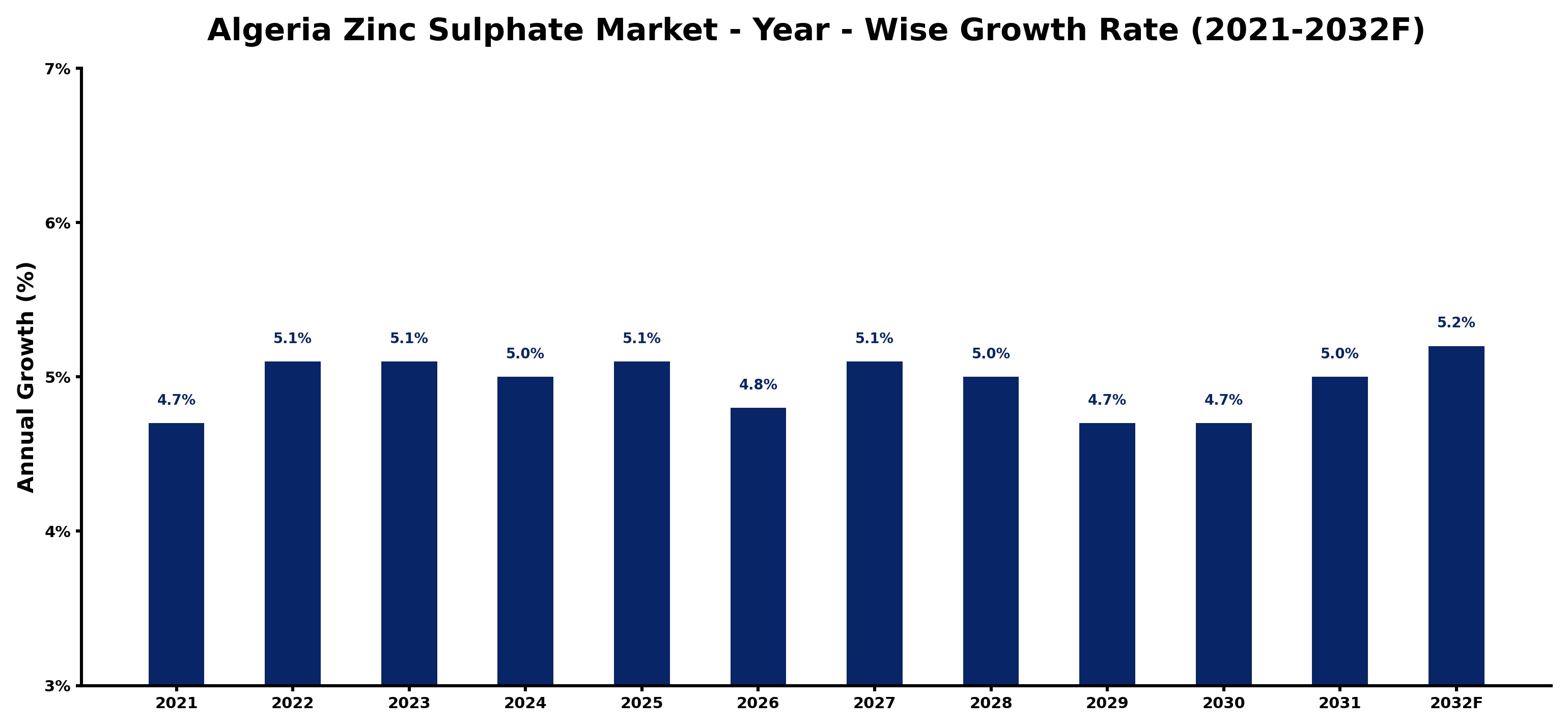
The table below presents the year‑wise growth rates along with the key drivers influencing the market
| Year | Growth Rate | Major Drivers |
| 2021 | 4.7% | Agricultural demand for fertilizers increased |
| 2022 | 5.1% | Infrastructure development enhanced distribution |
| 2023 | 5.1% | Export opportunities expanded significantly |
| 2024 | 5.0% | Sustainable farming practices gained traction |
| 2025 | 5.1% | Innovative product formulations attracted interest |
| 2026 | 4.8% | Rising awareness of micronutrient benefits |
| 2027 | 5.1% | Government support for agriculture strengthened |
| 2028 | 5.0% | Technological advancements improved production |
| 2029 | 4.7% | Consumer preference for organic products |
| 2030 | 4.7% | Increased focus on soil health |
| 2031 | 5.0% | Research initiatives promoted product usage |
| 2032 | 5.2% | Collaboration with agricultural cooperatives expanded |
Note - Market size estimations and growth projections presented in this report are based on 6Wresearch's advanced forecasting approach, validated with industry datasets as of June 2026.
Algeria Zinc Sulphate Market Synopsis
The agricultural landscape in Algeria is actively shifting towards modern practices, where zinc sulfate is becoming indispensable for enhancing soil health. As the government emphasizes food security, the demand for zinc-rich fertilizers is surging, positioning zinc sulfate as a vital player in national agricultural policy.
Moreover, the livestock industry in Algeria is experiencing significant growth, leading to increased usage of zinc sulfate in animal feed formulations. This rising focus on livestock health and productivity creates a dual demand trajectory for zinc sulfate, making it an attractive market for suppliers and manufacturers alike.
Algeria Zinc Sulphate Market Key Takeaways
- The market is witnessing robust growth due to the rising adoption of zinc sulfate as a micronutrient in fertilizers.
- Government initiatives aimed at improving agricultural productivity further stimulate market demand.
- Significant potential exists in the livestock feed sector, promoting zinc supplementation.
- Limited domestic production necessitates reliance on imports, impacting cost and supply stability.
- Technological advancements in manufacturing processes could enhance local production capacity and competitiveness.
Evaluation of Restraints in Algeria Zinc Sulphate Market
Despite the promising growth trajectory, the Algeria Zinc Sulphate market faces several obstacles. A significant limitation is the current reliance on imported zinc sulfate, which subjects local manufacturers to supply chain vulnerabilities and fluctuating global prices. Additionally, the lack of advanced technological infrastructure hinders the competitive edge of domestic producers. Regulatory complexities and bureaucratic challenges further deter new entrants, creating a restrictive environment for potential market expansion. These factors collectively pose substantial challenges to achieving optimal market growth.
Algeria Zinc Sulphate Market Trends
Several trends are shaping the Algeria Zinc Sulphate market, notably the increasing integration of sustainable agricultural practices. Farmers are increasingly adopting eco-friendly solutions that incorporate micronutrients, emphasizing the importance of soil health. Furthermore, the movement towards organic farming is compelling stakeholders to explore innovative applications for zinc sulfate. This shift is not only enhancing agricultural productivity but also attracting investments into the research and development of advanced formulations.
Algeria Zinc Sulphate Market Opportunities
The expansion of the agricultural and livestock sectors presents numerous growth opportunities for the zinc sulfate market. As domestic production capability improves, local manufacturers can seize the chance to meet rising demand while reducing reliance on imports. Additionally, the exploration of new industrial applications—such as in chemical manufacturing and water treatment—further opens avenues for investment. Fostering partnerships among stakeholders in agriculture, livestock, and industry could unlock innovative applications and revenue streams.
Government Initiatives in the Algeria Zinc Sulphate Market
The Algerian government plays an influential role in supporting the zinc sulfate market through various initiatives focused on agricultural development. Policies designed to promote modern farming practices and improve yield quality are pivotal in encouraging the use of micronutrient fertilizers. Furthermore, public funding for research and development in zinc sulfate applications aims to enhance product efficiency and effectiveness, ultimately contributing to the nation's agricultural and economic growth.
Future Insights of the Algeria Zinc Sulphate Market
Looking ahead to the period from 2026 to 2032, the Algeria Zinc Sulphate market is poised for continued expansion. The growing emphasis on sustainable agriculture, coupled with rising standards of living, is likely to boost the consumption of zinc sulfate in both agricultural and industrial applications. Enhanced local production capabilities, driven by government support and technological advancements, will further fortify the market's foundation, paving the way for new investments and innovations.
Algeria Zinc Sulphate Market Latest Developments (May 2025 - June 2026)
Recent developments in the Algeria Zinc Sulphate market indicate a growing trend towards partnerships between the government and private sectors aimed at enhancing agricultural productivity. Initiatives focusing on educational programs regarding zinc supplementation's benefits are increasingly prominent. Moreover, the introduction of new regulatory measures is expected to streamline manufacturing processes, thereby fostering a more competitive market landscape for both domestic and international players.
Algeria Zinc Sulphate Market - Key Attractiveness of the Report
- 10 Years of Market Numbers
- Historical Data Starting from 2022 to 2025
- Base Year: 2025
- Forecast Data until 2032
- Key Performance Indicators Impacting the Market
- Major Upcoming Developments and Projects
Key Highlights of the Report:
- Algeria Zinc Sulphate Market Outlook
- Market Size of Algeria Zinc Sulphate Market, 2025
- Forecast of Algeria Zinc Sulphate Market, 2032
- Historical Data and Forecast of Algeria Zinc Sulphate Revenues & Volume for the Period 2022-2032F
- Algeria Zinc Sulphate Market Trend Evolution
- Algeria Zinc Sulphate Market Drivers and Challenges
- Algeria Zinc Sulphate Price Trends
- Algeria Zinc Sulphate Porter's Five Forces
- Algeria Zinc Sulphate Industry Life Cycle
- Historical Data and Forecast of Algeria Zinc Sulphate Market Revenues & Volume By Type for the Period 2022-2032F
- Historical Data and Forecast of Algeria Zinc Sulphate Market Revenues & Volume By Zinc Sulphate Anhydrous for the Period 2022-2032F
- Historical Data and Forecast of Algeria Zinc Sulphate Market Revenues & Volume By Zinc Sulphate Hexahydrate for the Period 2022-2032F
- Historical Data and Forecast of Algeria Zinc Sulphate Market Revenues & Volume By Zinc Sulphate Heptahydrate for the Period 2022-2032F
- Historical Data and Forecast of Algeria Zinc Sulphate Market Revenues & Volume By Zinc Sulphate Monohydrate for the Period 2022-2032F
- Historical Data and Forecast of Algeria Zinc Sulphate Market Revenues & Volume By Application for the Period 2022-2032F
- Historical Data and Forecast of Algeria Zinc Sulphate Market Revenues & Volume By Agrochemicals for the Period 2022-2032F
- Historical Data and Forecast of Algeria Zinc Sulphate Market Revenues & Volume By Chemicals for the Period 2022-2032F
- Historical Data and Forecast of Algeria Zinc Sulphate Market Revenues & Volume By Pharmaceuticals for the Period 2022-2032F
- Historical Data and Forecast of Algeria Zinc Sulphate Market Revenues & Volume By Synthetic Fibers for the Period 2022-2032F
- Historical Data and Forecast of Algeria Zinc Sulphate Market Revenues & Volume By Water Treatment for the Period 2022-2032F
- Historical Data and Forecast of Algeria Zinc Sulphate Market Revenues & Volume By Others for the Period 2022-2032F
- Algeria Zinc Sulphate Import Export Trade Statistics
- Market Opportunity Assessment By Type
- Market Opportunity Assessment By Application
- Algeria Zinc Sulphate Top Companies Market Share
- Algeria Zinc Sulphate Competitive Benchmarking By Technical and Operational Parameters
- Algeria Zinc Sulphate Company Profiles
- Algeria Zinc Sulphate Key Strategic Recommendations






































