Angola Artichokes Market Growth Rate Analysis (2025 - 2031)
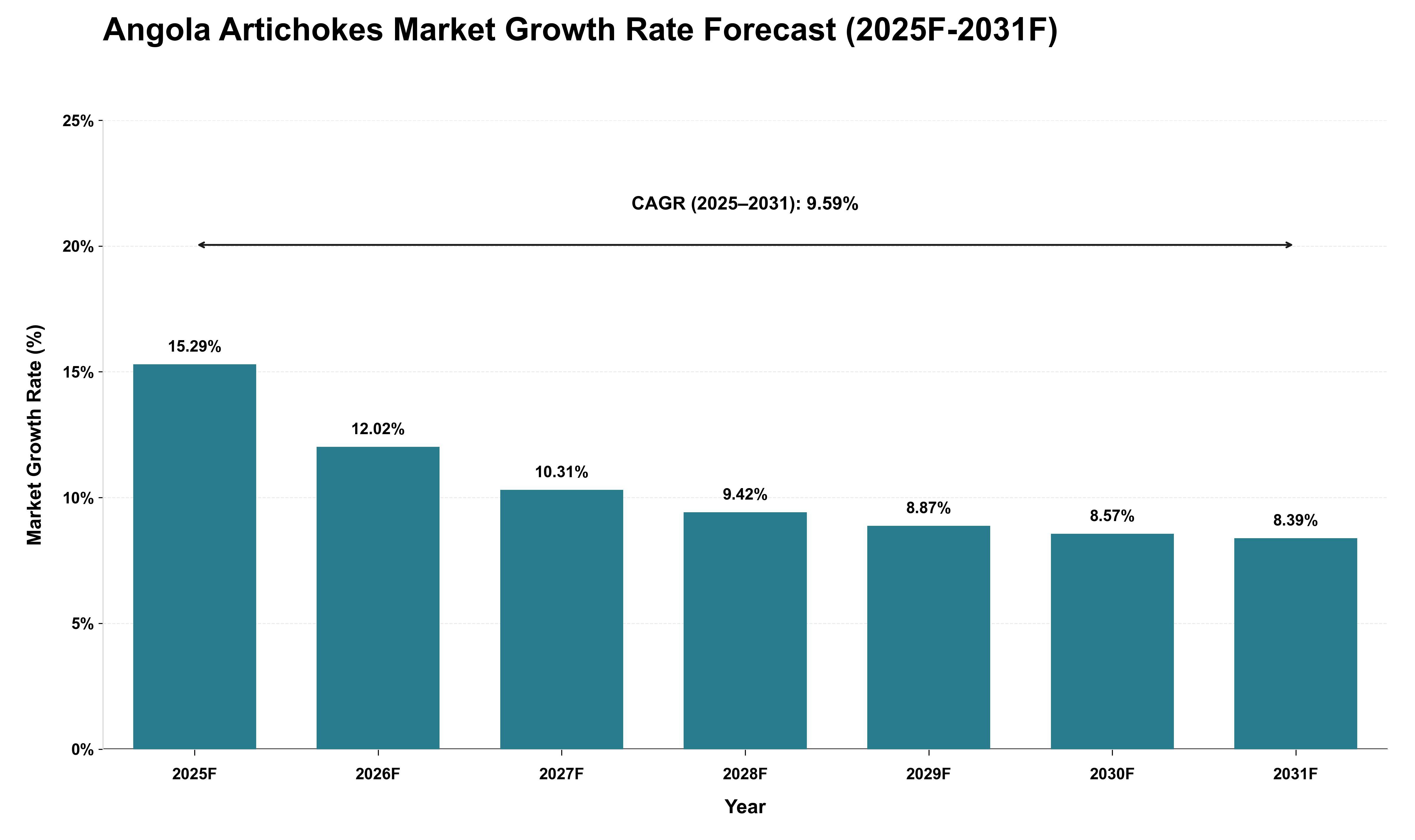
The Angola artichokes market is poised for significant growth, with an anticipated CAGR of 9.59% from 2025 to 2031, reflecting robust demand dynamics in both domestic consumption and export potential. The initial surge of 15.29% in 2025 will likely be driven by increasing health consciousness among consumers and a growing culinary interest in diverse produce, which will enhance import flows as local production scales up to meet this demand. As the forecast progresses, annual growth rates will gradually decline, indicating a natural adjustment as the market stabilizes; however, the sustained positive trajectory suggests that Angola's strategic positioning within regional trade networks will facilitate ongoing import dependencies for high-quality artichokes. By 2031, while growth rates may taper to 8.39%, the overall upward trend underscores a resilient market responding to evolving consumer preferences and potential export opportunities within neighboring markets.
Key Highlights of the Report:
- Angola Artichokes Market Outlook
- Market Size of Angola Artichokes Market, 2024
- Forecast of Angola Artichokes Market, 2031
- Historical Data and Forecast of Angola Artichokes Revenues & Volume for the Period 2021-2031
- Angola Artichokes Market Trend Evolution
- Angola Artichokes Market Drivers and Challenges
- Angola Artichokes Price Trends
- Angola Artichokes Porter`s Five Forces
- Angola Artichokes Industry Life Cycle
- Historical Data and Forecast of Angola Artichokes Market Revenues & Volume By Category for the Period 2021-2031
- Historical Data and Forecast of Angola Artichokes Market Revenues & Volume By Organic for the Period 2021-2031
- Historical Data and Forecast of Angola Artichokes Market Revenues & Volume By Conventional for the Period 2021-2031
- Historical Data and Forecast of Angola Artichokes Market Revenues & Volume By Product Type for the Period 2021-2031
- Historical Data and Forecast of Angola Artichokes Market Revenues & Volume By Globe Artichokes for the Period 2021-2031
- Historical Data and Forecast of Angola Artichokes Market Revenues & Volume By Elongated Artichokes for the Period 2021-2031
- Historical Data and Forecast of Angola Artichokes Market Revenues & Volume By End Use for the Period 2021-2031
- Historical Data and Forecast of Angola Artichokes Market Revenues & Volume By Direct Consumption for the Period 2021-2031
- Historical Data and Forecast of Angola Artichokes Market Revenues & Volume By Food Processing for the Period 2021-2031
- Historical Data and Forecast of Angola Artichokes Market Revenues & Volume By Beverage Processing for the Period 2021-2031
- Historical Data and Forecast of Angola Artichokes Market Revenues & Volume By Others for the Period 2021-2031
- Angola Artichokes Import Export Trade Statistics
- Market Opportunity Assessment By Category
- Market Opportunity Assessment By Product Type
- Market Opportunity Assessment By End Use
- Angola Artichokes Top Companies Market Share
- Angola Artichokes Competitive Benchmarking By Technical and Operational Parameters
- Angola Artichokes Company Profiles
- Angola Artichokes Key Strategic Recommendations






































