Angola Flower and Ornamental Plants Market Growth Rate Analysis (2025 - 2031)
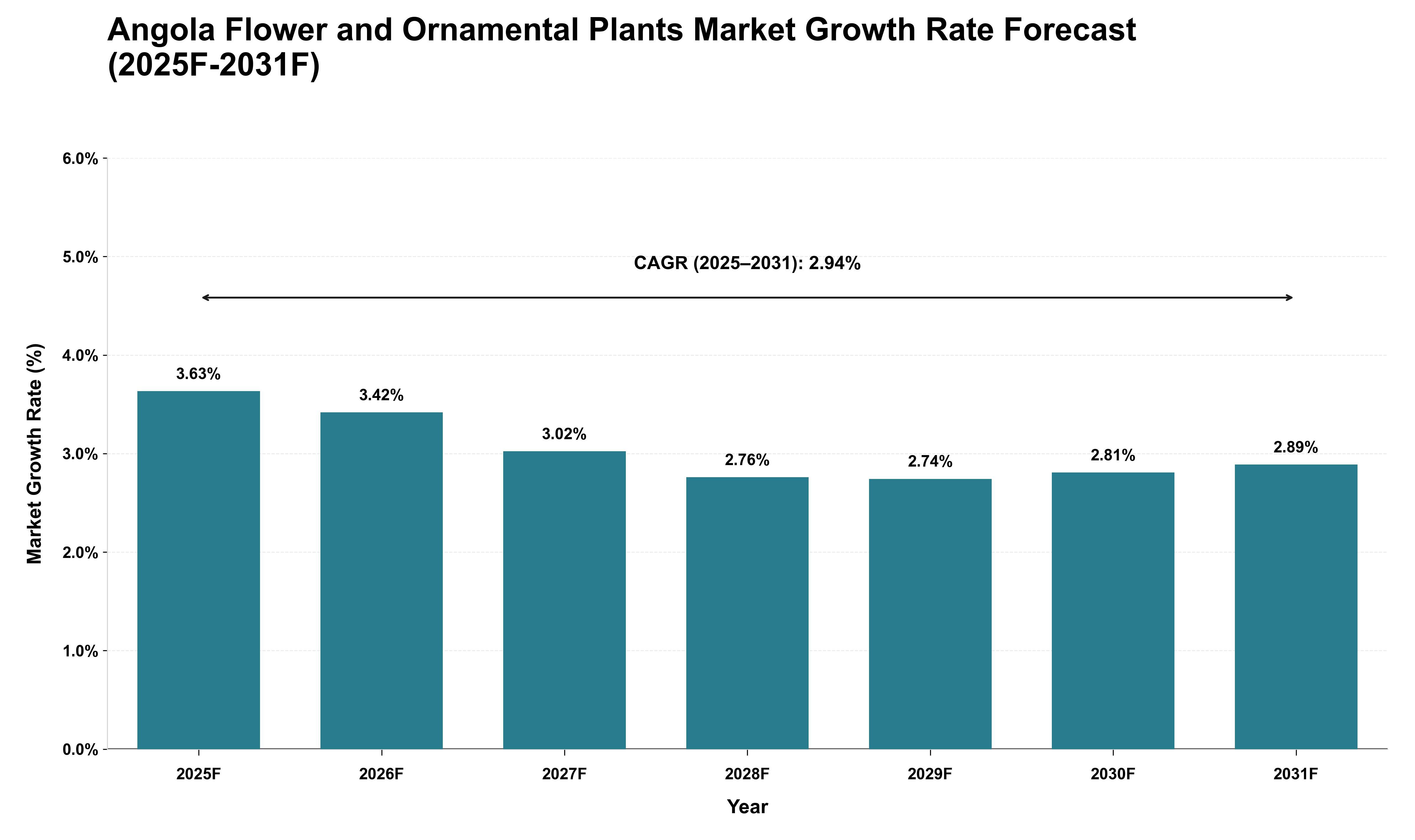
The projected growth trajectory for the Angola flower and ornamental plants market will exhibit a gradual deceleration, with the annual growth rate declining from 3.63% in 2025 to 2.74% by 2029, before slightly rebounding to 2.89% in 2031. This pattern suggests that while demand will remain robust, it will be increasingly influenced by supply chain dynamics and input costs associated with agricultural production. As global supply chains continue to adapt post-pandemic, fluctuations in transportation costs and availability of raw materials may impact pricing structures and profit margins within this sector. Additionally, reliance on imports for certain ornamental varieties could introduce volatility due to geopolitical tensions or trade policies affecting sourcing strategies. Consequently, stakeholders will need to navigate these complexities while capitalizing on cyclical trends that may emerge from seasonal demand variations in the ornamental plant market during this forecast period.
Key Highlights of the Report:
- Angola Flower and Ornamental Plants Market Outlook
- Market Size of Angola Flower and Ornamental Plants Market, 2024
- Forecast of Angola Flower and Ornamental Plants Market, 2031
- Historical Data and Forecast of Angola Flower and Ornamental Plants Revenues & Volume for the Period 2021-2031
- Angola Flower and Ornamental Plants Market Trend Evolution
- Angola Flower and Ornamental Plants Market Drivers and Challenges
- Angola Flower and Ornamental Plants Price Trends
- Angola Flower and Ornamental Plants Porter`s Five Forces
- Angola Flower and Ornamental Plants Industry Life Cycle
- Historical Data and Forecast of Angola Flower and Ornamental Plants Market Revenues & Volume By Product Type for the Period 2021-2031
- Historical Data and Forecast of Angola Flower and Ornamental Plants Market Revenues & Volume By Potted Plants for the Period 2021-2031
- Historical Data and Forecast of Angola Flower and Ornamental Plants Market Revenues & Volume By Cut Flowers for the Period 2021-2031
- Historical Data and Forecast of Angola Flower and Ornamental Plants Market Revenues & Volume By Application for the Period 2021-2031
- Historical Data and Forecast of Angola Flower and Ornamental Plants Market Revenues & Volume By Home for the Period 2021-2031
- Historical Data and Forecast of Angola Flower and Ornamental Plants Market Revenues & Volume By Commercial for the Period 2021-2031
- Angola Flower and Ornamental Plants Import Export Trade Statistics
- Market Opportunity Assessment By Product Type
- Market Opportunity Assessment By Application
- Angola Flower and Ornamental Plants Top Companies Market Share
- Angola Flower and Ornamental Plants Competitive Benchmarking By Technical and Operational Parameters
- Angola Flower and Ornamental Plants Company Profiles
- Angola Flower and Ornamental Plants Key Strategic Recommendations






































