Angola Pumps Market Growth Rate Analysis (2025 - 2031)
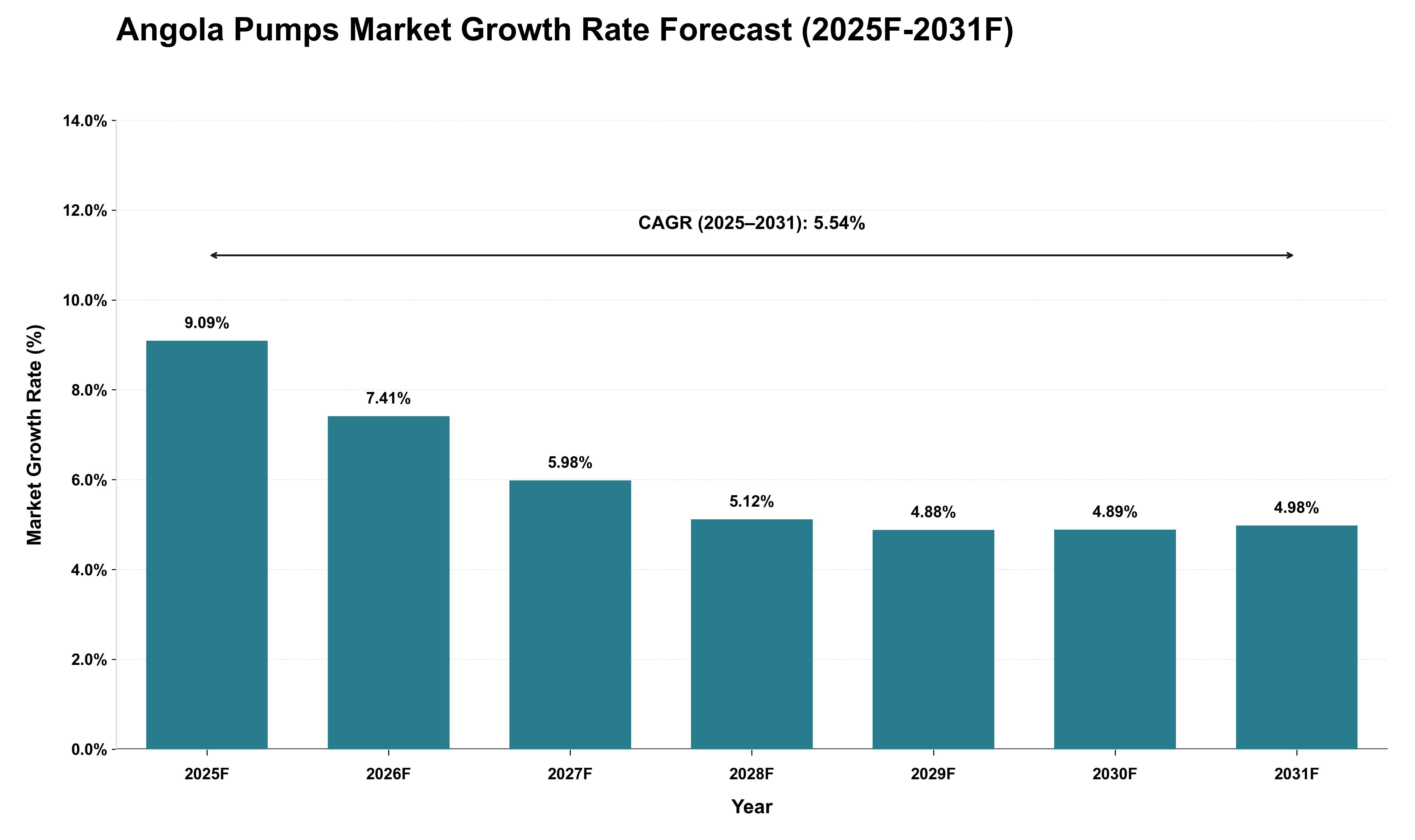
From 2025 onward, the Angola pumps market will experience a robust growth trajectory, driven by increasing industrialization and infrastructure development. The forecasted CAGR of 5.54% reflects a strong demand for pumps across various sectors, including oil and gas, agriculture, and water management. In 2025, the market is expected to expand by 9.09%, indicating an initial surge likely fueled by heightened import activities as local production ramps up to meet burgeoning needs. As the years progress, annual growth rates will gradually stabilize, with projections showing a decline to approximately 4.98% by 2031. This trend suggests that while demand remains strong, import dependencies may shift as domestic capabilities improve and supply chains adapt to evolving market conditions. Overall, the cyclical nature of pump demand in response to economic fluctuations will play a critical role in shaping trade flows during this period.
Key Highlights of the Report:
- Angola Pumps Market Outlook
- Market Size of Angola Pumps Market, 2024
- Forecast of Angola Pumps Market, 2031
- Historical Data and Forecast of Angola Pumps Revenues & Volume for the Period 2021-2031
- Angola Pumps Market Trend Evolution
- Angola Pumps Market Drivers and Challenges
- Angola Pumps Price Trends
- Angola Pumps Porter`s Five Forces
- Angola Pumps Industry Life Cycle
- Historical Data and Forecast of Angola Pumps Market Revenues & Volume By Product for the Period 2021-2031
- Historical Data and Forecast of Angola Pumps Market Revenues & Volume By Portable for the Period 2021-2031
- Historical Data and Forecast of Angola Pumps Market Revenues & Volume By Stationary for the Period 2021-2031
- Historical Data and Forecast of Angola Pumps Market Revenues & Volume By Position for the Period 2021-2031
- Historical Data and Forecast of Angola Pumps Market Revenues & Volume By Submersible for the Period 2021-2031
- Historical Data and Forecast of Angola Pumps Market Revenues & Volume By Non-submersible for the Period 2021-2031
- Historical Data and Forecast of Angola Pumps Market Revenues & Volume By Driving Force for the Period 2021-2031
- Historical Data and Forecast of Angola Pumps Market Revenues & Volume By Engine Driven for the Period 2021-2031
- Historical Data and Forecast of Angola Pumps Market Revenues & Volume By Electrical Driven for the Period 2021-2031
- Historical Data and Forecast of Angola Pumps Market Revenues & Volume By Technology for the Period 2021-2031
- Historical Data and Forecast of Angola Pumps Market Revenues & Volume By Centrifugal Pumps for the Period 2021-2031
- Historical Data and Forecast of Angola Pumps Market Revenues & Volume By Diaphragm Pumps for the Period 2021-2031
- Historical Data and Forecast of Angola Pumps Market Revenues & Volume By Application for the Period 2021-2031
- Historical Data and Forecast of Angola Pumps Market Revenues & Volume By Mining for the Period 2021-2031
- Historical Data and Forecast of Angola Pumps Market Revenues & Volume By Building & Construction for the Period 2021-2031
- Historical Data and Forecast of Angola Pumps Market Revenues & Volume By Oil & Gas for the Period 2021-2031
- Historical Data and Forecast of Angola Pumps Market Revenues & Volume By Industrial for the Period 2021-2031
- Historical Data and Forecast of Angola Pumps Market Revenues & Volume By Municipal for the Period 2021-2031
- Angola Pumps Import Export Trade Statistics
- Market Opportunity Assessment By Product
- Market Opportunity Assessment By Position
- Market Opportunity Assessment By Driving Force
- Market Opportunity Assessment By Technology
- Market Opportunity Assessment By Application
- Angola Pumps Top Companies Market Share
- Angola Pumps Competitive Benchmarking By Technical and Operational Parameters
- Angola Pumps Company Profiles
- Angola Pumps Key Strategic Recommendations






































