Angola Seaweed Market Growth Rate Analysis (2025 - 2031)
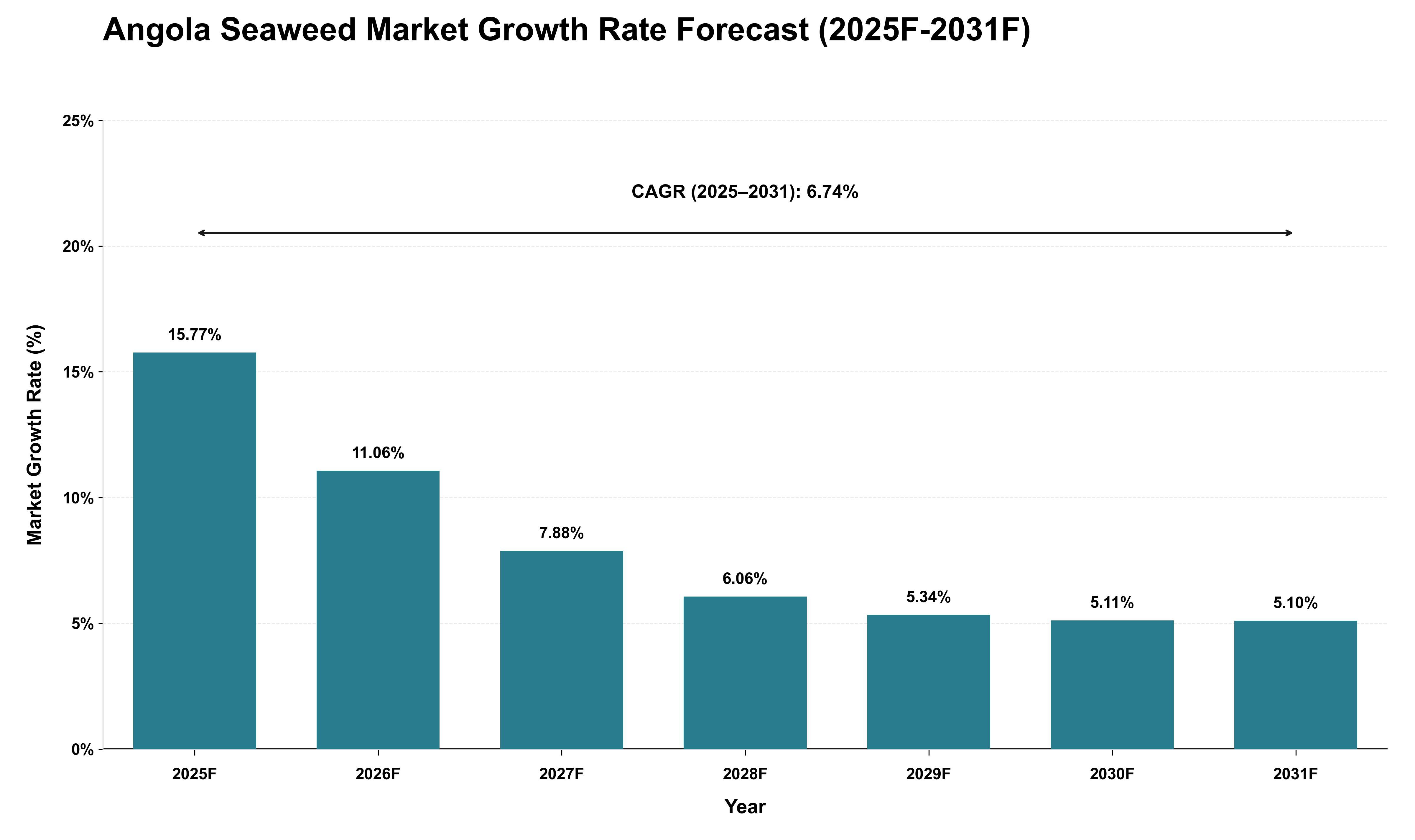
The Angola seaweed market will experience a robust growth trajectory driven by increasing global demand for sustainable food sources and natural ingredients, alongside rising health consciousness among consumers. The forecasted CAGR of 6.74% from 2025 to 2031 reflects a strong initial surge of 15.77% in 2025, likely fueled by heightened export opportunities and investment in aquaculture technologies. As the period progresses, growth rates are expected to moderate, with annual increases tapering down to approximately 5.10% by 2031. This deceleration can be attributed to cyclical trends in agricultural production and potential fluctuations in import dependencies as local supply chains adapt to meet rising consumption needs. Additionally, macroeconomic factors such as currency stability and trade policies will play crucial roles in shaping the market dynamics throughout this forecast period, influencing both domestic production capabilities and international competitiveness.
Key Highlights of the Report:
- Angola Seaweed Market Outlook
- Market Size of Angola Seaweed Market, 2024
- Forecast of Angola Seaweed Market, 2031
- Historical Data and Forecast of Angola Seaweed Revenues & Volume for the Period 2021-2031
- Angola Seaweed Market Trend Evolution
- Angola Seaweed Market Drivers and Challenges
- Angola Seaweed Price Trends
- Angola Seaweed Porter`s Five Forces
- Angola Seaweed Industry Life Cycle
- Historical Data and Forecast of Angola Seaweed Market Revenues & Volume By Product for the Period 2021-2031
- Historical Data and Forecast of Angola Seaweed Market Revenues & Volume By Red for the Period 2021-2031
- Historical Data and Forecast of Angola Seaweed Market Revenues & Volume By Brown for the Period 2021-2031
- Historical Data and Forecast of Angola Seaweed Market Revenues & Volume By Green for the Period 2021-2031
- Historical Data and Forecast of Angola Seaweed Market Revenues & Volume By Application for the Period 2021-2031
- Historical Data and Forecast of Angola Seaweed Market Revenues & Volume By Human Food for the Period 2021-2031
- Historical Data and Forecast of Angola Seaweed Market Revenues & Volume By Hydrocolloids for the Period 2021-2031
- Historical Data and Forecast of Angola Seaweed Market Revenues & Volume By Fertilizers for the Period 2021-2031
- Historical Data and Forecast of Angola Seaweed Market Revenues & Volume By Animal Feed Additives for the Period 2021-2031
- Historical Data and Forecast of Angola Seaweed Market Revenues & Volume By Others for the Period 2021-2031
- Angola Seaweed Import Export Trade Statistics
- Market Opportunity Assessment By Product
- Market Opportunity Assessment By Application
- Angola Seaweed Top Companies Market Share
- Angola Seaweed Competitive Benchmarking By Technical and Operational Parameters
- Angola Seaweed Company Profiles
- Angola Seaweed Key Strategic Recommendations






































