Angola Sugar Confectionery Market Growth Rate Analysis (2025 - 2031)
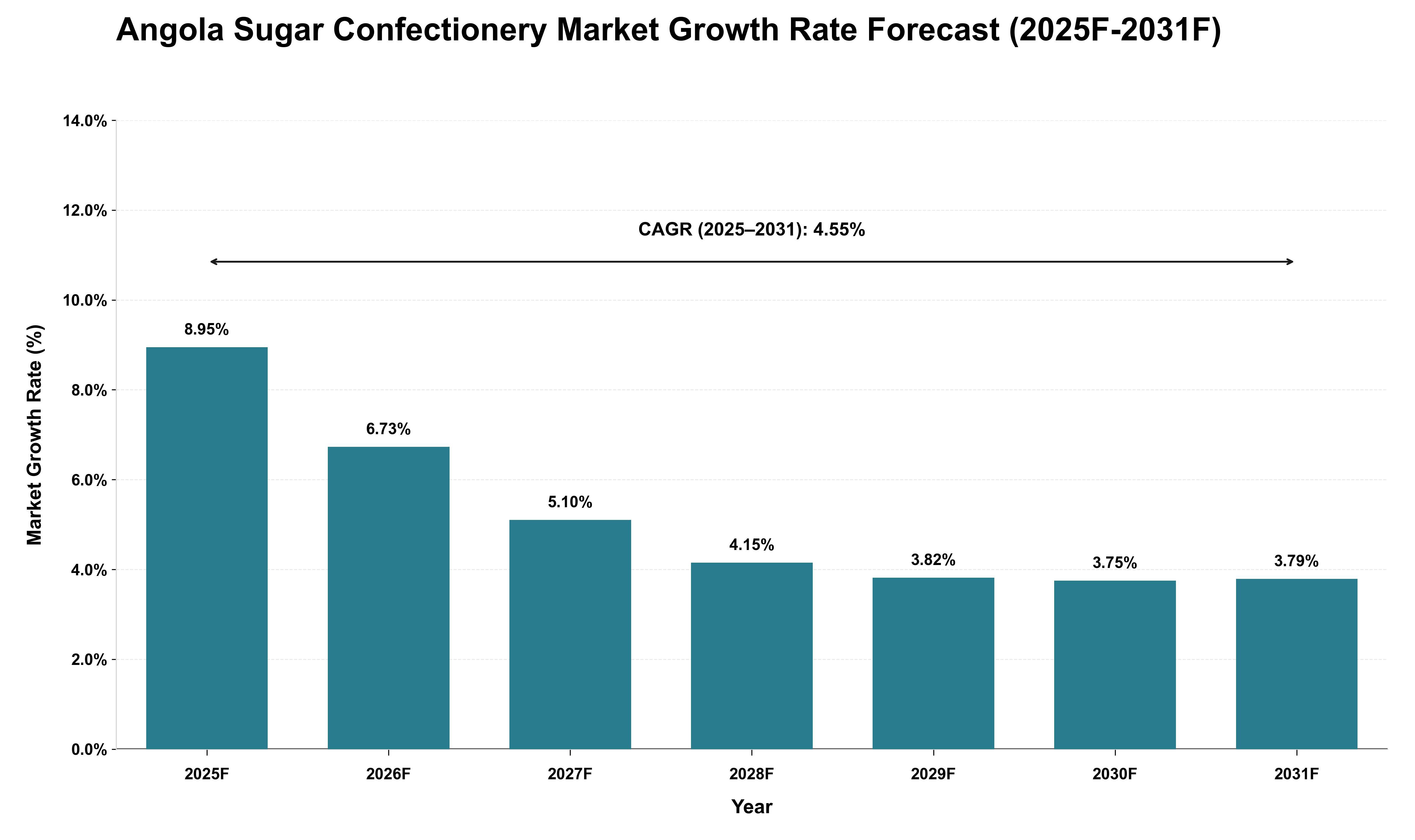
The forecasted growth trajectory for the Angola sugar confectionery market will exhibit a notable deceleration from an initial robust increase of 8.95% in 2025 to a more tempered rate of 3.79% by 2031, reflecting a gradual decline in annual growth rates. This trend suggests that while demand for sugar confectionery will remain strong, it will be increasingly influenced by raw material availability and pricing dynamics. The reliance on imported sugar and other ingredients may lead to fluctuations in production costs, particularly as global supply chains face pressures from climate change and geopolitical factors. As the market evolves, manufacturers will likely need to navigate these challenges while adapting to consumer preferences for healthier options, which could further impact growth rates. The projected CAGR of 4.55% indicates that despite these headwinds, the sector is expected to maintain a positive outlook through strategic adjustments and innovation in product offerings.
Key Highlights of the Report:
- Angola Sugar Confectionery Market Outlook
- Market Size of Angola Sugar Confectionery Market, 2024
- Forecast of Angola Sugar Confectionery Market, 2031
- Historical Data and Forecast of Angola Sugar Confectionery Revenues & Volume for the Period 2021-2031
- Angola Sugar Confectionery Market Trend Evolution
- Angola Sugar Confectionery Market Drivers and Challenges
- Angola Sugar Confectionery Price Trends
- Angola Sugar Confectionery Porter`s Five Forces
- Angola Sugar Confectionery Industry Life Cycle
- Historical Data and Forecast of Angola Sugar Confectionery Market Revenues & Volume By Product Type for the Period 2021-2031
- Historical Data and Forecast of Angola Sugar Confectionery Market Revenues & Volume By Hard-Boiled Sweets for the Period 2021-2031
- Historical Data and Forecast of Angola Sugar Confectionery Market Revenues & Volume By Caramel & Toffees for the Period 2021-2031
- Historical Data and Forecast of Angola Sugar Confectionery Market Revenues & Volume By Gums & Jellies for the Period 2021-2031
- Historical Data and Forecast of Angola Sugar Confectionery Market Revenues & Volume By Medicated Confectionery for the Period 2021-2031
- Historical Data and Forecast of Angola Sugar Confectionery Market Revenues & Volume By Mints for the Period 2021-2031
- Historical Data and Forecast of Angola Sugar Confectionery Market Revenues & Volume By Othersfor the Period 2021-2031
- Historical Data and Forecast of Angola Sugar Confectionery Market Revenues & Volume By Packaging Type for the Period 2021-2031
- Historical Data and Forecast of Angola Sugar Confectionery Market Revenues & Volume By Sachet for the Period 2021-2031
- Historical Data and Forecast of Angola Sugar Confectionery Market Revenues & Volume By Box for the Period 2021-2031
- Historical Data and Forecast of Angola Sugar Confectionery Market Revenues & Volume By Others for the Period 2021-2031
- Historical Data and Forecast of Angola Sugar Confectionery Market Revenues & Volume By Distribution Channel for the Period 2021-2031
- Historical Data and Forecast of Angola Sugar Confectionery Market Revenues & Volume By Retail Stores for the Period 2021-2031
- Historical Data and Forecast of Angola Sugar Confectionery Market Revenues & Volume By Online Stores for the Period 2021-2031
- Historical Data and Forecast of Angola Sugar Confectionery Market Revenues & Volume By Others for the Period 2021-2031
- Angola Sugar Confectionery Import Export Trade Statistics
- Market Opportunity Assessment By Product Type
- Market Opportunity Assessment By Packaging Type
- Market Opportunity Assessment By Distribution Channel
- Angola Sugar Confectionery Top Companies Market Share
- Angola Sugar Confectionery Competitive Benchmarking By Technical and Operational Parameters
- Angola Sugar Confectionery Company Profiles
- Angola Sugar Confectionery Key Strategic Recommendations






































