Angola Textile Market Growth Rate Analysis (2025 - 2031)
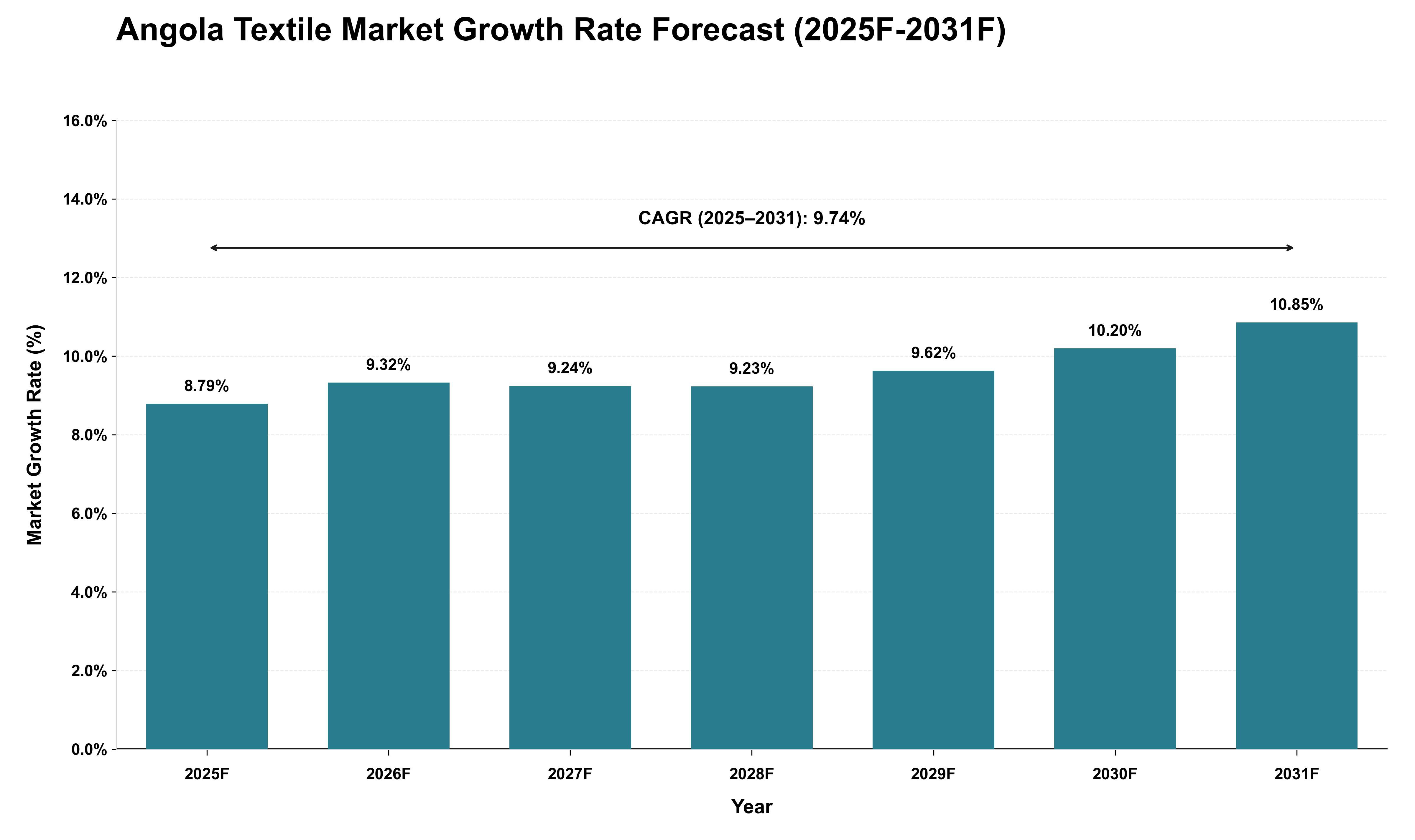
The Angola textile market is projected to experience a compound annual growth rate of 9.74% from 2025 to 2031, reflecting a robust trajectory driven by evolving supply chain dynamics and fluctuating input costs. As global demand for textiles continues to rise, Angola's reliance on imported raw materials will likely intensify, influencing pricing structures and availability. The annual growth rates indicate a gradual acceleration, peaking at 10.85% in 2031, suggesting that manufacturers may increasingly seek cost-effective sourcing strategies to mitigate rising input costs. Additionally, cyclical trends in consumer preferences towards sustainable and locally produced textiles could further stimulate domestic production capabilities. This interplay between import dependencies and local manufacturing initiatives will shape the competitive landscape, ultimately fostering an environment conducive to sustained growth within the sector throughout the forecast period.
Key Highlights of the Report:
- Angola Textile Market Outlook
- Market Size of Angola Textile Market, 2024
- Forecast of Angola Textile Market, 2031
- Historical Data and Forecast of Angola Textile Revenues & Volume for the Period 2021-2031
- Angola Textile Market Trend Evolution
- Angola Textile Market Drivers and Challenges
- Angola Textile Price Trends
- Angola Textile Porter`s Five Forces
- Angola Textile Industry Life Cycle
- Historical Data and Forecast of Angola Textile Market Revenues & Volume By Raw Material Types for the Period 2021-2031
- Historical Data and Forecast of Angola Textile Market Revenues & Volume By Cotton for the Period 2021-2031
- Historical Data and Forecast of Angola Textile Market Revenues & Volume By Chemical for the Period 2021-2031
- Historical Data and Forecast of Angola Textile Market Revenues & Volume By Wool for the Period 2021-2031
- Historical Data and Forecast of Angola Textile Market Revenues & Volume By Silk for the Period 2021-2031
- Historical Data and Forecast of Angola Textile Market Revenues & Volume By Others for the Period 2021-2031
- Historical Data and Forecast of Angola Textile Market Revenues & Volume By Product Types for the Period 2021-2031
- Historical Data and Forecast of Angola Textile Market Revenues & Volume By Natural Fibers for the Period 2021-2031
- Historical Data and Forecast of Angola Textile Market Revenues & Volume By Polyesters for the Period 2021-2031
- Historical Data and Forecast of Angola Textile Market Revenues & Volume By Nylon for the Period 2021-2031
- Historical Data and Forecast of Angola Textile Market Revenues & Volume By Others for the Period 2021-2031
- Historical Data and Forecast of Angola Textile Market Revenues & Volume By Applications for the Period 2021-2031
- Historical Data and Forecast of Angola Textile Market Revenues & Volume By Household for the Period 2021-2031
- Historical Data and Forecast of Angola Textile Market Revenues & Volume By Technical for the Period 2021-2031
- Historical Data and Forecast of Angola Textile Market Revenues & Volume By Fashion & Clothing for the Period 2021-2031
- Historical Data and Forecast of Angola Textile Market Revenues & Volume By Others for the Period 2021-2031
- Angola Textile Import Export Trade Statistics
- Market Opportunity Assessment By Raw Material Types
- Market Opportunity Assessment By Product Types
- Market Opportunity Assessment By Applications
- Angola Textile Top Companies Market Share
- Angola Textile Competitive Benchmarking By Technical and Operational Parameters
- Angola Textile Company Profiles
- Angola Textile Key Strategic Recommendations






































