Angola Textile Yarn Market Growth Rate Analysis (2025 - 2031)
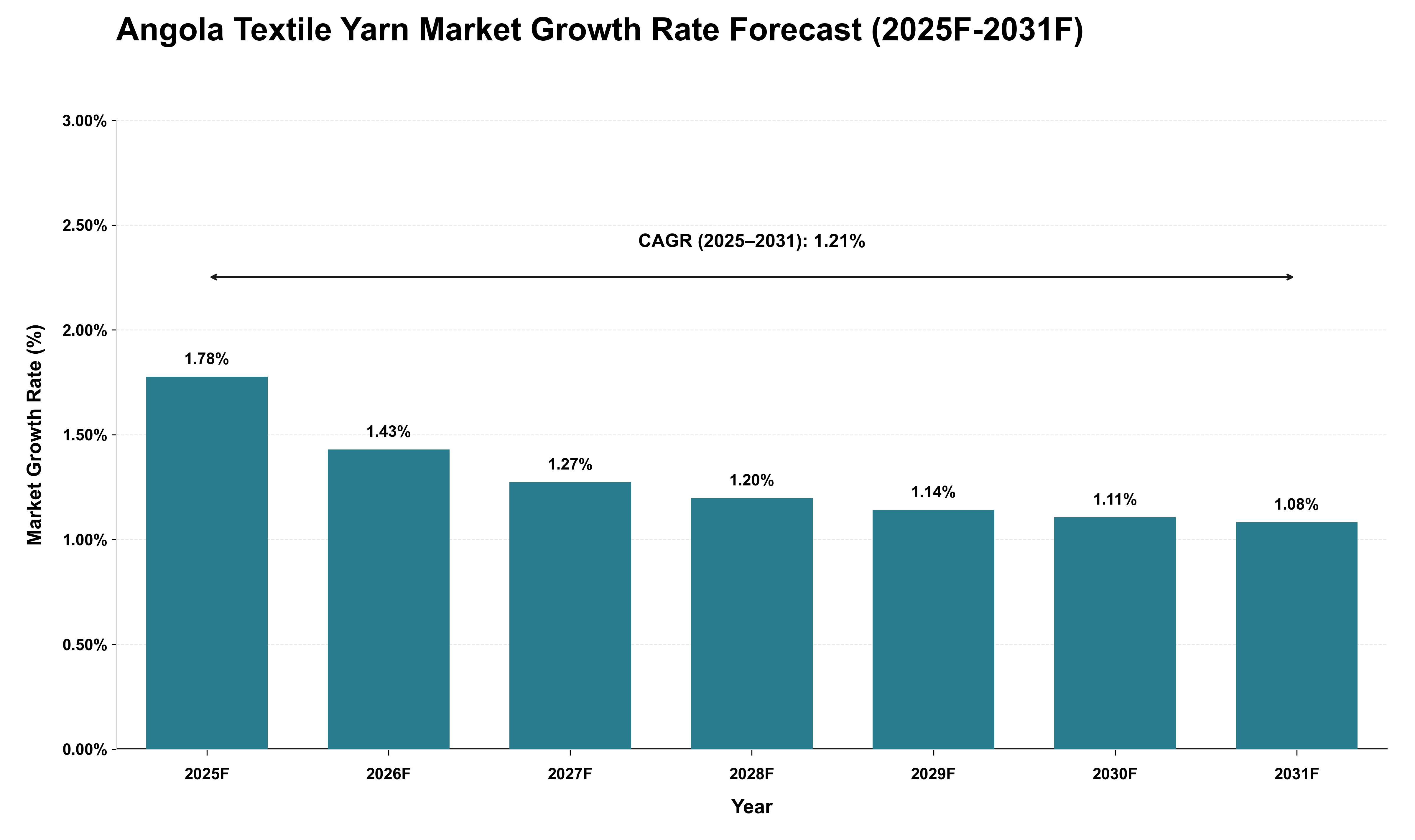
The Angola textile yarn market is projected to experience a compound annual growth rate (CAGR) of 1.21% from 2025 to 2031, reflecting a gradual deceleration in growth rates over the forecast period. This trend indicates that while demand for textile yarn will continue to rise, it will do so at diminishing rates, with initial growth peaking at 1.78% in 2025 before tapering off to 1.08% by 2031. The anticipated import dependencies will play a crucial role in shaping this trajectory, as Angola's reliance on foreign textile inputs may influence pricing and availability, thereby impacting domestic production capabilities. Additionally, cyclical trends in global textile demand and shifts in consumer preferences towards sustainable materials could further affect trade flows. As such, stakeholders must navigate these dynamics carefully to optimize their positioning within the evolving market landscape.
Key Highlights of the Report:
- Angola Textile Yarn Market Outlook
- Market Size of Angola Textile Yarn Market, 2024
- Forecast of Angola Textile Yarn Market, 2031
- Historical Data and Forecast of Angola Textile Yarn Revenues & Volume for the Period 2021-2031
- Angola Textile Yarn Market Trend Evolution
- Angola Textile Yarn Market Drivers and Challenges
- Angola Textile Yarn Price Trends
- Angola Textile Yarn Porter`s Five Forces
- Angola Textile Yarn Industry Life Cycle
- Historical Data and Forecast of Angola Textile Yarn Market Revenues & Volume By Sources for the Period 2021-2031
- Historical Data and Forecast of Angola Textile Yarn Market Revenues & Volume By Chemical for the Period 2021-2031
- Historical Data and Forecast of Angola Textile Yarn Market Revenues & Volume By Animal for the Period 2021-2031
- Historical Data and Forecast of Angola Textile Yarn Market Revenues & Volume By Plant for the Period 2021-2031
- Historical Data and Forecast of Angola Textile Yarn Market Revenues & Volume By Others for the Period 2021-2031
- Historical Data and Forecast of Angola Textile Yarn Market Revenues & Volume By Applications for the Period 2021-2031
- Historical Data and Forecast of Angola Textile Yarn Market Revenues & Volume By Home Textile for the Period 2021-2031
- Historical Data and Forecast of Angola Textile Yarn Market Revenues & Volume By Apparel for the Period 2021-2031
- Historical Data and Forecast of Angola Textile Yarn Market Revenues & Volume By Industrial for the Period 2021-2031
- Historical Data and Forecast of Angola Textile Yarn Market Revenues & Volume By Artificial Subtype for the Period 2021-2031
- Historical Data and Forecast of Angola Textile Yarn Market Revenues & Volume By Viscose for the Period 2021-2031
- Historical Data and Forecast of Angola Textile Yarn Market Revenues & Volume By Polyester for the Period 2021-2031
- Historical Data and Forecast of Angola Textile Yarn Market Revenues & Volume By Acrylic for the Period 2021-2031
- Historical Data and Forecast of Angola Textile Yarn Market Revenues & Volume By Nylon for the Period 2021-2031
- Historical Data and Forecast of Angola Textile Yarn Market Revenues & Volume By Type for the Period 2021-2031
- Historical Data and Forecast of Angola Textile Yarn Market Revenues & Volume By Artificial for the Period 2021-2031
- Historical Data and Forecast of Angola Textile Yarn Market Revenues & Volume By Natural Type for the Period 2021-2031
- Angola Textile Yarn Import Export Trade Statistics
- Market Opportunity Assessment By Sources
- Market Opportunity Assessment By Applications
- Market Opportunity Assessment By Artificial Subtype
- Market Opportunity Assessment By Type
- Angola Textile Yarn Top Companies Market Share
- Angola Textile Yarn Competitive Benchmarking By Technical and Operational Parameters
- Angola Textile Yarn Company Profiles
- Angola Textile Yarn Key Strategic Recommendations






































