Angola Vegetable Oil Market Growth Rate Analysis (2021 - 2031)
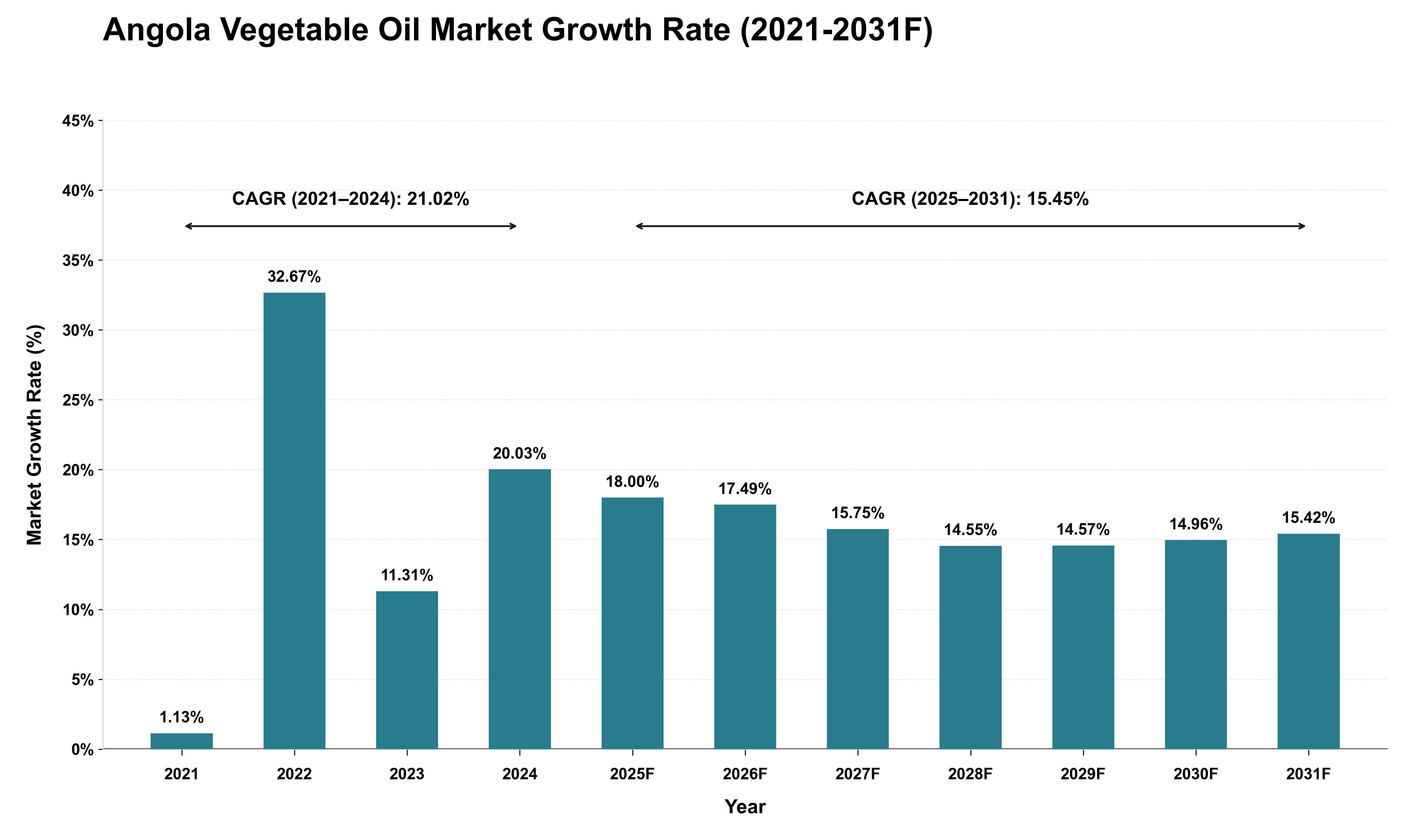
The Angola vegetable oil market experienced significant growth from 2021 to 2024, with a historical CAGR of 21.02%, driven by regulatory shifts aimed at enhancing domestic production and reducing import reliance. The sharp increase in 2022 (32.67%) can be attributed to post-pandemic recovery dynamics, where demand surged as hospitality sectors reopened, coupled with global commodity price fluctuations that affected supply chains. As the market transitioned into a more stable growth phase, the forecasted CAGR of 15.45% from 2025 to 2031 reflects a normalization process influenced by ongoing trade policy adjustments and potential tariff implementations on imported oils. This period is expected to see continued investment in local production capabilities, aligning with broader trends in food security and self-sufficiency initiatives across emerging markets, while also responding to global shifts in agricultural commodity prices and trade agreements impacting import dynamics.
Key Highlights of the Report:
- Angola Vegetable Oil Market Outlook
- Market Size of Angola Vegetable Oil Market, 2024
- Forecast of Angola Vegetable Oil Market, 2031
- Historical Data and Forecast of Angola Vegetable Oil Revenues & Volume for the Period 2021- 2031
- Angola Vegetable Oil Market Trend Evolution
- Angola Vegetable Oil Market Drivers and Challenges
- Angola Vegetable Oil Price Trends
- Angola Vegetable Oil Porter's Five Forces
- Angola Vegetable Oil Industry Life Cycle
- Historical Data and Forecast of Angola Vegetable Oil Market Revenues & Volume By Type for the Period 2021- 2031
- Historical Data and Forecast of Angola Vegetable Oil Market Revenues & Volume By Sunflower Oil for the Period 2021- 2031
- Historical Data and Forecast of Angola Vegetable Oil Market Revenues & Volume By Rapeseed (Canola) Oil for the Period 2021- 2031
- Historical Data and Forecast of Angola Vegetable Oil Market Revenues & Volume By Soybean Oil for the Period 2021- 2031
- Historical Data and Forecast of Angola Vegetable Oil Market Revenues & Volume By Application for the Period 2021- 2031
- Historical Data and Forecast of Angola Vegetable Oil Market Revenues & Volume By Food for the Period 2021- 2031
- Historical Data and Forecast of Angola Vegetable Oil Market Revenues & Volume By Feed for the Period 2021- 2031
- Historical Data and Forecast of Angola Vegetable Oil Market Revenues & Volume By Industrial for the Period 2021- 2031
- Angola Vegetable Oil Import Export Trade Statistics
- Market Opportunity Assessment By Type
- Market Opportunity Assessment By Application
- Angola Vegetable Oil Top Companies Market Share
- Angola Vegetable Oil Competitive Benchmarking By Technical and Operational Parameters
- Angola Vegetable Oil Company Profiles
- Angola Vegetable Oil Key Strategic Recommendations






































