Argentina Aircraft Engine Market Size, Share & Growth Rate
The Argentina Aircraft Engine Market was estimated at USD 457 Million in 2025 and is projected to reach USD 762 Million by 2032, growing at a CAGR of 7.6% from 2026 to 2032. This robust growth trajectory is driven by the expanding commercial aviation sector, along with significant military investment. Additionally, the modernization of the fleet towards more fuel-efficient engines aligns with global trends emphasizing sustainability, further propelling market demand.
Argentina Aircraft Engine Market Year-wise Growth Rate and Key Drivers
This graph highlights how the Argentina Aircraft Engine Market has steadily grown over the years, supported by major growth factors.
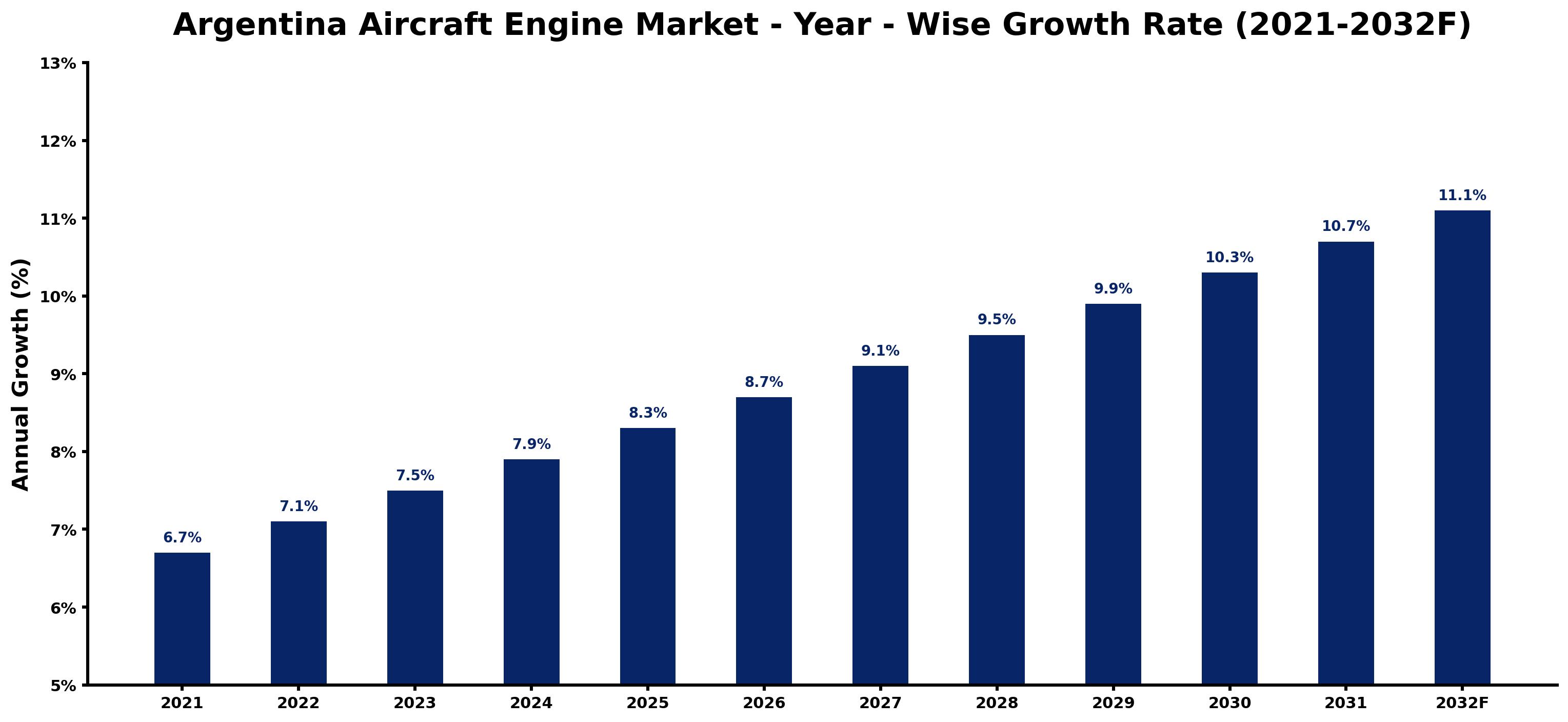
The table below presents the year‑wise growth rates along with the key drivers influencing the market
| Year | Growth Rate | Major Drivers |
| 2021 | 6.7% | Increasing industrial infrastructure investments |
| 2022 | 7.1% | Growing renewable energy integration projects |
| 2023 | 7.5% | Rising electricity demand across industries |
| 2024 | 7.9% | Expansion of transportation and logistics networks |
| 2025 | 8.3% | Expansion of transportation and logistics networks |
| 2026 | 8.7% | Government infrastructure modernization initiatives |
| 2027 | 9.1% | Expansion of transportation and logistics networks |
| 2028 | 9.5% | Increasing adoption of advanced technologies |
| 2029 | 9.9% | Expansion of transportation and logistics networks |
| 2030 | 10.3% | Government infrastructure modernization initiatives |
| 2031 | 10.7% | Increasing adoption of advanced technologies |
| 2032 | 11.1% | Growing renewable energy integration projects |
Note - Market size estimations and growth projections presented in this report are based on 6Wresearch’s advanced forecasting approach, validated with industry datasets as of June 2026.
Argentina Aircraft Engine Market Synopsis
The Argentina Aircraft Engine Market is characterized by a dynamic interplay between increasing demand for air travel and the urgent need to modernize aging fleets. International manufacturers dominate the landscape, catering to both commercial and military sectors with advanced technologies designed to enhance performance and efficiency.
Furthermore, as Argentina positions itself as a critical hub in South America, the growth of regional aviation is creating additional opportunities for engine manufacturers. The emphasis on reducing emissions and noise is prompting a shift towards environmentally friendly engine solutions, aligning with global aviation sustainability goals.
Argentina Aircraft Engine Market Key Takeaways
- Significant growth expected in the Argentina Aircraft Engine Market due to rising air travel demand.
- Investment opportunities driven by governmental support for aerospace infrastructure development.
- International manufacturers maintain a stronghold, focusing on innovative and fuel-efficient technologies.
- Growing emphasis on sustainability is shaping consumer preferences and industry standards.
- Economic factors and regulatory environments pose challenges but also foster innovation in the sector.
Evaluation of Restraints in Argentina Aircraft Engine Market
Despite the promising outlook, the Argentina Aircraft Engine Market faces substantial restraints primarily linked to economic and political instability. Fluctuations in economic stability may dampen the purchasing power of potential buyers, impacting overall demand for aircraft engines. Regulatory complexities, including import restrictions and certification processes, create hurdles for new entrants and existing players. Additionally, inadequate infrastructure and limited technical capabilities can pose challenges for companies striving to manufacture and maintain high-quality aircraft engines efficiently.
Argentina Aircraft Engine Market Trends
The market is witnessing a pronounced trend towards fuel-efficient and environmentally friendly engines. Increased regulatory pressure related to emissions is steering manufacturers toward developing advanced turbofan engines with better thrust-to-weight ratios and lower emissions. Additionally, the exploration of electric propulsion systems and hybrid technologies is gaining traction as stakeholders seek innovative solutions to address environmental concerns and reduce operational costs.
Argentina Aircraft Engine Market Opportunities
Investment opportunities within the Argentina Aircraft Engine Market are ripe as the aviation sector undergoes a transformation. The modernization of commercial and military fleets presents a prime avenue for manufacturers to introduce advanced engines. Moreover, the growing demand for maintenance and repair services highlights a need for specialized expertise and resources, allowing companies to carve out a niche in service offerings. With ongoing governmental initiatives aimed at attracting foreign investment, the market's growth potential is set to expand further.
Government Initiatives in the Argentina Aircraft Engine Market
The Argentine government has taken proactive steps to foster growth within the Aircraft Engine Market. This includes tax incentives and subsidies directed at domestic manufacturers to enhance competitiveness. Additionally, there is a strong emphasis on promoting research and development in the aerospace industry, along with initiatives to improve aviation infrastructure. These supportive policies are designed not only to attract foreign investment but also to create a robust framework that aligns with international aviation regulations and safety standards.
Future Insights of the Argentina Aircraft Engine Market
Looking ahead, the Argentina Aircraft Engine Market is poised for sustained growth between 2026 and 2032. The anticipated rise in air travel demand, coupled with the expansion of commercial aviation operations, will bolster the need for modern aircraft engines. Government investments in aviation infrastructure and a shift towards sustainability will further influence the market landscape. As manufacturers innovate to meet these evolving needs, opportunities for collaboration and growth will likely emerge, positioning the market for long-term viability.
Argentina Aircraft Engine Market Latest Developments (May 2025 - June 2026)
Recent developments within the Argentina Aircraft Engine Market indicate a trend towards enhancing technological capabilities. New collaborations aimed at integrating hybrid and electric propulsion systems are underway, reflecting the industry's response to environmental pressures. Additionally, manufacturers are investing in local partnerships to streamline certification processes, aiming to navigate regulatory challenges more effectively. The focus on sustainability continues to gain momentum, with companies exploring innovative materials and manufacturing techniques that minimize environmental impact.
Argentina Aircraft Engine Market - Key Attractiveness of the Report
- 10 Years of Market Numbers
- Historical Data Starting from 2022 to 2025
- Base Year: 2025
- Forecast Data until 2032
- Key Performance Indicators Impacting the Market
- Major Upcoming Developments and Projects
Key Highlights of the Report:
- Argentina Aircraft Engine Market Outlook
- Market Size of Argentina Aircraft Engine Market, 2025
- Forecast of Argentina Aircraft Engine Market, 2032
- Historical Data and Forecast of Argentina Aircraft Engine Revenues & Volume for the Period 2022-2032F
- Argentina Aircraft Engine Market Trend Evolution
- Argentina Aircraft Engine Market Drivers and Challenges
- Argentina Aircraft Engine Price Trends
- Argentina Aircraft Engine Porter's Five Forces
- Argentina Aircraft Engine Industry Life Cycle
- Historical Data and Forecast of Argentina Aircraft Engine Market Revenues & Volume By Type for the Period 2022-2032F
- Historical Data and Forecast of Argentina Aircraft Engine Market Revenues & Volume By Turboprop for the Period 2022-2032F
- Historical Data and Forecast of Argentina Aircraft Engine Market Revenues & Volume By Turbofan for the Period 2022-2032F
- Historical Data and Forecast of Argentina Aircraft Engine Market Revenues & Volume By Turboshaft for the Period 2022-2032F
- Historical Data and Forecast of Argentina Aircraft Engine Market Revenues & Volume By Piston Engine for the Period 2022-2032F
- Historical Data and Forecast of Argentina Aircraft Engine Market Revenues & Volume By Application for the Period 2022-2032F
- Historical Data and Forecast of Argentina Aircraft Engine Market Revenues & Volume By Military Aviation for the Period 2022-2032F
- Historical Data and Forecast of Argentina Aircraft Engine Market Revenues & Volume By Commercial Aviation for the Period 2022-2032F
- Historical Data and Forecast of Argentina Aircraft Engine Market Revenues & Volume By General Aviation for the Period 2022-2032F
- Historical Data and Forecast of Argentina Aircraft Engine Market Revenues & Volume By Platform for the Period 2022-2032F
- Historical Data and Forecast of Argentina Aircraft Engine Market Revenues & Volume By Fixed Wing for the Period 2022-2032F
- Historical Data and Forecast of Argentina Aircraft Engine Market Revenues & Volume By Rotary Wing for the Period 2022-2032F
- Argentina Aircraft Engine Import Export Trade Statistics
- Market Opportunity Assessment By Type
- Market Opportunity Assessment By Application
- Market Opportunity Assessment By Platform
- Argentina Aircraft Engine Top Companies Market Share
- Argentina Aircraft Engine Competitive Benchmarking By Technical and Operational Parameters
- Argentina Aircraft Engine Company Profiles
- Argentina Aircraft Engine Key Strategic Recommendations






































