Argentina Aviation Test Equipment Market Size, Share & Growth Rate
The Argentina Aviation Test Equipment Market was estimated at USD 177 Million in 2025 and is projected to reach USD 245 Million by 2032, growing at a CAGR of 4.8% from 2026 to 2032. This upward trajectory is largely fueled by the ongoing modernization of the aviation sector, characterized by an increase in air traffic and a heightened focus on safety and operational efficiency. Additionally, the growing adoption of advanced testing technologies and compliance with international aviation standards are pivotal elements driving market expansion.
Argentina Aviation Test Equipment Market Year-wise Growth Rate and Key Drivers
This graph highlights how the Argentina Aviation Test Equipment Market has steadily grown over the years, supported by major growth factors.
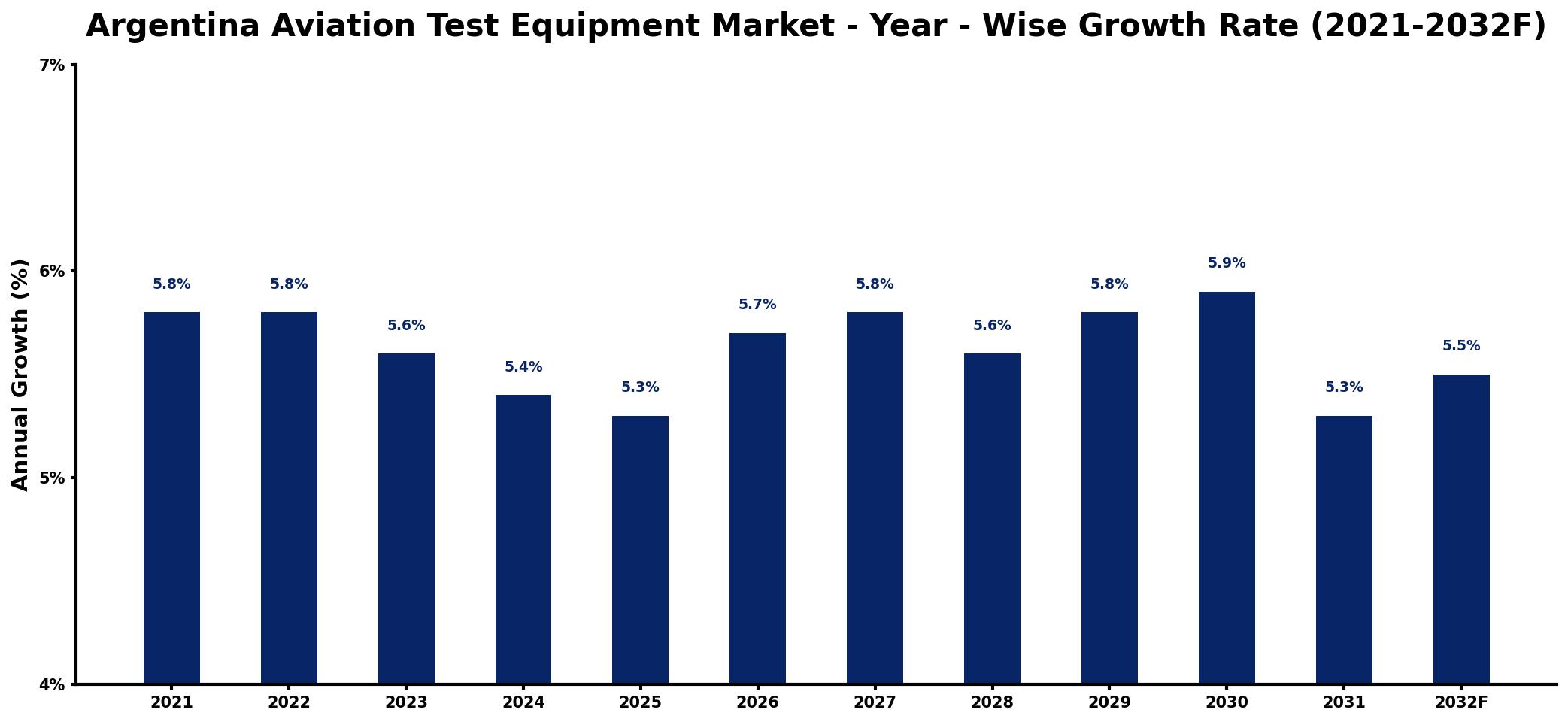
The table below presents the year‑wise growth rates along with the key drivers influencing the market
| Year | Growth Rate | Major Drivers |
| 2021 | 5.8% | Increased defense sector investments |
| 2022 | 5.8% | Rising commercial airline expansion |
| 2023 | 5.6% | Growing aerospace manufacturing demand |
| 2024 | 5.4% | Emerging drone technology applications |
| 2025 | 5.3% | Strengthening regulatory compliance requirements |
| 2026 | 5.7% | Enhanced research and development funding |
| 2027 | 5.8% | Surge in pilot training programs |
| 2028 | 5.6% | Expanding international trade agreements |
| 2029 | 5.8% | expanding industrial usage applications |
| 2030 | 5.9% | Growing emphasis on safety standards |
| 2031 | 5.3% | Boost in regional connectivity initiatives |
| 2032 | 5.5% | Increased focus on sustainability practices |
Note: Market size estimations and growth projections presented in this report are based on 6Wresearch's proprietary forecasting methodology, utilizing the latest available industry data, government publications, and primary research inputs.
Argentina Aviation Test Equipment Market Synopsis
Currently, the Argentina Aviation Test Equipment Market is witnessing a transformative phase as operators strive to meet increasingly stringent safety regulations and efficiency requirements. The demand for specialized testing equipment is rising, propelled by advancements in technology that enable more thorough and accurate assessments of aircraft systems.
In the local market, both international giants and emerging domestic manufacturers are vying for a share, responding to a growing appetite for innovative solutions. As the aviation industry in Argentina continues to expand, the focus on maintaining high safety standards and embracing new technology is likely to shape the competitive landscape.
Argentina Aviation Test Equipment Market Key Takeaways
- Steady growth driven by modernization in the aviation sector and increasing air traffic.
- Advanced testing equipment adoption is essential for compliance with international safety regulations.
- The market is becoming more technology-driven, with an emphasis on automation and data analytics.
- Domestic manufacturing is on the rise, catering to local demand and reducing import dependencies.
- Investment opportunities are burgeoning, particularly in maintenance, repair, and overhaul (MRO) segments.
Evaluation of Restraints in Argentina Aviation Test Equipment Market
Despite the positive outlook, several restraints are affecting the Argentina Aviation Test Equipment Market. High import tariffs on aviation equipment complicate access to advanced technology, limiting the options available to local companies. Furthermore, economic fluctuations and exchange rate instability can impact the financial capacity of aviation firms, making investment in new test equipment challenging. The absence of standardized regulations for testing equipment also contributes to inconsistencies, posing a risk to operational effectiveness and safety compliance.
Argentina Aviation Test Equipment Market Trends
Key trends currently shaping the Argentina Aviation Test Equipment Market include the growing integration of automation and digital technologies. Automation is streamlining maintenance workflows, while IoT and data analytics are enhancing predictive maintenance capabilities. Moreover, there is a marked increase in interest toward specialized equipment designed to meet stringent regulatory standards, ensuring aircraft performance and safety. This evolution indicates a shift towards smarter, more efficient testing methodologies.
Argentina Aviation Test Equipment Market Opportunities
The market presents significant investment opportunities, particularly in areas such as the development and distribution of specialized test equipment tailored for MRO facilities. As local companies seek to upgrade their capabilities, there is a compelling case for innovative testing technologies that align with international standards. Investors can capitalize on the need for advanced solutions that enhance safety and operational efficiency within Argentina's expanding aviation landscape.
Government Initiatives in the Argentina Aviation Test Equipment Market
Government policies in Argentina are increasingly geared toward fostering a safe and competitive aviation industry. Regulations focusing on equipment certification, maintenance protocols, and operator training ensure that testing equipment adheres to strict quality standards. Additionally, the government is actively promoting research and development initiatives aimed at encouraging technological innovation. Collaborative efforts with international entities are also being pursued to align local practices with global aviation standards, enhancing the competitiveness of the market.
Future Insights of the Argentina Aviation Test Equipment Market
Looking ahead to 2026-2032, the Argentina Aviation Test Equipment Market is poised for steady growth, buoyed by ongoing investments in aviation infrastructure and fleet modernization. The demand for cutting-edge testing equipment, driven by the need for compliance and improved operational efficiency, will likely continue to rise. As technologies like artificial intelligence and advanced automation become more integrated into testing processes, the market will evolve to meet these sophisticated requirements, positioning itself for substantial expansion in the coming years.
Argentina Aviation Test Equipment Market Latest Developments (2025 - 2026)
The industry is currently experiencing a push toward adopting state-of-the-art technologies that enhance testing accuracy and efficiency. There is a notable trend towards partnerships between local and international firms to facilitate technology transfer and innovation. Additionally, several initiatives aimed at improving MRO capabilities are in the pipeline, reflecting the sector's commitment to enhancing safety standards and operational excellence.
Argentina Aviation Test Equipment Market - Key Attractiveness of the Report
- 10 Years of Market Numbers
- Historical Data Starting from 2022 to 2025
- Base Year: 2025
- Forecast Data until 2032
- Key Performance Indicators Impacting the Market
- Major Upcoming Developments and Projects
Key Highlights of the Report:
- Argentina Aviation Test Equipment Market Outlook
- Market Size of Argentina Aviation Test Equipment Market, 2025
- Forecast of Argentina Aviation Test Equipment Market, 2032
- Historical Data and Forecast of Argentina Aviation Test Equipment Revenues & Volume for the Period 2022-2032F
- Argentina Aviation Test Equipment Market Trend Evolution
- Argentina Aviation Test Equipment Market Drivers and Challenges
- Argentina Aviation Test Equipment Price Trends
- Argentina Aviation Test Equipment Porter's Five Forces
- Argentina Aviation Test Equipment Industry Life Cycle
- Historical Data and Forecast of Argentina Aviation Test Equipment Market Revenues & Volume By Product for the Period 2022-2032F
- Historical Data and Forecast of Argentina Aviation Test Equipment Market Revenues & Volume By Electrical Aviation Test Equipment for the Period 2022-2032F
- Historical Data and Forecast of Argentina Aviation Test Equipment Market Revenues & Volume By Hydraulic Aviation Test Equipment for the Period 2022-2032F
- Historical Data and Forecast of Argentina Aviation Test Equipment Market Revenues & Volume By Power Aviation Test Equipment for the Period 2022-2032F
- Historical Data and Forecast of Argentina Aviation Test Equipment Market Revenues & Volume By Pneumatic Aviation Test Equipment for the Period 2022-2032F
- Historical Data and Forecast of Argentina Aviation Test Equipment Market Revenues & Volume By End User for the Period 2022-2032F
- Historical Data and Forecast of Argentina Aviation Test Equipment Market Revenues & Volume By Commercial for the Period 2022-2032F
- Historical Data and Forecast of Argentina Aviation Test Equipment Market Revenues & Volume By Defense/Military Sector for the Period 2022-2032F
- Argentina Aviation Test Equipment Import Export Trade Statistics
- Market Opportunity Assessment By Product
- Market Opportunity Assessment By End User
- Argentina Aviation Test Equipment Top Companies Market Share
- Argentina Aviation Test Equipment Competitive Benchmarking By Technical and Operational Parameters
- Argentina Aviation Test Equipment Company Profiles
- Argentina Aviation Test Equipment Key Strategic Recommendations






































