Argentina Cameras Market Summary
The argentina cameras market was estimated at USD 283 Million in 2025 and is projected to reach USD 400 Million by 2032, growing at a CAGR of 6.0% from 2026 to 2032.
Argentina Cameras Market Year-wise Growth Rate and Key Drivers
This graph highlights how the Argentina Cameras Market has steadily grown over the past five years, supported by major growth factors.
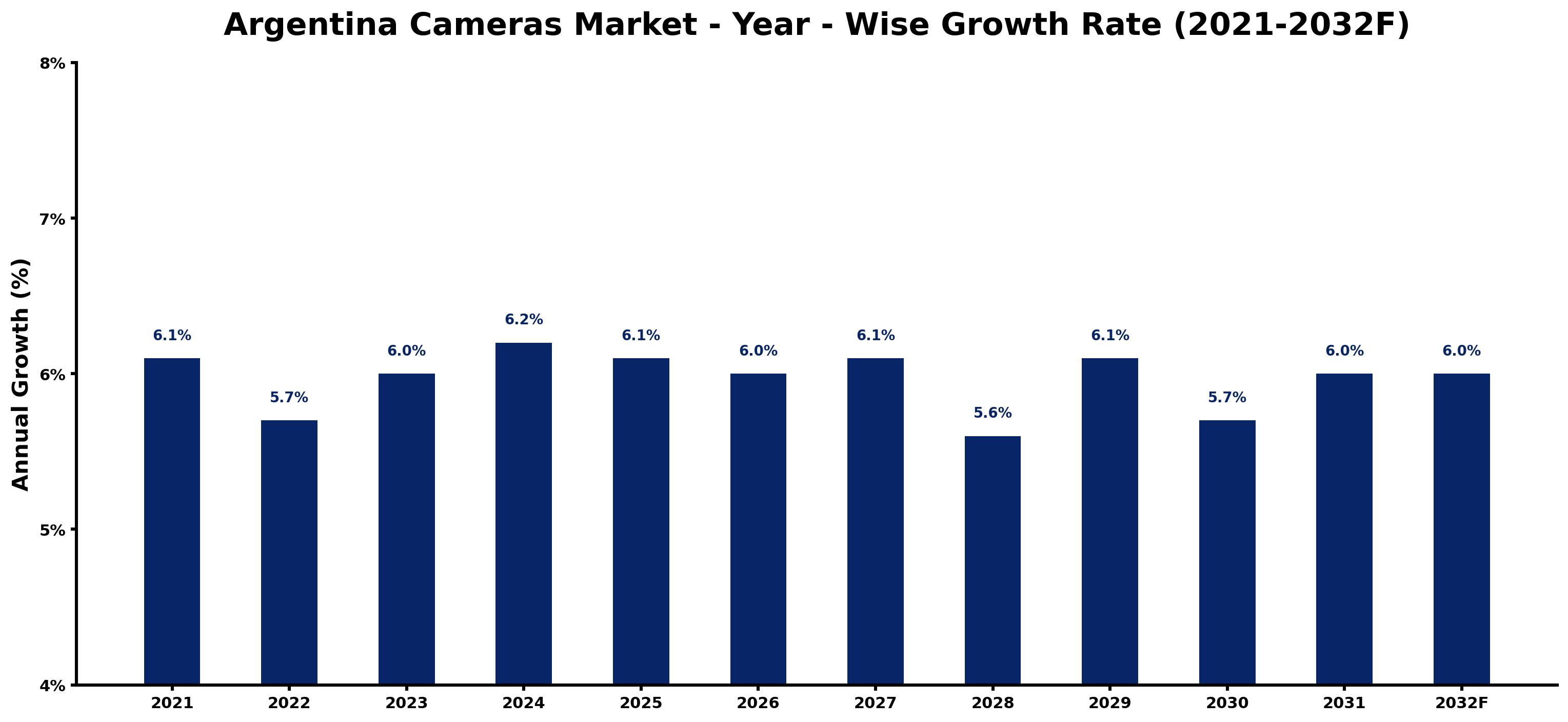
The table below presents the year wise growth rates along with the key drivers influencing the market
| Year | Growth Rate | Major Drivers |
| 2021 | 6.1% | Post-pandemic consumer behavior showcased a renewed interest in photography and videography. |
| 2022 | 5.7% | Emerging social media trends fueled a significant uptick in camera purchases among millennials. |
| 2023 | 6.0% | Local manufacturers began introducing affordable DSLRs and mirrorless options for budget-conscious buyers. |
| 2024 | 6.2% | Cross-border e-commerce platforms expanded, providing wider access to international camera brands. |
| 2025 | 6.1% | Improvements in smartphone camera technology spurred demand for higher-quality standalone devices. |
| 2026 | 6.0% | Expanding influencer culture motivated younger generations to invest in professional-grade cameras. |
| 2027 | 6.1% | Sustainable manufacturing practices gained attention, driving eco-conscious consumers towards specific brands. |
| 2028 | 5.6% | The rise of content creation workshops increased awareness of photography equipment importance. |
| 2029 | 6.1% | Tech-savvy consumers began prioritizing camera accessories for enhanced performance and versatility. |
| 2030 | 5.7% | New photography-related tourism experiences emerged, creating demand for portable and versatile cameras. |
| 2031 | 6.0% | Investment in local photography schools signaled increased interest in professional training and equipment. |
| 2032 | 6.0% | Consumer preferences shifted towards hybrid cameras, blending video and photo capabilities seamlessly. |
Note - Market size estimations and growth projections presented in this report are based on 6Wresearch's advanced forecasting approach, validated with industry datasets as of June 2026.
Argentina Cameras Market Synopsis
The Argentina Cameras Market is projected to reach 6.0% and witness significant growth during the forecast period (2026-2032). This growth is primarily driven by the increasing popularity of photography and videography among consumers, as well as the rising trend of social media engagement. The market encompasses a diverse range of products including digital cameras, DSLRs, mirrorless cameras, and action cameras, catering to various consumer preferences and use cases.
Argentina Cameras Market Growth Drivers
Several key factors are contributing to the growth of the Argentina Cameras Market. Firstly, the surge in visual content creation, driven by social media platforms, has led to higher demand for quality cameras that support high-resolution images and videos. Additionally, the growing interest in photography as a hobby has encouraged consumers to invest in dedicated camera equipment. Furthermore, the advancement of technology, especially in mirrorless cameras, has attracted consumers with their compactness, superior features, and enhanced image quality.
- Consumer engagement with platforms like Instagram and TikTok drives demand for high-quality cameras, particularly those with advanced video recording capabilities.
- The rise of social media influencers has significantly impacted buying behaviors, prompting purchases of specialized cameras for content creation.
- Economic recovery in Argentina is expected to increase consumer spending power, leading to more investments in premium camera products.
- The transition from traditional DSLRs to mirrorless cameras is shaping consumer preferences, particularly among professionals and enthusiasts.
- Technological innovations, such as improved image stabilization and connectivity features, are creating new opportunities for market growth.
Argentina Cameras Market Trends and Opportunities
Within the Argentina Cameras Market, notable trends are enhancing growth prospects. There is a marked shift towards purchasing mirrorless cameras, which are favored for their lightweight design and advanced capabilities. Furthermore, the demand for action cameras is on the rise, driven by consumers seeking to document their adventures and outdoor activities. The increasing emphasis on high-definition video recording and features such as 4K capabilities and image stabilization is becoming a crucial factor in purchasing decisions.
- Consumers are increasingly looking for cameras that offer seamless connectivity with smartphones for easier sharing of content.
- The trend of online shopping is gaining traction, providing consumers with access to a wider array of products and competitive pricing.
- The expansion of rental services for high-end cameras is making advanced photography equipment more accessible to a larger audience.
- Local retailers are enhancing their marketing strategies to reach target demographics, taking advantage of social media platforms for promotions.
- Emerging photography and vlogging communities are providing new avenues for market engagement, driving up the need for specific camera features.
Argentina Cameras Market Challenges and Restraints
Despite the favorable outlook, the Argentina Cameras Market faces significant challenges. Economic instability, including inflation and currency fluctuations, affects consumer purchasing power, making it difficult for some consumers to afford high-value products like cameras. The informal economy's large presence creates competition with unregulated products, further complicating the market landscape. Additionally, the rapid advancements in smartphone camera technology pose a threat to traditional camera sales, as consumers may opt for multifunctional devices over dedicated photography equipment.
- The fluctuating economy can lead to unpredictable consumer spending patterns, making it challenging for businesses to forecast demand accurately.
- Competition from smartphones, which often provide adequate camera functionality without the need for a separate device, is a growing concern.
- Informal market channels may divert potential sales away from regulated retailers, negatively impacting overall market growth.
- To remain competitive, businesses in this market must continuously innovate to offer unique features that distinguish their products from smartphone capabilities.
- Adapting marketing strategies to target specific customer segments effectively is essential to overcome market challenges.
Argentina Cameras Market Investment Opportunities
The Argentina Cameras Market presents a wealth of investment opportunities amid its growth trajectory. The increasing interest in visual content creation signifies a robust demand for high-quality digital cameras, particularly mirrorless and action cameras. Investments in cutting-edge technology firms engaged in camera development and production represent a lucrative avenue for potential investors. Additionally, establishing retail channels focused on camera sales and accessories can capitalize on rising consumer interest.
- The rising trend of photography education and workshops opens new markets for camera manufacturers and retailers.
- Investing in product innovation, particularly in the realm of advanced imaging technologies, offers strategic advantages.
- Partnerships with content creators and influencers can enhance brand visibility and attract a dedicated customer base.
- As consumers increasingly favor online shopping, expanding e-commerce capabilities can drive significant sales growth.
- Supporting local production initiatives may yield long-term benefits as the industry stabilizes and matures.
Argentina Cameras Market Government Investment and Initiatives
The Argentine government plays an essential role in shaping the Cameras Market through various policies and initiatives. Tariffs and import restrictions are implemented to protect local manufacturers and encourage domestic production, which can ultimately enhance market competitiveness. Regulatory measures ensure that all camera products meet safety standards, protecting consumer interests and health. Incentives for local manufacturers, which may include subsidies or tax breaks, are designed to stimulate industry growth and attract investment.
Argentina Cameras Market Latest Developments (May 2025 - June 2026)
Recent developments in the Argentina Cameras Market from May 2025 to June 2026 indicate a dynamic shift towards more robust online sales platforms, reflecting changing consumer behaviors. The ongoing economic adjustments have prompted many retailers to enhance their digital presence and improve the consumer shopping experience. Additionally, advancements in camera technology continue to draw attention, as brands innovate to meet the needs of the evolving consumer landscape, focusing particularly on features that enhance video recording capabilities.
Argentina Cameras Market - Key Attractiveness of the Report
- 10 Years of Market Numbers
- Historical Data Starting from 2022 to 2025
- Base Year: 2025
- Forecast Data until 2032
- Key Performance Indicators Impacting the Market
- Major Upcoming Developments and Projects
Key Highlights of the Report:
- Argentina Cameras Market Outlook
- Market Size of Argentina Cameras Market, 2025
- Forecast of Argentina Cameras Market, 2032F
- Historical Data and Forecast of Argentina Cameras Revenues & Volume for the Period 2022-2032F
- Argentina Cameras Market Trend Evolution
- Argentina Cameras Market Drivers and Challenges
- Argentina Cameras Price Trends
- Argentina Cameras Porter's Five Forces
- Argentina Cameras Industry Life Cycle
- Historical Data and Forecast of Argentina Cameras Market Revenues & Volume By Product Type for the Period 2022-2032F
- Historical Data and Forecast of Argentina Cameras Market Revenues & Volume By Built-in Lens Camera for the Period 2022-2032F
- Historical Data and Forecast of Argentina Cameras Market Revenues & Volume By Interchangeable Lens Camera for the Period 2022-2032F
- Historical Data and Forecast of Argentina Cameras Market Revenues & Volume By DSLR for the Period 2022-2032F
- Historical Data and Forecast of Argentina Cameras Market Revenues & Volume By Non-reflex for the Period 2022-2032F
- Historical Data and Forecast of Argentina Cameras Market Revenues & Volume By Application for the Period 2022-2032F
- Historical Data and Forecast of Argentina Cameras Market Revenues & Volume By Commercial for the Period 2022-2032F
- Historical Data and Forecast of Argentina Cameras Market Revenues & Volume By Residential for the Period 2022-2032F
- Historical Data and Forecast of Argentina Cameras Market Revenues & Volume By Distribution Channel for the Period 2022-2032F
- Historical Data and Forecast of Argentina Cameras Market Revenues & Volume By Online for the Period 2022-2032F
- Historical Data and Forecast of Argentina Cameras Market Revenues & Volume By Offline for the Period 2022-2032F
- Argentina Cameras Import Export Trade Statistics
- Market Opportunity Assessment By Product Type
- Market Opportunity Assessment By Application
- Market Opportunity Assessment By Distribution Channel
- Argentina Cameras Top Companies Market Share
- Argentina Cameras Competitive Benchmarking By Technical and Operational Parameters
- Argentina Cameras Company Profiles
- Argentina Cameras Key Strategic Recommendations






































