Argentina Chatbot Market Size & Growth Rate (2026-2032)
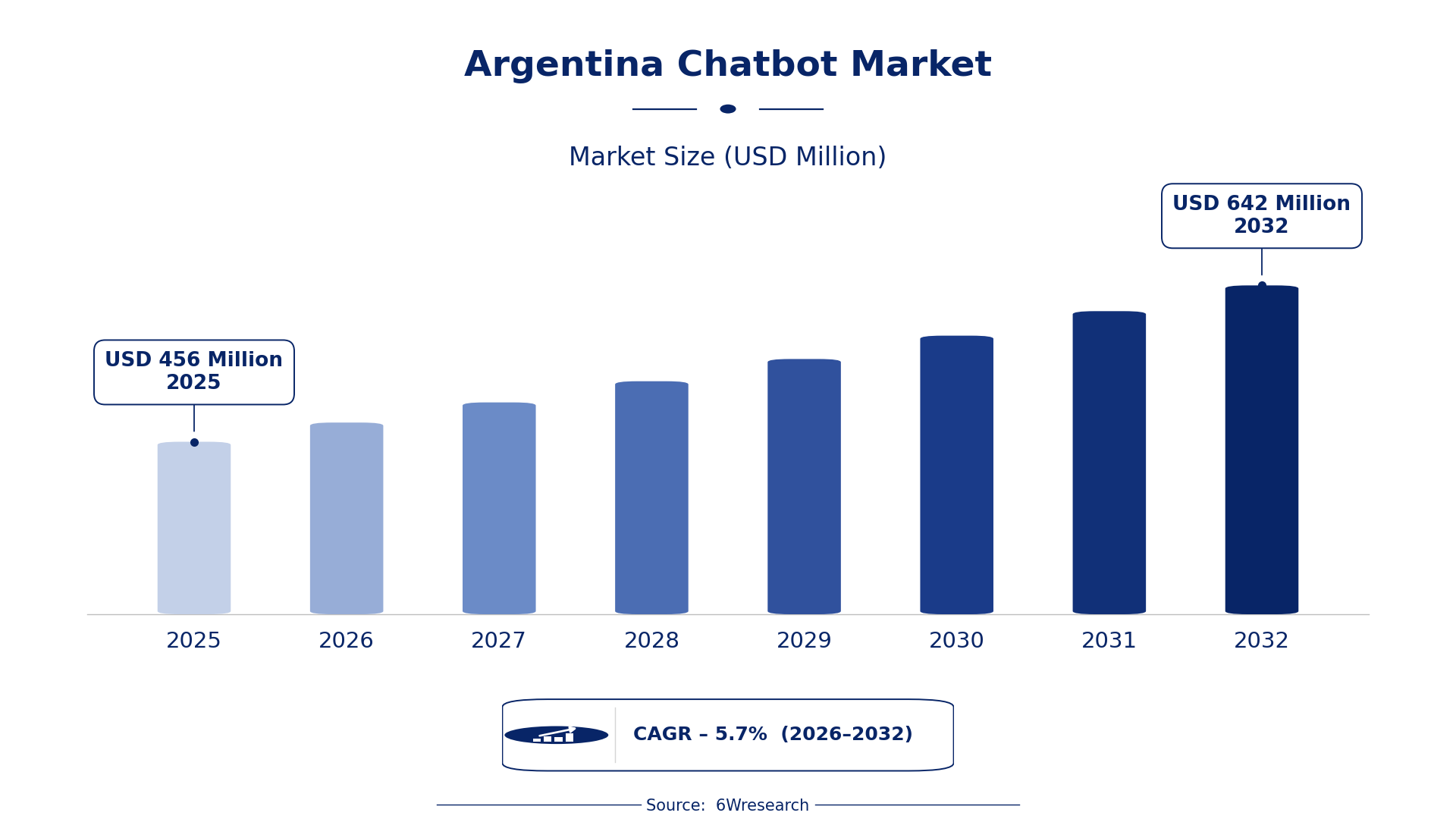
The Argentina Chatbot Market was estimated at USD 456 Million in 2025 and is projected to reach USD 642 Million by 2032, growing at a CAGR of 5.7% from 2026 to 2032.
Argentina Chatbot Market Synopsis
The demand for chatbots in Argentina is gaining traction, particularly within sectors like banking and e-commerce, where personalized customer interaction is vital. Businesses are increasingly turning to chatbots to reduce response times and improve service quality, reflecting a broader trend towards automation in customer service.
As smartphone penetration rises and internet access expands, consumers are seeking efficient self-service options. This shift is compelling organizations to invest in chatbot technologies that enhance user experiences while simultaneously addressing operational efficiencies.
Argentina Chatbot Market Year-wise Growth Rate and Key Drivers
This graph illustrates the annual growth rates of the Argentina Chatbot Market from 2021 to 2032, highlighting a steady upward trajectory and projected expansion over the forecast period.
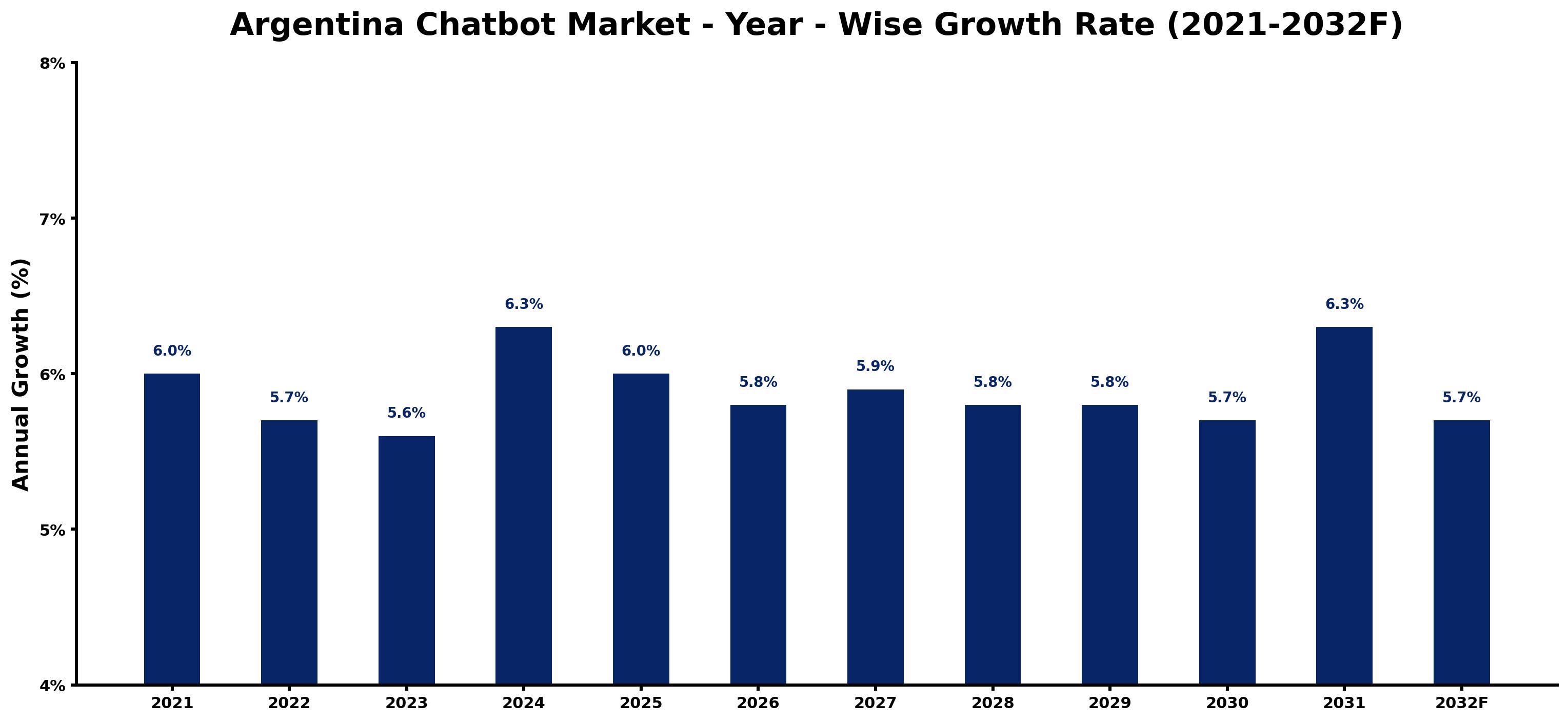
The table below presents the year‑wise growth rates along with the key drivers influencing the market
| Year | Growth Rate | Major Drivers |
| 2021 | 6.0% | Increase in remote work driving digital customer support needs. |
| 2022 | 5.7% | Local startups adopting AI technologies for enhanced user interaction. |
| 2023 | 5.6% | Rise in mobile banking usage requiring chatbot services. |
| 2024 | 6.3% | Government initiatives promoting tech entrepreneurship boosting chatbot solutions. |
| 2025 | 6.0% | Boost in e-commerce sales leading to chat support demand. |
| 2026 | 5.8% | Cultural shift towards digital transactions enhancing chatbot adoption. |
| 2027 | 5.9% | Adoption of conversational AI in local retail brands. |
| 2028 | 5.8% | Increased smartphone penetration fostering chatbot usage growth. |
| 2029 | 5.8% | Telecommunications improvements enhancing chatbot implementation capabilities. |
| 2030 | 5.7% | Surge in digital marketing campaigns requiring chatbot integration. |
| 2031 | 6.3% | Growing necessity for efficient service in small businesses. |
| 2032 | 5.7% | Increased focus on customer service automation in various sectors. |
Note: Market size estimations and growth projections presented in this report are based on 6Wresearch's proprietary forecasting methodology, utilizing the latest available industry data, government publications, and primary research inputs.
Argentina Chatbot Market Key Takeaways
Below are some of the specific key takeaways from the market, including:
- The Argentina Chatbot Market is expanding rapidly across various sectors, driven by the demand for enhanced customer service.
- Integration of AI technologies and natural language processing is creating more effective chatbot solutions.
- Challenges related to language nuances in Spanish remain a barrier for effective communication.
- Data privacy regulations are shaping the operational landscape for chatbot developers.
- Opportunities for growth are present, particularly within digital transformation initiatives across industries.
Evaluation of Restraints in Argentina Chatbot Market
A few constraints are currently hindering the growth of the Argentina Chatbot Market. Notably, the complexities surrounding language variations in Spanish create hurdles for effective chatbot deployment. Many businesses struggle to ensure their chatbots communicate effectively with users, which can lead to dissatisfaction and reduced adoption rates. on top of that, data privacy regulations require adherence to stringent laws, adding layers of complexity to implementation processes. As new competitors enter the market, existing firms must continuously innovate to maintain relevance, which can be a resource-intensive endeavor.
Argentina Chatbot Market Trends
The trend towards automation in customer service is undeniable. Companies are integrating advanced technologies, such as AI and natural language processing, to create chatbots that can handle more complex queries and provide personalized experiences. The increasing use of messaging applications is also significant; consumers now prefer communicating through these platforms, prompting businesses to adapt their chatbot solutions accordingly. As organizations invest in digital transformation, the appetite for chatbots will continue to grow.
Argentina Chatbot Market Opportunities
There are clear opportunities for growth in the Argentina Chatbot Market. As businesses recognize the need for enhanced customer engagement, investments in chatbot technologies will likely increase. The healthcare sector, in particular, presents a fertile ground for chatbot integration, given its need for efficient patient interactions. Additionally, the ongoing digital transformation across various industries opens up avenues for innovative solutions that can streamline operations while improving customer satisfaction.
Government Initiatives in the Argentina Chatbot Market
While there are no specific policies directly targeting the chatbot market, Argentina's government has enacted regulations that impact data privacy and consumer protection. These frameworks are vital for shaping the operational capabilities of chatbot technologies. Additionally, broader initiatives to foster digital innovation are creating a conducive environment for technology adoption, which includes chatbot solutions.
- A national digital infrastructure upgrade programme launched recently aims to enhance internet connectivity, indirectly benefiting chatbot accessibility.
- Current regulatory frameworks are being refined to ensure data privacy compliance, which is crucial for chatbot developers.
- Ongoing efforts are focused on promoting tech entrepreneurship, creating more opportunities for startups in the chatbot space.
- Upcoming initiatives are expected to introduce incentives for businesses adopting AI technologies, including chatbots, to improve customer service.
Future Insights of the Argentina Chatbot Market
Looking ahead to 2026-2032, the Argentina Chatbot Market is set for considerable expansion. As businesses increasingly recognize the value of chatbots for operational efficiency and customer engagement, demand is expected to surge. The integration of more advanced AI capabilities will enable chatbots to manage more intricate interactions, thus enhancing their utility. With the ongoing push for digital transformation and a growing consumer preference for automated solutions, the market is likely to witness innovative developments and heightened investment.
Argentina Chatbot Market Latest Developments
In the past year, the Argentina Chatbot Market has seen several noteworthy developments that signify its growth trajectory. Companies are actively pursuing innovative solutions to cater to evolving consumer expectations and enhance service delivery through automation.
- A leading regional operator launched a new chatbot platform in early 2025, designed to streamline customer service interactions across multiple channels.
- Ongoing partnerships between tech firms and financial institutions are fostering the development of AI-driven chatbots tailored for banking services, enhancing customer interactions.
- In mid-2025, a significant upgrade to existing chatbot technologies was initiated to incorporate advanced natural language processing features, improving user experience.
- A rollout of a new chatbot service aimed at the healthcare sector is planned for the second half of 2026, targeting patient engagement and support.
Argentina Chatbot Market - Key Attractiveness of the Report
- 10 Years of Market Numbers
- Historical Data Starting from 2022 to 2025
- Base Year: 2025
- Forecast Data until 2032
- Key Performance Indicators Impacting the Market
- Major Upcoming Developments and Projects
Key Highlights of the Report:
- Argentina Chatbot Market Outlook
- Market Size of Argentina Chatbot Market, 2025
- Forecast of Argentina Chatbot Market, 2032
- Historical Data and Forecast of Argentina Chatbot Revenues & Volume for the Period 2022-2032F
- Argentina Chatbot Market Trend Evolution
- Argentina Chatbot Market Drivers and Challenges
- Argentina Chatbot Price Trends
- Argentina Chatbot Porter's Five Forces
- Argentina Chatbot Industry Life Cycle
- Historical Data and Forecast of Argentina Chatbot Market Revenues & Volume By Component for the Period 2022-2032F
- Historical Data and Forecast of Argentina Chatbot Market Revenues & Volume By Solutions for the Period 2022-2032F
- Historical Data and Forecast of Argentina Chatbot Market Revenues & Volume By Services for the Period 2022-2032F
- Historical Data and Forecast of Argentina Chatbot Market Revenues & Volume By Type for the Period 2022-2032F
- Historical Data and Forecast of Argentina Chatbot Market Revenues & Volume By Rule Based for the Period 2022-2032F
- Historical Data and Forecast of Argentina Chatbot Market Revenues & Volume By AI Based for the Period 2022-2032F
- Historical Data and Forecast of Argentina Chatbot Market Revenues & Volume By Deployment Mode for the Period 2022-2032F
- Historical Data and Forecast of Argentina Chatbot Market Revenues & Volume By On-premises for the Period 2022-2032F
- Historical Data and Forecast of Argentina Chatbot Market Revenues & Volume By Cloud for the Period 2022-2032F
- Historical Data and Forecast of Argentina Chatbot Market Revenues & Volume By Channel Integration for the Period 2022-2032F
- Historical Data and Forecast of Argentina Chatbot Market Revenues & Volume By Websites for the Period 2022-2032F
- Historical Data and Forecast of Argentina Chatbot Market Revenues & Volume By Contact Centers for the Period 2022-2032F
- Historical Data and Forecast of Argentina Chatbot Market Revenues & Volume By Social Media for the Period 2022-2032F
- Historical Data and Forecast of Argentina Chatbot Market Revenues & Volume By Mobile Applications for the Period 2022-2032F
- Historical Data and Forecast of Argentina Chatbot Market Revenues & Volume By Organization Size for the Period 2022-2032F
- Historical Data and Forecast of Argentina Chatbot Market Revenues & Volume By Large Enterprises for the Period 2022-2032F
- Historical Data and Forecast of Argentina Chatbot Market Revenues & Volume By SMEs for the Period 2022-2032F
- Historical Data and Forecast of Argentina Chatbot Market Revenues & Volume By Business Function for the Period 2022-2032F
- Historical Data and Forecast of Argentina Chatbot Market Revenues & Volume By Information Technology Service Management for the Period 2022-2032F
- Historical Data and Forecast of Argentina Chatbot Market Revenues & Volume By Human Resources for the Period 2022-2032F
- Historical Data and Forecast of Argentina Chatbot Market Revenues & Volume By Sales and Marketing for the Period 2022-2032F
- Historical Data and Forecast of Argentina Chatbot Market Revenues & Volume By Finance for the Period 2022-2032F
- Historical Data and Forecast of Argentina Chatbot Market Revenues & Volume By Application for the Period 2022-2032F
- Historical Data and Forecast of Argentina Chatbot Market Revenues & Volume By Customer Service for the Period 2022-2032F
- Historical Data and Forecast of Argentina Chatbot Market Revenues & Volume By Personal Assistant for the Period 2022-2032F
- Historical Data and Forecast of Argentina Chatbot Market Revenues & Volume By Branding and Advertisement for the Period 2022-2032F
- Historical Data and Forecast of Argentina Chatbot Market Revenues & Volume By Customer Engagement and Retention for the Period 2022-2032F
- Historical Data and Forecast of Argentina Chatbot Market Revenues & Volume By Data Privacy and Compliance for the Period 2022-2032F
- Historical Data and Forecast of Argentina Chatbot Market Revenues & Volume By Employee Engagement and On Boarding for the Period 2022-2032F
- Historical Data and Forecast of Argentina Chatbot Market Revenues & Volume By Payment Processing for the Period 2022-2032F
- Historical Data and Forecast of Argentina Chatbot Market Revenues & Volume By Others for the Period 2022-2032F
- Historical Data and Forecast of Argentina Chatbot Market Revenues & Volume By Vertical for the Period 2022-2032F
- Historical Data and Forecast of Argentina Chatbot Market Revenues & Volume By BFSI for the Period 2022-2032F
- Historical Data and Forecast of Argentina Chatbot Market Revenues & Volume By IT and Telecom for the Period 2022-2032F
- Historical Data and Forecast of Argentina Chatbot Market Revenues & Volume By Retail and Ecommerce for the Period 2022-2032F
- Historical Data and Forecast of Argentina Chatbot Market Revenues & Volume By Healthcare and Life Sciences for the Period 2022-2032F
- Historical Data and Forecast of Argentina Chatbot Market Revenues & Volume By Transportation and Logistics for the Period 2022-2032F
- Historical Data and Forecast of Argentina Chatbot Market Revenues & Volume By Government for the Period 2022-2032F
- Historical Data and Forecast of Argentina Chatbot Market Revenues & Volume By Travel and Hospitality for the Period 2022-2032F
- Historical Data and Forecast of Argentina Chatbot Market Revenues & Volume By Media and Entertainment for the Period 2022-2032F
- Argentina Chatbot Import Export Trade Statistics
- Market Opportunity Assessment By Component
- Market Opportunity Assessment By Type
- Market Opportunity Assessment By Deployment Mode
- Market Opportunity Assessment By Channel Integration
- Market Opportunity Assessment By Organization Size
- Market Opportunity Assessment By Business Function
- Market Opportunity Assessment By Application
- Market Opportunity Assessment By Vertical
- Argentina Chatbot Top Companies Market Share
- Argentina Chatbot Competitive Benchmarking By Technical and Operational Parameters
- Argentina Chatbot Company Profiles
- Argentina Chatbot Key Strategic Recommendations






































