Global Chatbot Market Highlights
| Market Size (2025) | USD 5.8 Billion |
| Forecast Size (2032) | USD 13.2 Billion |
| CAGR | 7.90% |
| Base Year | 2025 |
| Forecast Period | 2026-2032 |
| Largest Region | North America |
| Fastest Growing Region | Asia Pacific |
| Largest Segment | Large Enterprises |
| Fastest Growing Segment | Medium Enterprises |
| Leading Companies | Microsoft Corporation, Google LLC, IBM Corporation, Amazon Web Services, Zendesk Inc. |
Global Chatbot Market Size & Growth Rate (2026-2032)
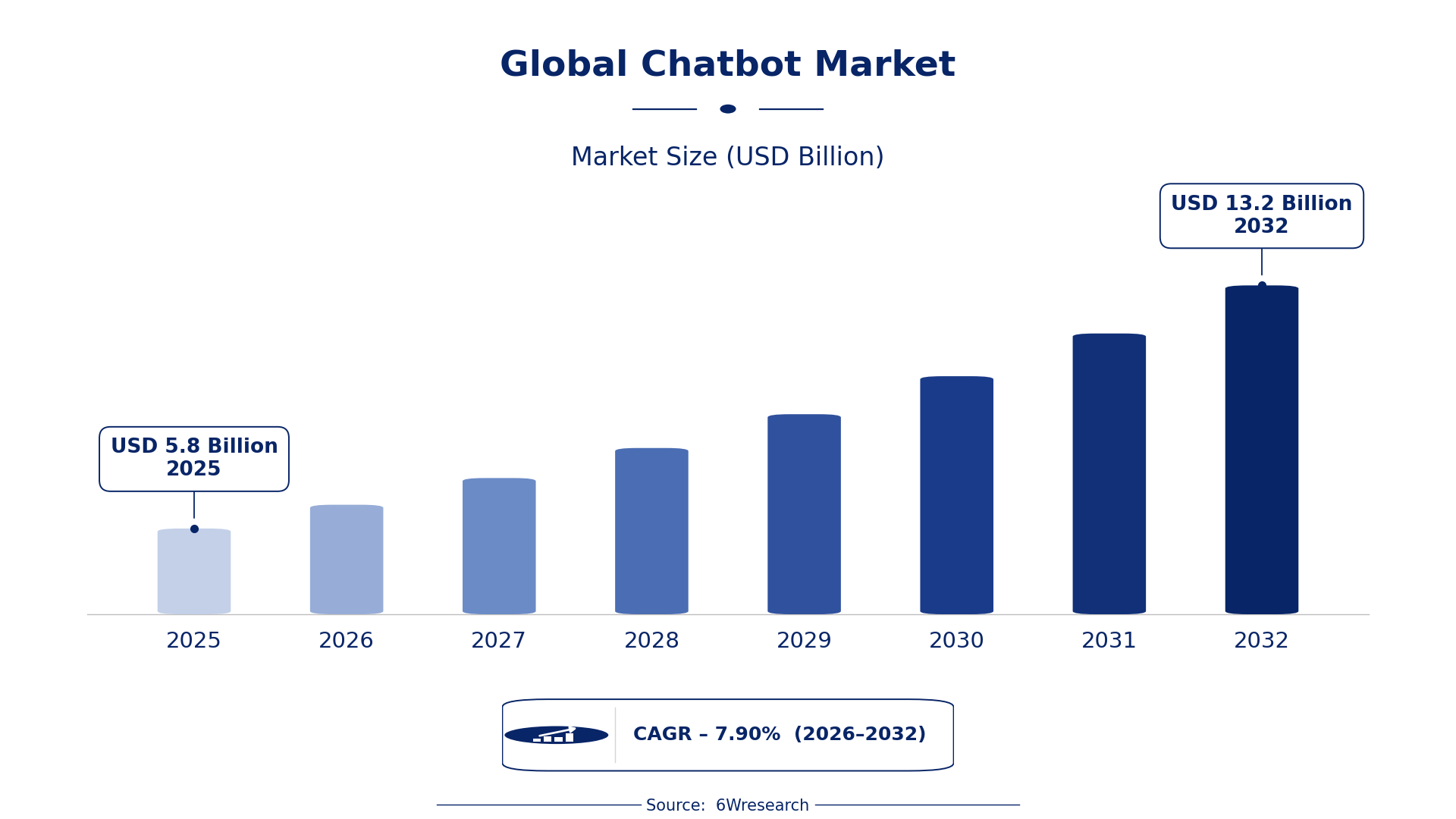
The Global Chatbot Market was estimated at USD 5.8 Billion in 2025 and is projected to reach USD 13.2 Billion by 2032, growing at a CAGR of 7.90% from 2026 to 2032.
Global Chatbot Market Synopsis
The Global Chatbot Market stands at a pivotal juncture, driven by businesses' increasing reliance on AI-driven solutions for enhanced customer interaction and operational optimization. As industries adopt chatbots for tasks ranging from customer service automation to data analytics, traditional business operations are undergoing a profound transformation.
Notably, the market is characterized by the dual presence of rule-based and AI-powered chatbots, each catering to unique business needs. This shift is not just a trend but a foundational change in how businesses communicate, with enterprises recognizing chatbots as essential tools for maintaining competitive advantage.
Global Chatbot Market Year-wise Growth Rate and Key Drivers
This graph illustrates the annual growth rates of the Global Chatbot Market from 2022 to 2032, highlighting a steady upward trajectory and projected expansion over the forecast period.
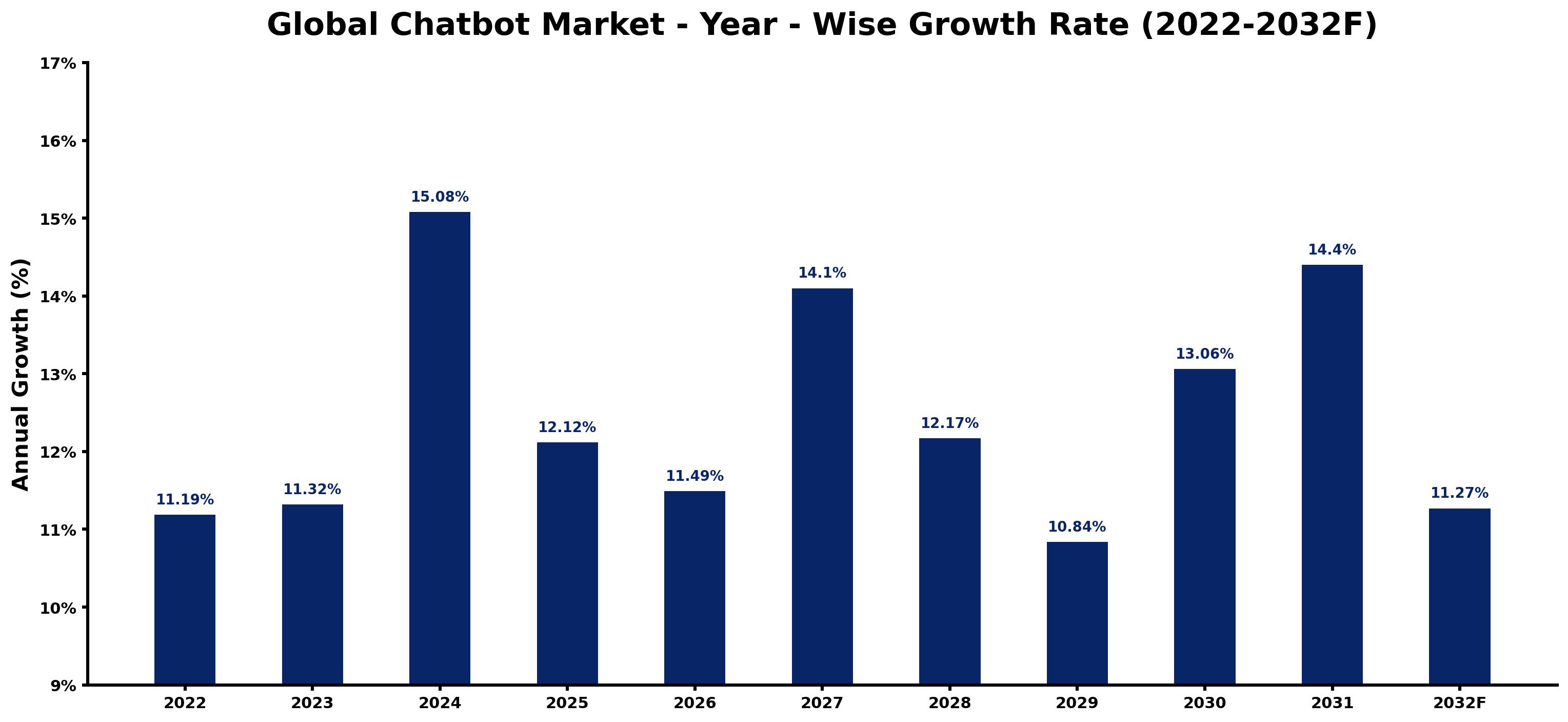
The table below presents the year‑wise growth rates along with the key drivers influencing the market
| Year | Growth Rate (%) | Major Drivers |
| 2022 | 11.19 | In North America, increased investment in chatbot technology enhances telecommunications services. |
| 2023 | 11.32 | Businesses are focusing on sustainability goals, prompting chatbot integration for efficiency. |
| 2024 | 15.08 | Regulators are enforcing data privacy policies, compelling chatbot developers to comply swiftly. |
| 2025 | 12.12 | Lower costs of cloud infrastructure enable wider adoption of advanced chatbot solutions. |
| 2026 | 11.49 | Increasing cloud migration enhances the scalability of chatbot applications across sectors. |
| 2027 | 14.1 | A growing emphasis on digital skills training elevates chatbot development capabilities. |
| 2028 | 12.17 | As advancements in AI algorithms improve, chatbots are becoming more sophisticated and efficient. |
| 2029 | 10.84 | Artificial intelligence chatbots are driving a shift toward automated customer support solutions. |
| 2030 | 13.06 | A shift toward personalized customer interactions transforms the expectations for chatbots. |
| 2031 | 14.4 | Rising global demand for chatbot services expands regional market opportunities significantly. |
| 2032 | 11.27 | Tech companies advancing competitive chatbot features are reshaping industry standards and offerings. |
Note - Market size estimations and growth projections presented in this report are based on 6Wresearch's proprietary research methodology, combining internal industry data, secondary research, and primary validation, updated periodically to reflect current market conditions. As markets evolve rapidly, figures for certain industries may vary slightly and are intended as informed estimates rather than absolute figures. For the most current market sizing, we recommend validating figures with a 6Wresearch analyst.
Global Chatbot Market Key Takeaways
Below are some of the specific key takeaways from the market, including:
- Large Enterprises commanded approximately 60% market share in 2025, indicating their substantial investment in chatbot solutions.
- Asia Pacific is anticipated to grow at a CAGR of 9.5% from 2026 to 2032, reflecting increasing digitalization in the region.
- Google's Dialogflow platform was adopted by over 500,000 developers worldwide as of 2023, showcasing the rapid uptake of chatbot technologies.
- As of 2025, the healthcare sector is projected to account for around 20% of chatbot applications, positioning it as a key vertical.
- ZigZag Global successfully handled over 1 million customer inquiries using chatbots in 2023, demonstrating the effectiveness of automated solutions.
Evaluation of Restraints in Global Chatbot Market
Despite the promising growth trajectory of the Global Chatbot Market, several restraints are noteworthy. The integration complexity remains a primary challenge; businesses may incur costs upwards of $100,000 in system integration efforts. For example, a recent survey indicated that 40% of enterprises faced hurdles in adapting chatbots into existing IT frameworks, causing delays and additional expenditure. Furthermore, privacy and data security concerns linger as chatbots often manage sensitive customer information, with regulations like GDPR intensifying compliance requirements.
Global Chatbot Market Trends
A significant trend shaping the Global Chatbot Market is the rise of conversational commerce, where chatbots facilitate transactions directly within messaging platforms. For instance, as of 2023, Facebook Messenger enabled over 100,000 businesses to conduct sales through its chat interface. Another trend gaining traction is the deployment of voice-enabled chatbots, which saw Amazon Echo's Alexa expanding its capabilities to handle customer service inquiries, prompting a 25% increase in usage over the past year. Additionally, the integration of machine learning algorithms within chatbots has enhanced their capabilities, with companies like IBM embedding advanced sentiment analysis features to better comprehend user emotions, proving pivotal in customer engagement strategies.
Global Chatbot Market Opportunities
As the Global Chatbot Market matures, distinct opportunities are emerging for substantial growth. The healthcare industry represents a lucrative sector, with projections suggesting that the use of chatbots for patient interaction will generate over $3 billion by 2026. For example, the partnership between Babylon Health and NHS, initiated in 2021, aims to leverage chatbot technology to provide health consultations, thus alleviating pressures on healthcare providers. Furthermore, the adoption of chatbots in the fintech sector is expected to grow significantly, with major players like Mastercard leveraging chatbot solutions to facilitate transactions and customer queries, thereby enhancing user experience.
Global Chatbot Market by Enterprise Size
In the Global Chatbot Market, Large Enterprises dominate the landscape, capturing approximately 60% share in 2025. This is primarily due to their considerable resources to invest in sophisticated chatbot solutions that enhance efficiency and customer engagement. Conversely, Medium Enterprises are expected to be the fastest-growing sector, exhibiting a CAGR of 9.2% from 2026 to 2032, as they increasingly seek affordable, scalable solutions to compete with larger counterparts. The growing emphasis on customer service and operational efficiency is driving this trend.
Global Chatbot Market by End-user Vertical
Within the Global Chatbot Market, the BFSI sector emerges as the largest vertical, capturing an estimated 25% of the market share in 2025. The sector's focus on customer satisfaction and operational efficiency propels this dominance. Meanwhile, the Retail vertical is anticipated to be the fastest-growing segment, expected to grow at a CAGR of 10.1% from 2026 to 2032, as more retailers adopt chatbots for personalized shopping experiences and to manage customer inquiries, enhancing customer service amidst intensifying competition.
Global Chatbot Market by Region
North America is the largest region in the Global Chatbot Market, holding ~48% share in 2025. The region benefits from a mature technology ecosystem and high digitalization rates across industries. In contrast, the Asia Pacific region is projected to be the fastest-growing, with a CAGR of 9.7% from 2026 to 2032. This growth is largely driven by the rapid adoption of AI technologies and an increasing focus on automation in emerging markets like India and China, where digital customer engagement is becoming crucial.
Government Initiatives in the Global Chatbot Market
Government policies are progressively shaping the landscape of the Global Chatbot Market, fostering innovation and supporting businesses in integrating advanced technologies. These initiatives not only incentivize the adoption of chatbot solutions but also align with national strategies to enhance digital services.
- Ministry of Electronics and Information Technology (MeitY), India - National Policy on Software Products, 2023. This initiative incentivizes companies developing chatbot technologies by providing financial support aimed at bolstering local manufacturing aspirations.
- European Commission - Digital Europe Programme, rolled out in 2021, funds projects aimed at fostering the development of AI, including chatbots, with an annual budget of €1.2 billion.
- U.S. Department of Commerce - Artificial Intelligence Strategy, introduced in 2023, emphasizes fostering AI deployment, enhancing chatbot capabilities for businesses by providing guidelines and funding opportunities.
- Government of Canada - Innovation Superclusters Initiative, established in 2018, supports collaborative efforts in AI research, enhancing chatbot development through a funding pool of CAD 950 million, particularly benefiting startups in this sector.
Future Insights of the Global Chatbot Market
The Global Chatbot Market is expected to see substantial shifts in operational frameworks as companies redefine customer engagement strategies. By 2032, machine learning and natural language processing technologies will likely become more integrated, allowing chatbots to facilitate complex problem-solving independently. For example, major players like Microsoft are investing heavily in AI solutions that enhance machine learning capabilities, which will likely improve chatbot responsiveness and accuracy, ensuring they meet evolving user expectations.
Global Chatbot Market Latest Developments
Recent developments in the Global Chatbot Market highlight significant enhancements in technology and strategy among key players. These advancements are vital for maintaining competitive positions in a rapidly changing landscape.
- In July 2023, Microsoft announced ongoing integration of advanced AI functionalities into their Azure Bot Services, enhancing user experience by allowing more tailored interactions based on customer behavior.
- Google LLC also recently completed the rollout of upgraded features in Dialogflow in September 2023, improving multilingual support, thus enabling businesses to connect with a broader, international audience.
- In November 2023, IBM Corporation unveiled a new suite of AI-driven chatbot tools aimed at the healthcare sector, strategically targeting the growing demand for patient engagement solutions while addressing compliance with data privacy regulations.
- Zendesk Inc. is planning an upcoming partnership with several e-commerce companies in early 2024 to integrate conversational commerce options directly into their platforms, enhancing customer service capabilities and facilitating transactions through chat interfaces.
Global Chatbot Market Key Players and Industry Positioning
The Global Chatbot Market features a fragmented landscape with dominant players making strategic moves to consolidate their positions. Each company brings unique strengths and focuses that define their market approach.
| Leading Company | Core Strength | Strategic Focus |
|---|---|---|
| Microsoft Corporation | Pioneering AI technology integration | Enhancing cloud-based chatbot solutions |
| Google LLC | Extensive data processing capabilities | Expanding multilingual support |
| IBM Corporation | Strong focus on enterprise solutions | Innovating in sector-specific chatbot applications |
| Amazon Web Services | Robust cloud infrastructure | Integrating AI with e-commerce functionalities |
| Zendesk Inc. | Comprehensive customer service solutions | Building e-commerce-driven service frameworks |
The competitive dynamics illustrated here reveal a proactive environment where each player continually seeks differentiation through technology and application specialization, thereby driving innovation across the sector.
Key Attractiveness of the Report
- 10 Years of Market Numbers
- Historical Data Starting from 2022 to 2025
- Base Year: 2025
- Forecast Data until 2032
- Key Performance Indicators Impacting the Market
- Major Upcoming Developments and Projects
Key Highlights of the Report:
- Global Chatbot Market Outlook
- Market Size of Global Chatbot Market, 2025
- Forecast of Global Chatbot Market, 2032
- Historical Data and Forecast of Global Chatbot Revenues & Volume for the Period 2022-2032
- Global Chatbot Market Trend Evolution
- Global Chatbot Market Drivers and Challenges
- Global Chatbot Price Trends
- Global Chatbot Porter's Five Forces
- Global Chatbot Industry Life Cycle
- Historical Data and Forecast of Global Chatbot Market Revenues & Volume
- Historical Data and Forecast of Global Chatbot Market Revenues & Volume By Enterprise Size for the Period 2022-2032
- Historical Data and Forecast of Global Chatbot Market Revenues & Volume By Small for the Period 2022-2032
- Historical Data and Forecast of Global Chatbot Market Revenues & Volume By Medium Enterprises for the Period 2022-2032
- Historical Data and Forecast of Global Chatbot Market Revenues & Volume By Large Enterprises for the Period 2022-2032
- Historical Data and Forecast of Global Chatbot Market Revenues & Volume By End-user Vertical for the Period 2022-2032
- Historical Data and Forecast of Global Chatbot Market Revenues & Volume By Retail for the Period 2022-2032
- Historical Data and Forecast of Global Chatbot Market Revenues & Volume By BFSI for the Period 2022-2032
- Historical Data and Forecast of Global Chatbot Market Revenues & Volume By Healthcare for the Period 2022-2032
- Historical Data and Forecast of Global Chatbot Market Revenues & Volume By IT and Telecom for the Period 2022-2032
- Historical Data and Forecast of Global Chatbot Market Revenues & Volume By Travel and Hospitality for the Period 2022-2032
- Historical Data and Forecast of North America Chatbot Market Revenues & Volume By Enterprise Size for the Period 2022-2032
- Historical Data and Forecast of North America Chatbot Market Revenues & Volume By Small for the Period 2022-2032
- Historical Data and Forecast of North America Chatbot Market Revenues & Volume By Medium Enterprises for the Period 2022-2032
- Historical Data and Forecast of North America Chatbot Market Revenues & Volume By Large Enterprises for the Period 2022-2032
- Historical Data and Forecast of North America Chatbot Market Revenues & Volume By End-user Vertical for the Period 2022-2032
- Historical Data and Forecast of North America Chatbot Market Revenues & Volume By Retail for the Period 2022-2032
- Historical Data and Forecast of North America Chatbot Market Revenues & Volume By BFSI for the Period 2022-2032
- Historical Data and Forecast of North America Chatbot Market Revenues & Volume By Healthcare for the Period 2022-2032
- Historical Data and Forecast of North America Chatbot Market Revenues & Volume By IT and Telecom for the Period 2022-2032
- Historical Data and Forecast of North America Chatbot Market Revenues & Volume By Travel and Hospitality for the Period 2022-2032
- Historical Data and Forecast of United States of America Chatbot Market Revenues & Volume for the Period 2022-2032
- Historical Data and Forecast of Canada Chatbot Market Revenues & Volume for the Period 2022-2032
- Historical Data and Forecast of Rest of North America Chatbot Market Revenues & Volume for the Period 2022-2032
- Historical Data and Forecast of Latin America (LATAM) Chatbot Market Revenues & Volume By Enterprise Size for the Period 2022-2032
- Historical Data and Forecast of Latin America (LATAM) Chatbot Market Revenues & Volume By Small for the Period 2022-2032
- Historical Data and Forecast of Latin America (LATAM) Chatbot Market Revenues & Volume By Medium Enterprises for the Period 2022-2032
- Historical Data and Forecast of Latin America (LATAM) Chatbot Market Revenues & Volume By Large Enterprises for the Period 2022-2032
- Historical Data and Forecast of Latin America (LATAM) Chatbot Market Revenues & Volume By End-user Vertical for the Period 2022-2032
- Historical Data and Forecast of Latin America (LATAM) Chatbot Market Revenues & Volume By Retail for the Period 2022-2032
- Historical Data and Forecast of Latin America (LATAM) Chatbot Market Revenues & Volume By BFSI for the Period 2022-2032
- Historical Data and Forecast of Latin America (LATAM) Chatbot Market Revenues & Volume By Healthcare for the Period 2022-2032
- Historical Data and Forecast of Latin America (LATAM) Chatbot Market Revenues & Volume By IT and Telecom for the Period 2022-2032
- Historical Data and Forecast of Latin America (LATAM) Chatbot Market Revenues & Volume By Travel and Hospitality for the Period 2022-2032
- Historical Data and Forecast of Brazil Chatbot Market Revenues & Volume for the Period 2022-2032
- Historical Data and Forecast of Mexico Chatbot Market Revenues & Volume for the Period 2022-2032
- Historical Data and Forecast of Argentina Chatbot Market Revenues & Volume for the Period 2022-2032
- Historical Data and Forecast of Rest of LATAM Chatbot Market Revenues & Volume for the Period 2022-2032
- Historical Data and Forecast of Asia Chatbot Market Revenues & Volume By Enterprise Size for the Period 2022-2032
- Historical Data and Forecast of Asia Chatbot Market Revenues & Volume By Small for the Period 2022-2032
- Historical Data and Forecast of Asia Chatbot Market Revenues & Volume By Medium Enterprises for the Period 2022-2032
- Historical Data and Forecast of Asia Chatbot Market Revenues & Volume By Large Enterprises for the Period 2022-2032
- Historical Data and Forecast of Asia Chatbot Market Revenues & Volume By End-user Vertical for the Period 2022-2032
- Historical Data and Forecast of Asia Chatbot Market Revenues & Volume By Retail for the Period 2022-2032
- Historical Data and Forecast of Asia Chatbot Market Revenues & Volume By BFSI for the Period 2022-2032
- Historical Data and Forecast of Asia Chatbot Market Revenues & Volume By Healthcare for the Period 2022-2032
- Historical Data and Forecast of Asia Chatbot Market Revenues & Volume By IT and Telecom for the Period 2022-2032
- Historical Data and Forecast of Asia Chatbot Market Revenues & Volume By Travel and Hospitality for the Period 2022-2032
- Historical Data and Forecast of China Chatbot Market Revenues & Volume for the Period 2022-2032
- Historical Data and Forecast of India Chatbot Market Revenues & Volume for the Period 2022-2032
- Historical Data and Forecast of Japan Chatbot Market Revenues & Volume for the Period 2022-2032
- Historical Data and Forecast of Rest of Asia Chatbot Market Revenues & Volume for the Period 2022-2032
- Historical Data and Forecast of Africa Chatbot Market Revenues & Volume By Enterprise Size for the Period 2022-2032
- Historical Data and Forecast of Africa Chatbot Market Revenues & Volume By Small for the Period 2022-2032
- Historical Data and Forecast of Africa Chatbot Market Revenues & Volume By Medium Enterprises for the Period 2022-2032
- Historical Data and Forecast of Africa Chatbot Market Revenues & Volume By Large Enterprises for the Period 2022-2032
- Historical Data and Forecast of Africa Chatbot Market Revenues & Volume By End-user Vertical for the Period 2022-2032
- Historical Data and Forecast of Africa Chatbot Market Revenues & Volume By Retail for the Period 2022-2032
- Historical Data and Forecast of Africa Chatbot Market Revenues & Volume By BFSI for the Period 2022-2032
- Historical Data and Forecast of Africa Chatbot Market Revenues & Volume By Healthcare for the Period 2022-2032
- Historical Data and Forecast of Africa Chatbot Market Revenues & Volume By IT and Telecom for the Period 2022-2032
- Historical Data and Forecast of Africa Chatbot Market Revenues & Volume By Travel and Hospitality for the Period 2022-2032
- Historical Data and Forecast of South Africa Chatbot Market Revenues & Volume for the Period 2022-2032
- Historical Data and Forecast of Nigeria Chatbot Market Revenues & Volume for the Period 2022-2032
- Historical Data and Forecast of Egypt Chatbot Market Revenues & Volume for the Period 2022-2032
- Historical Data and Forecast of Rest of Africa Chatbot Market Revenues & Volume for the Period 2022-2032
- Historical Data and Forecast of Europe Chatbot Market Revenues & Volume By Enterprise Size for the Period 2022-2032
- Historical Data and Forecast of Europe Chatbot Market Revenues & Volume By Small for the Period 2022-2032
- Historical Data and Forecast of Europe Chatbot Market Revenues & Volume By Medium Enterprises for the Period 2022-2032
- Historical Data and Forecast of Europe Chatbot Market Revenues & Volume By Large Enterprises for the Period 2022-2032
- Historical Data and Forecast of Europe Chatbot Market Revenues & Volume By End-user Vertical for the Period 2022-2032
- Historical Data and Forecast of Europe Chatbot Market Revenues & Volume By Retail for the Period 2022-2032
- Historical Data and Forecast of Europe Chatbot Market Revenues & Volume By BFSI for the Period 2022-2032
- Historical Data and Forecast of Europe Chatbot Market Revenues & Volume By Healthcare for the Period 2022-2032
- Historical Data and Forecast of Europe Chatbot Market Revenues & Volume By IT and Telecom for the Period 2022-2032
- Historical Data and Forecast of Europe Chatbot Market Revenues & Volume By Travel and Hospitality for the Period 2022-2032
- Historical Data and Forecast of United Kingdom Chatbot Market Revenues & Volume for the Period 2022-2032
- Historical Data and Forecast of France Chatbot Market Revenues & Volume for the Period 2022-2032
- Historical Data and Forecast of Germany Chatbot Market Revenues & Volume for the Period 2022-2032
- Historical Data and Forecast of Rest of Europe Chatbot Market Revenues & Volume for the Period 2022-2032
- Historical Data and Forecast of Middle East Chatbot Market Revenues & Volume By Enterprise Size for the Period 2022-2032
- Historical Data and Forecast of Middle East Chatbot Market Revenues & Volume By Small for the Period 2022-2032
- Historical Data and Forecast of Middle East Chatbot Market Revenues & Volume By Medium Enterprises for the Period 2022-2032
- Historical Data and Forecast of Middle East Chatbot Market Revenues & Volume By Large Enterprises for the Period 2022-2032
- Historical Data and Forecast of Middle East Chatbot Market Revenues & Volume By End-user Vertical for the Period 2022-2032
- Historical Data and Forecast of Middle East Chatbot Market Revenues & Volume By Retail for the Period 2022-2032
- Historical Data and Forecast of Middle East Chatbot Market Revenues & Volume By BFSI for the Period 2022-2032
- Historical Data and Forecast of Middle East Chatbot Market Revenues & Volume By Healthcare for the Period 2022-2032
- Historical Data and Forecast of Middle East Chatbot Market Revenues & Volume By IT and Telecom for the Period 2022-2032
- Historical Data and Forecast of Middle East Chatbot Market Revenues & Volume By Travel and Hospitality for the Period 2022-2032
- Historical Data and Forecast of Saudi Arabia Chatbot Market Revenues & Volume for the Period 2022-2032
- Historical Data and Forecast of UAE Chatbot Market Revenues & Volume for the Period 2022-2032
- Historical Data and Forecast of Turkey Chatbot Market Revenues & Volume for the Period 2022-2032
- Historical Data and Forecast of Rest of Middle East Chatbot Market Revenues & Volume for the Period 2022-2032
- Global Chatbot Market - Key Performance Indicators
- Global Chatbot Market - Import Export Trade Statistics
- Global Chatbot Market - Opportunity Assessment By Countries
- Global Chatbot Market - Opportunity Assessment By Enterprise Size
- Global Chatbot Market - Opportunity Assessment By End-user Vertical
- Global Chatbot Market - Top Companies Market Share
- Global Chatbot Market - Top Companies Profiles
- Global Chatbot Market - Comparison of Players in Technical and Operating Parameters
- Global Chatbot Market - Strategic Recommendations
Markets Covered
The Global Chatbot Market report provides a detailed analysis of the following market segments:
By Regions and Countries:
- North America
- Europe
- LATAM
- Middle East
- Asia
- Africa
By Enterprise Size:
- Small
- Medium Enterprises
- Large Enterprises
By End-user Vertical:
- Retail
- BFSI
- Healthcare
- IT
- Telecom
- Travel
- Hospitality






































