Russia Chatbot Market Size & Growth Rate (2026-2032)
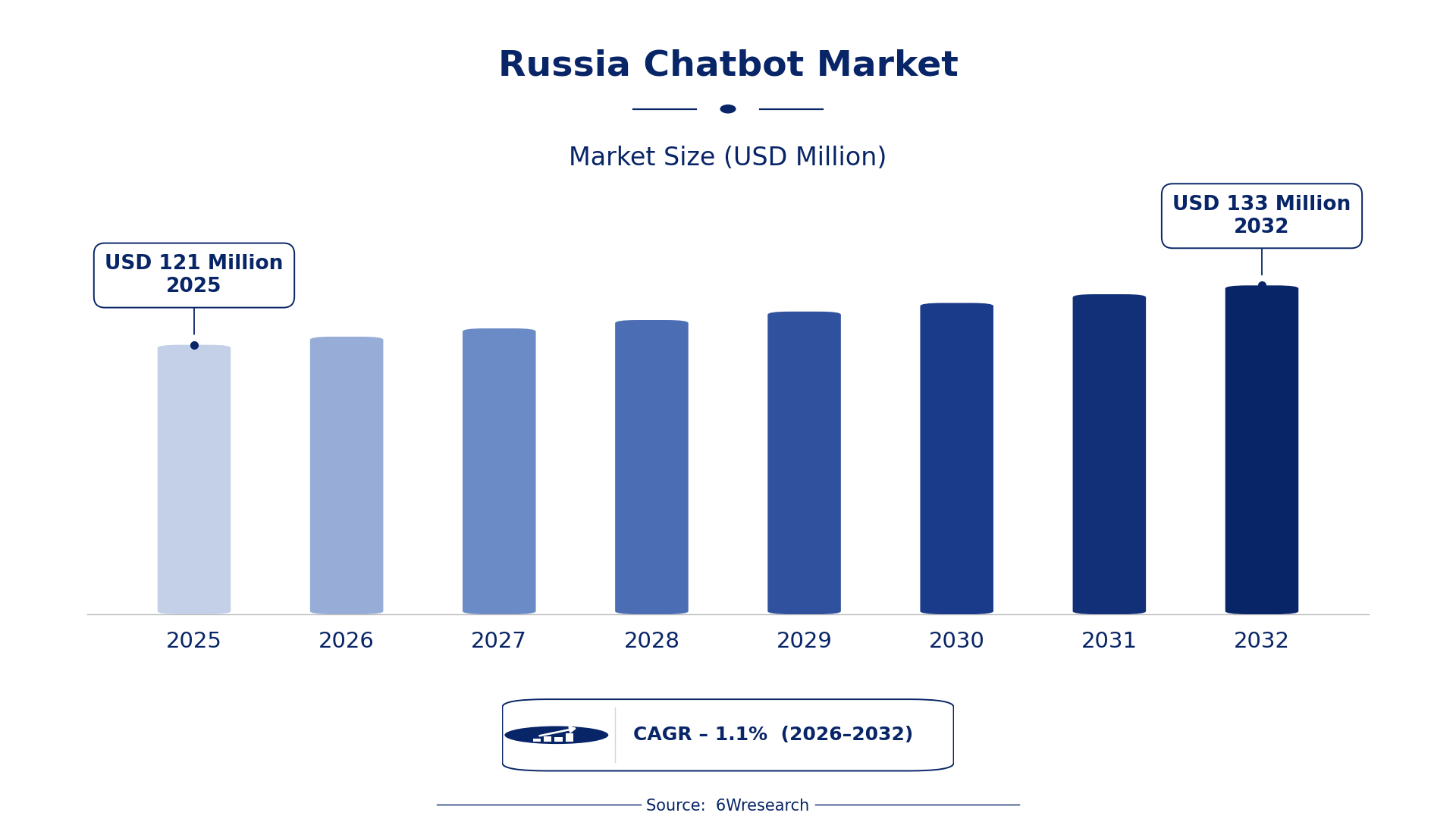
The Russia Chatbot Market was estimated at USD 121 Million in 2025 and is projected to reach USD 133 Million by 2032, growing at a CAGR of 1.1% from 2026 to 2032.
Russia Chatbot Market Synopsis
The Russia Chatbot Market is currently witnessing an upward trajectory, fueled by the growing integration of AI technologies across diverse sectors. Businesses are increasingly adopting chatbots to refine customer service and optimize operational workflows, responding to the rising demand for enhanced user experiences.
As consumer expectations evolve, organizations are prioritizing the deployment of personalized and interactive chatbot solutions. Sectors such as e-commerce, banking, and healthcare are leading this charge, as companies leverage chatbots to automate processes and improve customer interactions.
Russia Chatbot Market Year-wise Growth Rate and Key Drivers
This graph illustrates the annual growth rates of the Russia Chatbot Market from 2021 to 2032, highlighting a steady upward trajectory and projected expansion over the forecast period.
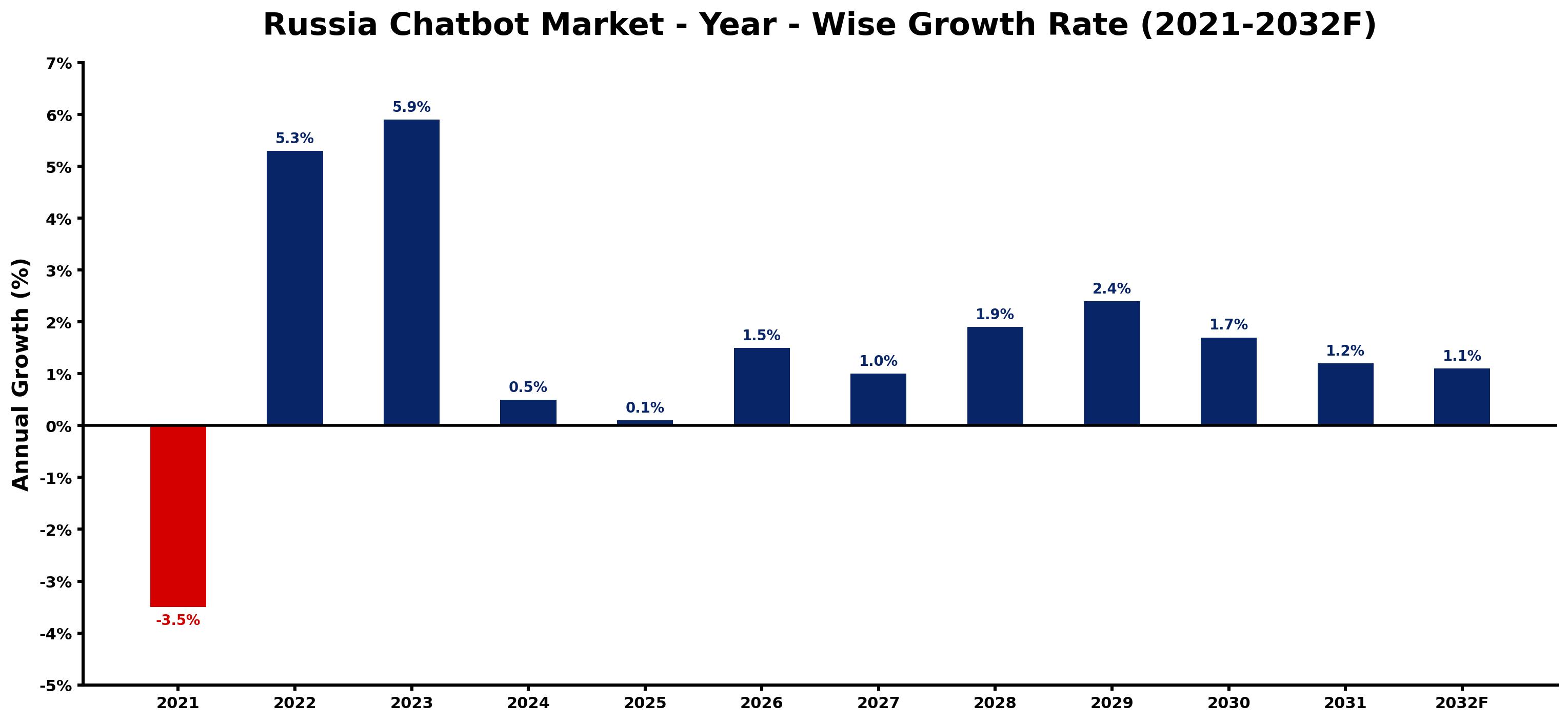
The table below presents the year‑wise growth rates along with the key drivers influencing the market
| Year | Growth Rate | Major Drivers |
| 2021 | -3.5% | Sanctions hindered technology imports and development efforts. |
| 2022 | 5.3% | Increased remote work driving demand for virtual assistance. |
| 2023 | 5.9% | Growth of e-commerce boosting chatbot interactions for sales. |
| 2024 | 0.5% | Rising smartphone penetration facilitating chatbot accessibility. |
| 2025 | 0.1% | Emergence of AI regulations fostering responsible chatbot development. |
| 2026 | 1.5% | Adoption of educational chatbots in remote learning environments. |
| 2027 | 1.0% | Demand surge in customer service automation across industries. |
| 2028 | 1.9% | Integration of chatbots in government services for citizen engagement. |
| 2029 | 2.4% | Increased digital marketing efforts utilizing chatbots for lead generation. |
| 2030 | 1.7% | Growth in healthcare teleconsultations encouraging chatbot support. |
| 2031 | 1.2% | Popularity of chatbots in social media customer interactions. |
| 2032 | 1.1% | Continuous improvement in natural language processing technologies. |
Note: Market size estimations and growth projections presented in this report are based on 6Wresearch's proprietary forecasting methodology, utilizing the latest available industry data, government publications, and primary research inputs.
Russia Chatbot Market Key Takeaways
Below are some of the specific key takeaways from the market, including:
- The market is increasingly characterized by the demand for voice-enabled chatbots.
- Advancements in natural language processing technology are enhancing chatbot capabilities.
- Businesses are focusing on developing multilingual chatbots to cater to a diverse audience.
- Integration with popular messaging platforms is becoming a key feature for chatbot solutions.
- Automating customer interactions is driving efficiency and reducing operational costs.
Evaluation of Restraints in Russia Chatbot Market
Despite its growth potential, the Russia Chatbot Market faces notable restraints. Language barriers pose a challenge, as effective engagement requires chatbots to be proficient in Russian. on top of that, cultural preferences impact how these technologies are received, with local consumers having unique expectations that differ from global norms. Data privacy concerns are also significant, given the stringent regulations surrounding personal information in Russia. These factors create hurdles for developers aiming to create universally accepted chatbot solutions. Additionally, the market is competitive, with both domestic and international players constantly innovating to meet customer demands.
Russia Chatbot Market Trends
Several trends are currently shaping the Russia Chatbot Market. The shift towards personalized interactions is evident, with companies striving to offer tailored experiences that resonate with users. There is a marked rise in the use of chatbots within e-commerce, banking, and healthcare, driven by the need for efficient customer service. on top of that, the integration of chatbots into messaging apps is becoming increasingly common, as businesses recognize the importance of being where their customers are. This trend is accompanied by a growing focus on natural language processing advancements, which are enabling chatbots to handle more complex queries and enhance user satisfaction.
Russia Chatbot Market Opportunities
The Russia Chatbot Market presents numerous growth opportunities, particularly in the development of multilingual chatbots to cater to the country's diverse demographics. Businesses can capitalize on the increasing trend of integrating chatbots with social media platforms, allowing for greater customer engagement. on top of that, leveraging advanced technologies such as AI and machine learning will enable the creation of more sophisticated chatbots capable of providing real-time assistance and personalized interactions. As digital transformation continues to drive demand, companies that innovate and adapt will find themselves well-positioned for success.
Government Initiatives in the Russia Chatbot Market
Government policies are significantly influencing the Russia Chatbot Market, shaping its trajectory and regulatory environment. The Russian government has initiated several programs aimed at enhancing the digital infrastructure and promoting AI technologies, which are crucial for the development of chatbots. These initiatives not only aim to facilitate the growth of digital solutions but also address data protection concerns, ensuring compliance with local regulations.
- A "Digital Economy National Program" launched in 2019 focuses on advancing the country's digital infrastructure and promoting AI technologies.
- Ongoing regulatory efforts ensure compliance with the Federal Law on Personal Data, impacting how chatbot developers handle user information.
- A planned public-private partnership aims to expand the adoption of AI in various sectors, including customer service technologies.
- Current initiatives are underway to enhance digital literacy and promote the use of chatbots in public services.
- Future policies are expected to address content restrictions and surveillance concerns that may affect chatbot functionalities.
Future Insights of the Russia Chatbot Market
Looking ahead to 2026-2032, the Russia Chatbot Market is set for substantial growth, driven by increasing automation and digitalization across industries. As businesses continue to seek ways to improve customer interactions and operational efficiency, the demand for sophisticated chatbot solutions will rise. The integration of advanced AI technologies will further enhance the capabilities of chatbots, enabling them to provide more personalized and efficient services. Additionally, the growing reliance on messaging platforms for customer engagement will likely play a critical role in shaping the future of this market.
Russia Chatbot Market Latest Developments
Recent developments in the Russia Chatbot Market indicate a dynamic evolution of technology and customer engagement strategies. Companies are increasingly focusing on innovative solutions to meet the demands of a digitally savvy consumer base. These developments reflect a broader trend of integrating AI technologies into business operations, with a specific emphasis on enhancing user experiences.
- A new chatbot solution launched in early 2025 is designed specifically for the banking sector, providing streamlined customer service and support.
- An ongoing initiative that began in late 2024 focuses on integrating chatbots with popular social media platforms to enhance customer interaction.
- A major technology vendor announced plans for a rollout of an advanced natural language processing feature in their chatbot services expected in mid-2026.
- A pilot program aimed at improving chatbot interactions in healthcare services is currently underway, testing new AI capabilities for real-time patient support.
- Upcoming regulations scheduled for late 2026 will focus on enhancing data privacy measures for chatbot developers, ensuring compliance with local laws.
Russia Chatbot Market - Key Attractiveness of the Report
- 10 Years of Market Numbers
- Historical Data Starting from 2022 to 2025
- Base Year: 2025
- Forecast Data until 2032
- Key Performance Indicators Impacting the Market
- Major Upcoming Developments and Projects
Key Highlights of the Report:
- Russia Chatbot Market Outlook
- Market Size of Russia Chatbot Market, 2025
- Forecast of Russia Chatbot Market, 2032
- Historical Data and Forecast of Russia Chatbot Revenues & Volume for the Period 2022-2032F
- Russia Chatbot Market Trend Evolution
- Russia Chatbot Market Drivers and Challenges
- Russia Chatbot Price Trends
- Russia Chatbot Porter's Five Forces
- Russia Chatbot Industry Life Cycle
- Historical Data and Forecast of Russia Chatbot Market Revenues & Volume By Component for the Period 2022-2032F
- Historical Data and Forecast of Russia Chatbot Market Revenues & Volume By Solutions for the Period 2022-2032F
- Historical Data and Forecast of Russia Chatbot Market Revenues & Volume By Services for the Period 2022-2032F
- Historical Data and Forecast of Russia Chatbot Market Revenues & Volume By Type for the Period 2022-2032F
- Historical Data and Forecast of Russia Chatbot Market Revenues & Volume By Rule Based for the Period 2022-2032F
- Historical Data and Forecast of Russia Chatbot Market Revenues & Volume By AI Based for the Period 2022-2032F
- Historical Data and Forecast of Russia Chatbot Market Revenues & Volume By Deployment Mode for the Period 2022-2032F
- Historical Data and Forecast of Russia Chatbot Market Revenues & Volume By On-premises for the Period 2022-2032F
- Historical Data and Forecast of Russia Chatbot Market Revenues & Volume By Cloud for the Period 2022-2032F
- Historical Data and Forecast of Russia Chatbot Market Revenues & Volume By Channel Integration for the Period 2022-2032F
- Historical Data and Forecast of Russia Chatbot Market Revenues & Volume By Websites for the Period 2022-2032F
- Historical Data and Forecast of Russia Chatbot Market Revenues & Volume By Contact Centers for the Period 2022-2032F
- Historical Data and Forecast of Russia Chatbot Market Revenues & Volume By Social Media for the Period 2022-2032F
- Historical Data and Forecast of Russia Chatbot Market Revenues & Volume By Mobile Applications for the Period 2022-2032F
- Historical Data and Forecast of Russia Chatbot Market Revenues & Volume By Organization Size for the Period 2022-2032F
- Historical Data and Forecast of Russia Chatbot Market Revenues & Volume By Large Enterprises for the Period 2022-2032F
- Historical Data and Forecast of Russia Chatbot Market Revenues & Volume By SMEs for the Period 2022-2032F
- Historical Data and Forecast of Russia Chatbot Market Revenues & Volume By Business Function for the Period 2022-2032F
- Historical Data and Forecast of Russia Chatbot Market Revenues & Volume By Information Technology Service Management for the Period 2022-2032F
- Historical Data and Forecast of Russia Chatbot Market Revenues & Volume By Human Resources for the Period 2022-2032F
- Historical Data and Forecast of Russia Chatbot Market Revenues & Volume By Sales and Marketing for the Period 2022-2032F
- Historical Data and Forecast of Russia Chatbot Market Revenues & Volume By Finance for the Period 2022-2032F
- Historical Data and Forecast of Russia Chatbot Market Revenues & Volume By Application for the Period 2022-2032F
- Historical Data and Forecast of Russia Chatbot Market Revenues & Volume By Customer Service for the Period 2022-2032F
- Historical Data and Forecast of Russia Chatbot Market Revenues & Volume By Personal Assistant for the Period 2022-2032F
- Historical Data and Forecast of Russia Chatbot Market Revenues & Volume By Branding and Advertisement for the Period 2022-2032F
- Historical Data and Forecast of Russia Chatbot Market Revenues & Volume By Customer Engagement and Retention for the Period 2022-2032F
- Historical Data and Forecast of Russia Chatbot Market Revenues & Volume By Data Privacy and Compliance for the Period 2022-2032F
- Historical Data and Forecast of Russia Chatbot Market Revenues & Volume By Employee Engagement and On Boarding for the Period 2022-2032F
- Historical Data and Forecast of Russia Chatbot Market Revenues & Volume By Payment Processing for the Period 2022-2032F
- Historical Data and Forecast of Russia Chatbot Market Revenues & Volume By Others for the Period 2022-2032F
- Historical Data and Forecast of Russia Chatbot Market Revenues & Volume By Vertical for the Period 2022-2032F
- Historical Data and Forecast of Russia Chatbot Market Revenues & Volume By BFSI for the Period 2022-2032F
- Historical Data and Forecast of Russia Chatbot Market Revenues & Volume By IT and Telecom for the Period 2022-2032F
- Historical Data and Forecast of Russia Chatbot Market Revenues & Volume By Retail and Ecommerce for the Period 2022-2032F
- Historical Data and Forecast of Russia Chatbot Market Revenues & Volume By Healthcare and Life Sciences for the Period 2022-2032F
- Historical Data and Forecast of Russia Chatbot Market Revenues & Volume By Transportation and Logistics for the Period 2022-2032F
- Historical Data and Forecast of Russia Chatbot Market Revenues & Volume By Government for the Period 2022-2032F
- Historical Data and Forecast of Russia Chatbot Market Revenues & Volume By Travel and Hospitality for the Period 2022-2032F
- Historical Data and Forecast of Russia Chatbot Market Revenues & Volume By Media and Entertainment for the Period 2022-2032F
- Russia Chatbot Import Export Trade Statistics
- Market Opportunity Assessment By Component
- Market Opportunity Assessment By Type
- Market Opportunity Assessment By Deployment Mode
- Market Opportunity Assessment By Channel Integration
- Market Opportunity Assessment By Organization Size
- Market Opportunity Assessment By Business Function
- Market Opportunity Assessment By Application
- Market Opportunity Assessment By Vertical
- Russia Chatbot Top Companies Market Share
- Russia Chatbot Competitive Benchmarking By Technical and Operational Parameters
- Russia Chatbot Company Profiles
- Russia Chatbot Key Strategic Recommendations






































