Argentina Chewing Gum Market Growth Rate Analysis (2021-2031)
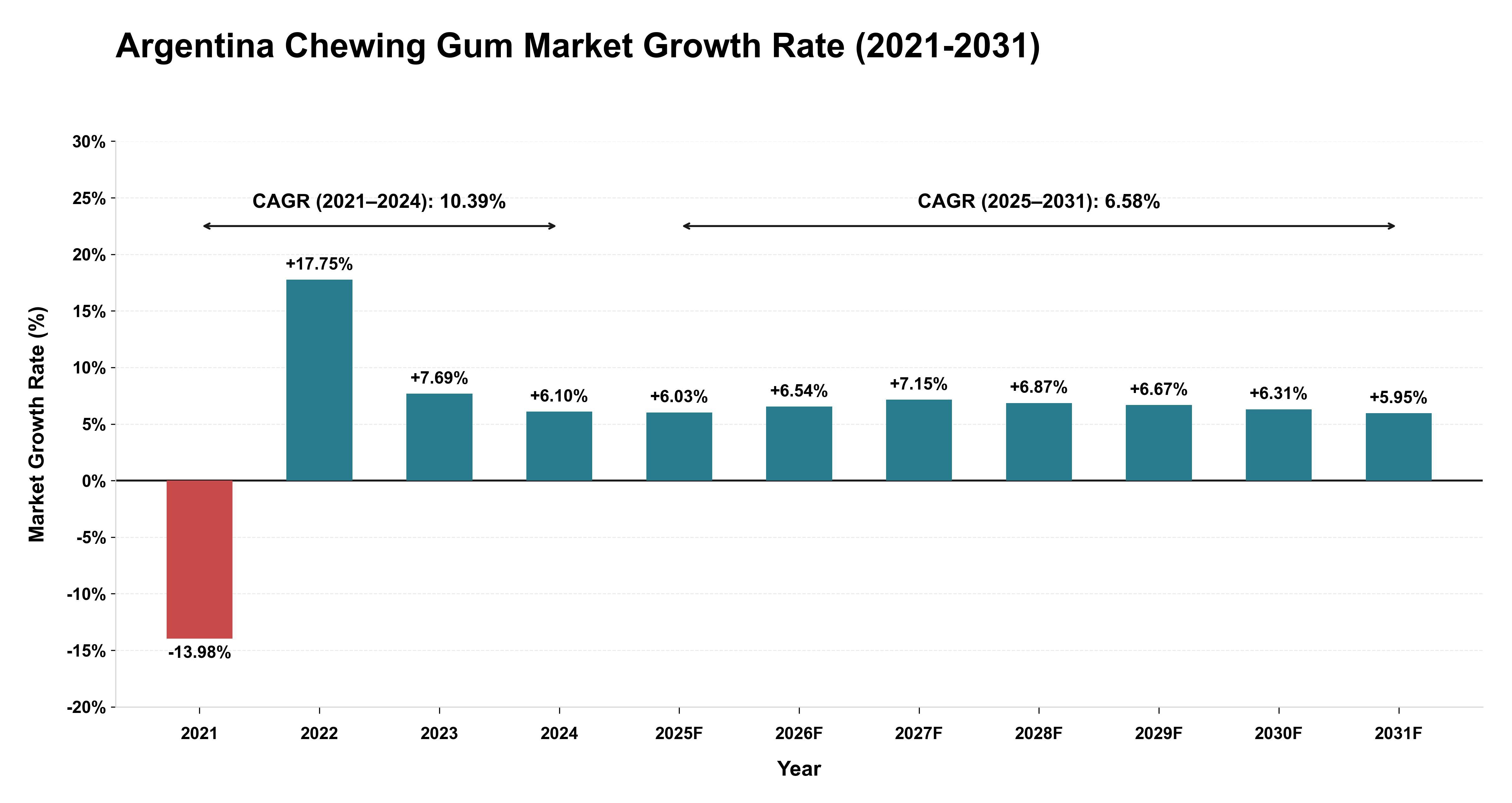
The Argentina chewing gum market faced a challenging period in 2021, witnessing a significant decline of -13.98% attributed to economic uncertainties impacting consumer spending. However, a strong rebound of 17.75% in 2022 indicated renewed consumer confidence and economic stability. Subsequent years showed more moderate yet consistent growth rates, signaling a gradual normalization and stabilization post the initial volatility. The historical CAGR of 10.39% from 2021 to 2024 denoted rapid expansion and market maturation, while the forecasted CAGR of 6.58% from 2025 to 2031 suggested a phase of slower but steady growth, potentially influenced by market saturation, heightened competition, and evolving consumer preferences towards healthier snack alternatives.
Argentina Chewing Gum Market Synopsis
The chewing gum market in Argentina has shown steady growth over recent years, driven by factors such as changing consumer preferences, increasing disposable incomes, and the introduction of innovative flavors and packaging. Chewing gum is widely consumed across different age groups in Argentina, with a preference for both sugar and sugar-free varieties. Major players in the market continue to invest in marketing and advertising campaigns to capture a larger share of the consumer base. Additionally, advancements in technology and production processes have contributed to the expansion of the chewing gum market in Argentina.
Drivers of the market
The Argentina chewing gum market is being driven by several factors. Firstly, there is a growing trend towards healthier and functional gum products, with consumers seeking options that offer benefits such as teeth whitening, breath freshening, and even stress relief. Additionally, innovations in flavors and packaging are attracting consumers, especially younger demographics. Moreover, the rising disposable income among Argentinian consumers is fueling the demand for premium chewing gum products. Furthermore, aggressive marketing strategies by key players in the market are contributing to its growth, with extensive advertising campaigns and promotional activities driving awareness and consumption.
Challenges of the market
The Argentina chewing gum market faces several challenges amidst shifting consumer preferences and economic conditions. One major challenge is the increasing health consciousness among consumers, leading to a decline in demand for traditional sugary gum products. To counter this trend, manufacturers are exploring options to innovate and introduce healthier alternatives or incorporate functional ingredients. Additionally, economic instability and fluctuating disposable incomes in Argentina pose challenges for companies operating in the chewing gum sector, affecting consumer purchasing power and overall market demand.
Government Policy of the market
The Argentina chewing gum market has witnessed steady growth in recent years, driven by factors such as increasing disposable income, changing consumer preferences, and the introduction of innovative products. The market is characterized by the presence of both domestic and international players competing fiercely to capture market share. Government policies aimed at promoting consumer goods industries have also contributed to the expansion of the chewing gum market in Argentina. However, challenges such as fluctuating raw material prices and changing regulations regarding food additives pose significant hurdles to market players.
Key Highlights of the Report:
- Argentina Chewing Gum Market Outlook
- Market Size of Argentina Chewing Gum Market, 2025
- Forecast of Argentina Chewing Gum Market, 2032
- Historical Data and Forecast of Argentina Chewing Gum Revenues & Volume for the Period 2022-2032F
- Argentina Chewing Gum Market Trend Evolution
- Argentina Chewing Gum Market Drivers and Challenges
- Argentina Chewing Gum Price Trends
- Argentina Chewing Gum Porter's Five Forces
- Argentina Chewing Gum Industry Life Cycle
- Historical Data and Forecast of Argentina Chewing Gum Market Revenues & Volume By Product Type for the Period 2022-2032F
- Historical Data and Forecast of Argentina Chewing Gum Market Revenues & Volume By Sugared Chewing Gum for the Period 2022-2032F
- Historical Data and Forecast of Argentina Chewing Gum Market Revenues & Volume By Sugar-free Chewing Gum for the Period 2022-2032F
- Historical Data and Forecast of Argentina Chewing Gum Market Revenues & Volume By Distribution Channel for the Period 2022-2032F
- Historical Data and Forecast of Argentina Chewing Gum Market Revenues & Volume By Supermarkets and Hypermarkets for the Period 2022-2032F
- Historical Data and Forecast of Argentina Chewing Gum Market Revenues & Volume By Convenience Stores for the Period 2022-2032F
- Historical Data and Forecast of Argentina Chewing Gum Market Revenues & Volume By Specalist Retailers for the Period 2022-2032F
- Historical Data and Forecast of Argentina Chewing Gum Market Revenues & Volume By Online Retail for the Period 2022-2032F
- Historical Data and Forecast of Argentina Chewing Gum Market Revenues & Volume By Others for the Period 2022-2032F
- Argentina Chewing Gum Import Export Trade Statistics
- Market Opportunity Assessment By Product Type
- Market Opportunity Assessment By Distribution Channel
- Argentina Chewing Gum Top Companies Market Share
- Argentina Chewing Gum Competitive Benchmarking By Technical and Operational Parameters
- Argentina Chewing Gum Company Profiles
- Argentina Chewing Gum Key Strategic Recommendations






































