Argentina Cloud CRM Market Size & Growth Rate (2026-2032)
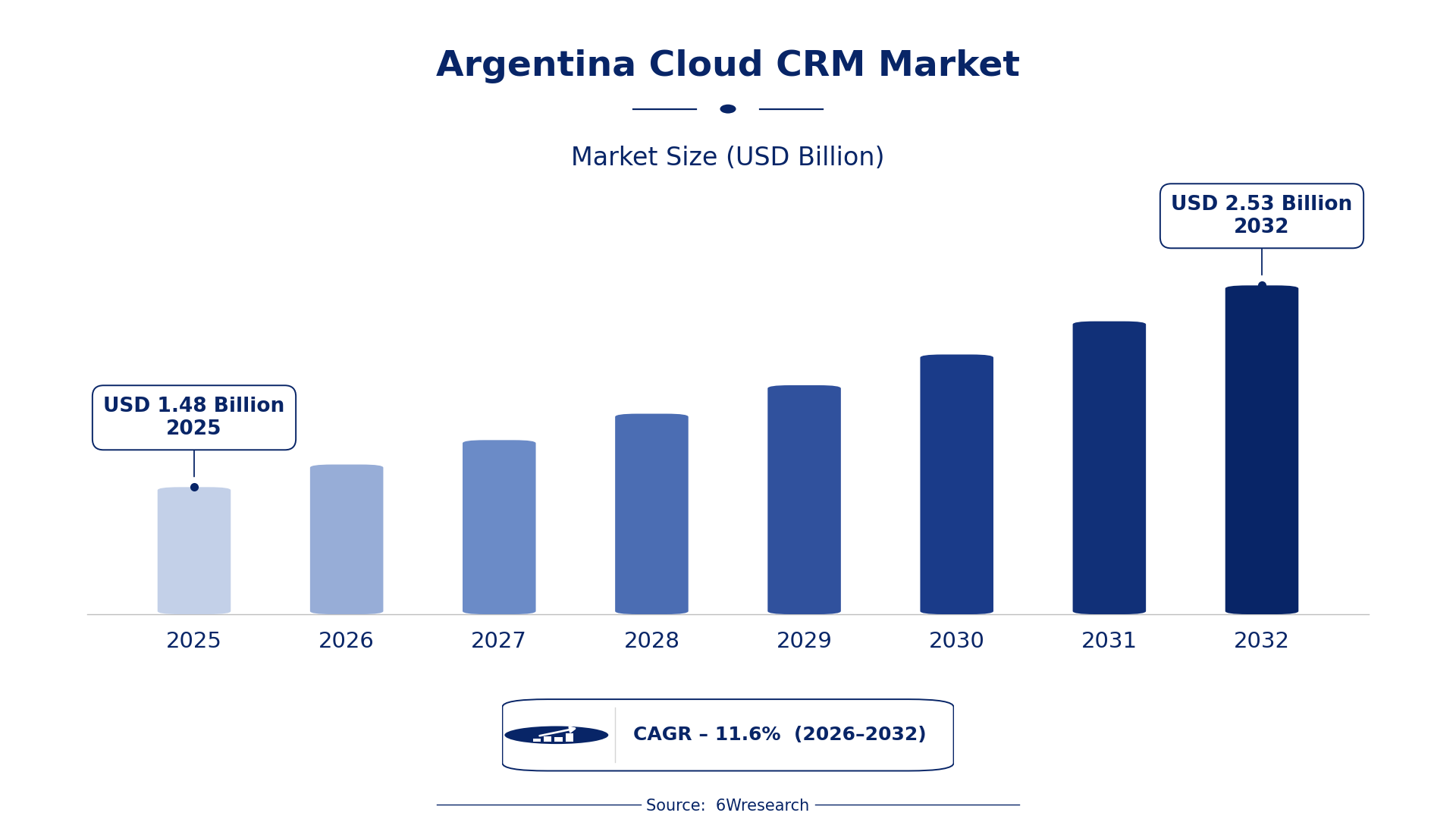
The Argentina Cloud CRM Market was estimated at USD 1475 Million in 2025 and is projected to reach USD 2528 Million by 2032, growing at a CAGR of 11.6% from 2026 to 2032.
Argentina Cloud CRM Market Synopsis
The driving force behind the Argentina Cloud CRM market is the swift adoption of cloud-based technologies by businesses across various sectors. This trend is particularly pronounced among small and medium-sized enterprises that seek to enhance customer engagement and streamline operations.
As organizations increasingly prioritize customer-centric strategies, Cloud CRM solutions are becoming essential tools for managing interactions. The ongoing digital transformation initiatives and the shift towards remote work further propel the demand for these platforms, allowing businesses to maintain connectivity with their customers.
Argentina Cloud CRM Market Year-wise Growth Rate and Key Drivers
This graph illustrates the annual growth rates of the Argentina Cloud CRM Market from 2021 to 2032, highlighting a steady upward trajectory and projected expansion over the forecast period.
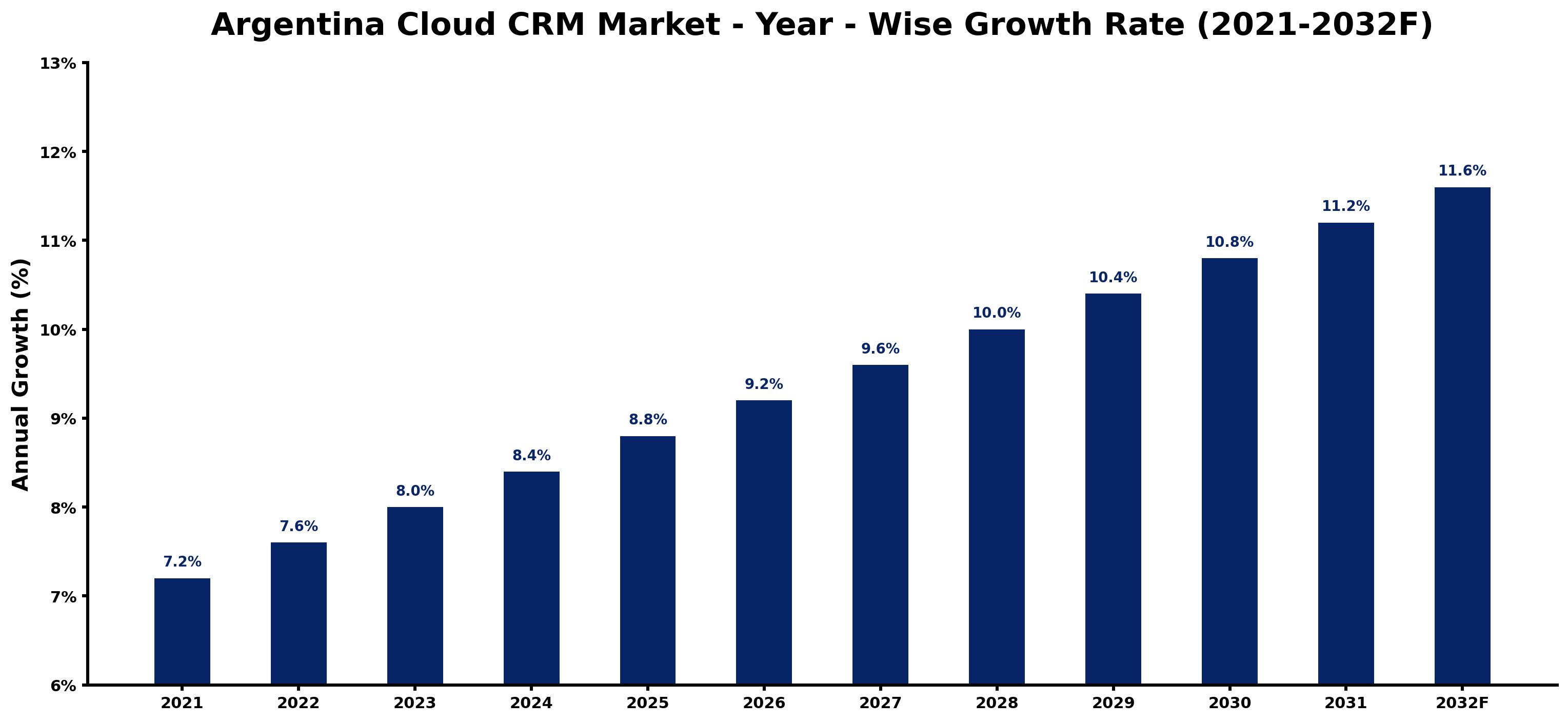
The table below presents the year‑wise growth rates along with the key drivers influencing the market
| Year | Growth Rate | Major Drivers |
| 2021 | 7.2% | Government tax incentives for digital transformation projects |
| 2022 | 7.6% | Rise in e-commerce driving customer relationship needs |
| 2023 | 8.0% | Growing adoption of mobile solutions among businesses |
| 2024 | 8.4% | Small business growth fueled by technological investments |
| 2025 | 8.8% | Increased focus on customer experience by local firms |
| 2026 | 9.2% | Local startups leveraging cloud tech for competitive advantage |
| 2027 | 9.6% | Regulatory push for improving data management practices |
| 2028 | 10.0% | Adoption of AI tools enhancing CRM capabilities in Argentina |
| 2029 | 10.4% | Rising digital marketing expenditures supporting CRM systems |
| 2030 | 10.8% | Government initiatives promoting software as a service adaptation |
| 2031 | 11.2% | Emergence of local CRM vendors increasing market competition |
| 2032 | 11.6% | Higher consumer demand for personalized services enabling CRM growth |
Note: Market size estimations and growth projections presented in this report are based on 6Wresearch's proprietary forecasting methodology, utilizing the latest available industry data, government publications, and primary research inputs.
Argentina Cloud CRM Market Key Takeaways
Below are some of the specific key takeaways from the market, including:
- The Argentina Cloud CRM market is on track for substantial growth driven by cloud adoption.
- AI-powered CRM tools are becoming increasingly sought after, enhancing data-driven decision-making.
- Mobile CRM applications are gaining traction as businesses prioritize on-the-go access to customer data.
- Data security and compliance are crucial factors influencing purchasing decisions among organizations.
- There is a notable demand for industry-specific CRM solutions tailored to local market needs.
Evaluation of Restraints in Argentina Cloud CRM Market
Despite the promising growth, the Argentina Cloud CRM market faces notable constraints. Data privacy concerns, largely due to regulatory complexities, deter some businesses from fully embracing cloud solutions. on top of that, internet connectivity issues and infrastructure challenges can hinder the accessibility and performance of these systems. Cultural preferences for traditional business practices may also slow the adoption rate of newer technologies. As the market matures, addressing these barriers will be essential for sustained growth.
Argentina Cloud CRM Market Trends
Current trends indicate a marked rise in the integration of AI and machine learning capabilities within CRM platforms, enabling businesses to gain deeper insights into customer behavior. Additionally, there is an increasing emphasis on incorporating social media data to enhance customer interactions. Mobile-friendly CRM solutions are becoming a necessity, as more organizations adopt remote work models. These trends indicate a shift towards more personalized customer experiences, as businesses aim to leverage data for targeted marketing strategies.
Argentina Cloud CRM Market Opportunities
The landscape presents numerous growth opportunities for Cloud CRM providers. Companies can capitalize on the demand for tailored solutions that meet the specific needs of diverse sectors, including retail and healthcare. Additionally, as regulatory frameworks evolve, there is potential for vendors to differentiate themselves through enhanced security features and compliance solutions. The drive for improved customer experiences opens avenues for innovation in CRM functionalities and services.
Government Initiatives in the Argentina Cloud CRM Market
While the Argentine government has not specifically targeted Cloud CRM through distinct policies, its broader focus on data protection and innovation significantly impacts the market. The regulatory framework concerning data privacy is pivotal for how businesses deploy Cloud CRM solutions. Continued support for technology and digital infrastructure development will further shape market dynamics, fostering a favorable environment for growth.
- A regulatory framework for data protection was introduced in 2021, mandating stricter compliance measures for businesses using cloud technologies.
- An ongoing initiative is the National Digital Transformation Strategy, aimed at enhancing internet access and digital literacy across the country.
- A planned public-private partnership expected to launch in 2026 will focus on upgrading technological infrastructure to support cloud services.
- The government is currently promoting innovation through grants for tech startups, indirectly benefiting the Cloud CRM sector.
- A cybersecurity awareness campaign started in early 2025 to educate businesses on best practices for data protection.
Future Insights of the Argentina Cloud CRM Market
Looking ahead to 2026-2032, the Argentina Cloud CRM market is set to expand as businesses increasingly prioritize digital customer interactions. As organizations adapt to the challenges of a more connected world, the demand for solutions that enhance customer experiences will rise. Companies focusing on personalized marketing strategies will likely find a competitive edge, particularly as data analytics capabilities improve. The market's trajectory suggests robust growth, driven by a continuous push towards technological advancement and customer engagement.
Argentina Cloud CRM Market Latest Developments
In the past year, the Argentina Cloud CRM market has seen a flurry of activity, with various initiatives aimed at enhancing service offerings and expanding market reach. As businesses continue to adapt to changing customer needs, innovation in cloud solutions remains a priority.
- A major technology vendor launched a new AI-driven CRM platform in late 2025, designed to improve customer engagement through predictive analytics.
- An initiative that began in early 2025 focuses on integrating social media analytics with CRM systems, aimed at providing businesses with comprehensive customer insights.
- A partnership between local software firms and international cloud service providers is currently underway, aimed at enhancing local support and service delivery capabilities.
- Upcoming in mid-2026 is a planned rollout of mobile CRM applications that will cater specifically to the needs of remote workers.
- A recently completed pilot program in late 2025 tested cloud CRM solutions in the healthcare sector, showing promising results for broader implementation.
Argentina Cloud CRM Market - Key Attractiveness of the Report
- 10 Years of Market Numbers
- Historical Data Starting from 2022 to 2025
- Base Year: 2025
- Forecast Data until 2032
- Key Performance Indicators Impacting the Market
- Major Upcoming Developments and Projects
Key Highlights of the Report:
- Argentina Cloud CRM Market Outlook
- Market Size of Argentina Cloud CRM Market, 2025
- Forecast of Argentina Cloud CRM Market, 2032
- Historical Data and Forecast of Argentina Cloud CRM Revenues & Volume for the Period 2022-2032F
- Argentina Cloud CRM Market Trend Evolution
- Argentina Cloud CRM Market Drivers and Challenges
- Argentina Cloud CRM Price Trends
- Argentina Cloud CRM Porter's Five Forces
- Argentina Cloud CRM Industry Life Cycle
- Historical Data and Forecast of Argentina Cloud CRM Market Revenues & Volume By Vertical for the Period 2022-2032F
- Historical Data and Forecast of Argentina Cloud CRM Market Revenues & Volume By Nonprofit for the Period 2022-2032F
- Historical Data and Forecast of Argentina Cloud CRM Market Revenues & Volume By Higher Education for the Period 2022-2032F
- Historical Data and Forecast of Argentina Cloud CRM Market Revenues & Volume By Nonprofit Sub Vertical for the Period 2022-2032F
- Historical Data and Forecast of Argentina Cloud CRM Market Revenues & Volume By Education for the Period 2022-2032F
- Historical Data and Forecast of Argentina Cloud CRM Market Revenues & Volume By Research and Innovation for the Period 2022-2032F
- Historical Data and Forecast of Argentina Cloud CRM Market Revenues & Volume By Social Affairs for the Period 2022-2032F
- Historical Data and Forecast of Argentina Cloud CRM Market Revenues & Volume By Children and Youth for the Period 2022-2032F
- Historical Data and Forecast of Argentina Cloud CRM Market Revenues & Volume By Art and Culture for the Period 2022-2032F
- Historical Data and Forecast of Argentina Cloud CRM Market Revenues & Volume By Others for the Period 2022-2032F
- Argentina Cloud CRM Import Export Trade Statistics
- Market Opportunity Assessment By Vertical
- Market Opportunity Assessment By Nonprofit Sub Vertical
- Argentina Cloud CRM Top Companies Market Share
- Argentina Cloud CRM Competitive Benchmarking By Technical and Operational Parameters
- Argentina Cloud CRM Company Profiles
- Argentina Cloud CRM Key Strategic Recommendations






































