Argentina Community Cloud Market Size & Growth Rate (2026-2032)
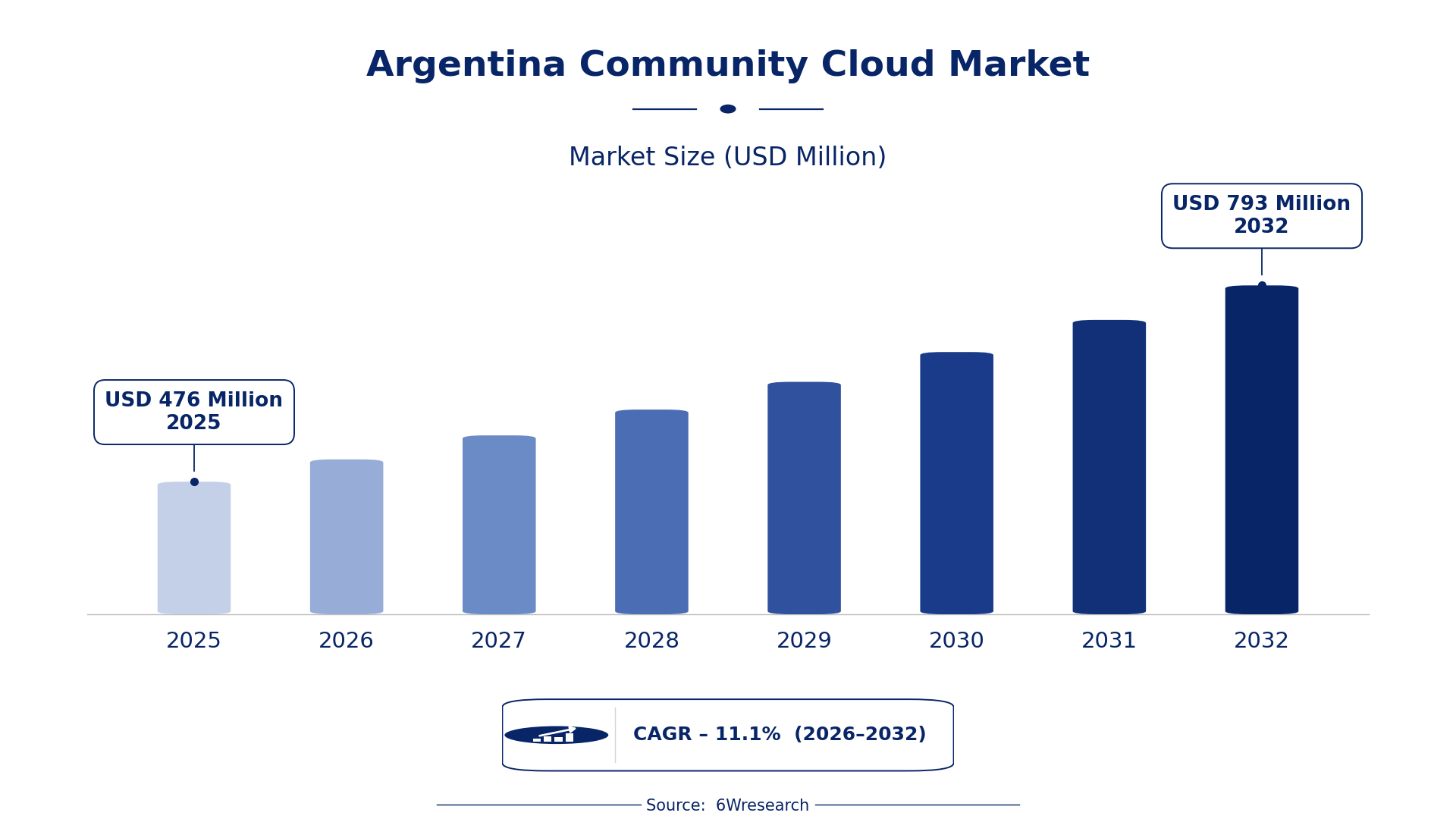
The Argentina Community Cloud Market was estimated at USD 476 Million in 2025 and is projected to reach USD 793 Million by 2032, growing at a CAGR of 11.1% from 2026 to 2032.
Argentina Community Cloud Market Synopsis
The escalating demand for data security and privacy is the primary force driving the Argentina Community Cloud market today. As organizations increasingly recognize the need to comply with local regulations and safeguard sensitive information, community cloud solutions tailored to specific sectors are gaining traction.
Small and medium-sized enterprises (SMEs), along with government entities, are at the forefront of this shift. Their growing reliance on cost-effective cloud solutions has prompted providers to innovate and adapt, making the Argentina Community Cloud market a dynamic space ripe for development.
Argentina Community Cloud Market Year-wise Growth Rate and Key Drivers
This graph illustrates the annual growth rates of the Argentina Community Cloud Market from 2021 to 2032, highlighting a steady upward trajectory and projected expansion over the forecast period.
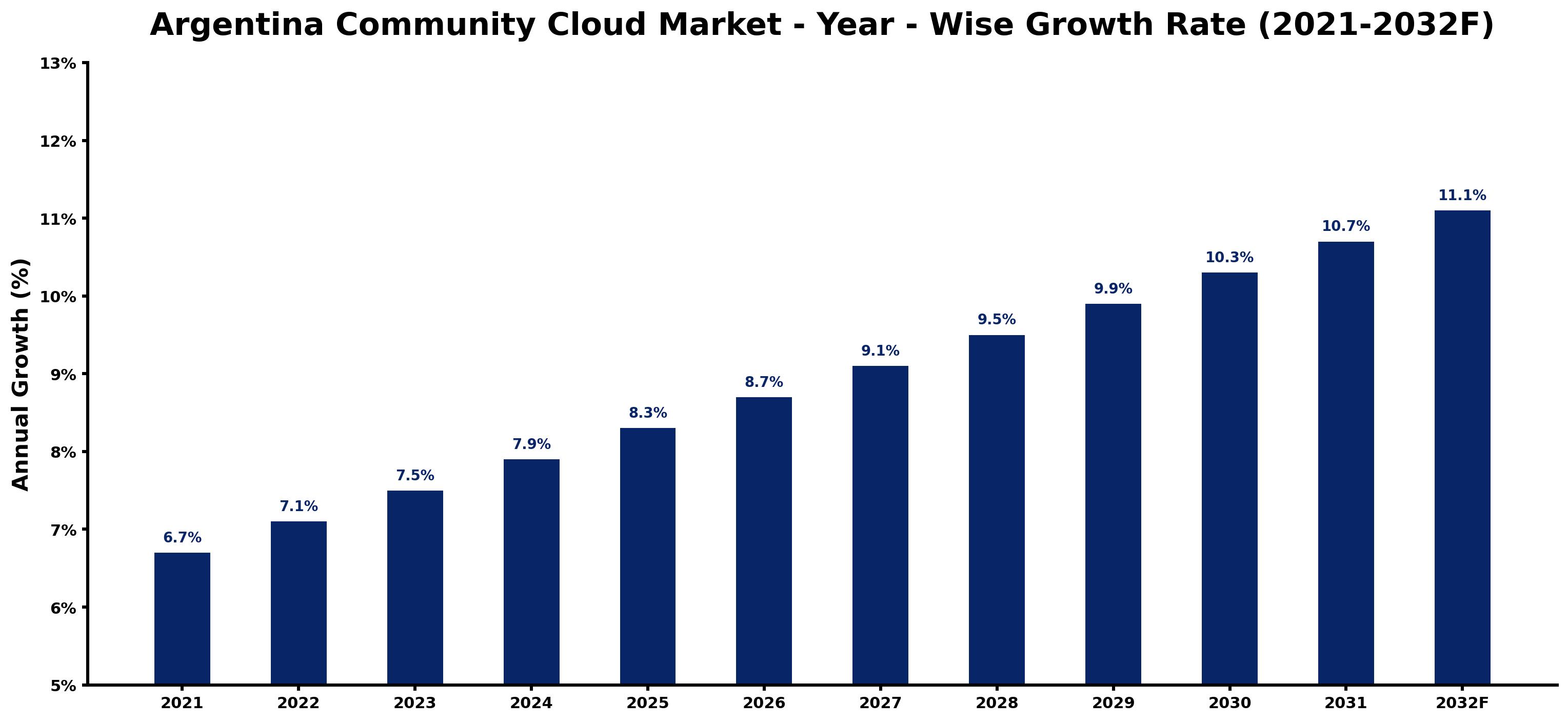
The table below presents the year‑wise growth rates along with the key drivers influencing the market
| Year | Growth Rate | Major Drivers |
| 2021 | 6.7% | Argentina's Digital Agenda promotes cloud adoption initiatives. |
| 2022 | 7.1% | Increased remote work drives demand for community cloud solutions. |
| 2023 | 7.5% | Government incentives for local data centers boost community cloud. |
| 2024 | 7.9% | Growing SME digitalization accelerates community cloud migration. |
| 2025 | 8.3% | Rising concerns over data sovereignty enhance local cloud services. |
| 2026 | 8.7% | Public sector cloud adoption supports increased community engagement. |
| 2027 | 9.1% | Rising internet penetration enhances community cloud accessibility. |
| 2028 | 9.5% | Local tech startups leverage community cloud for innovation. |
| 2029 | 9.9% | Digital transformation strategies fuel community cloud utilization. |
| 2030 | 10.3% | Regulatory compliance drives demand for secure community cloud. |
| 2031 | 10.7% | Expanding e-commerce platforms seek community cloud support. |
| 2032 | 11.1% | Increased collaboration across sectors boosts community cloud usage. |
Note: Market size estimations and growth projections presented in this report are based on 6Wresearch's proprietary forecasting methodology, utilizing the latest available industry data, government publications, and primary research inputs.
Argentina Community Cloud Market Key Takeaways
Below are some of the specific key takeaways from the market, including:
- The Argentina Community Cloud market is experiencing steady growth fueled by increased adoption among SMEs and government organizations.
- Data sovereignty and compliance with local regulations are critical drivers of demand for community cloud services.
- Cost-effectiveness compared to traditional private clouds is a significant motivator for organizations transitioning to community cloud solutions.
- Current trends emphasize sustainability, pushing for cloud solutions powered by renewable energy.
- Government initiatives are enhancing infrastructure and supporting the digital transformation of local businesses.
Evaluation of Restraints in Argentina Community Cloud Market
Despite its growth, the Argentina Community Cloud market faces notable restraints. Limited awareness among businesses about the benefits of community cloud solutions remains a substantial barrier, primarily due to the prevalence of traditional cloud services. Additionally, the regulatory landscape surrounding data privacy can create hesitation among potential users, hindering wider adoption. Infrastructure limitations in certain regions also pose challenges for reliable service delivery. As these issues are addressed, the market's growth potential can be fully realized.
Argentina Community Cloud Market Trends
A clear trend is emerging where organizations increasingly seek community cloud solutions that cater specifically to their operational needs. This demand is especially pronounced in sensitive sectors like healthcare and finance, where compliance and data security are paramount. on top of that, the integration of renewable energy sources into cloud services is becoming a priority, aligning with the global push for sustainability. These trends suggest that providers who can innovate and meet these specific demands will thrive in the Argentina Community Cloud market.
Argentina Community Cloud Market Opportunities
There are numerous opportunities for growth and investment in the Argentina Community Cloud market. The increasing need for tailored cloud solutions presents an opening for providers to develop services that meet specific industry requirements. Additionally, partnerships with government agencies can facilitate access to funding and resources, promoting innovation and technology deployment. As organizations focus on data sovereignty, localized cloud offerings will become increasingly valuable, driving market expansion.
Government Initiatives in the Argentina Community Cloud Market
The Argentine government is actively shaping the community cloud market through various initiatives aimed at promoting cloud adoption among local businesses. These efforts include regulatory measures that prioritize data protection and investment in infrastructure to improve internet access. Such policies are crucial for ensuring that cloud solutions are not only available but also secure and compliant with local standards.
- A recently completed national program aimed at enhancing internet connectivity across underserved regions, facilitating broader access to cloud services.
- Current initiatives focusing on providing tax incentives for SMEs that adopt community cloud solutions, encouraging more businesses to transition.
- A planned public-private partnership set to launch in 2026, aimed at developing specialized cloud services for the healthcare sector.
- Ongoing efforts to establish a regulatory framework addressing data privacy specifically for community cloud services, enhancing user confidence.
- A series of workshops and training programs initiated in early 2025 to raise awareness about the benefits of community cloud solutions among local businesses.
Future Insights of the Argentina Community Cloud Market
Looking ahead to 2026-2032, the Argentina Community Cloud market is expected to grow significantly as organizations continue to prioritize data security and compliance. The increasing shift towards community clouds, especially in sectors requiring stringent data handling protocols, will further drive market expansion. As more businesses recognize the scalability and flexibility offered by these solutions, investment in community cloud infrastructures will likely surge.
Argentina Community Cloud Market Latest Developments
Over the past year, the Argentina Community Cloud market has seen notable activity as service providers and organizations adapt to changing demands. Increased focus on compliance and sustainability has led to innovative service offerings and collaborations aimed at enhancing the overall cloud experience.
- A major technology vendor launched a new community cloud service tailored for the finance sector in early 2025, focusing on compliance with local regulations.
- An ongoing initiative started in mid-2025 aims to integrate renewable energy sources into cloud operations, promoting sustainability.
- A partnership between a regional cloud provider and a government agency is currently underway, aimed at delivering cost-effective solutions for SMEs.
- A planned rollout of enhanced data protection features for community cloud services is expected to begin in Q3 2026, addressing security concerns.
- In late 2025, a collaborative project was initiated to develop training materials for businesses on the benefits of community cloud adoption, enhancing awareness.
Argentina Community Cloud Market - Key Attractiveness of the Report
- 10 Years of Market Numbers
- Historical Data Starting from 2022 to 2025
- Base Year: 2025
- Forecast Data until 2032
- Key Performance Indicators Impacting the Market
- Major Upcoming Developments and Projects
Key Highlights of the Report:
- Argentina Community Cloud Market Outlook
- Market Size of Argentina Community Cloud Market, 2025
- Forecast of Argentina Community Cloud Market, 2032
- Historical Data and Forecast of Argentina Community Cloud Revenues & Volume for the Period 2022-2032F
- Argentina Community Cloud Market Trend Evolution
- Argentina Community Cloud Market Drivers and Challenges
- Argentina Community Cloud Price Trends
- Argentina Community Cloud Porter's Five Forces
- Argentina Community Cloud Industry Life Cycle
- Historical Data and Forecast of Argentina Community Cloud Market Revenues & Volume By Components for the Period 2022-2032F
- Historical Data and Forecast of Argentina Community Cloud Market Revenues & Volume By Server for the Period 2022-2032F
- Historical Data and Forecast of Argentina Community Cloud Market Revenues & Volume By Storage Devices for the Period 2022-2032F
- Historical Data and Forecast of Argentina Community Cloud Market Revenues & Volume By Network Equipments for the Period 2022-2032F
- Historical Data and Forecast of Argentina Community Cloud Market Revenues & Volume By Verticals for the Period 2022-2032F
- Historical Data and Forecast of Argentina Community Cloud Market Revenues & Volume By Healthcare for the Period 2022-2032F
- Historical Data and Forecast of Argentina Community Cloud Market Revenues & Volume By Finance for the Period 2022-2032F
- Historical Data and Forecast of Argentina Community Cloud Market Revenues & Volume By Government for the Period 2022-2032F
- Historical Data and Forecast of Argentina Community Cloud Market Revenues & Volume By Transport and Logistics for the Period 2022-2032F
- Historical Data and Forecast of Argentina Community Cloud Market Revenues & Volume By Gaming for the Period 2022-2032F
- Historical Data and Forecast of Argentina Community Cloud Market Revenues & Volume By Education for the Period 2022-2032F
- Argentina Community Cloud Import Export Trade Statistics
- Market Opportunity Assessment By Components
- Market Opportunity Assessment By Verticals
- Argentina Community Cloud Top Companies Market Share
- Argentina Community Cloud Competitive Benchmarking By Technical and Operational Parameters
- Argentina Community Cloud Company Profiles
- Argentina Community Cloud Key Strategic Recommendations






































