Argentina Containerized Data Center Market Size & Growth Rate (2026-2032)
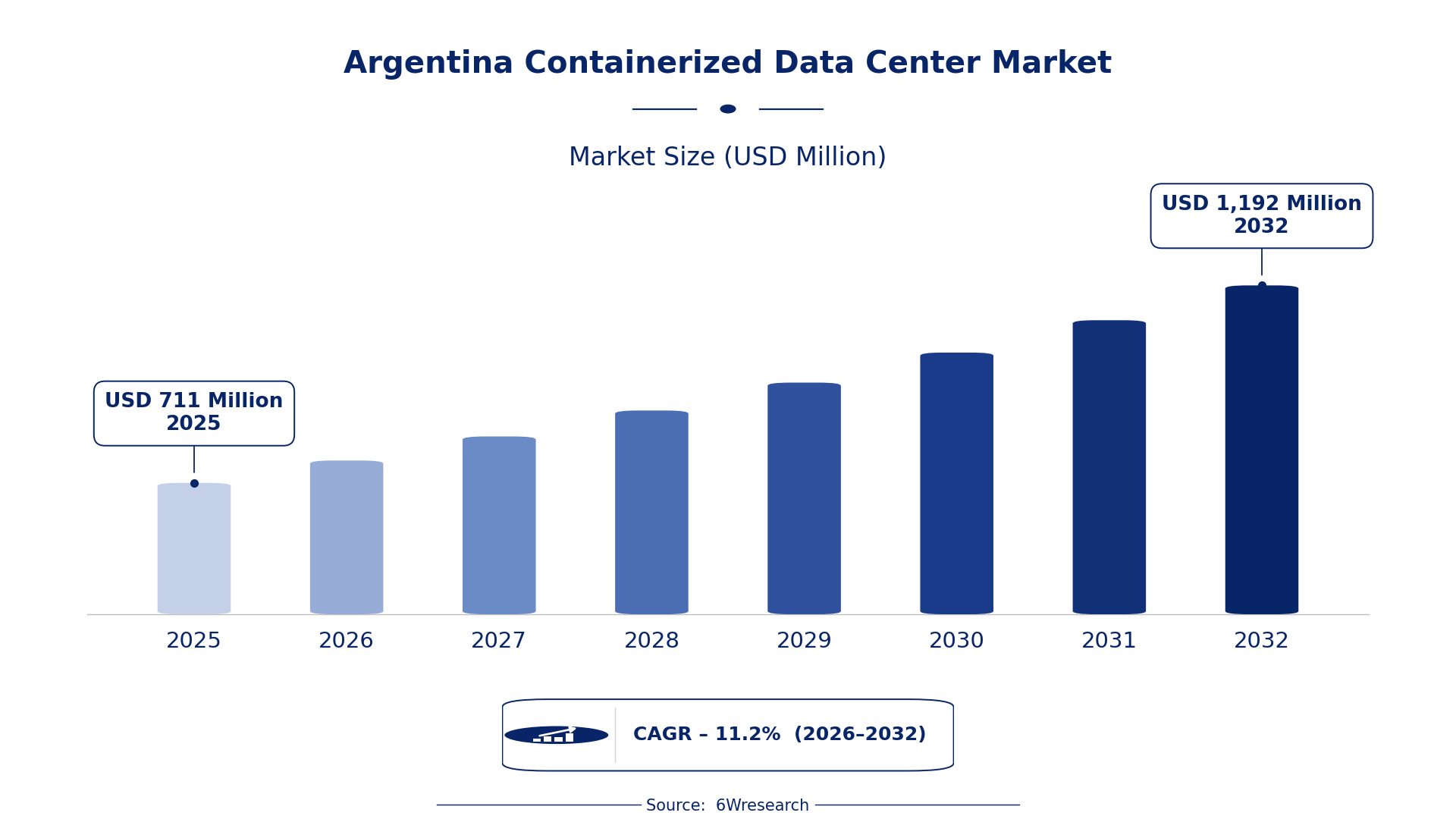
The Argentina Containerized Data Center Market was estimated at USD 711 Million in 2025 and is projected to reach USD 1192 Million by 2032, growing at a CAGR of 11.2% from 2026 to 2032.
Argentina Containerized Data Center Market Synopsis
Argentina's containerized data center market is witnessing a surge in demand, fueled by the increasing need for flexible and scalable IT infrastructure. Organizations are increasingly opting for these modular solutions, which allow for rapid deployment and efficient resource utilization, catering especially to sectors such as cloud computing and IoT.
The focus on reducing capital expenditures while maximizing operational efficiency is pushing businesses towards containerized data centers. These facilities provide a practical response to the growing data requirements in the country, making them an attractive choice for enterprises aiming to stay competitive in a digital-first environment.
Argentina Containerized Data Center Market Year-wise Growth Rate and Key Drivers
This graph illustrates the annual growth rates of the Argentina Containerized Data Center Market from 2021 to 2032, highlighting a steady upward trajectory and projected expansion over the forecast period.
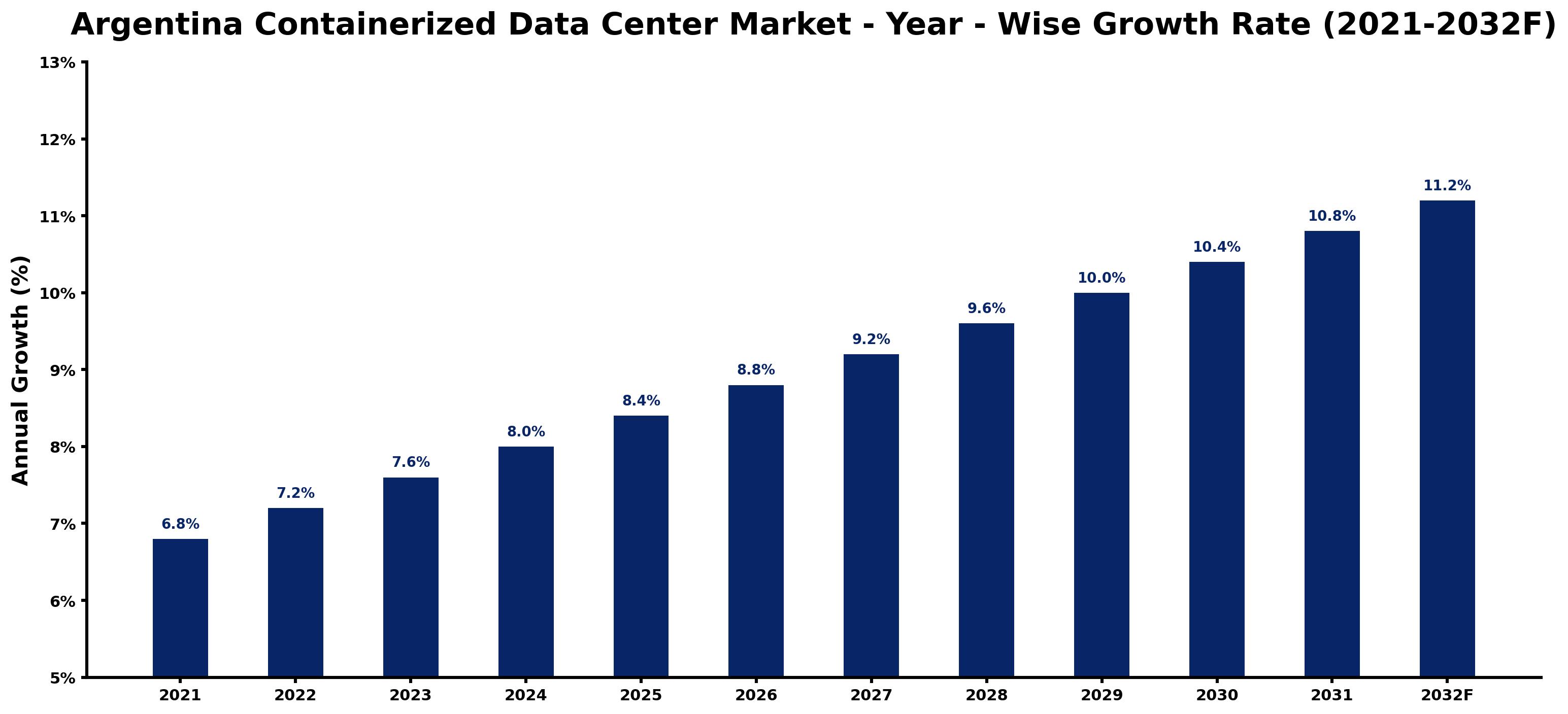
The table below presents the year‑wise growth rates along with the key drivers influencing the market
| Year | Growth Rate | Major Drivers |
| 2021 | 6.8% | Increased local demand for cloud services and storage. |
| 2022 | 7.2% | Government incentives promoting IT infrastructure development. |
| 2023 | 7.6% | Emergence of remote work boosting data center needs. |
| 2024 | 8.0% | Growing adoption of IoT applications in agriculture. |
| 2025 | 8.4% | Regional tech hubs driving data processing requirements. |
| 2026 | 8.8% | Rising e-commerce activities necessitating scalable data solutions. |
| 2027 | 9.2% | Enhanced cybersecurity regulations requiring advanced data protection. |
| 2028 | 9.6% | Increased investments in digital transformation across sectors. |
| 2029 | 10.0% | Local universities training workforce in data management. |
| 2030 | 10.4% | Implementation of 5G networks enhancing data center capabilities. |
| 2031 | 10.8% | Demand for edge computing solutions in urban centers. |
| 2032 | 11.2% | Government partnership with tech firms for data initiatives. |
Note: Market size estimations and growth projections presented in this report are based on 6Wresearch's proprietary forecasting methodology, utilizing the latest available industry data, government publications, and primary research inputs.
Argentina Containerized Data Center Market Key Takeaways
Below are some of the specific key takeaways from the market, including:
- The market is projected to grow significantly, reaching USD 1192 Million by 2032.
- Rapid deployment and scalability are the main advantages driving adoption among businesses.
- Government policies supporting digital infrastructure are enhancing market growth.
- Challenges related to data sovereignty and integration with legacy systems persist.
- Emerging technologies such as AI and machine learning are expected to further boost demand.
Evaluation of Restraints in Argentina Containerized Data Center Market
Despite its positive trajectory, the Argentina containerized data center market faces several constraints. Concerns regarding reliability and data sovereignty loom large, particularly as organizations grapple with compliance and security issues. The challenge of integrating new containerization technologies with existing legacy systems is another hurdle that can stifle the rapid adoption of these solutions. As businesses seek innovative ways to expand their infrastructure, these issues must be addressed for sustained growth.
Argentina Containerized Data Center Market Trends
The trend toward edge computing is gaining momentum, as organizations realize the need for localized processing to meet latency demands. Containerized data centers are perfectly suited for this, allowing businesses to deploy resources closer to the end-user. Additionally, the adoption of hybrid cloud solutions is influencing the design and deployment of data centers, with companies looking for ways to balance on-premises and cloud resources efficiently.
Sustainability is becoming a key focus as well. Companies are increasingly seeking energy-efficient solutions, and containerized data centers often offer reduced power consumption, appealing to businesses committed to environmental responsibility. This alignment with corporate sustainability goals is likely to drive further adoption.
Argentina Containerized Data Center Market Opportunities
As organizations in Argentina continue to embrace digital transformation, the containerized data center market presents numerous opportunities for growth and investment. The increasing demand for remote and flexible work solutions means that businesses will require more scalable and efficient data infrastructures. on top of that, industries such as telecommunications and healthcare are ripe for containerized data center implementation, given their need for robust and adaptable IT environments.
Investments in AI and machine learning technologies are also set to create new avenues for containerized data centers, as companies look to harness advanced analytics to drive decision-making. This forward-thinking approach will likely position the market for significant advancements and innovation.
Government Initiatives in the Argentina Containerized Data Center Market
The Argentine government is actively promoting the modernization of digital infrastructure, recognizing its critical role in economic development. With policies aimed at enhancing data center efficiency and scalability, public-sector initiatives are aligned with the needs of the growing containerized data center market. Government support for digital infrastructure projects is crucial for fostering a conducive environment for private investment in this sector.
- A national digital infrastructure upgrade program launched in early 2023 aims to enhance connectivity across urban and rural areas.
- Current initiatives focus on energy efficiency standards for new data center constructions, ensuring compliance with sustainable practices.
- A public-private partnership is underway to develop advanced data center facilities, expected to be operational by late 2024.
- Plans for a regulatory framework introduced in mid-2025 will promote transparency in data management and enhance data sovereignty compliance.
- Upcoming investment incentives aimed at fostering innovation in data center technology are expected to roll out in 2026.
Future Insights of the Argentina Containerized Data Center Market
Looking ahead to 2026-2032, the Argentina containerized data center market is set for substantial growth driven by the continued expansion of cloud services and edge computing. As organizations strive for greater efficiency and responsiveness, the modular nature of containerized solutions positions them as a go-to option. The intersection of emerging technologies with data center capabilities will likely lead to innovative applications and more sophisticated infrastructure solutions.
Argentina Containerized Data Center Market Latest Developments
In the past year, the Argentina containerized data center market has experienced noteworthy developments, reflecting a broader commitment to enhancing digital capabilities across various sectors. Companies are increasingly focusing on adopting new technologies and expanding their infrastructure to meet rising data demands.
- A major technology vendor announced plans in early 2023 to launch a new line of energy-efficient containerized data centers, focusing on sustainability.
- An initiative that began in mid-2023 is currently underway to deploy containerized solutions in remote areas, improving access to digital services.
- A leading regional operator is expected to complete the expansion of its containerized data center facilities by late 2024, increasing capacity significantly.
- Research and development efforts are ongoing to integrate AI capabilities into containerized data centers, enhancing operational efficiency.
- A rollout of a new regulatory compliance program is planned for the second half of 2025, aimed at standardizing data security measures.
Argentina Containerized Data Center Market - Key Attractiveness of the Report
- 10 Years of Market Numbers
- Historical Data Starting from 2022 to 2025
- Base Year: 2025
- Forecast Data until 2032
- Key Performance Indicators Impacting the Market
- Major Upcoming Developments and Projects
Key Highlights of the Report:
- Argentina Containerized Data Center Market Outlook
- Market Size of Argentina Containerized Data Center Market, 2025
- Forecast of Argentina Containerized Data Center Market, 2032
- Historical Data and Forecast of Argentina Containerized Data Center Revenues & Volume for the Period 2022-2032F
- Argentina Containerized Data Center Market Trend Evolution
- Argentina Containerized Data Center Market Drivers and Challenges
- Argentina Containerized Data Center Price Trends
- Argentina Containerized Data Center Porter's Five Forces
- Argentina Containerized Data Center Industry Life Cycle
- Historical Data and Forecast of Argentina Containerized Data Center Market Revenues & Volume By Container Types for the Period 2022-2032F
- Historical Data and Forecast of Argentina Containerized Data Center Market Revenues & Volume By 20 Feet container for the Period 2022-2032F
- Historical Data and Forecast of Argentina Containerized Data Center Market Revenues & Volume By 40 Feet container for the Period 2022-2032F
- Historical Data and Forecast of Argentina Containerized Data Center Market Revenues & Volume By Customized (10 Feet, 53 Feet, and custom containers) for the Period 2022-2032F
- Historical Data and Forecast of Argentina Containerized Data Center Market Revenues & Volume By Application for the Period 2022-2032F
- Historical Data and Forecast of Argentina Containerized Data Center Market Revenues & Volume By Greenfield for the Period 2022-2032F
- Historical Data and Forecast of Argentina Containerized Data Center Market Revenues & Volume By Brownfield for the Period 2022-2032F
- Historical Data and Forecast of Argentina Containerized Data Center Market Revenues & Volume By Upgrade and consolidation for the Period 2022-2032F
- Historical Data and Forecast of Argentina Containerized Data Center Market Revenues & Volume By Deployment size for the Period 2022-2032F
- Historical Data and Forecast of Argentina Containerized Data Center Market Revenues & Volume By Small business for the Period 2022-2032F
- Historical Data and Forecast of Argentina Containerized Data Center Market Revenues & Volume By Midsize business for the Period 2022-2032F
- Historical Data and Forecast of Argentina Containerized Data Center Market Revenues & Volume By Large business for the Period 2022-2032F
- Historical Data and Forecast of Argentina Containerized Data Center Market Revenues & Volume By Vertical for the Period 2022-2032F
- Historical Data and Forecast of Argentina Containerized Data Center Market Revenues & Volume By Banking, Financial Services and Insurance (BFSI) for the Period 2022-2032F
- Historical Data and Forecast of Argentina Containerized Data Center Market Revenues & Volume By Telecom and IT for the Period 2022-2032F
- Historical Data and Forecast of Argentina Containerized Data Center Market Revenues & Volume By Government and public for the Period 2022-2032F
- Historical Data and Forecast of Argentina Containerized Data Center Market Revenues & Volume By Defense for the Period 2022-2032F
- Historical Data and Forecast of Argentina Containerized Data Center Market Revenues & Volume By Energy for the Period 2022-2032F
- Historical Data and Forecast of Argentina Containerized Data Center Market Revenues & Volume By Healthcare for the Period 2022-2032F
- Historical Data and Forecast of Argentina Containerized Data Center Market Revenues & Volume By Education for the Period 2022-2032F
- Historical Data and Forecast of Argentina Containerized Data Center Market Revenues & Volume By Other verticals for the Period 2022-2032F
- Argentina Containerized Data Center Import Export Trade Statistics
- Market Opportunity Assessment By Container Types
- Market Opportunity Assessment By Application
- Market Opportunity Assessment By Deployment size
- Market Opportunity Assessment By Vertical
- Argentina Containerized Data Center Top Companies Market Share
- Argentina Containerized Data Center Competitive Benchmarking By Technical and Operational Parameters
- Argentina Containerized Data Center Company Profiles
- Argentina Containerized Data Center Key Strategic Recommendations






































