Argentina Data Protection Market Size & Growth Rate (2026-2032)
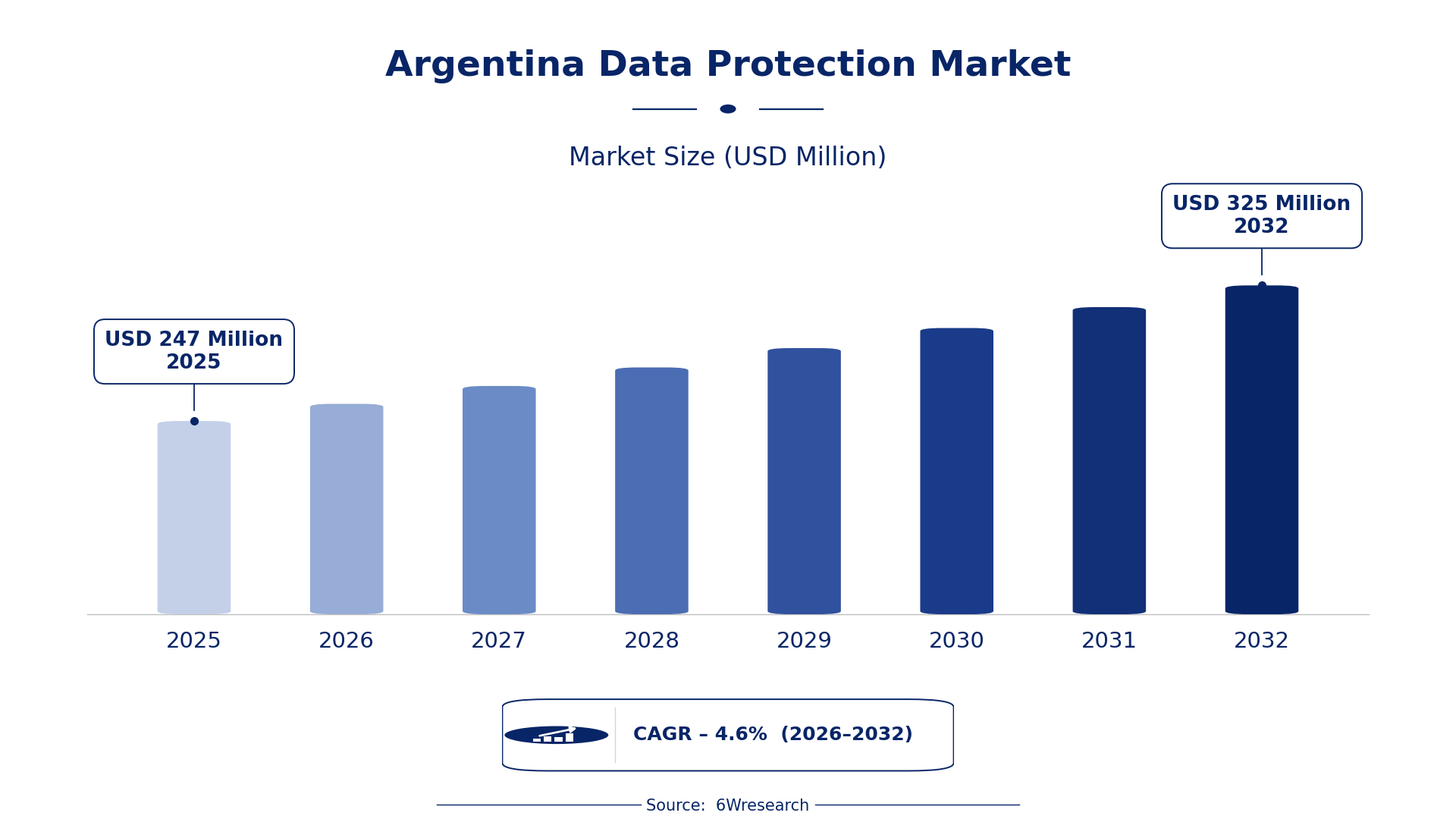
The Argentina Data Protection Market was estimated at USD 247 Million in 2025 and is projected to reach USD 325 Million by 2032, growing at a CAGR of 4.6% from 2026 to 2032.
Argentina Data Protection Market Synopsis
Rising concerns over data privacy and the necessity for compliance are driving Argentina's data protection market to new heights. Businesses are increasingly aware that safeguarding sensitive information is not just an IT issue; it’s a critical component of operational integrity and customer trust.
With stringent regulations like the Personal Data Protection Law in place, organizations are investing in advanced solutions to meet compliance demands and mitigate the risks associated with cyber threats. The urgency to shield personal data has sparked robust market growth, positioning Argentina as a focal point for data protection initiatives.
Argentina Data Protection Market Year-wise Growth Rate and Key Drivers
This graph illustrates the annual growth rates of the Argentina Data Protection Market from 2021 to 2032, highlighting a steady upward trajectory and projected expansion over the forecast period.
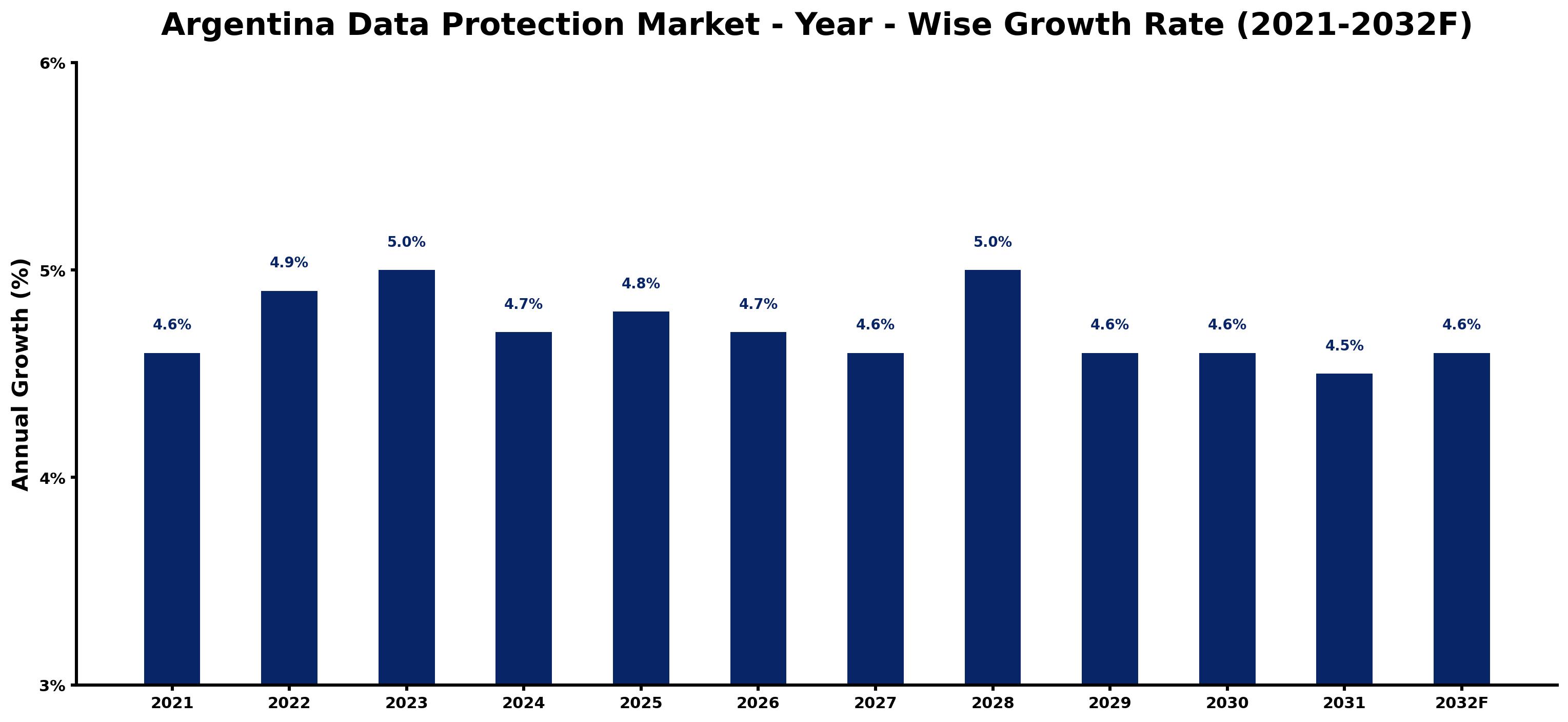
The table below presents the year‑wise growth rates along with the key drivers influencing the market
| Year | Growth Rate | Major Drivers |
| 2021 | 4.6% | Implementation of Personal Data Protection Law enhances compliance needs. |
| 2022 | 4.9% | Growing concerns over data breaches drive regulatory scrutiny. |
| 2023 | 5.0% | Rising digital transactions necessitate stronger data security measures. |
| 2024 | 4.7% | Increased remote work demands robust data protection protocols. |
| 2025 | 4.8% | Government initiatives promoting digital economy boost data protection investments. |
| 2026 | 4.7% | Adoption of GDPR-style regulations raises market awareness. |
| 2027 | 4.6% | Surge in cyberattacks heightens focus on data security solutions. |
| 2028 | 5.0% | Expanding eCommerce sector fuels demand for data privacy tools. |
| 2029 | 4.6% | Regulatory compliance audits drive investment in data protection. |
| 2030 | 4.6% | Upholding consumer trust accelerates data protection advancements. |
| 2031 | 4.5% | Rising internet penetration amplifies data protection requirements. |
| 2032 | 4.6% | Increased awareness of personal data rights boosts market growth. |
Note: Market size estimations and growth projections presented in this report are based on 6Wresearch's proprietary forecasting methodology, utilizing the latest available industry data, government publications, and primary research inputs.
Argentina Data Protection Market Key Takeaways
Below are some of the specific key takeaways from the market, including:
- The increasing investment in data protection solutions reflects heightened organizational awareness regarding compliance and security.
- Emerging technologies are redefining data protection strategies across various sectors, enhancing resilience against breaches.
- Regulatory frameworks are evolving, demanding stricter adherence to data handling standards.
- Cyber threats are becoming more sophisticated, necessitating advanced protective measures from businesses.
- The government's initiatives are aligning with market needs, supporting robust data protection infrastructure.
Evaluation of Restraints in Argentina Data Protection Market
The Argentina Data Protection Market faces notable challenges that can hinder its expansion. Compliance with complex regulatory requirements poses a significant hurdle for businesses, especially those operating across borders where laws like GDPR and LGPD come into play. These multifaceted frameworks can create confusion and increase operational costs.
In addition, the evolving threat landscape means that companies must constantly adapt their security measures, which can strain resources. The need for continuous training and technology updates adds another layer of complexity, making it challenging for smaller firms to keep pace with larger competitors.
Argentina Data Protection Market Trends
As digital transformation accelerates, so too does the demand for innovative data protection solutions. Organizations are increasingly implementing AI and machine learning technologies to enhance their security posture, allowing for proactive rather than reactive measures.
The adoption of zero-trust frameworks is gaining traction, reflecting a paradigm shift in how businesses approach data security. This trend is complemented by a growing emphasis on employee training and awareness programs, recognizing that human error remains a critical vulnerability.
Argentina Data Protection Market Opportunities
Opportunities abound in Argentina’s data protection market as organizations seek to build resilience against data breaches. There is a strong demand for consulting services that guide businesses in achieving compliance and implementing effective data security frameworks.
The rise in cloud computing offers another avenue for growth, as companies increasingly rely on secure cloud storage solutions to protect their data. Startups focusing on niche data protection technologies can thrive, particularly those providing scalable and customizable solutions tailored to specific industries.
Government Initiatives in the Argentina Data Protection Market
The Argentine government is actively shaping the data protection landscape through stringent regulations aimed at safeguarding personal information. The introduction of laws like the Personal Data Protection Law signals a commitment to data privacy, urging organizations to adopt compliant practices. Compliance monitoring and enforcement are critical aspects of this regulatory framework, necessitating adherence from all sectors.
- A regulatory framework introduced in 2023 mandates stricter data handling standards, compelling businesses to enhance compliance measures.
- Current initiatives focus on public awareness campaigns promoting data protection rights among citizens and businesses alike.
- A planned overhaul of compliance monitoring practices is set to take effect by mid-2026, aiming to bolster enforcement measures.
- In 2024, government agencies launched a public-private partnership to develop a comprehensive data protection education program.
- The introduction of a digital identity verification program expected in late 2025 aims to streamline data processing across sectors.
Future Insights of the Argentina Data Protection Market
Looking ahead, the Argentina Data Protection Market is expected to expand substantially as regulatory scrutiny increases and cyber threats evolve. Companies will need to continuously innovate their data protection strategies to stay ahead of regulatory requirements and emerging security threats.
Investment in advanced technologies will play a crucial role, particularly in automation and AI-driven analytics. As businesses increasingly recognize data as a valuable asset, the integration of data protection with business strategy will likely become a key differentiator in the competitive landscape.
Argentina Data Protection Market Latest Developments
In the past year, the Argentina Data Protection Market has witnessed significant activity as businesses ramp up their compliance efforts and embrace innovative technologies. Organizations are increasingly recognizing that robust data protection is not only a regulatory requirement but also a competitive advantage.
- An initiative that began in early 2023 focusing on the integration of AI-based security solutions in SMEs continues to gain traction, with multiple firms implementing pilot programs.
- In Q2 2024, a major technology vendor announced the launch of a next-generation data encryption solution tailored for the Argentine market.
- A partnership between a leading consultancy and governmental agency is currently underway, aimed at enhancing public sector data protection capabilities.
- Companies are preparing for a rollout of comprehensive compliance auditing services expected to commence in early 2026.
- A new public awareness campaign on data rights is set to launch by late 2025, aimed at increasing citizen engagement in data privacy matters.
Argentina Data Protection Market - Key Attractiveness of the Report
- 10 Years of Market Numbers
- Historical Data Starting from 2022 to 2025
- Base Year: 2025
- Forecast Data until 2032
- Key Performance Indicators Impacting the Market
- Major Upcoming Developments and Projects
Key Highlights of the Report:
- Argentina Data Protection Market Outlook
- Market Size of Argentina Data Protection Market, 2025
- Forecast of Argentina Data Protection Market, 2032
- Historical Data and Forecast of Argentina Data Protection Revenues & Volume for the Period 2022-2032F
- Argentina Data Protection Market Trend Evolution
- Argentina Data Protection Market Drivers and Challenges
- Argentina Data Protection Price Trends
- Argentina Data Protection Porter's Five Forces
- Argentina Data Protection Industry Life Cycle
- Historical Data and Forecast of Argentina Data Protection Market Revenues & Volume By Component for the Period 2022-2032F
- Historical Data and Forecast of Argentina Data Protection Market Revenues & Volume By Solutions for the Period 2022-2032F
- Historical Data and Forecast of Argentina Data Protection Market Revenues & Volume By Services (Professional Services and Managed Services) for the Period 2022-2032F
- Historical Data and Forecast of Argentina Data Protection Market Revenues & Volume By Deployment Mode for the Period 2022-2032F
- Historical Data and Forecast of Argentina Data Protection Market Revenues & Volume By On-premises for the Period 2022-2032F
- Historical Data and Forecast of Argentina Data Protection Market Revenues & Volume By Cloud for the Period 2022-2032F
- Historical Data and Forecast of Argentina Data Protection Market Revenues & Volume By Industry Vertical for the Period 2022-2032F
- Historical Data and Forecast of Argentina Data Protection Market Revenues & Volume By Government and defense for the Period 2022-2032F
- Historical Data and Forecast of Argentina Data Protection Market Revenues & Volume By Banking, Financial Services, and Insurance (BFSI) for the Period 2022-2032F
- Historical Data and Forecast of Argentina Data Protection Market Revenues & Volume By Healthcare for the Period 2022-2032F
- Historical Data and Forecast of Argentina Data Protection Market Revenues & Volume By IT and telecom for the Period 2022-2032F
- Historical Data and Forecast of Argentina Data Protection Market Revenues & Volume By Consumer goods and retail for the Period 2022-2032F
- Historical Data and Forecast of Argentina Data Protection Market Revenues & Volume By Education for the Period 2022-2032F
- Historical Data and Forecast of Argentina Data Protection Market Revenues & Volume By Media and entertainment for the Period 2022-2032F
- Historical Data and Forecast of Argentina Data Protection Market Revenues & Volume By Organization Size Large Enterprises for the Period 2022-2032F
- Historical Data and Forecast of Argentina Data Protection Market Revenues & Volume By SMEs for the Period 2022-2032F
- Historical Data and Forecast of Argentina Data Protection Market Revenues & Volume By Large Enterprises for the Period 2022-2032F
- Argentina Data Protection Import Export Trade Statistics
- Market Opportunity Assessment By Component
- Market Opportunity Assessment By Deployment Mode
- Market Opportunity Assessment By Industry Vertical
- Market Opportunity Assessment By Organization Size Large Enterprises
- Argentina Data Protection Top Companies Market Share
- Argentina Data Protection Competitive Benchmarking By Technical and Operational Parameters
- Argentina Data Protection Company Profiles
- Argentina Data Protection Key Strategic Recommendations






































