Argentina Industrial Computers Market Summary
The argentina industrial computers market was estimated at USD 151 Million in 2025 and is projected to reach USD 165 Million by 2032, growing at a CAGR of 1.3% from 2026 to 2032.
Argentina Industrial Computers Market Year-wise Growth Rate and Key Drivers
This graph highlights how the Argentina Industrial Computers Market has steadily grown over the past five years, supported by major growth factors.
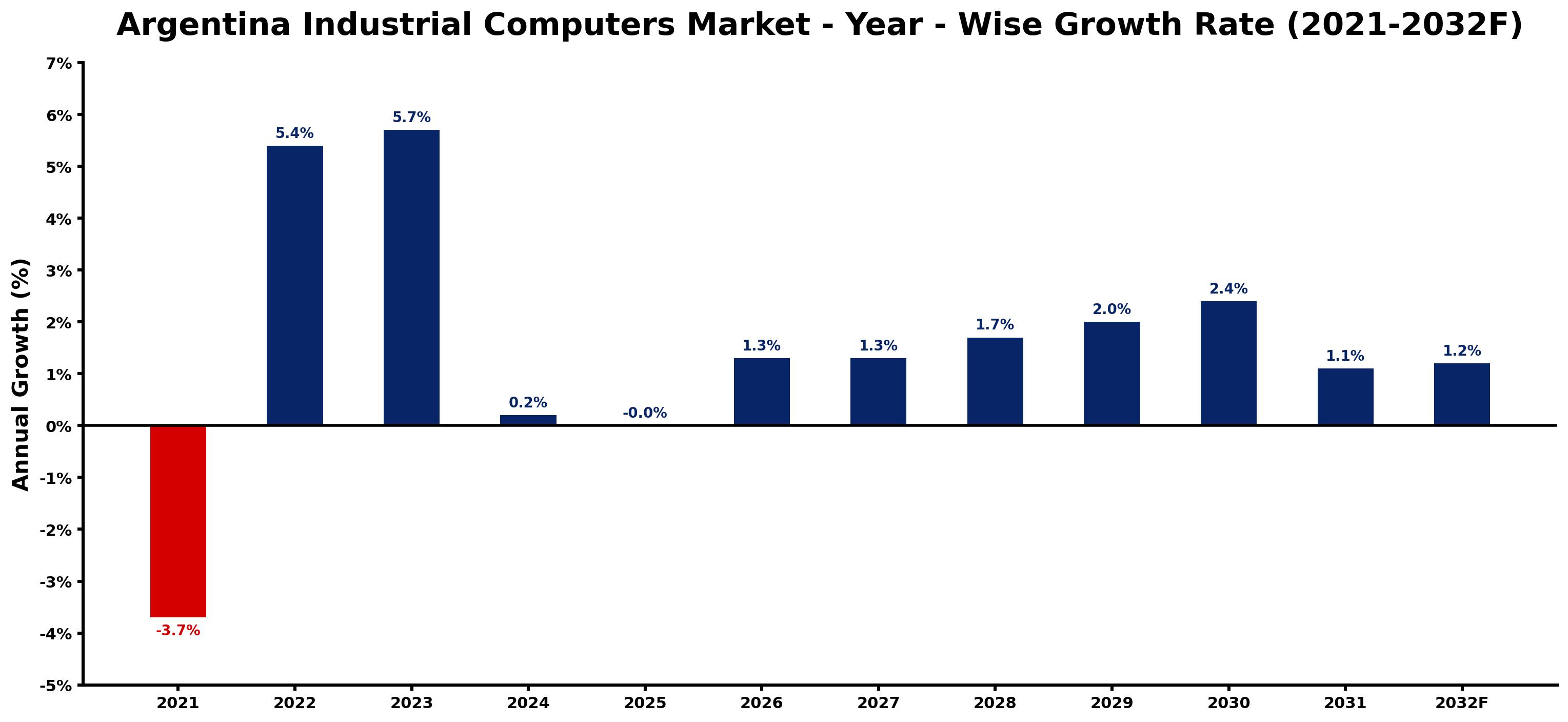
The table below presents the year wise growth rates along with the key drivers influencing the market
| Year | Growth Rate | Major Drivers |
| 2021 | -3.7% | Economic instability and high inflation rates deterred investments in industrial technology upgrades and expansions. |
| 2022 | 5.4% | Increased focus on automation resulted in higher demand for industrial computing solutions. |
| 2023 | 5.7% | Supply chain disruptions pushed manufacturers to invest in localized computing technologies. |
| 2024 | 0.2% | Enhanced connectivity requirements in factories supported the rise of industrial computer usage. |
| 2025 | -0.0% | Emerging AI applications in manufacturing stimulated interest in advanced computing systems. |
| 2026 | 1.3% | Economic recovery plans emphasized modernization, attracting investments in industrial computing. |
| 2027 | 1.3% | Efforts to reduce operational costs led to a surge in efficiency-driven technologies. |
| 2028 | 1.7% | Sustainability goals prompted manufacturers to seek energy-efficient computing options. |
| 2029 | 2.0% | Technological partnerships began addressing specific industrial needs, fostering innovation. |
| 2030 | 2.4% | Increased environmental regulations pushed companies toward compliant computing infrastructures. |
| 2031 | 1.1% | Growing cybersecurity threats required more sophisticated solutions for industrial systems. |
| 2032 | 1.2% | Shift towards smart factories created a robust market for interconnected computing devices. |
Note - Market size estimations and growth projections presented in this report are based on 6Wresearch's advanced forecasting approach, validated with industry datasets as of June 2026.
Argentina Industrial Computers Market Synopsis
The Argentina Industrial Computers Market is projected to reach 1.3% and witness significant growth during the forecast period (2026-2032). This growth is driven by the increasing automation and digitalization trends across various sectors, including manufacturing, energy, and transportation. The rising demand for efficient and high-performance computing systems is a key factor pushing the market forward, as businesses embrace Industry 4.0 technologies and seek to enhance operational efficiency.
Argentina Industrial Computers Market Growth Drivers
Several critical factors are propelling the Argentina Industrial Computers Market. The following are the primary growth drivers:
- Automation Adoption: The shift towards automation in production processes has led to increased demand for robust industrial computers that can support advanced technologies.
- Digital Transformation: Businesses are investing heavily in digital solutions to modernize their operations and enhance productivity, leading to higher consumption of industrial computing technologies.
- Industry 4.0 Integration: As companies transition to Industry 4.0 models, the need for sophisticated computing solutions that enable data exchange and connectivity becomes essential.
- Environmental Resilience: The demand for ruggedized industrial computers capable of operating under extreme conditions supports growth, particularly in sectors like mining and energy.
- Enhanced Features: The integration of IoT connectivity, AI capabilities, and cloud computing functionalities in industrial computers is further invigorating market expansion.
Argentina Industrial Computers Market Challenges and Restraints
Despite the promising growth trajectory, the Argentina Industrial Computers Market also faces several challenges that could impede its expansion:
- Economic Volatility: Fluctuations in the Argentine economy can impact investment in industrial computing technologies, affecting overall market demand.
- Currency Instability: Currency devaluation influences the pricing of industrial computers, particularly for imported components, creating unpredictability in costs.
- Political Uncertainty: The shifting political landscape in Argentina presents challenges for businesses, inducing caution in investment decisions that are crucial for market growth.
- Infrastructure Gaps: Insufficient infrastructure in certain regions can limit accessibility and deployment of advanced industrial computing solutions, affecting adoption rates.
- Cybersecurity Concerns: With increasing reliance on digital systems, the need for enhanced cybersecurity measures in industrial computing solutions poses a challenge for manufacturers.
Argentina Industrial Computers Market Trends and Opportunities
The Argentina Industrial Computers Market is observing significant trends that underline the future landscape of industrial computing:
- Demand for Rugged Solutions: There is a noticeable increase in the need for durable industrial computers that can withstand harsh working environments, particularly in sectors like energy and transportation.
- Shift Towards Edge Computing: The rising emphasis on edge computing solutions allows for real-time data processing and analysis, providing opportunities for advanced computational applications.
- Growth of IIoT Applications: The expansion of Industrial Internet of Things (IIoT) technologies is revolutionizing data monitoring, creating demand for interconnected computing systems.
- Investment in R&D: Companies are concentrating on research and development initiatives to drive innovation in industrial computing technologies, which serves as a catalyst for market growth.
- Increasing Focus on Cybersecurity: As cyber threats escalate, there is a growing trend towards implementing advanced cybersecurity features in industrial computers to safeguard critical infrastructure.
Argentina Industrial Computers Market Government Investment and Initiatives
Government policies play a crucial role in the development of the Argentina Industrial Computers Market. The authorities have launched various initiatives that foster technological advancement and local manufacturing, including:
- Import Tariffs: The government has established tariffs on imported industrial computers to promote domestic production, making locally manufactured solutions more competitive.
- Tax Incentives: Incentives for companies investing in technology and manufacturing facilities aim to stimulate growth and innovation within the sector.
- Support for R&D: Initiatives designed to enhance research and development capabilities are fundamental to driving innovation in industrial computing technologies.
- Quality Standards Regulation: Regulations that enforce quality and safety standards ensure that industrial computers meet the necessary operational requirements and enhance market credibility.
- Public-Private Partnerships: The establishment of partnerships between government and private entities aims to boost investment in advanced manufacturing technologies, aligning with global industry trends.
Argentina Industrial Computers Market Latest Developments (May 2025 - June 2026)
Recent developments in the Argentina Industrial Computers Market indicate a dynamic shift towards more integrated and advanced computing solutions. During this period, there has been an uptick in the deployment of IIoT applications, reflecting the increasing need for connected devices capable of real-time data processing. Additionally, businesses are focusing on enhancing the ruggedness and reliability of their systems to meet the demands of various industrial sectors. Cybersecurity has emerged as a significant priority, leading manufacturers to incorporate advanced protective measures in their computing systems. This heightened focus on digital transformation aligns with global trends towards automation and data-driven decision-making, suggesting a robust future for the Argentina Industrial Computers Market.
Argentina Industrial Computers Market - Key Attractiveness of the Report
- 10 Years of Market Numbers
- Historical Data Starting from 2022 to 2025
- Base Year: 2025
- Forecast Data until 2032
- Key Performance Indicators Impacting the Market
- Major Upcoming Developments and Projects
Key Highlights of the Report:
- Argentina Industrial Computers Market Outlook
- Market Size of Argentina Industrial Computers Market, 2025
- Forecast of Argentina Industrial Computers Market, 2032F
- Historical Data and Forecast of Argentina Industrial Computers Revenues & Volume for the Period 2022-2032F
- Argentina Industrial Computers Market Trend Evolution
- Argentina Industrial Computers Market Drivers and Challenges
- Argentina Industrial Computers Price Trends
- Argentina Industrial Computers Porter's Five Forces
- Argentina Industrial Computers Industry Life Cycle
- Historical Data and Forecast of Argentina Industrial Computers Market Revenues & Volume By Type for the Period 2022-2032F
- Historical Data and Forecast of Argentina Industrial Computers Market Revenues & Volume By Panel for the Period 2022-2032F
- Historical Data and Forecast of Argentina Industrial Computers Market Revenues & Volume By Box for the Period 2022-2032F
- Historical Data and Forecast of Argentina Industrial Computers Market Revenues & Volume By Embedded for the Period 2022-2032F
- Historical Data and Forecast of Argentina Industrial Computers Market Revenues & Volume By Din Rail for the Period 2022-2032F
- Historical Data and Forecast of Argentina Industrial Computers Market Revenues & Volume By Rack Mount for the Period 2022-2032F
- Historical Data and Forecast of Argentina Industrial Computers Market Revenues & Volume By Thin Client for the Period 2022-2032F
- Historical Data and Forecast of Argentina Industrial Computers Market Revenues & Volume By Technology for the Period 2022-2032F
- Historical Data and Forecast of Argentina Industrial Computers Market Revenues & Volume By Resistive for the Period 2022-2032F
- Historical Data and Forecast of Argentina Industrial Computers Market Revenues & Volume By Capacitive for the Period 2022-2032F
- Historical Data and Forecast of Argentina Industrial Computers Market Revenues & Volume By Others for the Period 2022-2032F
- Historical Data and Forecast of Argentina Industrial Computers Market Revenues & Volume By ?End Use for the Period 2022-2032F
- Historical Data and Forecast of Argentina Industrial Computers Market Revenues & Volume By Automotive for the Period 2022-2032F
- Historical Data and Forecast of Argentina Industrial Computers Market Revenues & Volume By Chemicals for the Period 2022-2032F
- Historical Data and Forecast of Argentina Industrial Computers Market Revenues & Volume By Electronics for the Period 2022-2032F
- Historical Data and Forecast of Argentina Industrial Computers Market Revenues & Volume By Oil & Gas for the Period 2022-2032F
- Historical Data and Forecast of Argentina Industrial Computers Market Revenues & Volume By Food & Beverages for the Period 2022-2032F
- Historical Data and Forecast of Argentina Industrial Computers Market Revenues & Volume By Pharmaceuticals for the Period 2022-2032F
- Historical Data and Forecast of Argentina Industrial Computers Market Revenues & Volume By Others for the Period 2022-2032F
- Argentina Industrial Computers Import Export Trade Statistics
- Market Opportunity Assessment By Type
- Market Opportunity Assessment By Technology
- Market Opportunity Assessment By ?End Use
- Argentina Industrial Computers Top Companies Market Share
- Argentina Industrial Computers Competitive Benchmarking By Technical and Operational Parameters
- Argentina Industrial Computers Company Profiles
- Argentina Industrial Computers Key Strategic Recommendations






































